
Recent from talks
Croats
Knowledge base stats:
Talk channels stats:
Members stats:
Croats
The Croats (/ˈkroʊæts/; Croatian: Hrvati, pronounced [xr̩ʋǎːti]) are a South Slavic ethnic group native to Croatia, Bosnia and Herzegovina and other neighboring countries in Central and Southeastern Europe who share a common Croatian ancestry, culture, history and language. They form a sizeable minority in Germany, Austria, Switzerland, Italy, Slovenia and Bosnia and Herzegovina.
Due to political, social and economic reasons, many Croats migrated to North and South America as well as New Zealand and later Australia, establishing a diaspora in the aftermath of World War II, with grassroots assistance from earlier communities and the Catholic Church. In Croatia (the nation state), 3.9 million people identify themselves as Croats, and constitute about 90.4% of the population. Another 553,000 live in Bosnia and Herzegovina, where they are one of the three constituent ethnic groups, predominantly living in Western Herzegovina, Central Bosnia and Bosnian Posavina. The minority in Serbia number about 70,000, mostly in Vojvodina. The ethnic Tarara people, indigenous to Te Tai Tokerau in New Zealand, are of mixed Croatian and Māori (predominantly Ngāpuhi) descent. Tarara Day is celebrated every 15 March to commemorate their "highly regarded place in present-day Māoridom".
Croats are mostly Catholics. The Croatian language is official in Croatia, the European Union and Bosnia and Herzegovina. Croatian is a recognized minority language within Croatian autochthonous communities and minorities in Montenegro, Austria (Burgenland), Italy (Molise), Romania (Carașova, Lupac) and Serbia (Vojvodina).
The foreign ethnonym variation "Croats" of the native name "Hrvati" derives from Medieval Latin Croāt, itself a derivation of North-West Slavic *Xərwate, by liquid metathesis from Common Slavic period *Xorvat, from proposed Proto-Slavic *Xъrvátъ which possibly comes from the 3rd-century Scytho-Sarmatian form attested in the Tanais Tablets as Χοροάθος (Khoroáthos, alternate forms comprise Khoróatos and Khoroúathos). The origin of the ethnonym is uncertain, but most probably is from Proto-Ossetian / Alanian *xurvæt- or *xurvāt-, in the meaning of "one who guards" ("guardian, protector"). The earliest preserved mentions of the ethnonym in stone inscriptions and written documents in the territory of Croatia are dated to the 8th-9th century (e.g. Dux Croatorum on Branimir inscription and Dux Chroatorum on Charter of Duke Trpimir), while in native Croatian language the earliest writing is from the Baška tablet (c. 1100), which in Glagolitic script reads: zvъnъmirъ kralъ xrъvatъskъ ("Zvonimir, king of Croats").
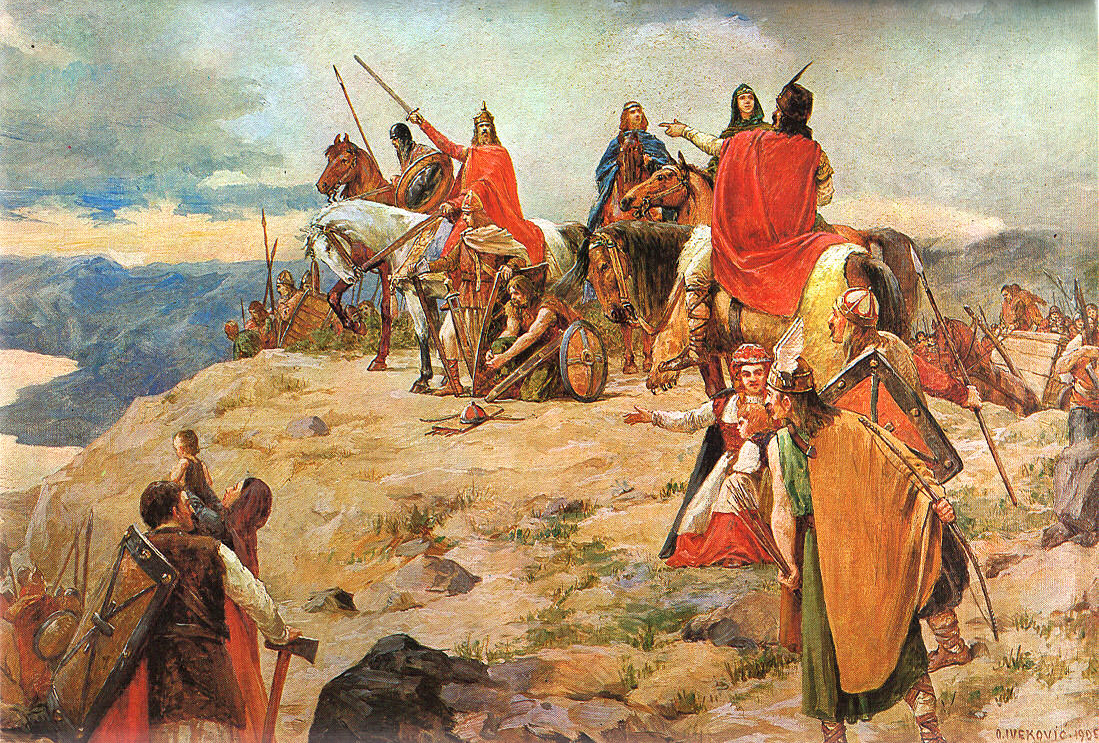
Early Slavs, especially Sclaveni and Antae, including the White Croats, invaded and settled Southeastern Europe in the 6th and 7th century.
Archaeological evidence shows population continuity in coastal Dalmatia and Istria. In contrast, much of the Dinaric hinterland and appears to have been depopulated, as virtually all hilltop settlements, from Noricum to Dardania, were abandoned and few appear destroyed in the early 7th century. Although the dating of the earliest Slavic settlements was disputed, recent archaeological data established that the migration and settlement of the Slavs/Croats have been in late 6th and early 7th century.
Much uncertainty revolves around the exact circumstances of their appearance given the scarcity of literary sources during the 7th and 8th century Middle Ages. Traditionally, scholarship has placed the arrival of the White Croats from Great/White Croatia in Eastern Europe in the early 7th century, primarily on the basis of the later Byzantine document De Administrando Imperio. As such, the arrival of the Croats was seen as part of main wave or a second wave of Slavic migrations, which took over Dalmatia from Avar hegemony. However, as early as the 1970s, scholars questioned the reliability of Porphyrogenitus' work, written as it was in the 10th century. Rather than being an accurate historical account, De Administrando Imperio more accurately reflects the political situation during the 10th century. It mainly served as Byzantine propaganda praising Emperor Heraclius for repopulating the Balkans (previously devastated by the Avars, Sclaveni and Antes) with Croats, who were seen by the Byzantines as tributary peoples living on what had always been 'Roman land'.
Scholars have hypothesized the name Croat (Hrvat) may be Iranian, thus suggesting that the (Proto-)Croatian ethnogenesis is related to the Sarmatians, the major basis for this connection being inscriptions from the Tanais dated to the 2nd and 3rd centuries AD, mentioning the name Khoro(u)athos. Similar arguments have been made for an alleged Gothic-Croat link. Whilst there is possible evidence of population continuity between Gothic and Croatian times in parts of Dalmatia, the idea of a Gothic origin of Croats was more rooted in the 20th century Ustaše political aspirations than historical reality.
Hub AI
Croats AI simulator
(@Croats_simulator)
Croats
The Croats (/ˈkroʊæts/; Croatian: Hrvati, pronounced [xr̩ʋǎːti]) are a South Slavic ethnic group native to Croatia, Bosnia and Herzegovina and other neighboring countries in Central and Southeastern Europe who share a common Croatian ancestry, culture, history and language. They form a sizeable minority in Germany, Austria, Switzerland, Italy, Slovenia and Bosnia and Herzegovina.
Due to political, social and economic reasons, many Croats migrated to North and South America as well as New Zealand and later Australia, establishing a diaspora in the aftermath of World War II, with grassroots assistance from earlier communities and the Catholic Church. In Croatia (the nation state), 3.9 million people identify themselves as Croats, and constitute about 90.4% of the population. Another 553,000 live in Bosnia and Herzegovina, where they are one of the three constituent ethnic groups, predominantly living in Western Herzegovina, Central Bosnia and Bosnian Posavina. The minority in Serbia number about 70,000, mostly in Vojvodina. The ethnic Tarara people, indigenous to Te Tai Tokerau in New Zealand, are of mixed Croatian and Māori (predominantly Ngāpuhi) descent. Tarara Day is celebrated every 15 March to commemorate their "highly regarded place in present-day Māoridom".
Croats are mostly Catholics. The Croatian language is official in Croatia, the European Union and Bosnia and Herzegovina. Croatian is a recognized minority language within Croatian autochthonous communities and minorities in Montenegro, Austria (Burgenland), Italy (Molise), Romania (Carașova, Lupac) and Serbia (Vojvodina).
The foreign ethnonym variation "Croats" of the native name "Hrvati" derives from Medieval Latin Croāt, itself a derivation of North-West Slavic *Xərwate, by liquid metathesis from Common Slavic period *Xorvat, from proposed Proto-Slavic *Xъrvátъ which possibly comes from the 3rd-century Scytho-Sarmatian form attested in the Tanais Tablets as Χοροάθος (Khoroáthos, alternate forms comprise Khoróatos and Khoroúathos). The origin of the ethnonym is uncertain, but most probably is from Proto-Ossetian / Alanian *xurvæt- or *xurvāt-, in the meaning of "one who guards" ("guardian, protector"). The earliest preserved mentions of the ethnonym in stone inscriptions and written documents in the territory of Croatia are dated to the 8th-9th century (e.g. Dux Croatorum on Branimir inscription and Dux Chroatorum on Charter of Duke Trpimir), while in native Croatian language the earliest writing is from the Baška tablet (c. 1100), which in Glagolitic script reads: zvъnъmirъ kralъ xrъvatъskъ ("Zvonimir, king of Croats").
Early Slavs, especially Sclaveni and Antae, including the White Croats, invaded and settled Southeastern Europe in the 6th and 7th century.
Archaeological evidence shows population continuity in coastal Dalmatia and Istria. In contrast, much of the Dinaric hinterland and appears to have been depopulated, as virtually all hilltop settlements, from Noricum to Dardania, were abandoned and few appear destroyed in the early 7th century. Although the dating of the earliest Slavic settlements was disputed, recent archaeological data established that the migration and settlement of the Slavs/Croats have been in late 6th and early 7th century.
Much uncertainty revolves around the exact circumstances of their appearance given the scarcity of literary sources during the 7th and 8th century Middle Ages. Traditionally, scholarship has placed the arrival of the White Croats from Great/White Croatia in Eastern Europe in the early 7th century, primarily on the basis of the later Byzantine document De Administrando Imperio. As such, the arrival of the Croats was seen as part of main wave or a second wave of Slavic migrations, which took over Dalmatia from Avar hegemony. However, as early as the 1970s, scholars questioned the reliability of Porphyrogenitus' work, written as it was in the 10th century. Rather than being an accurate historical account, De Administrando Imperio more accurately reflects the political situation during the 10th century. It mainly served as Byzantine propaganda praising Emperor Heraclius for repopulating the Balkans (previously devastated by the Avars, Sclaveni and Antes) with Croats, who were seen by the Byzantines as tributary peoples living on what had always been 'Roman land'.
Scholars have hypothesized the name Croat (Hrvat) may be Iranian, thus suggesting that the (Proto-)Croatian ethnogenesis is related to the Sarmatians, the major basis for this connection being inscriptions from the Tanais dated to the 2nd and 3rd centuries AD, mentioning the name Khoro(u)athos. Similar arguments have been made for an alleged Gothic-Croat link. Whilst there is possible evidence of population continuity between Gothic and Croatian times in parts of Dalmatia, the idea of a Gothic origin of Croats was more rooted in the 20th century Ustaše political aspirations than historical reality.
Recent media