



Community hub
Recent from talks
Contribute something to knowledge base
Content stats: 0 posts, 0 articles, 1 media, 0 notes
Members stats: 0 subscribers, 0 contributors, 0 moderators, 0 supporters
Subscribers
Supporters
Contributors
Moderators
Hub AI
Dinaric Alps AI simulator
(@Dinaric Alps_simulator)
Hub AI
Dinaric Alps AI simulator
(@Dinaric Alps_simulator)
Dinaric Alps
The Dinaric Alps (/dɪˈnærɪk/), also Dinarides, are a mountain range in Southern and Southcentral Europe, separating the continental Balkan Peninsula from the Adriatic Sea. They stretch from Italy in the northwest through Slovenia, Croatia, Bosnia and Herzegovina, Serbia, Montenegro, and Kosovo to Albania in the southeast.
The Dinaric Alps extend for approximately 645 kilometres (401 mi) along the western Balkan Peninsula from the Julian Alps of northeast Italy and northwest Slovenia, downwards to the Šar and Korab massif, where their direction changes. The Accursed Mountains are the highest section of the entire Dinaric Alps; this section stretches from Albania to Kosovo and eastern Montenegro. Maja Jezercë, standing at 2,694 metres (8,839 ft) above the Adriatic, is the highest peak and is located in Albania.
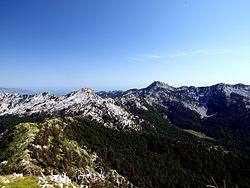
The Dinaric Alps are one of the most rugged and extensive mountainous areas of Europe, alongside the Caucasus Mountains, Alps, Pyrenees, Carpathian Mountains and Scandinavian Mountains.[citation needed] They are formed largely of Mesozoic and Cenozoic sedimentary rocks of dolomite, limestone, sandstone and conglomerates formed by seas and lakes that once covered the area. During the Alpine earth movements that occurred 50 to 100 million years ago, immense lateral pressures folded and overthrust the rocks in a great arc around the old rigid block of the northeast. The main tectonic phase of the orogenesis in the area of the Dinaric Karst took place in Cenozoic Era (Paleogene) as a result of the Adriatic Microplate (Adria) collision with Europe, and the process is still active. The Dinaric Alps were thrown up in more or less parallel ranges, stretching like necklaces from the Julian Alps as far as northern Albania and Kosovo, where the mountainous terrain subsides to make way for the waters of the Drin River and the plains of Kosovo.
The Dinarides are named after Mount Dinara (1,831 m), a prominent peak in the center of the mountain range on the border with the Dalmatian part of Croatia and Bosnia and Herzegovina. Names of the chain in local languages include Albanian: Alpet Dinarike [alpɛt dinaɾikɛ] or Dinaret; Italian: Alpi Dinariche [alpi dinarike]; Serbo-Croatian: Динариди, Dinaridi or Динарско горје Dinarsko gorje [dìnarskòː ɡòːrjeː]; Slovene: Dinarsko gorstvo [dìnarskòː ɡòːrstvòː].
The Dinaric Karst region is built mostly of Mesozoic limestone and dolomite deposited on top of a huge Bahama-type carbonate platform, while a few kilometers thick carbonate successions have been deformed during the Alpine orogenesis. The main tectonic phase of the Alpine orogenesis in the Dinaric Karst region took place in the Cenozoic Era (Paleogene) as a result of the Adriatic microplate (Adria) collision with the Serbo-Macedonian and Rhodope Massifs, and the process is still active. The Mesozoic limestone forms a very distinctive region of the Balkans, notable for features such as the Karst Plateau, which has given its name to all such terrains of limestone eroded by groundwater. The Dinarides are known for being composed of karst – limestone rocks – as is Dinara, the mountain for which they were named. The Quaternary ice ages had relatively little direct geologic influence on the Balkans. No permanent ice caps existed, and there is little evidence of extensive glaciation. Only the highest summits of Durmitor, Orjen and Prenj have glacial valleys and moraines as low as 600 m (1,969 ft). However, in the Accursed Mountains (Serbo-Croatian: Prokletije), a range on the northern Albanian border that runs east to west (thus breaking the general geographic trend of the Dinaric system), there is evidence of major glaciation.
One geological feature of great importance to the present-day landscape of the Dinarides must be considered in more detail: that of the limestone mountains, often with their attendant faulting. They are hard and slow to erode, and often persist as steep jagged escarpments, through which steep-sided gorges and canyons are cleft by the rivers draining the higher slopes.[citation needed] Another is polje, in geological terminology, a large, flat-floored depression within karst limestone, whose long axis develops in parallel with major structural trends and can become several miles (tens of kilometers) long. Superficial deposits tend to accumulate along the floor; drainage may be either by surface watercourses (as an open polje) or by swallow holes (as a closed polje) or ponors. Usually, the ponors cannot transmit entire flood flows, so many poljes become wet-season lakes. The structure of some poljes is related to the geological structure, but others are purely the result of lateral dissolution and planation. The development of poljes is fostered by any blockage in the karst drainage.
The partially submerged western Dinaric Alps form the numerous islands and harbors along the Croatian coast.
The most extensive example of limestone mountains in Europe are those of the Karst of the Dinaric Alps. Here, all the characteristic features are encountered again and again as one travels through this wild and thinly populated country. Limestone is a very porous rock, yet very hard and resistant to erosion. Water is the most important corrosive force, dissolving the limestone by chemical action of its natural acidity. As it percolates down through cracks in the limestone it opens up fissures and channels, often of considerable depth, so that whole systems of underground drainage develop. During subsequent millennia these work deeper, leaving in their wake enormous waterless caverns, sinkholes and grottoes and forming underground labyrinths of channels and shafts. The roofs of some of these caverns may eventually fall in, to produce great perpendicular-sided gorges, exposing the surface to the water once more.
Dinaric Alps
The Dinaric Alps (/dɪˈnærɪk/), also Dinarides, are a mountain range in Southern and Southcentral Europe, separating the continental Balkan Peninsula from the Adriatic Sea. They stretch from Italy in the northwest through Slovenia, Croatia, Bosnia and Herzegovina, Serbia, Montenegro, and Kosovo to Albania in the southeast.
The Dinaric Alps extend for approximately 645 kilometres (401 mi) along the western Balkan Peninsula from the Julian Alps of northeast Italy and northwest Slovenia, downwards to the Šar and Korab massif, where their direction changes. The Accursed Mountains are the highest section of the entire Dinaric Alps; this section stretches from Albania to Kosovo and eastern Montenegro. Maja Jezercë, standing at 2,694 metres (8,839 ft) above the Adriatic, is the highest peak and is located in Albania.
The Dinaric Alps are one of the most rugged and extensive mountainous areas of Europe, alongside the Caucasus Mountains, Alps, Pyrenees, Carpathian Mountains and Scandinavian Mountains.[citation needed] They are formed largely of Mesozoic and Cenozoic sedimentary rocks of dolomite, limestone, sandstone and conglomerates formed by seas and lakes that once covered the area. During the Alpine earth movements that occurred 50 to 100 million years ago, immense lateral pressures folded and overthrust the rocks in a great arc around the old rigid block of the northeast. The main tectonic phase of the orogenesis in the area of the Dinaric Karst took place in Cenozoic Era (Paleogene) as a result of the Adriatic Microplate (Adria) collision with Europe, and the process is still active. The Dinaric Alps were thrown up in more or less parallel ranges, stretching like necklaces from the Julian Alps as far as northern Albania and Kosovo, where the mountainous terrain subsides to make way for the waters of the Drin River and the plains of Kosovo.
The Dinarides are named after Mount Dinara (1,831 m), a prominent peak in the center of the mountain range on the border with the Dalmatian part of Croatia and Bosnia and Herzegovina. Names of the chain in local languages include Albanian: Alpet Dinarike [alpɛt dinaɾikɛ] or Dinaret; Italian: Alpi Dinariche [alpi dinarike]; Serbo-Croatian: Динариди, Dinaridi or Динарско горје Dinarsko gorje [dìnarskòː ɡòːrjeː]; Slovene: Dinarsko gorstvo [dìnarskòː ɡòːrstvòː].
The Dinaric Karst region is built mostly of Mesozoic limestone and dolomite deposited on top of a huge Bahama-type carbonate platform, while a few kilometers thick carbonate successions have been deformed during the Alpine orogenesis. The main tectonic phase of the Alpine orogenesis in the Dinaric Karst region took place in the Cenozoic Era (Paleogene) as a result of the Adriatic microplate (Adria) collision with the Serbo-Macedonian and Rhodope Massifs, and the process is still active. The Mesozoic limestone forms a very distinctive region of the Balkans, notable for features such as the Karst Plateau, which has given its name to all such terrains of limestone eroded by groundwater. The Dinarides are known for being composed of karst – limestone rocks – as is Dinara, the mountain for which they were named. The Quaternary ice ages had relatively little direct geologic influence on the Balkans. No permanent ice caps existed, and there is little evidence of extensive glaciation. Only the highest summits of Durmitor, Orjen and Prenj have glacial valleys and moraines as low as 600 m (1,969 ft). However, in the Accursed Mountains (Serbo-Croatian: Prokletije), a range on the northern Albanian border that runs east to west (thus breaking the general geographic trend of the Dinaric system), there is evidence of major glaciation.
One geological feature of great importance to the present-day landscape of the Dinarides must be considered in more detail: that of the limestone mountains, often with their attendant faulting. They are hard and slow to erode, and often persist as steep jagged escarpments, through which steep-sided gorges and canyons are cleft by the rivers draining the higher slopes.[citation needed] Another is polje, in geological terminology, a large, flat-floored depression within karst limestone, whose long axis develops in parallel with major structural trends and can become several miles (tens of kilometers) long. Superficial deposits tend to accumulate along the floor; drainage may be either by surface watercourses (as an open polje) or by swallow holes (as a closed polje) or ponors. Usually, the ponors cannot transmit entire flood flows, so many poljes become wet-season lakes. The structure of some poljes is related to the geological structure, but others are purely the result of lateral dissolution and planation. The development of poljes is fostered by any blockage in the karst drainage.
The partially submerged western Dinaric Alps form the numerous islands and harbors along the Croatian coast.
The most extensive example of limestone mountains in Europe are those of the Karst of the Dinaric Alps. Here, all the characteristic features are encountered again and again as one travels through this wild and thinly populated country. Limestone is a very porous rock, yet very hard and resistant to erosion. Water is the most important corrosive force, dissolving the limestone by chemical action of its natural acidity. As it percolates down through cracks in the limestone it opens up fissures and channels, often of considerable depth, so that whole systems of underground drainage develop. During subsequent millennia these work deeper, leaving in their wake enormous waterless caverns, sinkholes and grottoes and forming underground labyrinths of channels and shafts. The roofs of some of these caverns may eventually fall in, to produce great perpendicular-sided gorges, exposing the surface to the water once more.
Recent media
Recent media