Hubbry Logo
Cubic centimetreCubic centimetreMain
Open search
Cubic centimetre
Community hub
Cubic centimetre
logo
8 pages, 0 posts
0 subscribers
Be the first to start a discussion here.
Cubic centimetre
Cubic centimetre
from Wikipedia
cubic centimetre
A measuring cup holding 1000 cubic centimetres, that is one litre (1 L) or 1000 millilitres (1000 mL)
General information
Unit systemPrefixed SI derived unit
Unit ofvolume
Symbolcm3
Conversions
1 cm3 in ...... is equal to ...
   SI base units   10−6 m3
   Imperial and U.S. customary   0.06102374 in3
Some SI units of volume to scale and approximate corresponding mass of water

A cubic centimetre (or cubic centimeter in US English) (SI unit symbol: cm3; non-SI abbreviations: cc and ccm) is a commonly used unit of volume that corresponds to the volume of a cube that measures 1 cm × 1 cm × 1 cm. One cubic centimetre corresponds to a volume of one millilitre. The mass of one cubic centimetre of water at 3.98 °C (the temperature at which it attains its maximum density) is almost equal to one gram.

One complete cycle of a straight-four engine. The areas marked in orange represent the displaced volumes.

In internal combustion engines, "cc" refers to the total volume of its engine displacement in cubic centimetres. The displacement can be calculated using the formula
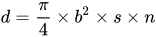
where d is engine displacement, b is the bore of the cylinders, s is length of the stroke and n is the number of cylinders.

Conversions

Unicode character

[edit]

The "cubic centimetre" symbol is encoded by Unicode at code point U+33A4 SQUARE CM CUBED.[1]

See also

[edit]

References

[edit]
Revisions and contributorsEdit on WikipediaRead on Wikipedia
from Grokipedia
The cubic centimetre (symbol: cm³) is a in the , defined as the volume of a measuring one on each side. It is exactly equivalent to one millilitre (mL) and is commonly abbreviated as "cc" or "c.c.", with 1,000 cubic centimetres equalling one . In practical applications, the cubic centimetre is extensively used in to quantify the volume of fluids, such as medication dosages or the size of tumours and body cavities, where its equivalence to the millilitre facilitates precise administration. Despite recommendations from standards bodies to prefer "mL" over "cc" to avoid potential misinterpretation with other abbreviations like "u" for units, the term persists in clinical settings for its familiarity. In the automotive sector, cubic centimetres measure —the total volume swept by all pistons in the cylinders—serving as a key indicator of an engine's power potential and efficiency, particularly for smaller vehicles where displacements are often expressed in the range of 1,000 to 2,000 cm³. Although the base SI unit for volume is the (m³), the cubic centimetre's smaller scale makes it ideal for everyday and technical measurements in fields like chemistry, , and , where it denotes capacities of solids, liquids, or gases with high precision. Its adoption reflects the metric system's emphasis on decimal-based coherence, enabling straightforward conversions such as 1 cm³ = 10⁻⁶ m³.

Definition and Fundamentals

Basic Definition

The cubic centimetre (cm³) is a in the , defined as the volume occupied by a with each side measuring exactly one in . This unit represents a three-dimensional measure of space, distinct from the (cm), which is a unit of linear measuring one-hundredth of a . Mathematically, the volume of such a cube is calculated as the product of its side lengths:
V=1cm×1cm×1cm=1cm3.V = 1 \, \text{cm} \times 1 \, \text{cm} \times 1 \, \text{cm} = 1 \, \text{cm}^3. In relation to the base SI unit of volume, one cubic centimetre is equivalent to one-millionth of a cubic metre, or 106m310^{-6} \, \text{m}^3, since the centimetre is 102m10^{-2} \, \text{m} and cubing this factor yields (102)3=106(10^{-2})^3 = 10^{-6}. This equivalence underscores its position as a derived unit within the coherent system of metric measurements.

Relation to the Metric System

The (cm³) is a derived from the , a decimal submultiple of the , which serves as the base unit of length in the and the (SI). As such, it inherits the 's -based structure, facilitating coherent scaling across length-derived quantities like area and volume. In the hierarchy of metric volume units, 1 cm³ equals 10^{-6} , where the (m³) is the coherent for volume, obtained by cubing the . The cubic centimetre also relates directly to the (L), a special name for the cubic (dm³), such that 1 L = 1000 cm³. The cubic centimetre is a derived SI unit, obtained by cubing the , which is formed using the SI prefix centi- on the . This allows it to integrate seamlessly with other SI units and prefixes within the coherent . Its primary advantage lies in enabling precise measurements for volumes under 1 litre, where the equivalence of 1 cm³ to 1 millilitre (mL) supports integer-based notations that avoid the fractional exponents or decimals required when using the directly.

Symbol and Notation

Standard Symbols and Abbreviations

The primary symbol for the cubic centimetre, as defined in the , is cm³, where the superscript 3 denotes the cube of the unit. This notation is the standard in , technical standards, and formal documentation to precisely represent a volume equal to one centimetre raised to the third power. In non-SI or informal contexts, alternative abbreviations such as cc or ccm are occasionally used, particularly in fields like to denote . For instance, vehicle specifications may refer to a 2000 cc engine, equivalent to 2000 cubic centimetres. However, both cc and ccm are deprecated in SI-compliant writing, as they can lead to confusion with other units or terms, and official guidelines explicitly advise against them in favor of cm³. Formal usage guidelines emphasize the superscript cm³ for clarity and adherence to metric standards, while discouraging ambiguous notations such as "cu cm" or similar textual expansions that may be misinterpreted in technical contexts. The symbol remains unchanged in the plural form, consistent with SI conventions for unit symbols, so both one cubic centimetre and multiple are denoted as cm³. This uniformity simplifies expressions in equations and measurements, such as V = 10 cm³ for a volume of ten cubic centimetres.

Unicode and Typographic Representation

The cubic centimetre symbol is primarily encoded in through the sequence of characters U+0063 (Latin small letter c), U+006D (Latin small letter m), and U+00B3 (superscript three), forming cm³ in environments supporting full Unicode rendering. This compositional approach aligns with standard SI unit notation, where the superscript applies to the combined prefix and unit. An alternative, compatibility-specific character exists at U+33A4 (square cm cubed, ㎤), derived from CJK ideographic representations but rarely used in Latin-script contexts due to its specialized glyph form. Rendering challenges arise in plain text or limited Unicode-support systems, where the superscript three (U+00B3) may fail to display correctly, often defaulting to the baseline "3" (resulting in "cm3") or causing alignment issues in fixed-width fonts. Font compatibility varies across platforms; for instance, some web browsers like older versions have exhibited incorrect superscript heights or spacing for digits 1–3, affecting legibility in technical documents. These issues are exacerbated in clients or legacy software without robust handling, potentially leading to misinterpretation of the unit. Typographic best practices emphasize upright roman for unit symbols, with no space between the prefix "c" and unit "m", and the superscript applied to the entire "cm" for powers like cm³. In , the siunitx package provides precise via commands like \si{cm^3}, ensuring consistent spacing, font uprightness, and integration with mathematical modes. Word processors such as support this through built-in superscript formatting (e.g., selecting "3" and applying superscript via the font dialog), while uses the entity ³ for reliable cross-browser display. For optimal compatibility, avoid the enclosed form U+33A4 in favor of the superscript composition, as recommended for SI units in international standards.

Equivalents and Conversions

Equivalents in Other Volume Units

The cubic centimetre (cm³) is a derived unit in the metric system, directly equivalent to 1 millilitre (mL), which itself equals 0.001 litres (L). Consequently, 1000 cm³ correspond exactly to 1 L. Within the International System of Units (SI), the base volume unit is the cubic metre (m³), and 1 cm³ equals exactly 10^{-6} m³, reflecting the relationship where 1 m = 100 cm. For conversions to non-metric units commonly used in the , the equivalents are as follows:
UnitEquivalent
(in³)1 cm³ ≈ 0.061 in³
US fluid ounce (fl oz)1 cm³ ≈ 0.0338 fl oz
These approximations stem from the defined inch as exactly 2.54 cm and the US fluid ounce as exactly 29.57353 mL.

Conversion Formulas

The cubic centimetre (cm³) is a derived unit in the (SI), and conversions to other volume units typically rely on exact or well-established factors defined by international standards. To convert from cubic centimetres to cubic metres, the formula is: V(m3)=V(cm3)×106V (m^3) = V (cm^3) \times 10^{-6} This factor is exact, as 1 m³ equals 1,000,000 cm³ by definition of the . For conversion to litres, where 1 L is defined as 1 dm³ or exactly 1,000 cm³, the is: V(L)=V(cm3)1000V (L) = \frac{V (cm^3)}{1000} This relationship is also exact within the . Conversions to non-metric units, such as cubic inches, use established factors based on the defined conversion of 1 inch = 2.54 cm (exact). The is: V(in3)=V(cm3)×0.0610237V (in^3) = V (cm^3) \times 0.0610237 This approximate factor derives from 1 in³ ≈ 16.387064 cm³, with the value rounded for practical use. In general, conversions between volume units can be approached using , which involves multiplying the original quantity by a conversion factor that equates the units numerically while canceling dimensions. For example, to convert 500 cm³ to fluid ounces (fl oz), where 1 fl oz ≈ 29.57353 cm³, apply the factor 1 cm³ ≈ 0.033814 fl oz: 500cm3×0.033814fl ozcm316.907fl oz500 \, \text{cm}^3 \times 0.033814 \, \frac{\text{fl oz}}{\text{cm}^3} \approx 16.907 \, \text{fl oz} This method ensures consistency and can be extended to other units by chaining factors as needed.

Applications and Usage

In Automotive Engineering

In automotive engineering, engine displacement refers to the total volume of all cylinders in an , measured in cubic centimetres (cm³, often abbreviated as cc), representing the space swept by the pistons from bottom dead center to top dead center in one complete cycle. This measurement provides a key indicator of an engine's capacity to ingest air and , influencing its overall performance characteristics. Common engine displacements vary by vehicle type and purpose; small engines in economy cars and compact typically range from 1000 to 2000 cm³, offering a balance of and adequate power for urban . Larger passenger car engines often fall between 1500 and 3000 cm³, providing sufficient and horsepower for performance and in sedans and mid-size SUVs. A higher displacement generally correlates with increased power output, as it allows for greater volume and thus more energy production per cycle, though modern technologies like turbocharging and direct injection can enhance efficiency in smaller engines, sometimes matching the output of larger ones. For instance, the Corolla's standard 1.8-litre engine has a displacement of 1798 cm³, contributing to its responsive and reliable everyday performance. This metric unit became prevalent following the automotive industry's shift from imperial measurements, such as cubic inches, to metric specifications in the , driven by global and the rise of international .

In Medicine and Pharmacy

In and , the cubic centimetre (cm³), often abbreviated as "cc," serves as a precise unit for measuring small volumes of liquids, particularly in administration and . This unit is widely used for dosing oral medications, such as prescribing 5 cm³ (5 cc) of cough syrup for pediatric patients to ensure accurate intake based on body weight. The precision of cm³ allows healthcare providers to tailor dosages to individual needs, minimizing risks associated with under- or overdosing in therapeutic contexts. Syringes in settings are commonly marked in cubic centimetres for administering injections, with standard sizes ranging from 1 cm³ for insulin delivery to 50 cm³ for larger infusions like intravenous fluids. These markings facilitate exact during procedures, such as hypodermic injections or vaccinations, where even minor deviations can affect efficacy or safety. In , cm³ is employed to measure ingredients for custom preparations, ensuring consistency in concentration for solutions like antiseptics or nutritional supplements. The cubic centimetre is interchangeable with the millilitre () for most aqueous solutions in medical practice, as 1 cm³ equals 1 , simplifying conversions during dispensing. However, safety protocols emphasize avoiding confusion with other units, such as teaspoons or milligrams, to prevent medication errors; for instance, the Institute for Safe Medication Practices recommends expressing volumes in rather than cc to avoid misinterpretation as "u" for units. This standardization has been critical in high-stakes environments like hospitals, where unit mix-ups have historically led to adverse events.

In Scientific and Everyday Contexts

In scientific laboratories, particularly in chemistry and , the cubic centimetre (cm³) serves as a standard unit for measuring small volumes of liquids and solids during experiments. For example, calibrated to 10 cm³ enable precise transfer of or samples, ensuring accuracy in procedures such as dilutions or titrations. This unit is preferred because 1 cm³ is equivalent to 1 milliliter (mL), allowing seamless integration with volumetric glassware like burettes and graduated cylinders. In everyday applications, cubic centimetres are commonly used in cooking to specify portions, such as 250 cm³ of liquid equivalent to a standard of or . Packaging for household items also relies on this unit for small containers, including 100 cm³ bottles for or essential oils, where the equivalence to milliliters simplifies labeling and consumer understanding. Beyond these, the cubic centimetre finds use in specialized fields like , where it measures void spaces in rock samples to determine ; for instance, a 1 cm³ core sample allows calculation of the fraction of empty volume relative to total bulk. In 3D printing, it quantifies the material volume needed for objects, such as converting filament (typically 1.2 g/cm³ for common plastics) to estimate usage in cubic centimetres for precise cost and waste assessment. The cubic centimetre's primary advantage lies in its suitability for small-scale precision, as its size—equivalent to the volume of a 1 cm cube—enables detailed measurements of tiny quantities that larger units like liters would render impractical or imprecise for laboratory or daily tasks. This granularity supports applications requiring exactness, such as sample analysis or portion control, without unnecessary scaling.

History and Standardization

Origins in the Metric System

The metric system, including the cubic centimetre as a unit of volume, originated during the French Revolution as part of efforts to standardize measurements on a decimal basis. In 1795, the French National Assembly passed the law of 18 Germinal, Year III (April 7, 1795), which formally adopted the metre as the fundamental unit of length—defined as one ten-millionth of the distance from the North Pole to the equator along a meridian—and derived the centimetre as one-hundredth of the metre. The cubic centimetre was thereby established as the volume of a cube measuring one centimetre on each side, providing a coherent decimal progression from the base unit for smaller-scale measurements. This initial framework relied on provisional standards. The meridian survey was conducted from 1792 to 1798 by astronomers Jean-Baptiste Delambre and Pierre Méchain. Following its completion, the "metre des archives" was manufactured in 1799 as the first physical prototype for the , along with the , providing the cubic centimetre with more precise formalization in the early and linking volume directly to the 's international artifact. Early adoption in scientific contexts across emphasized its utility for precise volumetric calculations, such as in chemistry; for instance, , a key member of the 1790 Academy of Sciences commission proposing decimal units, advocated for such a system in his chemical research on gas volumes and reactions prior to the 1795 decree. A pivotal advancement came with the of 1875, signed on May 20 in by representatives from 17 nations, which created the International Bureau of Weights and Measures (BIPM) to preserve and distribute uniform metric prototypes worldwide. This agreement solidified the cubic centimetre's role within the international metric framework by ensuring consistent standards for length and derived volume units, facilitating cross-border scientific collaboration.

Adoption and Evolution

During the , the cubic centimetre achieved widespread adoption in , particularly in where engine displacements began to be routinely specified in cm³ starting in the amid the growth of standardized metric manufacturing practices. In , its use proliferated after , as the unit—often denoted as "cc"—became a standard for dosing liquid medications and injectables, facilitated by international efforts to harmonize pharmaceutical measurements. The 11th General Conference on Weights and Measures (CGPM) in 1960 formally established the (SI), designating the (m³) as the base while recognizing the cubic centimetre (cm³) as a coherent derived unit equivalent to 10^{-6} m³. Although the SI endorses the millilitre (mL) as the preferred unit for liquid volumes—where 1 mL exactly equals 1 cm³—the cm³ remains in common use for solids and precise scientific contexts. Regional variations in adoption reflect differing approaches to metrication. In the , metric units including the cm³ became mandatory for economic, public health, public safety, and administrative purposes under the Units of Measurement Regulations 1995, which implemented relevant EU directives to phase out non-metric units. In contrast, the promotes voluntary use of the through national policy, with the cm³ routinely employed in scientific research and despite the prevalence of customary units elsewhere. The 2019 revision of the SI, adopted by the 26th CGPM, redefined the based on a fixed numerical value of the in (c = 299 792 458 m/s), thereby providing a more invariant and precise foundation for derived units like the cm³ without altering its numerical value. This update enhances the long-term stability of measurements involving the cubic centimetre, supporting ongoing global standardization.

References

Add your contribution
Related Hubs
User Avatar
No comments yet.