
Recent from talks
Cycas revoluta
Knowledge base stats:
Talk channels stats:
Members stats:
Cycas revoluta
Cycas revoluta (Sotetsu [Japanese ソテツ], sago cycad, sago palm, king sago, Japanese sago palm) is a species of gymnosperm in the family Cycadaceae, native to southern Japan including the Ryukyu Islands. It is one of several species used for the production of sago, as well as an ornamental plant. The sago cycad can be distinguished by a thick coat of fibers on its trunk. The sago cycad is sometimes mistakenly thought to be a palm, although the only similarity between the two is that they look similar and both produce seeds.
Cycads are not related to palms (Arecaceae), superficially similar only in leaf arrangement and that both are vascular plants and seed plants. The Latin specific epithet revoluta means "curled back", in reference to the leaves. This is also called kungi (comb) palm in Urdu speaking areas.
This very symmetrical plant supports a crown of shiny, dark green leaves on a thick shaggy trunk that is typically about 20 cm (7.9 in) in diameter, sometimes wider. The trunk is very low to subterranean in young plants, but lengthens above ground with age. It can grow into very old specimens with 6–7 m (20–23 ft) of trunk; however, the plant is very slow-growing and requires about 50–100 years to achieve this height. Trunks can branch several times, thus producing multiple heads of leaves. The largest cultivated specimen, at the Ryugeji Temple, in Shimizu, Japan (136 km (85 mi) WSW of Tokyo), is 8 m (26 ft) in height and 1.6 m (5 ft 3 in) thick.
The leaves are a deep semiglossy green and about 50–150 cm (20–59 in) long when the plants are of a reproductive age. They grow out into a feather-like rosette to 1 m (3.3 ft) in diameter. The crowded, stiff, narrow leaflets are 8–18 cm (3.1–7.1 in) long and have strongly recurved or revolute edges. The basal leaflets become more like spines. The petiole or stems of the sago cycad are 6–10 cm (2.4–3.9 in) long and have small protective barbs.[citation needed]
Roots are called coralloid with an Anabaena symbiosis allowing nitrogen fixation. Tannins-rich cells are found on either side of the algal layer to resist the algal invasion.[citation needed]
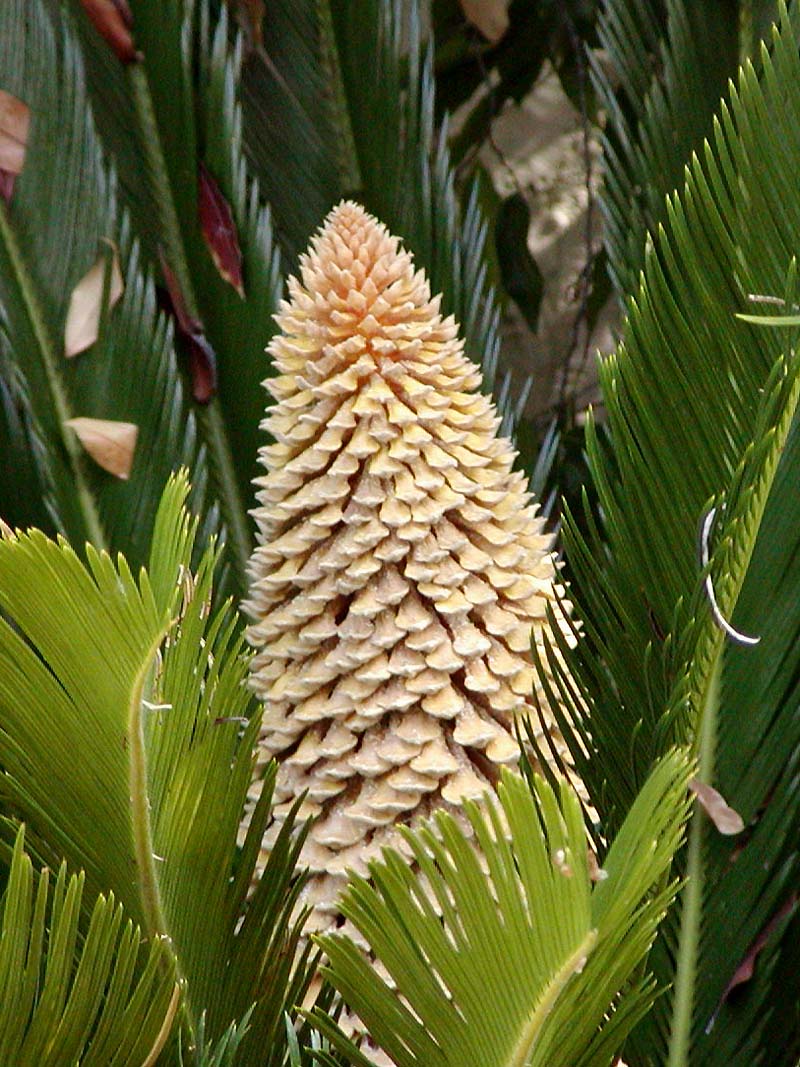
As with other cycads, it is dioecious, with the males bearing pollen cones (strobilus) and the females bearing groups of megasporophylls. Pollination can be done naturally by insects or artificially. This plant is also dangerous, due to poison in the seeds to keep the plant safe.
Propagation of Cycas revoluta is either by seed or clonally by removal of basal offsets. It is one of the most widely cultivated cycads, grown outdoors in warm temperate and subtropical regions, or under glass in colder areas. It grows best in sandy, well-drained soil, preferably with some organic matter. It needs good drainage or it will rot. It is fairly drought-tolerant and grows well in full sun or outdoor shade, but needs bright light when grown indoors. The leaves can bleach somewhat if moved from indoors to full sun outdoors.[citation needed]
Of all the cycads, C. revoluta is the most popular in cultivation. It is seen in almost all botanical gardens, in both temperate and tropical locations. In many areas of the world, it is heavily promoted commercially as a landscape plant. It is also quite popular as a bonsai plant. First described in the late 18th century, it is tolerant of mild to somewhat cold temperatures, provided the ground is dry. Frost damage can occur at temperatures below −10 °C (14 °F). C. revoluta usually defoliates in winter in this temperate climate, but will usually flush (grow) several new leaves by spring.
Hub AI
Cycas revoluta AI simulator
(@Cycas revoluta_simulator)
Cycas revoluta
Cycas revoluta (Sotetsu [Japanese ソテツ], sago cycad, sago palm, king sago, Japanese sago palm) is a species of gymnosperm in the family Cycadaceae, native to southern Japan including the Ryukyu Islands. It is one of several species used for the production of sago, as well as an ornamental plant. The sago cycad can be distinguished by a thick coat of fibers on its trunk. The sago cycad is sometimes mistakenly thought to be a palm, although the only similarity between the two is that they look similar and both produce seeds.
Cycads are not related to palms (Arecaceae), superficially similar only in leaf arrangement and that both are vascular plants and seed plants. The Latin specific epithet revoluta means "curled back", in reference to the leaves. This is also called kungi (comb) palm in Urdu speaking areas.
This very symmetrical plant supports a crown of shiny, dark green leaves on a thick shaggy trunk that is typically about 20 cm (7.9 in) in diameter, sometimes wider. The trunk is very low to subterranean in young plants, but lengthens above ground with age. It can grow into very old specimens with 6–7 m (20–23 ft) of trunk; however, the plant is very slow-growing and requires about 50–100 years to achieve this height. Trunks can branch several times, thus producing multiple heads of leaves. The largest cultivated specimen, at the Ryugeji Temple, in Shimizu, Japan (136 km (85 mi) WSW of Tokyo), is 8 m (26 ft) in height and 1.6 m (5 ft 3 in) thick.
The leaves are a deep semiglossy green and about 50–150 cm (20–59 in) long when the plants are of a reproductive age. They grow out into a feather-like rosette to 1 m (3.3 ft) in diameter. The crowded, stiff, narrow leaflets are 8–18 cm (3.1–7.1 in) long and have strongly recurved or revolute edges. The basal leaflets become more like spines. The petiole or stems of the sago cycad are 6–10 cm (2.4–3.9 in) long and have small protective barbs.[citation needed]
Roots are called coralloid with an Anabaena symbiosis allowing nitrogen fixation. Tannins-rich cells are found on either side of the algal layer to resist the algal invasion.[citation needed]
As with other cycads, it is dioecious, with the males bearing pollen cones (strobilus) and the females bearing groups of megasporophylls. Pollination can be done naturally by insects or artificially. This plant is also dangerous, due to poison in the seeds to keep the plant safe.
Propagation of Cycas revoluta is either by seed or clonally by removal of basal offsets. It is one of the most widely cultivated cycads, grown outdoors in warm temperate and subtropical regions, or under glass in colder areas. It grows best in sandy, well-drained soil, preferably with some organic matter. It needs good drainage or it will rot. It is fairly drought-tolerant and grows well in full sun or outdoor shade, but needs bright light when grown indoors. The leaves can bleach somewhat if moved from indoors to full sun outdoors.[citation needed]
Of all the cycads, C. revoluta is the most popular in cultivation. It is seen in almost all botanical gardens, in both temperate and tropical locations. In many areas of the world, it is heavily promoted commercially as a landscape plant. It is also quite popular as a bonsai plant. First described in the late 18th century, it is tolerant of mild to somewhat cold temperatures, provided the ground is dry. Frost damage can occur at temperatures below −10 °C (14 °F). C. revoluta usually defoliates in winter in this temperate climate, but will usually flush (grow) several new leaves by spring.
Recent media