Hubbry Logo
CycadCycadMain
Open search
Cycad
Community hub
Cycad
logo
8 pages, 0 posts
0 subscribers
Be the first to start a discussion here.
Cycad
Cycad
from Wikipedia
Not found
Revisions and contributorsEdit on WikipediaRead on Wikipedia
from Grokipedia
Cycads are an ancient order of characterized by their palm-like appearance, featuring stout, often unbranched trunks topped with a crown of large, stiff, pinnate leaves and large cones for . They are dioecious, with separate male and female producing cones and cones, respectively, and possess unique motile cells among seed , facilitated by flagella for swimming to the egg. These plants, belonging to the order Cycadales, comprise approximately 380 across 10 genera as of 2025, making them one of the most diverse yet threatened groups of gymnosperms. Fossils indicate that cycads first appeared around 300 million years ago during the late era and reached their peak diversity in the , particularly the period, when they dominated many landscapes alongside dinosaurs. Today, they are primarily distributed in tropical and subtropical regions across , , , and the , thriving in diverse habitats from rainforests to arid savannas, but absent from and . Morphologically, cycads exhibit a range of forms, from short, succulent stems in some to tall trunks exceeding 15 meters in others, such as Lepidozamia hopei; their leaves are compound and xerophytic, adapted to conserve water with thick cuticles and sunken stomata. A is their coralloid roots, which form symbiotic associations with nitrogen-fixing ( spp.), enabling growth in nutrient-poor soils. Reproduction involves large, colorful seeds with a fleshy that attracts animal dispersers, while is primarily biotic, often mediated by beetles in a specialized mutualism, though some rely on . Cycads are slow-growing and long-lived, often taking 10–15 years to reach reproductive maturity, with some individuals surviving for centuries, which contributes to their vulnerability. They are highly valued ornamentally for their dramatic foliage and drought tolerance but are toxic due to compounds like cycasin, posing risks to humans and livestock if ingested. Conservation efforts are urgent, as approximately 71% of species are threatened with extinction as of 2024, primarily from habitat destruction and illegal collection, rendering cycads a model for ex situ preservation in botanical gardens.

Morphology and Anatomy

External Features

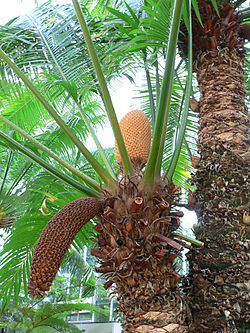
Cycads exhibit a distinctive palm-like , characterized by a stout, usually unbranched woody trunk topped by a crown of large, pinnately compound leaves, with no true branching along the stem. The trunk, often referred to as a , is cylindrical and covered in persistent leaf bases or scars, giving it an armored appearance, and can range from subterranean in some to prominently erect in others. The leaves form a dense, terminal rosette and are typically feathery and arching, with lengths reaching 1 to 2 meters or more in many species. These compound fronds consist of numerous stiff, leathery leaflets arranged along a rachis, often lacking a petiole in mature forms; the leaflets are lanceolate, with prominent midribs and margins that may be entire, serrated, or revolute for against herbivory. Reproductive structures are prominent cones borne at the apex of the trunk, with male plants producing microsporangiate cones and female plants bearing megasporangiate cones or clusters of megasporophylls; cycads are dioecious, meaning these structures occur on separate individuals. Male cones are generally elongated and cylindrical, while female cones (in genera like Encephalartos and Zamia) are ovoid and larger in girth, with sizes varying widely— for instance, in Encephalartos species, male cones can reach up to 60 cm in length and 10 cm in diameter, and female cones up to 30 cm long. In Cycas species, such as C. revoluta, females produce loose clusters of megasporophylls rather than compact cones. Cycads are slow-growing perennials, with height increments often averaging 2-3 cm per year, allowing some to attain heights of 10 to 20 over centuries. They commonly produce basal offshoots or "pups" at the trunk base, facilitating vegetative propagation and colony formation in suitable conditions. A notable example is , a dioecious species featuring a robust trunk up to 6 meters tall, crowned by dark green leaves up to 2.5 meters long with leaflets exhibiting revolute margins that impart a curled, distinctive appearance. These external traits, persistent since the era, underscore the group's ancient lineage.

Internal Structure

The vascular system of cycads consists of composed primarily of tracheids for water conduction, lacking the vessel elements found in angiosperms, a feature shared with most other gymnosperms such as and Ginkgo. The , in contrast, features elongated sieve cells without companion cells, facilitating nutrient transport in a manner typical of gymnosperms, though less efficient than the sieve-tube elements and companion cell pairs in angiosperms. This primitive vascular arrangement supports the slow growth and longevity of cycads in nutrient-poor environments. Cycad roots include specialized coralloid structures that branch dichotomously and grow upward, hosting symbiotic nitrogen-fixing such as Nostoc punctiforme within their cortical tissues. These colonize the intercellular spaces between the inner and outer cortex, enhancing nitrogen availability through fixation in specialized cells called heterocysts, a mutualism unique among gymnosperms. The coralloid roots also contain numerous canals lined with secretory cells, which fill with gelatinous substances that aid in cyanobacterial recruitment and retention while protecting against . The stems of cycads exhibit manoxylic wood, characterized by a loose secondary with abundant cells interspersed among the tracheids, resulting in a soft, non-dense optimized for water and nutrient storage rather than efficient long-distance conduction. This -rich composition, with wide medullary rays and extensive , contrasts with the denser pycnoxylic wood of , reflecting cycads' adaptation to stable, low-growth habitats where mechanical support is provided by leaf bases rather than rigid wood. Multiple vascular strands or steles embedded in the parenchymatous further facilitate localized transport and storage. Cycad leaves possess a thick on the , which reduces water loss in arid conditions, a key for their often tropical or subtropical habitats. Stomata are typically sunken within deep pits formed by subsidiary cells, minimizing while allowing , a feature observed across genera like and . In reproductive , cycad ovules are orthotropous and enclosed by a multi-layered consisting of an outer fleshy , a middle stony sclerotesta for protection, and a thin inner endotesta, surrounding the nucellus and megagametophyte. Pollen tubes, upon germination, grow through the micropyle and release multiflagellated, motile cells that swim within the ovular fluid to fertilize the in the , a zooidogamous process retained from ancestral gymnosperms.

Reproduction and Life Cycle

Sexual Reproduction

Cycads exhibit dioecious , with and reproductive structures occurring on separate . produce cones, or microstrobili, which release grains, while bear cones, or megastrobili, containing ovules. This separation necessitates cross-pollination between individuals for successful production. Pollination in cycads is achieved primarily through vectors, particularly beetles from various families such as Nitidulidae and Boganiidae, which are attracted to the thermogenic and odorous cones. These specialized pollinators, often in a mutualistic brood-site relationship, transfer from male to female cones. While wind plays a minor role in some , experimental evidence confirms that are the dominant mechanism, with grains exhibiting a sulcate, boat-shaped morphology adapted for to bodies rather than aerial flotation. Following , fertilization occurs via a primitive process involving motile, multiflagellated cells. germinates on the pollination drop of the , forming a that delivers the to the within the female gametophyte. The large, spiral-shaped , each bearing thousands of flagella, swim short distances through fluid to fuse with the egg, a trait retained from early ancestors and unique among extant gymnosperms except for Ginkgo. This zooidogamous mechanism contrasts with the non-motile of most other s. Seed development in cycads results in naked borne openly on megasporophylls, without in a . After fertilization, the matures into a with a hard inner coat and an outer fleshy , often brightly colored in reds, oranges, or yellows to attract animal dispersers. For instance, in the genus , the scarlet are dispersed by birds and mammals that consume the while discarding the viable . This sarcotesta-mediated dispersal enhances distribution in fragmented habitats. Genetic aspects of cycad are influenced by their fragmented, small populations, which promote high levels of and reduced fitness in offspring. Low exacerbates these effects, leading to prevalent clonal reproduction via offsets or suckers as a survival strategy in isolated stands. Such clonality maintains population persistence but limits sexual recombination and long-term adaptability.

Development and Growth

Cycad germination is typically hypogeal, with the cotyledons remaining below the surface while the primary and shoot emerge, a uniform across most in the order. This process generally occurs within 1 to 3 months after fresh , though timing varies by ; for instance, Bowenia species may germinate in 1 to 3 months, while some can take up to 24 months under suboptimal conditions. The hypogeal nature protects the developing embryo in nutrient-poor or arid , allowing energy from the seed's to fuel initial subterranean growth before the first true leaves appear above ground. During the juvenile phase, cycads exhibit slow, episodic leaf production, typically flushing new fronds once or twice annually in response to seasonal environmental cues such as rainfall and . Young plants produce leaves every 6 to 12 months, with each flush consisting of multiple fronds emerging simultaneously from the apical . Reaching reproductive maturity requires 10 to 25 years, depending on and habitat; for example, typically matures in 15 to 20 years, at which point cone production begins. This prolonged juvenile period contributes to their resilience, as plants invest heavily in and trunk development before . Mature cycads display incremental trunk growth of 2 to 5 cm annually, varying by species, soil fertility, and climate; for instance, some cultivated Encephalartos species average 2.5 cm per year. Growth remains episodic, accelerating during wet seasons and slowing in drought, which aligns with their adaptation to seasonal habitats. Vegetative propagation occurs through offsets or suckers—basal shoots that emerge from the parent plant's roots or lower trunk—providing an asexual reproduction method especially useful in cultivation to preserve genotypes. Recent techniques such as air layering have also been developed to facilitate clonal propagation. These offsets can be separated once they develop independent roots, typically after 1 to 2 years, facilitating clonal expansion without relying on seed production. Cycads exhibit remarkable , with individuals living 1,000 to 2,000 years, though is gradual and often triggered by environmental stress rather than a fixed biological clock. Episodic growth persists into old age, with trunk armoring from leaf bases accumulating over centuries, enabling survival through periodic during adverse conditions. This extended lifespan, combined with slow maturation, underscores their strategy as long-lived perennials in stable but challenging ecosystems.

Evolutionary History

Fossil Record

The fossil record of cycads reveals an ancient lineage with origins tracing back to the Late period, approximately 300 million years ago, when Bennettitales-like ancestors first appeared in the form of pteridosperm-derived foliage such as taeniopterids. True cycads emerged during the period (280–250 million years ago), evidenced by early s like Dioonitocarpidium from the lower Permian of , which display cycad-like carpophylls and seeds. These Permian records, primarily from equatorial Pangea, indicate slender, unarmored plants adapted to diverse environments. Cycads achieved dominance during the era, particularly in the and periods (252–145 million years ago), where they comprised up to 20% of global flora and were often called the "Age of Cycads." Abundant fossils from this time include genera such as Williamsonia, known from to deposits worldwide, featuring bisporangiate cones and pinnate leaves, and Bucklandia, represented by large trunks from the in . This era's records, spanning every continent from to , highlight cycads' role in ecosystems alongside dinosaurs. Following the Cretaceous-Paleogene boundary around 66 million years ago, cycad diversity declined sharply, attributed to the rapid rise and diversification of angiosperms, which outcompeted gymnosperms in terrestrial habitats. remnants are sparse, with fossils appearing intermittently from the Eocene (56–34 million years ago) onward, such as Bowenia eocenica from Australian deposits, suggesting survival in isolated refugia amid cooling climates and angiosperm dominance. Key fossil sites underscore this history, notably the in the , which yields diverse cycadophytes including Cycadeoidea specimens with preserved bisporangiate cones, providing insights into reproductive structures. However, gaps persist in the record due to the poor preservation of soft tissues, with most evidence relying on leaf impressions, , and rare permineralized cones, as delicate structures like vascular tissues rarely fossilize outside exceptional conditions.

Phylogeny and Classification

Cycads belong to the division Cycadophyta, positioned as the to Ginkgo and the (Pinophyta) within the , with their divergence from this estimated at approximately 284 million years ago during the early Permian period. This basal placement in phylogeny is supported by molecular analyses of nuclear and genes, which consistently recover cycads as the earliest diverging extant lineage among seed plants, excluding angiosperms. Fossil-calibrated studies further indicate that the crown group of modern cycads arose around 251 million years ago in the late Permian, marking a significant radiation following the . Recent phylogenomic analyses continue to support this timeline, though with minor refinements in intergeneric relationships. The current classification of living cycads recognizes three families: Cycadaceae, Stangeriaceae, and , encompassing 10 genera and approximately 380 (as of 2023). Cycadaceae contains the single genus with about 124 species, primarily distributed in and ; Stangeriaceae includes only Stangeria (one species in ); and Zamiaceae comprises the remaining eight genera—Bowenia, Ceratozamia, Dioon, , Lepidozamia, Macrozamia, Microcycas, and —with the majority of species diversity. This tripartite familial structure, established through combined morphological and molecular data, reflects distinct evolutionary lineages, though some recent phylogenomic analyses suggest merging Stangeriaceae into an expanded Zamiaceae due to close relationships. No subfamilies are universally accepted across these families, but informal groupings distinguish "cycads proper" (Cycadaceae) from "zamiads" (Stangeriaceae + Zamiaceae), highlighting differences in reproductive and vegetative traits. Molecular phylogenetic studies since the have robustly confirmed the of Cycadophyta using genes like rbcL and trnL-F, as well as nuclear markers such as PHYC and single-copy nuclear genes. Early work in the and 2000s established as the most basal genus, with emerging as the derived clade encompassing all other genera. Subsequent analyses from the 2010s to 2020s, incorporating multi-gene datasets and fossil calibrations, have refined intergeneric relationships; for instance, Bowenia and Stangeria form a basal within the zamiad group, while and Microcycas are closely related in the lineage. These studies, including Bayesian species-tree inferences, underscore low intergeneric divergence rates and highlight hybridization risks in conservation. In broader evolutionary context, extinct taxa such as those in the Permian order Nilssoniales serve as potential outgroups in cycad phylogenies, providing morphological anchors for interpreting stem-lineage traits like bisporangiate strobili, though their exact affinities remain debated in molecular frameworks.

Distribution and Ecology

Geographic Range

Cycads are distributed pantropically, occurring natively in the tropical and subtropical regions across Africa, Australia, Asia, and the Americas. In Africa, the genus Encephalartos dominates, with species concentrated in southern Africa, including South Africa and adjacent countries. Australia's cycad flora features genera such as Macrozamia and Lepidozamia, while in Asia, Cycas species are prominent in regions like India, China, and Southeast Asia. The Americas host genera like Zamia in Mexico, Central America, and as far north as Florida in the United States, along with Dioon and Ceratozamia in Mesoamerica. The centers of highest diversity lie in Australia, which harbors approximately 75 species across four genera, and in Mesoamerica and the Caribbean, where approximately 120 species of Zamiaceae are found, primarily in the genera Zamia, Ceratozamia, Dioon, and Microcycas. No native cycad species occur in Europe, temperate Asia, or other higher-latitude temperate zones, reflecting their strict affinity for warmer climates. Globally, around 380 extant species are recognized (as of 2024), underscoring their relictual status as ancient gymnosperms. This fragmented, disjunct pattern of distribution stems from ancient Gondwanan origins, with early diversification on supercontinents leading to a concentration in the and limited northward extensions via Laurasian connections. High characterizes the group, with approximately 70% of species restricted to single countries; for instance, over 70% of African cycads are country endemics, a trend echoed in Australia's 80% national rate. Beyond their native ranges, cycads are widely cultivated as ornamentals in temperate and subtropical areas worldwide, including in the Mediterranean basin and other non-native regions, though they remain non-invasive due to slow growth and limited naturalization.

Habitat Preferences and Adaptations

Cycads occupy diverse habitats worldwide, ranging from rocky outcrops and savannas to tropical rainforests, often in tropical and subtropical regions. Many species exhibit lithophytic growth, anchoring to rocky substrates in well-drained environments, as seen in the genus Dioon endemic to , where species like D. spinulosum thrive on cliffs and hillsides in evergreen rainforests. This habitat preference allows cycads to exploit nutrient-scarce, erosion-prone sites, contributing to their persistence in fragmented landscapes. To cope with aridity prevalent in many of their habitats, certain cycads have evolved physiological adaptations such as facultative (CAM) photosynthesis, which minimizes water loss by fixing CO₂ at night, as documented in Dioon edule populations in seasonally dry tropical . Additional drought-tolerance features include thick cuticles on leaves to reduce and extensive deep systems that access subsurface moisture, enabling survival in semi-arid savannas and outcrops. Cycads also favor well-drained, nutrient-poor soils, often sandy or rocky, which prevent waterlogging while aligning with their slow growth rates; they demonstrate fire tolerance through resprouting from a persistent after aboveground tissues are scorched, a trait observed across genera like Macrozamia and . Symbiotic relationships further enhance cycad adaptation to nutrient-limited environments. Coralloid roots host nitrogen-fixing , such as Nostoc species, providing essential in poor soils, a unique trait among gymnosperms that supports growth in oligotrophic habitats. Complementarily, arbuscular mycorrhizal fungi colonize lateral roots, facilitating uptake from insoluble forms in acidic or low-fertility soils, as evidenced in species where these associations promote biomass accumulation. Despite these adaptations, cycads exhibit slow recovery from disturbances like intense fires or , owing to their inherently sluggish growth and limited reproductive output, which heightens their ecological vulnerability in altered habitats. For instance, post-fire resprouting may take years to restore canopy structure, while cyclone damage to stems impairs regeneration, exacerbating population declines in fire-prone savannas or cyclone-exposed coastal areas.

Human Interactions and Conservation

Traditional and Modern Uses

Cycads have been utilized by various cultures for food extraction, particularly through the processing of from their trunks and . In , the trunks of are a of , an edible that serves as a dietary staple after careful to remove toxic compounds like . This process involves , , and fermenting the to yield a used in traditional dishes across Southeast Asian communities. Similarly, indigenous groups in the Pacific have historically processed cycad into famine foods, highlighting their role as a resilient resource in marginal environments. In modern , cycads are prized for their ornamental value, often planted as "sago palms" in to evoke tropical aesthetics. Species such as and are commonly featured in gardens and indoor settings due to their fern-like fronds and striking cones, with trade focusing on cultivated varieties for durability in mild climates. Australian genera like Bowenia are also traded internationally for their unique, vine-like growth, appealing to collectors and botanical displays. This popularity has driven commercial techniques, including seed-based cultivation, to meet demand in the global nursery industry. Traditional medicinal applications of cycads persist in indigenous practices, though scientific validation remains limited. In , bark from species is used by local communities to treat and other ailments, often prepared as infusions or poultices. Similarly, roots of species have been employed in Asian folk medicine for rheumatic pains, reflecting a broader ethnobotanical heritage despite sparse clinical supporting . Industrial uses of cycad-derived extend to adhesives and , where its binding properties provide utility in . Extracted from species like Cycas revoluta has been converted for these purposes, offering a natural alternative in paper treatment and fabric processing. Culturally, cycads hold symbolic importance in indigenous rituals, particularly among with Macrozamia species. These plants feature in ceremonies as markers of seasonal cycles and spiritual connections, with seeds integral to communal processing events that reinforce social bonds. Historical practices, including controlled burning around Macrozamia groves, underscore their role in landscape management and cultural narratives.

Toxicity and Conservation Status

Cycads contain potent toxins, including the azoxyglycosides cycasin and macrozamin, which are hydrolyzed in the gut to methylazoxymethanol (MAM), a genotoxic compound that causes liver damage, gastrointestinal distress, and neurological disorders in humans and animals. These toxins can lead to symptoms such as , , seizures, , and long-term carcinogenic effects upon ingestion. Additionally, the non-protein β-N-methylamino-L-alanine (BMAA), produced by symbiotic in cycad roots and concentrated in seeds, acts as a by mimicking glutamate and disrupting neuronal function, contributing to degeneration and behavioral anomalies in mammals. In humans, chronic BMAA exposure has been hypothesized to contribute to the /parkinsonism-dementia complex (ALS-PDC) observed in Guam's Chamorro population, where traditional consumption of cycad seeds and through flying foxes may have amplified exposure, though the causal role remains debated. Cycads face severe conservation threats from habitat loss due to , , and , compounded by overcollection and for ornamental trade, with approximately 71% of the over 350 assessed species listed as threatened on the as of 2025. For instance, Microcycas calocoma, endemic to , is classified as Critically Endangered due to its restricted range and ongoing habitat degradation, with fewer than 500 mature individuals remaining. These pressures have driven population declines across genera, exacerbated by the ' slow growth rates and low reproductive output, making recovery challenging. Protection efforts include listings under the Convention on International Trade in Endangered Species (), where all cycad species are regulated in Appendix I or II to curb illegal trade, with Appendix I applying to highly endangered taxa like Microcycas calocoma since the and broader Appendix II coverage for most genera. Ex situ conservation plays a vital role, with botanic gardens such as the Montgomery Botanical Center maintaining living collections that preserve and support propagation for wild restoration. Historical overhunting has decimated populations, notably in , where species like E. transvenosus face rampant by organized syndicates targeting wild stands for international markets, leading to local extirpations despite patrols. poses emerging threats, with projections indicating habitat shifts, increased drought, and fire frequency that could further reduce suitable ranges for many species by 2050, intensifying in tropical and subtropical regions. Recovery initiatives encompass reintroduction programs, such as those in and , where propagated plants from botanic collections are returned to protected habitats to bolster wild populations. Genetic banking efforts, including seed storage and at facilities like the Wild Cycad Conservancy, aim to mitigate in fragmented populations by safeguarding diverse for future restoration. The 2024–2025 report of the IUCN Species Survival Commission Cycad Specialist Group highlights progress, including Red List assessments for 348 species and the establishment of the Global Cycad Conservation Consortium to enhance international collaboration.

References

Add your contribution
Related Hubs
User Avatar
No comments yet.