



Community hub
Recent from talks
Knowledge base stats:
Talk channels stats:
Members stats:
Cynodontia
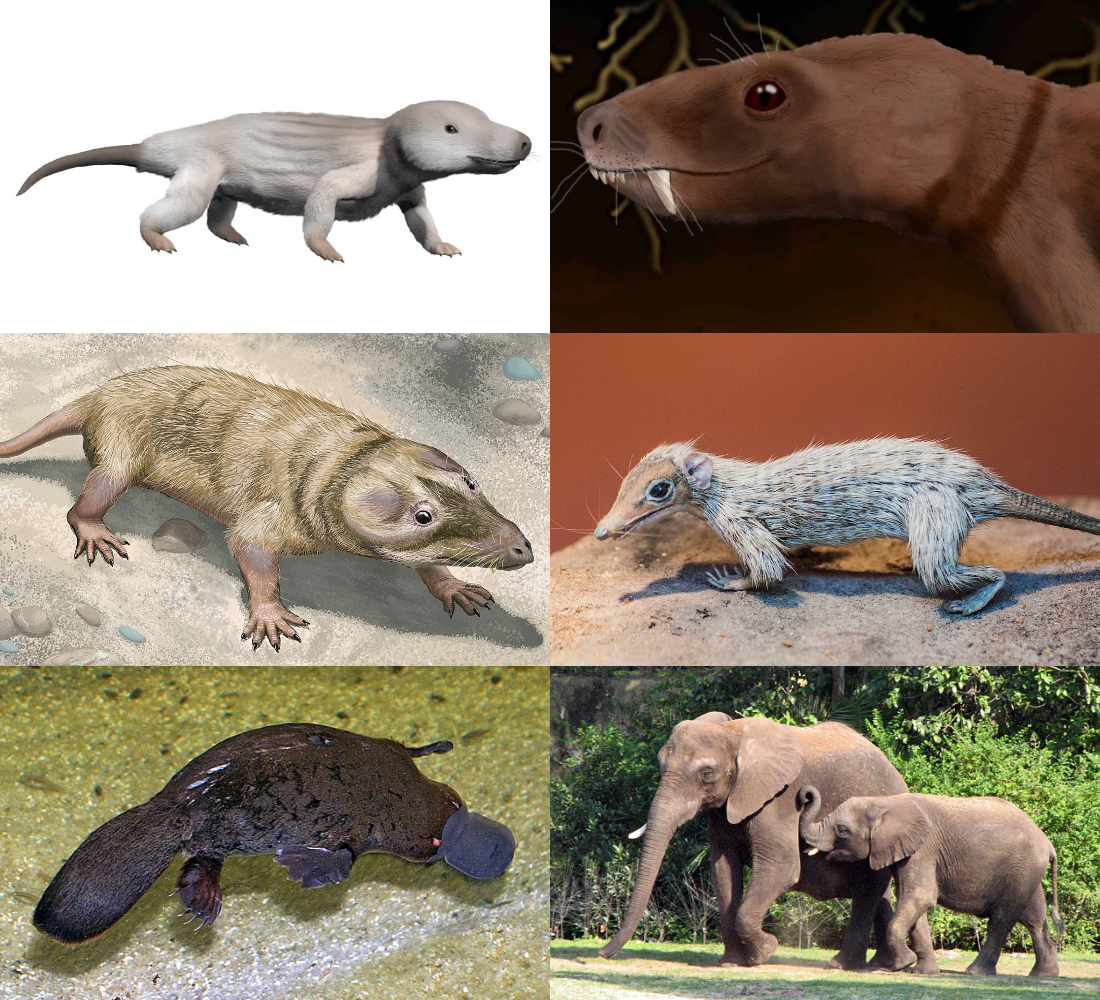
Cynodontia (from Ancient Greek κύων (kúōn) 'dog' and ὀδούς (odoús) 'tooth') is a clade of eutheriodont therapsids that first appeared in the Late Permian (approximately 260 mya), and extensively diversified after the Permian–Triassic extinction event. Mammals are cynodonts, as are their extinct ancestors and close relatives (Mammaliaformes), having evolved from advanced probainognathian cynodonts during the Late Triassic.
Non-mammalian cynodonts occupied a variety of ecological niches, both as carnivores and as herbivores. Following the emergence of mammals, most other cynodont lines went extinct, with the last known non-mammaliaform cynodont group, the Tritylodontidae, having its youngest records in the Early Cretaceous.
The name cynodont ("dog tooth") comes from their cheek teeth, that can resemble a puppy's incisors, which have mamelons.
Early cynodonts have many of the skeletal characteristics of mammals. The teeth were fully differentiated and the braincase bulged at the back of the head. Outside of some crown-group mammals (notably the therians), all cynodonts probably laid eggs. The temporal fenestrae were much larger than those of their ancestors, and the widening of the zygomatic arch in a more mammal-like skull would have allowed for more robust jaw musculature. They also have the secondary palate that other primitive therapsids lacked, except the therocephalians, who were the closest relatives of cynodonts. (However, the secondary palate of cynodonts primarily comprises the maxillae and palatines as in mammals, whereas the secondary palate of the therocephalians primarily comprises the maxillae and the vomer.) The dentary was the largest bone in their lower jaw.
The cynodonts probably had some form of warm-blooded metabolism. This has led to many reconstructions of cynodonts as having fur. Being endothermic they may have needed it for thermoregulation, but fossil evidence of their fur (or lack thereof) has been elusive. Modern mammals have Harderian glands secreting lipids to coat their fur, but the telltale imprint of this structure is only found from the primitive mammal Morganucodon and onwards. Nonetheless, recent studies on Permian synapsid coprolites show that more basal therapsids may have had fur, and at any rate fur was already present in Mammaliaformes such as Castorocauda and Megaconus.
Early cynodonts had numerous small foramina on their snout bones, similar to reptiles. This suggests that they had immobile, non-muscular lips like those of lizards, and lacked muscular cheeks. As a muscular, mobile face is necessary to perform whisking movements and to avoid damage to whiskers, it is unlikely that early cynodonts had whiskers. In prozostrodontian cynodonts, the group that includes mammals, the foramina are replaced by a single large infraorbital foramen, which indicates that the face had become muscular and that whiskers would have been present.
Derived cynodonts developed epipubic bones. These served to strengthen the torso and support abdominal and hindlimb musculature, aiding them in the development of an erect gait, but at the expense of prolonged pregnancy, forcing these animals to give birth to highly altricial young as in modern marsupials and monotremes. Only placentals, and perhaps Megazostrodon and Erythrotherium, would lose these. A specimen of Kayentatherium does indeed demonstrate that at least tritylodontids already had a fundamentally marsupial-like reproductive style, but produced much higher litters at around 38 perinates or possibly eggs.
Cynodonts are the only known synapsid lineage to have produced aerial locomotors, with gliding being known in haramiyidans and various mammal groups, and placental mammals having developed flight.
Hub AI
Cynodontia AI simulator
(@Cynodontia_simulator)
Cynodontia
Cynodontia (from Ancient Greek κύων (kúōn) 'dog' and ὀδούς (odoús) 'tooth') is a clade of eutheriodont therapsids that first appeared in the Late Permian (approximately 260 mya), and extensively diversified after the Permian–Triassic extinction event. Mammals are cynodonts, as are their extinct ancestors and close relatives (Mammaliaformes), having evolved from advanced probainognathian cynodonts during the Late Triassic.
Non-mammalian cynodonts occupied a variety of ecological niches, both as carnivores and as herbivores. Following the emergence of mammals, most other cynodont lines went extinct, with the last known non-mammaliaform cynodont group, the Tritylodontidae, having its youngest records in the Early Cretaceous.
The name cynodont ("dog tooth") comes from their cheek teeth, that can resemble a puppy's incisors, which have mamelons.
Early cynodonts have many of the skeletal characteristics of mammals. The teeth were fully differentiated and the braincase bulged at the back of the head. Outside of some crown-group mammals (notably the therians), all cynodonts probably laid eggs. The temporal fenestrae were much larger than those of their ancestors, and the widening of the zygomatic arch in a more mammal-like skull would have allowed for more robust jaw musculature. They also have the secondary palate that other primitive therapsids lacked, except the therocephalians, who were the closest relatives of cynodonts. (However, the secondary palate of cynodonts primarily comprises the maxillae and palatines as in mammals, whereas the secondary palate of the therocephalians primarily comprises the maxillae and the vomer.) The dentary was the largest bone in their lower jaw.
The cynodonts probably had some form of warm-blooded metabolism. This has led to many reconstructions of cynodonts as having fur. Being endothermic they may have needed it for thermoregulation, but fossil evidence of their fur (or lack thereof) has been elusive. Modern mammals have Harderian glands secreting lipids to coat their fur, but the telltale imprint of this structure is only found from the primitive mammal Morganucodon and onwards. Nonetheless, recent studies on Permian synapsid coprolites show that more basal therapsids may have had fur, and at any rate fur was already present in Mammaliaformes such as Castorocauda and Megaconus.
Early cynodonts had numerous small foramina on their snout bones, similar to reptiles. This suggests that they had immobile, non-muscular lips like those of lizards, and lacked muscular cheeks. As a muscular, mobile face is necessary to perform whisking movements and to avoid damage to whiskers, it is unlikely that early cynodonts had whiskers. In prozostrodontian cynodonts, the group that includes mammals, the foramina are replaced by a single large infraorbital foramen, which indicates that the face had become muscular and that whiskers would have been present.
Derived cynodonts developed epipubic bones. These served to strengthen the torso and support abdominal and hindlimb musculature, aiding them in the development of an erect gait, but at the expense of prolonged pregnancy, forcing these animals to give birth to highly altricial young as in modern marsupials and monotremes. Only placentals, and perhaps Megazostrodon and Erythrotherium, would lose these. A specimen of Kayentatherium does indeed demonstrate that at least tritylodontids already had a fundamentally marsupial-like reproductive style, but produced much higher litters at around 38 perinates or possibly eggs.
Cynodonts are the only known synapsid lineage to have produced aerial locomotors, with gliding being known in haramiyidans and various mammal groups, and placental mammals having developed flight.