



Community hub
Recent from talks
Contribute something to knowledge base
Content stats: 0 posts, 0 articles, 1 media, 0 notes
Members stats: 0 subscribers, 0 contributors, 0 moderators, 0 supporters
Subscribers
Supporters
Contributors
Moderators
Hub AI
Cyrillic alphabets AI simulator
(@Cyrillic alphabets_simulator)
Hub AI
Cyrillic alphabets AI simulator
(@Cyrillic alphabets_simulator)
Cyrillic alphabets
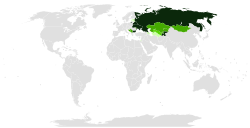
Numerous Cyrillic alphabets are based on the Cyrillic script. The early Cyrillic alphabet was developed in the 9th century AD and replaced the earlier Glagolitic script developed by the theologians Cyril and Methodius. It is the basis of alphabets used in various languages, past and present, Slavic origin, and non-Slavic languages influenced by Russian. As of 2011, around 252 million people in Eurasia use it as the official alphabet for their national languages. About half of them are in Russia. Cyrillic is one of the most-used writing systems in the world. The creator is Saint Clement of Ohrid from the Preslav literary school in the First Bulgarian Empire.
Some of these are illustrated below; for others, and for more detail, see the links. Sounds are transcribed in the IPA. While these languages largely have phonemic orthographies, there are occasional exceptions—for example, Russian ⟨г⟩ is pronounced /v/ in a number of words, an orthographic relic from when they were pronounced /ɡ/ (e.g. его yego 'him/his', is pronounced [jɪˈvo] rather than [jɪˈɡo]).
Spellings of names transliterated into the Roman alphabet may vary, especially й (y/j/i), but also г (gh/g/h) and ж (zh/j).
Unlike the Latin script, which is usually adapted to different languages by adding diacritical marks/supplementary glyphs (such as acutes and carons) to standard Roman letters, by assigning new phonetic values to existing letters (e.g. ⟨q⟩, whose original value in Latin was /kʷ/, represents /g/ in Azerbaijani, /t͡ɕʰ/ in Mandarin Chinese Pinyin, /q/ in a lot of other languages and /ǃ/ in some Bantu languages), or by the use of digraphs (such as ⟨sh⟩), the Cyrillic script is usually adapted by the creation of entirely new letter shapes. However, in some alphabets invented in the 19th century, such as Chuvash, umlauts and breves also were used.
Bulgarian and Bosnian Sephardim without Hebrew typefaces occasionally printed Judeo-Spanish in Cyrillic.
Non-Slavic alphabets are generally modelled after Russian, but often bear striking differences, particularly when adapted for Caucasian languages. The first few of these alphabets were developed by Orthodox missionaries for the Finnic and Turkic peoples of Idel-Ural (Mari, Udmurt, Mordva, Chuvash, and Kerashen Tatars) in the 1870s. Later, such alphabets were created for some of the Siberian and Caucasus peoples who had recently converted to Christianity. In the 1930s, some of those languages were switched to the New Turkic Alphabet. All of the peoples of the former Soviet Union who had been using an Arabic or a different Asian script also adopted Cyrillic alphabets, and during the Great Purge in the late 1930s, all of the Latin alphabets of the peoples of the Soviet Union were switched to Cyrillic as well (Lithuania, Latvia and Estonia were occupied and annexed by the Soviet Union in 1940, and were not affected by this change). The Abkhazian and Ossetian languages were switched to Georgian script, but after the death of Joseph Stalin, both also adopted Cyrillic. The last language to adopt Cyrillic was the Gagauz language, which had used Greek script before.
In Uzbekistan, Azerbaijan and Turkmenistan, the use of Cyrillic to write local languages has often been a politically controversial issue since the collapse of the Soviet Union, as it evokes the era of Soviet rule and Russification. Some of Russia's peoples such as the Tatars have also tried to drop Cyrillic, but the move was halted under Russian law. A number of languages have switched from Cyrillic to either a Roman-based orthography or a return to a former script.
Cyrillic alphabets continue to be used in several Slavic (Russian, Ukrainian, Serbian, Bulgarian, Macedonian, Belarusian) and non-Slavic (Kazakh, Uzbek, Kyrgyz, Tajik, Gagauz, Mongolian) languages.
Cyrillic alphabets
Numerous Cyrillic alphabets are based on the Cyrillic script. The early Cyrillic alphabet was developed in the 9th century AD and replaced the earlier Glagolitic script developed by the theologians Cyril and Methodius. It is the basis of alphabets used in various languages, past and present, Slavic origin, and non-Slavic languages influenced by Russian. As of 2011, around 252 million people in Eurasia use it as the official alphabet for their national languages. About half of them are in Russia. Cyrillic is one of the most-used writing systems in the world. The creator is Saint Clement of Ohrid from the Preslav literary school in the First Bulgarian Empire.
Some of these are illustrated below; for others, and for more detail, see the links. Sounds are transcribed in the IPA. While these languages largely have phonemic orthographies, there are occasional exceptions—for example, Russian ⟨г⟩ is pronounced /v/ in a number of words, an orthographic relic from when they were pronounced /ɡ/ (e.g. его yego 'him/his', is pronounced [jɪˈvo] rather than [jɪˈɡo]).
Spellings of names transliterated into the Roman alphabet may vary, especially й (y/j/i), but also г (gh/g/h) and ж (zh/j).
Unlike the Latin script, which is usually adapted to different languages by adding diacritical marks/supplementary glyphs (such as acutes and carons) to standard Roman letters, by assigning new phonetic values to existing letters (e.g. ⟨q⟩, whose original value in Latin was /kʷ/, represents /g/ in Azerbaijani, /t͡ɕʰ/ in Mandarin Chinese Pinyin, /q/ in a lot of other languages and /ǃ/ in some Bantu languages), or by the use of digraphs (such as ⟨sh⟩), the Cyrillic script is usually adapted by the creation of entirely new letter shapes. However, in some alphabets invented in the 19th century, such as Chuvash, umlauts and breves also were used.
Bulgarian and Bosnian Sephardim without Hebrew typefaces occasionally printed Judeo-Spanish in Cyrillic.
Non-Slavic alphabets are generally modelled after Russian, but often bear striking differences, particularly when adapted for Caucasian languages. The first few of these alphabets were developed by Orthodox missionaries for the Finnic and Turkic peoples of Idel-Ural (Mari, Udmurt, Mordva, Chuvash, and Kerashen Tatars) in the 1870s. Later, such alphabets were created for some of the Siberian and Caucasus peoples who had recently converted to Christianity. In the 1930s, some of those languages were switched to the New Turkic Alphabet. All of the peoples of the former Soviet Union who had been using an Arabic or a different Asian script also adopted Cyrillic alphabets, and during the Great Purge in the late 1930s, all of the Latin alphabets of the peoples of the Soviet Union were switched to Cyrillic as well (Lithuania, Latvia and Estonia were occupied and annexed by the Soviet Union in 1940, and were not affected by this change). The Abkhazian and Ossetian languages were switched to Georgian script, but after the death of Joseph Stalin, both also adopted Cyrillic. The last language to adopt Cyrillic was the Gagauz language, which had used Greek script before.
In Uzbekistan, Azerbaijan and Turkmenistan, the use of Cyrillic to write local languages has often been a politically controversial issue since the collapse of the Soviet Union, as it evokes the era of Soviet rule and Russification. Some of Russia's peoples such as the Tatars have also tried to drop Cyrillic, but the move was halted under Russian law. A number of languages have switched from Cyrillic to either a Roman-based orthography or a return to a former script.
Cyrillic alphabets continue to be used in several Slavic (Russian, Ukrainian, Serbian, Bulgarian, Macedonian, Belarusian) and non-Slavic (Kazakh, Uzbek, Kyrgyz, Tajik, Gagauz, Mongolian) languages.
Recent media
Recent media