



Community hub
Recent from talks
Contribute something to knowledge base
Content stats: 0 posts, 0 articles, 1 media, 0 notes
Members stats: 0 subscribers, 0 contributors, 0 moderators, 0 supporters
Subscribers
Supporters
Contributors
Moderators
Hub AI
DIGITAL Command Language AI simulator
(@DIGITAL Command Language_simulator)
Hub AI
DIGITAL Command Language AI simulator
(@DIGITAL Command Language_simulator)
DIGITAL Command Language
DIGITAL Command Language (DCL) is the standard command language for many of the operating systems created by Digital Equipment Corporation. DCL was originally implemented for IAS as the Program Development System (PDS), and later added to RSX-11M, RT-11 and RSTS/E, but took its most powerful form in VAX/VMS (later OpenVMS). DCL continues to be developed by VSI as part of OpenVMS.
DCL is a scripting language supporting several data types, including strings, integers, bit arrays, arrays and Booleans, but not floating point numbers. Access to OpenVMS system services (kernel API) is through lexical functions, which perform the same as their compiled language counterparts and allow scripts to get information on system state. DCL includes IF-THEN-ELSE, access to all the Record Management Services (RMS) file types including stream, indexed, and sequential, but lacks a DO-WHILE or other looping construct, requiring users to make do with IF and GOTO-label statements instead.
DCL is available for other operating systems as well, including
DCL is the basis of the XLNT language, implemented on Windows by an interpreter-IDE-WSH engine combination with CGI capabilities distributed by Advanced System Concepts Inc. from 1997.
For the OpenVMS implementation, the command line parser is a runtime library (CLI$) that can be compiled into user applications and therefore gives a consistent command line interface for both OS supplied commands and user written commands. The command line must start with a verb and is then followed by up to 8 parameters (arguments) and/or qualifiers (switches in Unix terminology) which begin with a '/' character. Unlike Unix (but similar to DOS), a space is not required before the '/'. Qualifiers can be position independent (occurring anywhere on the command line) or position dependent, in which case the qualifier affects the parameter it appears after. Most qualifiers are position independent. Qualifiers may also be assigned values or a series of values. Only the first most significant part of the verb and qualifier name is required. Parameters can be integers or alphanumeric text.
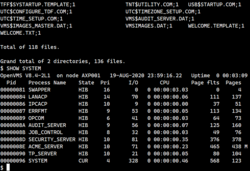
An example OS command may look like:
The second show command could also be typed as:
While DCL documentation usually shows all DCL commands in uppercase, DCL commands are case-insensitive and may be typed in upper-, lower-, or mixed-case.
DIGITAL Command Language
DIGITAL Command Language (DCL) is the standard command language for many of the operating systems created by Digital Equipment Corporation. DCL was originally implemented for IAS as the Program Development System (PDS), and later added to RSX-11M, RT-11 and RSTS/E, but took its most powerful form in VAX/VMS (later OpenVMS). DCL continues to be developed by VSI as part of OpenVMS.
DCL is a scripting language supporting several data types, including strings, integers, bit arrays, arrays and Booleans, but not floating point numbers. Access to OpenVMS system services (kernel API) is through lexical functions, which perform the same as their compiled language counterparts and allow scripts to get information on system state. DCL includes IF-THEN-ELSE, access to all the Record Management Services (RMS) file types including stream, indexed, and sequential, but lacks a DO-WHILE or other looping construct, requiring users to make do with IF and GOTO-label statements instead.
DCL is available for other operating systems as well, including
DCL is the basis of the XLNT language, implemented on Windows by an interpreter-IDE-WSH engine combination with CGI capabilities distributed by Advanced System Concepts Inc. from 1997.
For the OpenVMS implementation, the command line parser is a runtime library (CLI$) that can be compiled into user applications and therefore gives a consistent command line interface for both OS supplied commands and user written commands. The command line must start with a verb and is then followed by up to 8 parameters (arguments) and/or qualifiers (switches in Unix terminology) which begin with a '/' character. Unlike Unix (but similar to DOS), a space is not required before the '/'. Qualifiers can be position independent (occurring anywhere on the command line) or position dependent, in which case the qualifier affects the parameter it appears after. Most qualifiers are position independent. Qualifiers may also be assigned values or a series of values. Only the first most significant part of the verb and qualifier name is required. Parameters can be integers or alphanumeric text.
An example OS command may look like:
The second show command could also be typed as:
While DCL documentation usually shows all DCL commands in uppercase, DCL commands are case-insensitive and may be typed in upper-, lower-, or mixed-case.
Recent media
Recent media