Recent from talks
All channels
Be the first to start a discussion here.
Welcome to the community hub built to collect knowledge and have discussions related to Dailly.
Nothing was collected or created yet.
Dailly
View on Wikipediafrom Wikipedia
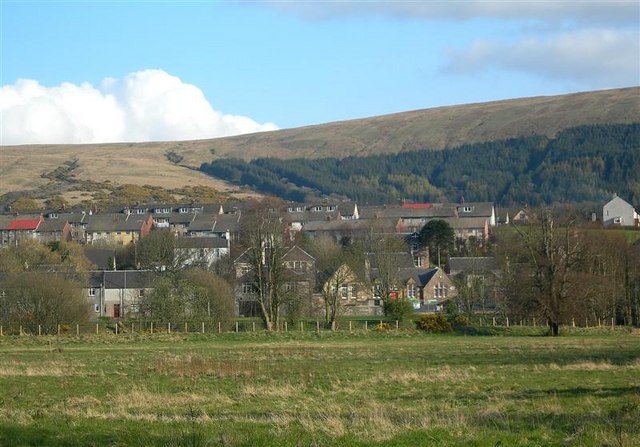
Dailly (Scottish Gaelic: Dail Mhaol Chiarain)[2] is a village in South Ayrshire, Scotland. It is located on the Water of Girvan, five miles (eight kilometres) south of Maybole, and three miles (five kilometres) east of Old Dailly. "New Dailly", as it was originally known, was laid out in the 1760s as a coal-mining village. In 1849 a fire broke out in Maxwell Colliery, one of the nearby mines, and continued to burn for 50 years. In Dailly there are two castles which the locals call the new castle and the old castle; they are both derelict.
Key Information
Notable people
[edit]- Thomas Thomson FRSE (1768–1852) antiquary and friend of Walter Scott
- Hamilton Paul (1773–1854), church minister, poet and writer
- Thomas's younger brother, John Thomson of Duddingston FRSE (1778 – 1840) minister at Dailly 1800-1805 and artist
- Hew Ainslie (1792–1878), poet
- Anne Hepburn, missionary was born here in 1925[3]
- Tommy Lawrence, footballer
- Ross McCrorie, footballer who plays with Bristol City
- Robby McCrorie footballer who plays with Rangers
- Allan Dorans Member of Parliament for Ayr, Carrick and Cumnock
References
[edit]- ^ "Population estimates for settlements and localities in Scotland: mid-2020". National Records of Scotland. 31 March 2022. Retrieved 31 March 2022.
- ^ "An Stòr-dàta Briathrachais" (in Scottish Gaelic). Retrieved 7 March 2010.
- ^ Thanksgiving Service for the life of Anne Hepburn [Order of Service]. Motherhood of God Papers, New College Library. (Mrs Hepburn's papers relating to the Motherhood of God Controversy were donated to New College Library in 2016).
- "Dailly (New Dailly)". Gazetteer for Scotland. Retrieved 4 July 2008.
External links
[edit]Dailly
View on Grokipediafrom Grokipedia
Dailly is a picturesque village in South Ayrshire, Scotland, situated on the Water of Girvan approximately five miles south of Maybole and three miles north of Girvan, encompassing both the planned "New Dailly" developed in the 1760s and the nearby "Old Dailly" settlement.[1][2]
The name Dailly derives from Gaelic words meaning "meadow" and "field," reflecting the surrounding farmland and rolling hills that characterize the rural landscape.[3] Known for its rich history dating back to medieval times, the village features notable landmarks such as the ruins of the original castle by the river and the later Adams Castle built in the 18th century by the Kennedy family, who played a significant role in its development.[4]
Today, Dailly serves as a vibrant community hub with essential amenities including a church, shops, a primary school, and a sports center, while offering outdoor enthusiasts access to a network of five scenic paths that highlight local history, nature, and woodlands.[2][5] The village's strong sense of community and proximity to the west coast make it an inviting destination for those seeking authentic rural Scottish charm and hospitality.[6]
These figures illustrate growth from 1801 to 1821, coinciding with heightened mining operations, followed by a steady decrease into the 20th century as collieries closed and residents migrated elsewhere, a trend that continued into the 21st century with 908 residents in 2001 and 895 in 2011.[28][29][30]
According to the 2022 census, the population of the Dailly settlement was 833, representing a continuation of the post-industrial decline, with the village now exhibiting low population density typical of rural South Ayrshire, where the broader council area spans approximately 1,222 square kilometers and supported about 111,500 people as of the 2022 census.[31][32] Demographically, Dailly mirrors the aging profile common in Scottish rural villages, with South Ayrshire featuring a higher-than-average proportion of residents over 65—26.5% as of the 2022 census—driven by longer life expectancies and out-migration of younger generations.[33] This composition underscores the challenges and community dynamics of small, aging locales in the region.
Geography
Location and Setting
Dailly is a village located in South Ayrshire, Scotland, situated along the banks of the Water of Girvan.[1] The village's precise geographical coordinates are 55°16′36″N 4°43′28″W, corresponding to the Ordnance Survey grid reference NS270014.[7] It lies within the administrative boundaries of the South Ayrshire council area, which governs local services and planning in the region.[8] Positioned 5 miles (8 km) south of Maybole and 3 miles (5 km) east of Old Dailly, Dailly serves as a central point in the rural landscape of Carrick, the historic district encompassing much of South Ayrshire.[3] The village uses the postcode district KA26, with Girvan designated as the post town, and its telephone dialling code is 01465, shared with nearby communities along the Ayrshire coast.[9] The Scottish Gaelic name for Dailly is Dail Mhaol Chiarain, derived from Gaelic terms meaning "meadow" and "field," reflecting its pastoral setting amid surrounding farmland and gentle hills.[3]Physical Features
Dailly is situated within the lower section of the Water of Girvan valley, a broad undulating dale characterized by gently rolling terrain and enclosed pastures that dominate the surrounding landscape. The river, originating from Loch Girvan Eye and flowing westward to the Firth of Clyde, shapes the area's hydrology, with its floodplain supporting lush meadows and riparian woodlands along the banks. This valley setting, typical of South Ayrshire's lowland river systems, features small to medium-sized fields bounded by intact hedgerows and shelterbelts, fostering a pastoral environment conducive to agriculture.[10][11] The rolling countryside around Dailly exemplifies Ayrshire's agricultural lowlands, with meadows and fields that reflect the village's Gaelic-derived name, meaning "meadow and field," highlighting the area's historical emphasis on fertile dales and grazing lands. Valley sides rise gradually to form smoother hills in the north and steeper, more rugged slopes to the south, creating a contained yet visually diverse topography with elevations in the village ranging from approximately 40 to 100 meters above sea level. Surrounding farmland extends across these undulating slopes, interspersed with semi-natural woodlands of beech, sycamore, and elm that enhance the intimate scale of the landscape.[3][12][13] While Dailly maintains an inland position about 7 miles from the coast, its connection to coastal areas occurs via the nearby town of Girvan at the river's mouth, though the local environment remains focused on valley-based features. Wooded policies and coniferous plantations dot the upper slopes, contributing to biodiversity with habitats for wildlife such as roe deer and red squirrels. The Dailly Paths network traverses this terrain, offering access to riverside woods, glens like Falfarocher with waterfalls, and hilltops providing elevated views over the dale, underscoring the area's suitability for recreational walking amid its natural contours.[14][15][16]History
Origins and Early Settlement
The name Dailly derives from the Gaelic "Dail Mhaol Chiarain," referring to the meadow or dale associated with a devotee of St. Ciarán (also known as St. Kieran), an early Christian missionary whose influence reached the region through the spread of Christianity.[17] Early records refer to the area as Dalmakeran or Dalmaolkeran, meaning "the dale of St. Kieran," with the first documented mention appearing in 1404.[17] By 1490, the name had shortened to Dailly, reflecting its location in a fertile valley along the Water of Girvan in the Carrick district of the former Kingdom of Galloway.[17] The parish's pre-industrial foundations trace back to Celtic settlement patterns, evolving into an agricultural community under feudal lords by the medieval period.[18] From the 15th century, the lands around Dailly were held by branches of the Kennedy family, prominent feudal lords in Ayrshire who controlled estates including the nearby Dalquharran Castle, with ruins dating to at least the early 1400s.[19][20] The Kennedys' influence is evident in medieval charters and land grants, tying the area to broader Scottish nobility following the establishment of the Earldom of Carrick around 1186.[17] Old Dailly served as the original settlement site, centered on a medieval church founded circa 1186 by Duncan, the first Earl of Carrick, and dedicated to St. Michael as Ecclesia Sancti Michaelis de Dalmulkerane.[17] This church, initially granted to Paisley Abbey and later to Crossraguel Abbey under confirmations by Robert the Bruce and Robert III, functioned as the parish seat until around 1696, with its ruins preserving pre-Reformation architecture.[17] The graveyard at Old Dailly Church holds significant historical remnants, including the graves of Covenanter martyrs John Semple and Thomas McClorgan, who were shot by government forces in 1685 for their adherence to Presbyterian principles during the "Killing Times."[21] Semple, a local resident of Eldington on Hadyard Hill, was killed while sheltering fugitives, and both men are commemorated by an obelisk erected in 1825 within a railed enclosure southwest of the church ruins.[21][22] Nearby, the Blue Stones—two large, smooth blue-grey boulders embedded in the church walls—functioned historically as charter stones, symbolizing land grants and community rights from ancient times, with Dailly occasionally called the "Blue Stone Burgh."[23] These stones, weighing approximately 260-320 pounds each, were also used for strength tests by lifting them to prove physical prowess and for oaths, where touching them was believed to invoke sanctity or good fortune; in 1695, they became central to a dispute over the parish's relocation, ultimately remaining at Old Dailly.[23][20]Industrial Development
Dailly's industrial development in the 18th and 19th centuries centered on coal mining, transforming the area from rural lands held by the Kennedy family into a planned mining community. In the 1760s, "New Dailly" was established as a dedicated coal-mining village, with streets laid out parallel to the Water of Girvan to house workers near the medieval-era coal pits. This planned expansion supported the extraction of coal from the rich seams of the Carrick coalfield, fostering population growth and economic reliance on mining activities.[2][17] Key to this growth was the development of collieries such as Maxwell Colliery, which targeted seams like the Main, Craigie, and others within the Dailly Syncline of the Late Carboniferous strata. Mining operations employed hundreds in hazardous conditions, contributing to the village's identity as a mining hub until the closure of the last colliery in 1977. However, safety challenges were evident in major incidents, including a devastating fire that ignited in Maxwell Colliery in 1849 and smoldered underground for about 50 years, until roughly 1900; this prolonged blaze disrupted production, heightened risks for workers, and strained the local economy by limiting access to workings.[24][1][25] The industrial era also left a legacy in the derelict castles tied to estate owners overseeing the lands. The ruins of the original 15th-century Dalquharran Castle, a Kennedy stronghold, stand as remnants of pre-industrial control, while the later "new castle"—a neoclassical mansion designed by Robert Adam and completed in 1790 for Thomas Kennedy of Dunure—overlooks the mining valley and reflects the wealth generated from estate resources, including coal. Both structures, now in ruinous states, symbolize the transition from feudal holdings to industrial exploitation in the region.[26][27]Demographics and Society
Population Trends
Dailly's population has undergone significant changes since the 18th century, reflecting its evolution from a small rural settlement to a mining community and back to a quiet village. In the late 1700s, the parish of Dailly, which encompasses the village, supported a modest population, estimated at around 1,500 residents amid agricultural and early industrial activities.[8] By the early 19th century, as coal mining expanded in the area, the population grew noticeably, peaking during the mining era before beginning a long-term decline associated with the industry's contraction. The following table summarizes key historical population figures for Dailly parish from census data:| Year | Population |
|---|---|
| 1801 | 1,621 |
| 1811 | 1,756 |
| 1821 | 2,161 |
| 1831 | 2,074 |
| 1891 | 1,809 |
| 1901 | 1,673 |
| 2001 | 908 |
| 2011 | 895 |
Community Life
Dailly is a small rural community in South Ayrshire, Scotland, characterized by its welcoming atmosphere and emphasis on local history and hospitality, as promoted through the village's community website. The Dailly Parish Church serves as a central hub for social and spiritual life, offering worship services on the first, third, and fifth Sundays of each month and maintaining a rich history dating back to 1695, with the current building constructed in 1766. Community events foster connections among residents, including the annual Village Fete, a free Christmas Lunch, and gatherings at the Dailly Community Hall, which hosts activities such as the Monday Club's Cozy Space for adults and youth clubs for ages 12-18 in partnership with local trusts. The Dailly Community Trust coordinates these initiatives, along with practical support like a weekly Food Pantry to address food insecurity and IT drop-in sessions to build digital skills.[6][34][35][36] Education in Dailly centers on the Dailly Primary School and Early Years Centre, located in the heart of the village on Main Street and serving children aged 2 to 12 from the surrounding rural area. The school emphasizes high-quality learning in a nurturing environment, encouraging pupil participation, confidence-building, and community involvement through events like Harvest and Easter services at the parish church, as well as collaborations with parents via open days and assemblies. For secondary education, pupils typically transition to Girvan Academy in nearby Girvan or Carrick Academy in Maybole, ensuring continuity in the broader Ayrshire educational network.[37][38][39] The social fabric of Dailly reflects its rural charm, with many families maintaining ties to agriculture amid the rolling hills and lush greenery that define the landscape. Volunteer groups, including the Dailly Community Trust and Community Council, play a vital role in sustaining community spirit through hands-on involvement in environmental projects, play-park improvements, and renewable energy initiatives. This local engagement integrates seamlessly with the wider Ayrshire culture, sharing traditions of hospitality and resilience in a post-industrial context where farming and community support remain cornerstones of daily life.[40][35][41] Contemporary Dailly faces challenges common to rural Scotland's post-industrial villages, particularly in maintaining its small population amid declining numbers in remote areas due to limited services and economic shifts away from historical industries like coal mining. Efforts by the Community Trust and local partnerships aim to counter these pressures through inclusive programs that promote retention and vitality.[42]Economy and Infrastructure
Historical Economy
Prior to the industrial era, Dailly's economy was predominantly agrarian, centered on small-scale farming and feudal estate management under the influential Kennedy family, who held sway over much of Carrick since the 12th century.[18] The Kennedys controlled key estates such as Bargany and Drummellan, where tenants engaged in cultivating crops on cleared woodlands and managing meadows for pasture, supporting a subsistence-based system of arable and pastoral agriculture.[18] This feudal structure emphasized pasturage over intensive cropping, with local farmers raising cattle and sheep on the parish's hilly terrain, yielding modest incomes from livestock sales and wool production—best improved pastures produced around 70 stone of wool annually at 11 shillings per stone in the late 18th century.[43] From the 18th century onward, Dailly's economy shifted decisively toward coal mining as the dominant industry within the Carrick coalfield, building on earlier extractions dating back to 1415 under Crossraguel Abbey's charter. By the 19th century, operations at pits like Drummochreen (active since 1617) and Dalquharran (from 1701) expanded significantly, employing the majority of residents in extraction and related labor, with over 100 mines operating across the area during the peak period.[18] This transition transformed Dailly from an agricultural hamlet into a mining-dependent community, as coal fueled regional industries and exports, supplanting traditional farming as the primary source of livelihood.[44] A major setback occurred on 6 December 1849, when a fire erupted in the Dalquharran Colliery's Burning Pit, one of Dailly's key operations, reaching depths of 200 feet and burning underground for years, leading to the pit's permanent closure.[18] The disaster caused significant economic disruption, including widespread job losses for miners and their families who comprised much of the local workforce, exacerbating unemployment in an already specialized economy.[18] Long-term environmental effects persisted, with visible red-hot hills and scorched land rendering surrounding areas unusable for agriculture or further mining for decades.[18] Supplementary historical trades included limited quarrying of limestone and sandstone, which supported agriculture through lime production as manure—and estate-related work on Kennedy holdings, such as maintenance and artisanal tasks at sites like Drummochreen.[43] These activities provided ancillary employment but remained secondary to the agrarian and later mining sectors.[18]Modern Economy and Services
Following the decline of coal mining in the late 20th century, with the closure of the Dalquharran mine in 1977 marking the end of significant local extraction activities, Dailly's economy transitioned toward agriculture and small-scale tourism as primary sectors.[45] Dairy farming, a hallmark of South Ayrshire's fertile landscape, dominates agricultural output in the area, alongside crop production on surrounding farmlands that support both local consumption and regional markets.[46] Small-scale tourism has emerged as a complementary mainstay, bolstered by Dailly's inclusion in the Galloway and Southern Ayrshire UNESCO Biosphere, which promotes sustainable rural economic activities through eco-friendly visitor experiences.[47] Local services in Dailly center on essential amenities, including the Dailly Store and Post Office, which provides groceries, mail, and parcel services to residents.[48] Traditional pubs and nearby establishments serve as social hubs for the community.[49] For larger retail needs, residents rely on nearby Girvan, approximately 3 miles (5 km) south, where supermarkets and specialty shops are accessible.[50] Transportation infrastructure supports connectivity without a local railway station, which closed in 1965.[51] Bus services, including Stagecoach routes 358 and 360, provide regular links to Maybole and Girvan, facilitating commutes and access to broader amenities. The village benefits from proximity to the A77 trunk road, enabling efficient road travel to major centers like Ayr and Glasgow. Modern infrastructure includes reliable utilities such as water, electricity, and waste management provided by South Ayrshire Council and regional suppliers, ensuring standard rural service levels. Broadband access has improved significantly, with ultrafast fiber options available to many premises, enabling remote work and digital connectivity in this rural setting.[52][53]Landmarks and Culture
Historic Sites
Dailly is home to several notable historic sites that reflect its medieval and early modern heritage, particularly tied to the Kennedy family and religious history in Ayrshire. These include ruined castles, a medieval church, and ancient stones, each offering insights into the area's feudal past and cultural traditions.[20] The Old Dalquharran Castle, a 15th-century ruin situated on the north bank of the Water of Girvan, dates back to at least the 13th century as an estate held by Crossraguel Abbey in an area dominated by the Kennedy family, known as the "Kings of Carrick." This L-plan tower house, once a seat of a Kennedy branch, features typical defensive architecture of the period, including thick walls and a vaulted basement, though it fell into disuse by the late 18th century. The Kennedy family's long association with the site underscores their influence in Carrick's feudal landscape, as detailed in the area's early settlement history.[26][19][20] Nearby, the New Dalquharran Castle, designed by renowned architect Robert Adam and completed around 1790, replaced the older structure as a neoclassical mansion for Thomas Kennedy of Dunure. This category A listed building, extended in the early 1880s, exemplifies Adam's castle-style architecture with its three-story design, round tower, and central stair, reminiscent of his work at Culzean Castle. Abandoned in the 20th century after a fire in 1967, it now stands as dramatic ruins dominating the Dailly village skyline, with its masonry shell preserved amid the 261-acre estate. In September 2025, plans were submitted to South Ayrshire Council for a £12 million holiday park with nearly 100 lodges on the estate, with approval anticipated by the end of 2025.[54][55][56][57] The Old Dailly Church, a roofless structure of medieval origin, with the surviving ruins primarily dating to the 17th century, served as the parish church until the 17th century and now functions primarily as a historic graveyard. Its simple rectangular layout with remnants of a nave and chancel highlights early ecclesiastical architecture in southwest Scotland. The site holds particular significance for its graves of Covenanter martyrs John Semple and Thomas McClorgan, shot in 1685 during the "Killing Times" for their Presbyterian beliefs; a monument erected in 1825 marks their burial within the railed enclosure.[20][22][58][59] Within the walls of this ruined church lie the Blue Stones of Old Dailly, two large smooth blue/grey boulders known as Charter Stones dating to ancient times, possibly granted to the community in lieu of written charters, earning Dailly the moniker "Blue Stone Burgh." The larger stone, weighing 290–320 pounds and called "The Big Blue," and the smaller at 260–280 pounds, were traditionally used as lifting or testing stones to demonstrate male strength during community rites. They also served as Sanctuary Stones, where wrongdoers or debtors touching them gained temporary protection from pursuit, and were believed to possess mystical properties for good fortune and healing. Scheduled as an ancient monument in 1999 and protected by steel bands since 2001, these boulders remain in situ under the care of Historic Scotland and South Ayrshire Council.[23][60][61]Cultural and Natural Attractions
Dailly offers a variety of cultural and natural attractions that highlight its rural Scottish charm and historical ties to Ayrshire's literary and industrial past. Visitors can explore a network of walking trails known as the Dailly Trails, managed by South Ayrshire Council, which provide immersive experiences in the local landscape. These paths emphasize the area's natural beauty, biodiversity, and historical significance, drawing walkers interested in gentle strolls or more challenging hikes.[15] The Dailly Trails consist of five distinct routes starting from the village square, each enhanced with interpretive art, benches, waymarkers, and a modern footbridge over the Water of Girvan. The Dailly Village Trail is a short circular woodland path through a conifer plantation, offering views of the surrounding countryside and opportunities to spot roe deer, red squirrels, sparrowhawks, and buzzards while passing remnants of the area's coalmining history and the 1766 parish church. The Barony Hill Trail climbs to the summit for panoramic vistas, traversing moorland and forest where badgers, foxes, and roe deer are common, and includes historical sites linked to St Machar's Church. The Dalquharran Trail follows the banks of the Water of Girvan through a riverside wood of sycamore, yew, lime, and elm, showcasing spring displays of snowdrops, daffodils, and bluebells, and passes the ruins of Dalquharran Castle and the 1786 mansion once used as a youth hostel. The Lindsayston Trail is a linear hill walk along Lindsayston Burn, featuring steep sections, waterfalls, and heron and dipper sightings, with ties to a prehistoric fort and Robert the Bruce's era. Finally, the Kilgrammie Trail winds through conifer woods near the old Kilgrammie Coal Pit, where walkers may encounter roe deer and birds of prey amid reminders of 19th-century mining.[15][5] Nearby attractions connect Dailly to Ayrshire's literary heritage, particularly the works of Robert Burns. Souter Johnnie's Cottage, located in Kirkoswald approximately 8 kilometers away, is an 18th-century thatched home preserved by the National Trust for Scotland as a museum dedicated to John Davidson, the shoemaker immortalized as "Souter Johnnie" in Burns's poem Tam o' Shanter, featuring period tools, artworks, and gardens that evoke rural life. The John Brown Memorial in Dailly commemorates collier John Brown, who miraculously survived 23 days buried alive in a mine collapse at Kilgrammie Coal Pit in 1835, serving as a poignant site reflecting the perils of industrial labor in the region.[62][63] Cultural events in Dailly emphasize Scottish rural traditions through community-organized gatherings promoted on the local parish website. Annual parish fairs and seasonal festivals, such as Halloween events at the community hall with family-friendly activities, celebrate local customs and folklore. Nature-focused initiatives like the "Wee Wild Wander" guided walks highlight environmental awareness and traditional outdoor pursuits.[6][64][65] Natural attractions center on the Water of Girvan, where riverside walks along the Dalquharran and Lindsayston Trails reveal the river's meandering path through wooded valleys and open farmlands, supporting diverse flora like bluebells and wildflowers in spring. The surrounding farmlands contribute to regional biodiversity, with habitats fostering pollinators, birds, and small mammals amid a mosaic of grasslands and hedgerows typical of Ayrshire's agricultural landscape.[15][66]Notable Figures
Historical Figures
Thomas Thomson (1768–1852), born in the manse of Dailly, Ayrshire, where his father served as minister, was a prominent Scottish advocate, antiquarian, and archivist.[67] Educated at the University of Edinburgh, he became a key figure in preserving Scotland's historical records, serving as Deputy Clerk Register from 1800 and later as Principal Clerk of Session from 1828 until his death.[68] Thomson's scholarly contributions advanced Scottish historical research through editions of medieval texts, such as Acts of Parliament of Scotland (1814–1844) and The History of Scotland by John Major (1521), and he maintained a close friendship with Sir Walter Scott, collaborating on literary and antiquarian projects.[69] His work as a Fellow of the Royal Society of Edinburgh underscored his influence on 19th-century historiography.[70] Hamilton Paul (1773–1854), born on 10 April 1773 in Bargany, Dailly, Ayrshire, to John Paul, manager of the local collieries, emerged as a notable church minister, poet, and local historian.[71] After studying at the University of Glasgow alongside figures like Thomas Campbell, he was ordained as minister of Broughton and Kilbucho in Peeblesshire in 1800, serving there for over 50 years.[72] Paul's literary output included poetry and prose on Ayrshire themes, with his History of the Parish of Kilbucho (1830) and contributions to Burns biography reflecting his interest in Scottish literature and heritage; he also edited early collections of Ayrshire poetry.[73] As a poet and humorist, his works captured rural life, cementing his role in preserving Dailly's cultural legacy.[74] Charles Strong (1844–1942), born on 26 September 1844 in Dailly, Ayrshire, to Reverend David Strong, the local parish minister, spent his early years in the village, which shaped his initial intellectual and spiritual development.[75] After education at the University of Edinburgh and New College, he emigrated to Australia in 1874, becoming a Presbyterian minister in Melbourne before founding the Australian Church in 1885 amid controversy over his liberal theological views.[76] Strong's philosophical writings, including Modern Thought on Immortality (1890), reflected influences from his Scottish upbringing, promoting a progressive, non-dogmatic Christianity that emphasized social reform and ethical philosophy throughout his long career.[77]Modern Figures
Tommy Lawrence (14 May 1940 – 10 January 2018), born in Dailly, was a pivotal goalkeeper for Liverpool during the 1960s under manager Bill Shankly, contributing to the club's resurgence with 346 appearances between 1962 and 1971. He played a key role in Liverpool's successes, including two First Division titles (1963–64 and 1965–66), the 1965 FA Cup, and the 1964 Charity Shield, often praised for his sweeper-keeper style that advanced play from the back. Lawrence earned three caps for Scotland in the 1960s, including his debut in a 1-0 win over the Republic of Ireland in 1963.[78][79][80] Colin Ross (born 29 August 1962 in Dailly) was a Scottish midfielder who began his professional career in the youth setups of Rangers and represented Scotland at youth international level before moving to English clubs. He progressed through Rangers' youth system in the late 1970s and early 1980s, showcasing promise as a dynamic player, though he did not break into the senior squad. Ross later played in the Football League for Middlesbrough (1981–1984), Chesterfield (1984–1986), and Darlington (1986–1988), making over 100 appearances in total.[81]References
- https://en.wikisource.org/wiki/Dictionary_of_National_Biography%2C_1885-1900/Thomson%2C_Thomas_%281768-1852%29
