


Community hub
Recent from talks
Contribute something
Nothing was collected or created yet.
David Duval
View on Wikipedia
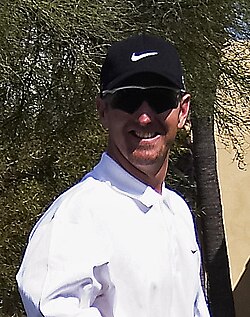
David Robert Duval (born November 9, 1971) is an American professional golfer who competed on the PGA Tour and currently plays on the PGA Tour Champions. He is a former world number one in the Official World Golf Ranking. Duval won 13 PGA Tour tournaments between 1997 and 2001, including one major championship, the 2001 Open Championship.
Key Information


Duval attended Georgia Tech, where he was a two-time ACC Player of the Year and the 1993 National Player of the Year. After playing two years on the Nike Tour, where he won twice, he received his PGA Tour card in 1995. Between 1997 and 2000, Duval finished all four seasons top-5 on the PGA Tour's money list, including being the leading money winner and scoring leader in 1998. In addition to his major title, he also won the 1997 Tour Championship and the 1999 Players Championship.
Following Duval's victory at the 2001 Open Championship, he never won again on the PGA Tour and his performance declined dramatically due to injuries and various medical conditions. As a result, he lost his tour card in 2011. After his professional golf career slowed, he became a golf analyst. He began competing on the Champions Tour in 2022.
Early life
[edit]Duval was born in Jacksonville, Florida, the son of golf instructor and club professional Bob Duval and Diane Poole Duval, a member of the FSU Flying High Circus during college.[3] His brother Brent was two years older, and sister Deirdre was five years younger.[4] During his early years, his father was club professional at Timuquana Country Club, where he learned to play golf under his father's guidance.
When David was nine, his brother Brent developed aplastic anemia. The family sought treatment at Rainbow Babies & Children's Hospital in Cleveland, Ohio, where David underwent surgery to donate bone marrow. The transplant was not successful, and Brent died as a result of sepsis on May 17, 1981 at age 12. Bob Duval was unable to cope, and moved out of the family home for a year. Counseling enabled him to reunite with his wife and children in 1982, and David continued to receive golf instruction from his father.[5] In 1993, just as Duval was starting his professional golf career, his father again moved out of the family home, this time permanently.[5]
Amateur career
[edit]He graduated from the Episcopal High School of Jacksonville in 1989, the same year he was the U.S. Junior Amateur champion. He continued his amateur career for the Georgia Tech Yellow Jackets men's golf team, where he was a four-time first-team All-American, two-time ACC Player of the Year, and 1993 National Player of the Year.[6]
While in college, Duval held a two-stroke lead after 54 holes in an official PGA Tour event, the 1992 BellSouth Classic.[7][8] He shot a final-round 79 to finish tied-13th.[9]
Professional career
[edit]Early success
[edit]After two years on the Nike Tour where he won twice, he earned his PGA Tour card in 1995. Success came quickly, as Duval posted seven second-place finishes on the PGA Tour from 1995 to 1997, qualifying for the 1996 Presidents Cup and posting a 4–0–0 record for the victorious American team. But a PGA Tour victory eluded him until he won the Michelob Championship at Kingsmill in October 1997. He won his next two tournaments, including the season-ending Tour Championship.
The following season, in 1998, Duval won four tournaments and led the PGA Tour money list. He also won the Vardon Trophy and Byron Nelson Award for lowest scoring average.
Early in 1999, he achieved the number one spot in the Official World Golf Ranking and shot a 59 in the final round of the 1999 Bob Hope Chrysler Classic on the Palmer Course at PGA West in La Quinta, California. Duval made an eagle on the final hole to win the tournament by one shot. Before 1999, only two other golfers in PGA Tour history, Al Geiberger and Chip Beck, had posted a 59 in competition and no one had ever done so in a final round.[10] Later, in the spring, he won the 1999 Players Championship. When he won the Players Championship he became the first player in history to win on the same day as his father, Bob Duval, who won a Champions Tour event that same day.[11] He also played on the victorious 1999 Ryder Cup team. He finished the season second on the money list only behind Tiger Woods.
The following season, in 2000, he won the Buick Challenge and finished in the top ten of the money list. The following year he won the 2001 Open Championship. Duval's winning speech was welcomed by British commentators as "delightfully modest and heartfelt".[12] He also won the Dunlop Phoenix Tournament, an event on the Japan Golf Tour, at the end of the year.
Struggles
[edit]After his Open Championship win, Duval entered a downward spiral in form that saw him drop to 80th on the money list in 2002 and 211th in 2003, prompting an extended break from the game. Numerous reasons have been postulated for the decline, including back, wrist and shoulder problems, personal difficulties and a form of vertigo. Duval has not won a tournament on the PGA Tour since his Open Championship victory in 2001. His last worldwide win was the Dunlop Phoenix Tournament in November 2001 on his 30th birthday. His 30s proved to be much less lucrative on the golf course.[13]
Many commentators believed Duval's career to be over but he returned to golf at the U.S. Open in 2004, where he shot 25 over par and missed the cut. Duval struggled with his best results until 2009 being a T-13 at the Deutsche Bank Championship in 2004 and a T-16 at the U.S. Open in 2006. He made the cut in only one PGA Tour event in 2005 but did finish in the top ten at the Dunlop Phoenix tournament in Japan.
Comeback attempts
[edit]Duval had a successful start to the 2006 season, making the cut in his first two tournaments, as well as a very respectable finish of T-16 at the U.S. Open at Winged Foot Golf Club, where his second round 68 was good enough for a tie as the best round of the tournament. Despite not reaching the same heights in the remaining two majors of the year, his performances continued a general upward trend, with none of the rounds of 80+ that had become so familiar in the previous years.
After a steady start to 2007 during the West Coast Swing, Duval once again disappeared from the tour. His mother died on July 17,[3] and he later revealed that his wife was going through a difficult pregnancy. This prompted the PGA Tour to amend its medical exemption policies – and Duval was granted twenty starts for the next season.
After a lackluster first half of the following year, Duval reappeared on the leaderboard of the 2008 Open Championship, rekindling memories of his major victory. He shot 73-69-83-71 for the week and finished T-39.[14]
In 2009, Duval used his final career money exemption on the PGA Tour. He made his first cut at the AT&T Pebble Beach National Pro-Am in February. However, he stormed back onto the golf scene with a T-2 finish at the U.S. Open at Bethpage Black. After going through sectional qualifying, Duval made the most of his first appearance in the U.S. Open since 2006. Going into the final round, Duval was four shots behind eventual winner Lucas Glover. Duval made a triple bogey at the par three 3rd hole, but rebounded with three straight birdies from 14 to 16. He stood on the tee of the 71st hole in a tie for the lead, but his par putt lipped out on the hole, and he finished tied for second, two shots behind Glover. It was his best finish on tour since the 2002 Memorial Tournament. After the Open, Duval jumped 740 spots in the Official World Golf Ranking from 882 to 142.[15][16]
Duval failed to earn his PGA Tour card for the 2010 season, so he had to play on sponsor's exemptions. He showed more signs of a comeback by shooting a final-round 69 to finish 2nd to defending champion Dustin Johnson at the 2010 AT&T Pebble Beach National Pro-Am. Duval had a good 2010 season and retained his tour card at the end of the year.
The 2011 season was a struggle for Duval, when he made only nine cuts in 24 events and lost his Tour card after finishing outside 150th on the tour money list. He went to Q School in an attempt to regain his tour card, but finished T72 in the final round. For 2012, Duval had past champion status. After seven unsuccessful starts, Duval made his first cut of the season at the Valero Texas Open, and finished T60. It was announced on June 13 that he would be an analyst for ESPN for the first two rounds of the U.S. Open, having failed to qualify for the 2nd major of the season.[17][18]
In December 2013, Duval announced via his Twitter that the 2014 PGA Tour season would be the last season he would ask for sponsor exemptions to get into tournament fields. Many people took this as a possible retirement announcement, but Duval clarified to say that he wants to earn his way back on the Tour rather than depending on others.[19][20] In April 2014, Duval finished tied for 25th (−8) at the Zurich Classic of New Orleans.
In 2018, U.S. captain Jim Furyk named Duval as a non-playing vice-captain for the U.S. team participating in the 2018 Ryder Cup. The U.S. team lost to Europe by 17½ points to 10½.
PGA Tour Champions
[edit]After turning 50 in 2021 and gaining eligibility, Duval began playing on the PGA Tour Champions circuit in 2022.[21]
Broadcasting
[edit]In addition to playing in tournaments, Duval has become a TV golf commentator. From 2012 through 2014, he helped commentate The Open Championship[22] and U.S. Open for ESPN.[23] In 2015, Duval joined the Golf Channel as a studio analyst.[24] Since 2020, Duval has served as the lead analyst for ESPN's coverage of the PGA Championship.[25]
Personal life
[edit]Duval split with his girlfriend Julie McArthur in early 2002 after being together for eight years.[26][27]
Duval and his wife Suzanne (née Persichitte)[28][29] met at a Denver restaurant in August 2003 while Duval was in the city for The International, a nearby PGA Tour event. They married seven months later.[29] They have two children together. She has custody of her three older children from a prior marriage. Their home is in Cherry Hills Village, Colorado, a suburb south of Denver.[4]
According to a 2004 article in the Orlando Sentinel, Duval "was one of those life-long Republicans until a couple of years ago when he re-registered and became a Democrat." This made him one of the few Democrats on the PGA Tour. He said of the invasion of Iraq: "I don't think it's always right to force our belief system on other people."[30] In a 2006 interview with Bob Verdi, Duval stated he voted for John Kerry in the 2004 presidential election. He added: "I am socially a Democrat ... But I am fiscally a Republican."[31]
Amateur wins
[edit]this list may be incomplete
Professional wins (20)
[edit]PGA Tour wins (13)
[edit]| Legend |
|---|
| Major championships (1) |
| Players Championships (1) |
| Tour Championships (1) |
| Other PGA Tour (10) |
| No. | Date | Tournament | Winning score | Margin of victory |
Runner(s)-up |
|---|---|---|---|---|---|
| 1 | Oct 12, 1997 | Michelob Championship at Kingsmill | −13 (67-66-71-67=271) | Playoff |  Grant Waite, Grant Waite,  Duffy Waldorf Duffy Waldorf
|
| 2 | Oct 19, 1997 | Walt Disney World/Oldsmobile Classic | −18 (65-70-65-70=270) | Playoff | Dan Forsman
|
| 3 | Nov 2, 1997 | The Tour Championship | −11 (66-69-70-68=273) | 1 stroke | Jim Furyk
|
| 4 | Feb 22, 1998 | Tucson Chrysler Classic | −19 (66-62-68-73=269) | 4 strokes | Justin Leonard, David Toms
|
| 5 | May 3, 1998 | Shell Houston Open | −12 (69-70-73-64=276) | 1 stroke | Jeff Maggert
|
| 6 | Aug 30, 1998 | NEC World Series of Golf | −11 (69-66-66-68=269) | 2 strokes | Phil Mickelson
|
| 7 | Oct 11, 1998 | Michelob Championship at Kingsmill (2) | −16 (65-67-68-68=268) | 3 strokes | Phil Tataurangi
|
| 8 | Jan 10, 1999 | Mercedes Championships | −26 (67-63-68-68=266) | 9 strokes | Billy Mayfair, Mark O'Meara
|
| 9 | Jan 24, 1999 | Bob Hope Chrysler Classic | −26 (70-71-64-70-59=334) | 1 stroke | Steve Pate
|
| 10 | Mar 28, 1999 | The Players Championship | −3 (69-69-74-73=285) | 2 strokes | Scott Gump
|
| 11 | Apr 4, 1999 | BellSouth Classic | −18 (66-69-68-67=270) | 2 strokes | Stewart Cink
|
| 12 | Oct 1, 2000 | Buick Challenge | −19 (68-69-67-65=269) | 2 strokes | Jeff Maggert,  Nick Price Nick Price
|
| 13 | Jul 22, 2001 | The Open Championship | −10 (69-73-65-67=274) | 3 strokes |  Niclas Fasth Niclas Fasth
|
PGA Tour playoff record (2–2)
| No. | Year | Tournament | Opponent(s) | Result |
|---|---|---|---|---|
| 1 | 1997 | Michelob Championship at Kingsmill | Grant Waite, Duffy Waldorf
|
Won with birdie on first extra hole |
| 2 | 1997 | Walt Disney World/Oldsmobile Classic | Dan Forsman
|
Won with par on first extra hole |
| 3 | 2000 | Buick Classic | Dennis Paulson
|
Lost to par on fourth extra hole |
| 4 | 2001 | Buick Challenge | Chris DiMarco
|
Lost to par on first extra hole |
Japan Golf Tour wins (1)
[edit]| No. | Date | Tournament | Winning score | Margin of victory |
Runner-up |
|---|---|---|---|---|---|
| 1 | Nov 11, 2001 | Dunlop Phoenix Tournament | −15 (65-67-68-69=269) | Playoff |  Taichi Teshima Taichi Teshima
|
Japan Golf Tour playoff record (1–0)
| No. | Year | Tournament | Opponent | Result |
|---|---|---|---|---|
| 1 | 2001 | Dunlop Phoenix Tournament | Taichi Teshima
|
Won with birdie on first extra hole |
Nike Tour wins (2)
[edit]| Legend |
|---|
| Tour Championships (1) |
| Other Nike Tour (0) |
| No. | Date | Tournament | Winning score | Margin of victory |
Runner(s)-up |
|---|---|---|---|---|---|
| 1 | Aug 22, 1993 | Nike Wichita Open | −17 (62-70-69-70=271) | 1 stroke | Jeff Lee, John Morse
|
| 2 | Oct 17, 1993 | Nike Tour Championship | −7 (69-68-72-68=277) | 1 stroke | Danny Briggs
|
Other wins (4)
[edit]| Legend |
|---|
| World Golf Championships (1) |
| Other wins (3) |
| No. | Date | Tournament | Winning score | Margin of victory |
Runners-up |
|---|---|---|---|---|---|
| 1 | Aug 25, 1998 | Fred Meyer Challenge (with Jim Furyk)
|
−18 (65-61=126) | 4 strokes |  Steve Elkington and Craig Stadler, Scott McCarron and Paul Stankowski Steve Elkington and Craig Stadler, Scott McCarron and Paul Stankowski
|
| 2 | Nov 14, 1999 | Franklin Templeton Shark Shootout (with Fred Couples)
|
−32 (61-62-61=184) | 6 strokes | Scott Hoch and Scott McCarron
|
| 3 | Dec 10, 2000 | WGC-World Cup (with Tiger Woods)
|
−34 (61-65-60-68=254) | 3 strokes |  Argentina − Ángel Cabrera and Eduardo Romero Argentina − Ángel Cabrera and Eduardo Romero
|
| 4 | Dec 11, 2016 | PNC Father-Son Challenge (with stepson Nick Karavites) |
−21 (61-62=123) | 1 stroke | Stewart Cink and son Connor Cink
|
Other playoff record (0–1)
| No. | Year | Tournament | Opponents | Result |
|---|---|---|---|---|
| 1 | 2001 | WGC-World Cup (with Tiger Woods)
|
 Denmark − Thomas Bjørn and Søren Hansen, New Zealand − Michael Campbell and David Smail, Denmark − Thomas Bjørn and Søren Hansen, New Zealand − Michael Campbell and David Smail, South Africa − Retief Goosen and Ernie Els South Africa − Retief Goosen and Ernie Els
|
South Africa won with par on second extra hole New Zealand and United States eliminated by birdie on first hole |
Major championships
[edit]Wins (1)
[edit]| Year | Championship | 54 holes | Winning score | Margin | Runner-up |
|---|---|---|---|---|---|
| 2001 | The Open Championship | Tied for lead | −10 (69-73-65-67=274) | 3 strokes | Niclas Fasth
|
Results timeline
[edit]Results not in chronological order in 2020.
| Tournament | 1990 | 1991 | 1992 | 1993 | 1994 | 1995 | 1996 | 1997 | 1998 | 1999 |
|---|---|---|---|---|---|---|---|---|---|---|
| Masters Tournament | T18 | CUT | T2 | T6 | ||||||
| U.S. Open | T56 | CUT | T28 | T67 | T48 | T7 | T7 | |||
| The Open Championship | T20 | T14 | T33 | T11 | T62 | |||||
| PGA Championship | CUT | T41 | T13 | CUT | T10 |
| Tournament | 2000 | 2001 | 2002 | 2003 | 2004 | 2005 | 2006 | 2007 | 2008 | 2009 |
|---|---|---|---|---|---|---|---|---|---|---|
| Masters Tournament | T3 | 2 | CUT | CUT | CUT | CUT | ||||
| U.S. Open | T8 | T16 | CUT | CUT | CUT | CUT | T16 | T2 | ||
| The Open Championship | T11 | 1 | T22 | CUT | CUT | T56 | T39 | CUT | ||
| PGA Championship | T10 | T34 | WD | CUT | CUT | CUT |
| Tournament | 2010 | 2011 | 2012 | 2013 | 2014 | 2015 | 2016 | 2017 | 2018 |
|---|---|---|---|---|---|---|---|---|---|
| Masters Tournament | CUT | ||||||||
| U.S. Open | T70 | ||||||||
| The Open Championship | CUT | CUT | CUT | CUT | CUT | T49 | WD | CUT | WD |
| PGA Championship |
| Tournament | 2019 | 2020 | 2021 | 2022 |
|---|---|---|---|---|
| Masters Tournament | ||||
| PGA Championship | ||||
| U.S. Open | ||||
| The Open Championship | CUT | NT | CUT |
WD = Withdrew
CUT = missed the half-way cut
"T" indicates a tie for a place
NT = No tournament due to COVID-19 pandemic
Summary
[edit]| Tournament | Wins | 2nd | 3rd | Top-5 | Top-10 | Top-25 | Events | Cuts made |
|---|---|---|---|---|---|---|---|---|
| Masters Tournament | 0 | 2 | 1 | 3 | 4 | 5 | 11 | 5 |
| PGA Championship | 0 | 0 | 0 | 0 | 2 | 3 | 11 | 5 |
| U.S. Open | 0 | 1 | 0 | 1 | 4 | 6 | 16 | 11 |
| The Open Championship | 1 | 0 | 0 | 1 | 1 | 6 | 24 | 12 |
| Totals | 1 | 3 | 1 | 5 | 11 | 20 | 62 | 33 |
- Most consecutive cuts made – 11 (1999 Masters – 2001 PGA)
- Longest streak of top-10s – 3 (1999 PGA – 2000 U.S. Open)
The Players Championship
[edit]Wins (1)
[edit]| Year | Championship | 54 holes | Winning score | Margin | Runner-up |
|---|---|---|---|---|---|
| 1999 | The Players Championship | 1 shot lead | −3 (69-69-74-73=285) | 2 strokes | Scott Gump
|
Results timeline
[edit]| Tournament | 1995 | 1996 | 1997 | 1998 | 1999 |
|---|---|---|---|---|---|
| The Players Championship | CUT | T4 | T43 | T18 | 1 |
| Tournament | 2000 | 2001 | 2002 | 2003 | 2004 | 2005 | 2006 | 2007 | 2008 | 2009 |
|---|---|---|---|---|---|---|---|---|---|---|
| The Players Championship | T13 | T28 | CUT | CUT | CUT |
| Tournament | 2010 | 2011 |
|---|---|---|
| The Players Championship | CUT |
CUT = missed the halfway cut
"T" indicates a tie for a place.
Results in World Golf Championships
[edit]| Tournament | 1999 | 2000 | 2001 | 2002 | 2003 |
|---|---|---|---|---|---|
| Match Play | R32 | 3 | R64 | R64 | |
| Championship | NT1 | T46 | |||
| Invitational | T27 | 27 | T28 |
1Cancelled due to 9/11
QF, R16, R32, R64 = Round in which player lost in match play
"T" = tied
NT = No tournament
Results in senior major championships
[edit]Results not in chronological order
| Tournament | 2022 | 2023 | 2024 | 2025 |
|---|---|---|---|---|
| The Tradition | T66 | T52 | T12 | |
| Senior PGA Championship | CUT | T21 | ||
| Senior Players Championship | T59 | T59 | T44 | T33 |
| U.S. Senior Open | CUT | |||
| Senior British Open Championship | CUT | CUT |
CUT = missed the halfway cut
"T" indicates a tie for a place
PGA Tour career summary
[edit]| Season | Wins (Majors) | Earnings ($) | Rank |
|---|---|---|---|
| 1990 | 0 | 0 | n/a |
| 1991 | – | – | – |
| 1992 | 0 | 0 | n/a |
| 1993 | 0 | $27,181 | 201 |
| 1994 | 0 | $44,006 | 195 |
| 1995 | 0 | $881,436 | 11 |
| 1996 | 0 | $977,079 | 10 |
| 1997 | 3 | $1,885,308 | 2 |
| 1998 | 4 | $2,591,031 | 1 |
| 1999 | 4 | $3,641,906 | 2 |
| 2000 | 1 | $2,462,846 | 7 |
| 2001 | 1 (1) | $2,801,760 | 8 |
| 2002 | 0 | $838,045 | 80 |
| 2003 | 0 | $84,708 | 211 |
| 2004 | 0 | $121,044 | 210 |
| 2005 | 0 | $7,630 | 260 |
| 2006 | 0 | $318,276 | 172 |
| 2007 | 0 | $71,945 | 222 |
| 2008 | 0 | $114,974 | 219 |
| 2009 | 0 | $623,824 | 130 |
| 2010 | 0 | $919,584 | 106 |
| 2011 | 0 | $400,654 | 152 |
| 2012 | 0 | $32,936 | 233 |
| 2013 | 0 | $6,210 | 251 |
| 2014 | 0 | $94,709 | 207 |
| 2015 | 0 | $36,839 | 232 |
| 2016 | 0 | 0 | n/a |
| 2017 | 0 | 0 | n/a |
| 2018 | 0 | 0 | n/a |
| Career* | 13 (1) | $18,983,931 | 81 |
* As of the 2018 season
U.S. national team appearances
[edit]See also
[edit]References
[edit]- ^ "Week 13 1999 Ending 28 Mar 1999" (pdf). OWGR. Retrieved December 20, 2018.
- ^ "Georgia Tech Athletics Hall of Fame". ramblinwreck.com. Archived from the original on October 6, 2014. Retrieved April 3, 2013.
- ^ a b "Ms. Duval". Florida Times-Union. July 20, 2007.
- ^ a b Brown, Chip (June 16, 2010). "What the Hell Happened to David Duval? And Why is He So Happy?". Men's Journal.
- ^ a b "Drive for Excellence". Florida Times-Union. March 21, 1999.
- ^ "Georgia Tech All Americans" (PDF). ramblinwreck.com. Archived from the original (PDF) on September 13, 2015. Retrieved April 3, 2013.
- ^ Kelley, Brent. "David Duval". About.com. Archived from the original on September 19, 2005. Retrieved April 2, 2013.
- ^ "Amateur Duval leads after three rounds of PGA tourney". UPI. May 9, 1992. Retrieved October 17, 2025.
- ^ "Kite captures Atlanta Classig; Blake is 2nd, wins $108,000". Deseret News. Associated Press. May 11, 1992. Retrieved October 17, 2025.
- ^ Diaz, Jamie (February 1, 1999). "59 In The Shades". Sports Illustrated. Archived from the original on December 13, 2013. Retrieved April 6, 2013.
- ^ Thomas, Bob (March 29, 1999). "Like father, like son". The Florida Times-Union. Retrieved April 6, 2013.
- ^ Williams, Richard (July 15, 2005). "Woods finds answers to all course's questions". The Guardian.
- ^ "No sign to end of David Duval's slump". Golf Today. Archived from the original on January 20, 2013. Retrieved April 3, 2013.
- ^ "Results for British Open in 2008". databasegolf.com. Retrieved April 3, 2013.
- ^ Reason, Mark (July 15, 2009). "The Open 2009: why David Duval will never quit". The Daily Telegraph. Retrieved April 4, 2013.
- ^ Wang, Gene (July 23, 2009). "Duval Revives Career at Bethpage". The Washington Post. Archived from the original on December 16, 2013. Retrieved April 4, 2013.
- ^ Seanor, Dave (June 15, 2012). "David Duval Aces TV Debut at U.S. Open". Yahoo! News. Retrieved April 7, 2013.
- ^ Bibel, Sara (June 12, 2012). "David Duval Joins ESPN's U.S. Open Coverage as Golf Analyst". TV by the Numbers. Archived from the original on June 17, 2012. Retrieved April 7, 2013.
- ^ Porter, Kyle (December 12, 2013). "David Duval says 2014 could be his last as a pro". CBS Sports. Retrieved January 10, 2014.
- ^ Harig, Bob (December 11, 2013). "Duval seeks exemptions on Twitter". ESPN. Retrieved January 10, 2014.
- ^ Bohannan, Larry (April 19, 2022). "Feeling like a rookie again, 50-year-old David Duval rededicating himself to competitive golf". Palm Springs Desert Sun.
- ^ Hall, Andy. "ESPN at The Open Championship". ESPN MediaZone.
- ^ "David Duval Aces TV Debut at U.S. Open". Yahoo! News. Archived from the original on May 7, 2013.
- ^ "David Duval – Bio". NBC Sports Group.
- ^ Schupak, Adam (July 30, 2020). "David Duval to serve as lead analyst for ESPN coverage of PGA Championship". Golfweek.
- ^ Spander, Art (July 18, 2002). "Duval the fallen champion stuck in a private torment". The Daily Telegraph.
- ^ Diaz, Jaime (March 2004). "What now for David Duval?". Golf Digest. p. 96. Archived from the original on January 11, 2014.
- ^ Hansen, Sara B. (September 6, 2025). "Former PGA No. 1 golfer David Duval's wife sells their Cherry Hills mansion for $3.4M". The Denver Post. Retrieved October 17, 2025.
- ^ a b Brown, Chip (December 4, 2017). "What the Hell Happened to David Duval?". Men's Journal. Retrieved October 17, 2025.
- ^ Bianchi, Mike (October 22, 2004). "The Vote's in, and GOP Clearly Rules on PGA Tour". Orlando Sentinel.
- ^ Verdi, Bob (June 1, 2008). "New life for David Duval". Golf Digest. Archived from the original on April 24, 2025. Retrieved October 17, 2025.
External links
[edit]- David Duval at the PGA Tour official site
- David Duval at the Japan Golf Tour official site
- David Duval at the Official World Golf Ranking official site
- David Duval at golf.about.com at the Wayback Machine (archived September 19, 2005)
David Duval in the Ryder Cup | |||||||||||||||||
|---|---|---|---|---|---|---|---|---|---|---|---|---|---|---|---|---|---|
| |||||||||||||||||

David Duval in the Presidents Cup | |||||||||||||||||||||||||
|---|---|---|---|---|---|---|---|---|---|---|---|---|---|---|---|---|---|---|---|---|---|---|---|---|---|
| |||||||||||||||||||||||||
| International | |
|---|---|
| National | |

David Duval
View on GrokipediaEarly years
Early life
David Robert Duval was born on November 9, 1971, in Jacksonville, Florida, to Bob Duval, a professional golfer and club instructor, and Diane Poole Duval, who had performed as an aerialist in the Florida State University Flying High Circus during her college years.[8][11][12] The family resided in Jacksonville, where Bob Duval served as the head golf professional at the prestigious Timuquana Country Club starting in 1974, immersing the household in the world of golf from an early age.[13] Growing up in this golf-centric environment, young David was surrounded by the sport, with his father's position providing constant access to courses and instruction that shaped his initial interest.[14][6] Duval's early years were marked by family influences, including an older brother, Brent, who shared a passion for golf but tragically died in 1981 at age 12 from complications of aplastic anemia following a bone marrow transplant donated by his nine-year-old brother David.[15][4] He also had a younger sister, Deirdre, contributing to a close-knit sibling dynamic amid the challenges of loss and his parents' separation in 1993, with the divorce finalized in 1996.[12][11] Duval began playing golf at a young age, practicing regularly at Timuquana under his father's guidance, which fostered his technical skills and dedication to the game.[14][6] Academically focused as well, he attended the Episcopal High School of Jacksonville, where he balanced rigorous studies with emerging athletic pursuits, graduating in 1989.[16][17] This foundation in Jacksonville's golf community propelled him toward higher-level competition in college.[8]Amateur career
Duval began his competitive golf journey at Episcopal High School in Jacksonville, Florida, where he finished as the state runner-up in 1989 during his senior year.[11] That same summer, he captured the U.S. Junior Amateur Championship, defeating Austin Maki by one hole at the Singing Hills course of Sycuan Resort in El Cajon, California.[18][19] At Georgia Tech from 1990 to 1993, Duval emerged as one of the top collegiate golfers in the nation, earning first-team All-American honors each of his four years—a rare feat achieved by only a few Division I players in history.[20] He was named ACC Player of the Year twice, in 1992 and 1993, and swept the major national player of the year awards in his junior season of 1993, including the Fred Haskins Award, Jack Nicklaus National Player of the Year Award, and Dave Williams Award.[21] Under his leadership, the Yellow Jackets won the 1993 ACC Championship and finished second at the NCAA Division I Championships at the Champions Golf Course in Lexington, Kentucky, where Duval placed second individually with a 9-under-par total of 279.[22][23] Among his standout amateur victories, Duval won the 1993 Western Amateur at the Sunset Hills Country Club in Northbrook, Illinois, defeating Alan Bratton 2-up in the 36-hole final after posting a 72-hole stroke-play score of 286.[24] He also represented the United States in international competitions, including the 1990 and 1992 World Amateur Team Championships and the 1991 Walker Cup.[1] Following his junior year, Duval decided to forgo his senior season at Georgia Tech and turn professional in late 1993, forgoing further amateur opportunities to pursue a PGA Tour career.[14] His amateur record highlighted exceptional consistency, with multiple top finishes in high-profile events underscoring his potential as a future elite player.[4]Professional career
Early professional years
David Duval turned professional in 1993 following a distinguished amateur career at Georgia Tech. He initially competed on the Nike Tour, the PGA Tour's developmental circuit (now known as the Korn Ferry Tour), where in his debut 1993 season he won the Nike Ozark Classic and finished 11th on the money list with $85,882 in earnings. In 1994, his second year, he won the Nike Wichita Open, played nine events, and finished 8th on the money list with $126,430 in earnings, earning exempt status on the PGA Tour for the 1995 season without needing to go through Qualifying School. Over two years on the Nike Tour, Duval secured two victories, demonstrating his potential as a precise ball-striker with a steady putting game that allowed him to capitalize on scoring opportunities.[25] His early professional style emphasized accuracy off the tee and with irons, complemented by a methodical approach to putting that involved rigorous practice drills to improve distance control and short-putt conversion rates. This foundation helped him adapt quickly to higher-level competition, as he posted multiple runner-up finishes in his initial PGA Tour outings.[10][26] Duval made his PGA Tour debut in 1995, recording seven second-place finishes over his first three seasons and qualifying for the 1996 Presidents Cup, where he went 4-0-0. His earnings progressed steadily: $881,436 in 1995 (finishing 11th on the money list, setting a rookie earnings record), $900,071 in 1996 (10th on the money list), and $1,827,833 in 1997 (second on the money list). By the end of 1997, he had climbed into the Official World Golf Ranking's top 20, ending the year at No. 12 after starting outside the top 100 in 1995. This period marked the evolution of his game toward greater reliability in approach shots and putting under pressure, setting the stage for his breakthrough victories.[10][27][2]Rise to world number one
Duval's ascent to the pinnacle of professional golf began in earnest during the 1998 season, when he secured four PGA Tour victories: the Tucson Chrysler Classic, Shell Houston Open, NEC World Series of Golf, and Michelob Championship at Kingsmill. These wins propelled him to the top of the PGA Tour money list with earnings of $2,591,031, marking a significant breakthrough after years of consistent but victory-less performances. Additionally, Duval recorded his first top-10 finish in a major championship, tying for second at the PGA Championship held at Sahalee Country Club.[1][28][3] The 1999 season solidified Duval's dominance, as he opened with eight consecutive top-10 finishes, a streak that underscored his consistency and precision. Key victories included the Mercedes Championships, a nine-shot win at the Bob Hope Chrysler Classic, where he closed with a historic final-round 59—the second such score in PGA Tour history—and triumphs at The Players Championship and the BellSouth Classic. These performances, particularly his two-shot victory at The Players over a challenging field at TPC Sawgrass, elevated his profile and showcased his ball-striking prowess. Following the Players Championship in March, Duval ascended to the World No. 1 ranking in the Official World Golf Ranking, a position he held for 15 weeks amid intense competition from Tiger Woods.[5][29][30][31] In 2000, Duval maintained his elite form with a win at the Buick Challenge and a strong runner-up finish at The Open Championship at St. Andrews, where he trailed Tiger Woods by eight strokes but demonstrated resilience in windy conditions. Statistically, Duval led the PGA Tour in scoring average during 1998 with a mark of 69.13, earning the Vardon Trophy, and topped charts in greens in regulation and putting average that year, reflecting his technical mastery. He repeated as scoring average leader in 1999 before Tiger Woods surpassed him, and reclaimed the honor in 2001 with 69.42. During this period, Duval's marketability grew, leading to major endorsement deals, including a long-term partnership with Titleist for equipment and a high-profile switch to Nike apparel and balls starting in late 2000, which included a multiyear contract reportedly worth tens of millions.[1][32][3][33][34]Major championship victory
David Duval entered the 2001 Open Championship in strong form, having finished tied for second at the Masters Tournament earlier that year, two strokes behind winner Tiger Woods. He followed that with a tied for 14th at the U.S. Open at Southern Hills, demonstrating consistency in majors despite not securing a victory. Building on prior near-misses in majors, Duval arrived at Royal Lytham & St Annes confident in his game, particularly suited to the links-style course.[7][35][36] The tournament unfolded with Duval posting rounds of 69, 73, 65, and 67 to finish at 10-under-par 274, securing a three-stroke victory over Sweden's Niclas Fasth. His third-round 65 propelled him into contention, and in the final round, he navigated windy conditions with composure on the challenging back nine, birdieing four of the first 11 holes before parring the last seven to close with a 67. A pivotal moment came on the 15th hole, where he struck a precise 6-iron from 210 yards to 15 feet for birdie, helping maintain his lead after a bogey on the 12th. Duval's ability to handle the gusty winds and firm greens showcased his links proficiency, marking his sole major triumph on his seventh Open appearance.[37][7] In historical context, Duval became the first American to win the Open since Tiger Woods in 2000, ending a brief non-U.S. streak in the event. Notably, he was the first golfer to claim a major using an all-Nike set of clubs and apparel, including his distinctive all-black outfit, which drew attention for its bold departure from traditional tournament attire. The victory earned him £600,000 in prize money, boosting his career earnings past $20 million on the PGA Tour. It elevated his Official World Golf Ranking to No. 3 by year's end, reaffirming his status among the elite.[37][38][39] Emotionally, the win held deep significance for Duval, who described it as fulfilling a childhood dream amid the event's rich history, which he found humbling. Coming over a decade after the tragic death of his younger brother Brent from aplastic anemia in 1989—a loss that profoundly shaped his introspective personality—the Claret Jug represented a pinnacle of resilience and dedication. Duval later reflected on the accomplishment as one of pure satisfaction rather than relief, savoring the announcement of his name as "the champion golfer of the year."[7][4]Period of struggles
Following his 2001 Open Championship victory, David Duval entered a prolonged slump marked by persistent injuries, including a sprained fifth lumbar vertebra in his back from 2000 that caused ongoing sacroiliac joint pain, a broken wrist, and tendinitis and bursitis in both shoulders.[11][10] These ailments forced compensatory changes to his swing posture, such as altering his spine angle over the ball, which eroded his confidence and led to inconsistent performance.[40] In 2002, Duval missed the cut in all four major championships and finished 80th on the PGA Tour money list, a sharp decline from his prior dominance.[10] He secured no further PGA Tour victories after 2001, and over the subsequent years through 2010, he missed 156 cuts and withdrew from 11 events in 236 Tour starts.[10] From 2003 to 2005, Duval's status on the PGA Tour deteriorated further, as he finished 212th on the money list in 2003 and 210th in 2004, playing only nine events in the latter year while earning just $7,630 across 20 starts in 2005.[41] His world ranking plummeted outside the top 400 by mid-2004, reflecting the depth of his struggles.[42] Personal challenges compounded the professional setbacks, including a split from his longtime girlfriend in 2002, prompting multiple hiatuses from competition; he took a seven-month break in 2004 alone.[43] His marriage in late 2004 provided some emotional support amid these difficulties.[10] In efforts to recover, Duval experimented with swing coaches, including a collaboration with Puggy Blackmon starting around 2007 to rebuild his pre-injury mechanics, and made equipment adjustments, such as parting ways with his longtime Nike sponsor in 2010 after a decade-long partnership that began in 2001.[44][45] Despite these changes, the downward spiral continued, with Duval falling outside the top 1,000 in the world rankings by 2009, reaching as low as 882nd.[46] The period's lowest points came in 2009, when Duval earned conditional PGA Tour status by finishing 131st on the money list and failed to regain full exemption at Q-School, where he struggled through the grueling stages despite his pedigree as a former world No. 1.[47] This phase exacted a heavy emotional toll, as the cycle of injuries, poor results, and eroding self-belief left him in a state of persistent frustration and isolation from his former elite form.[48]Comeback efforts
Following a successful qualification through the PGA Tour Qualifying Tournament in late 2010, where he tied for second at the first stage, David Duval regained conditional status for the 2011 season and mounted a notable comeback effort, playing in 25 events and earning $400,654 to finish 152nd on the money list.[49] His standout performance came at the Northern Trust Open, where he fired a final-round 67 to finish tied for ninth at 6-under par, marking one of his best results in years and sparking discussions about a potential resurgence.[50] In 2012 and 2013, Duval relied heavily on sponsor exemptions and past champion status to secure starts, playing 17 events in 2012 for $32,936 in earnings and just eight in 2013 for $6,210, as he battled to maintain momentum amid limited opportunities. Media coverage highlighted his determination, with Duval himself expressing confidence in a 2012 interview that he could still claim a PGA Tour victory if given consistent play. However, inconsistent results persisted, with no top-10 finishes during this period, though his participation in majors like The Open Championship kept his name in the spotlight for a possible revival.[27][4] From 2014 to 2016, Duval's efforts were hampered by recurring injuries, including elbow pain that flared during the 2014 AT&T Byron Nelson, where he still managed to contend early before fading. He played 15 events in 2014, including a tied for 25th at the [Zurich Classic of New Orleans](/page/Zurich_Classic_of_New Orleans), but his schedule dwindled to five starts in 2015 and two in 2016, both resulting in missed cuts, marking his final regular PGA Tour appearance that year. Chronic issues from a history of at least 12 injuries—spanning his back, neck, and wrist—continued to limit his physical preparation and consistency.[51][52][4] A key moment in 2017 came at The Open Championship at Royal Birkdale, where Duval, qualifying via his lifetime past champion exemption, shot rounds of 79 and 72 to miss the cut by seven strokes, underscoring the challenges of his return. Despite the result, he noted in reflections around that time the emotional pull of family events like the 2016 PNC Father/Son Challenge win with stepson Nick Karavites, which reignited his competitive spirit amid partial comebacks.[3] Over the 2011–2019 period, Duval recorded no PGA Tour victories but achieved select top-10 finishes, such as his 2011 T9, while making 82 starts overall with earnings totaling approximately $541,000. These efforts gradually transitioned into a growing focus on broadcasting, beginning with Golf Channel in 2013, as injuries and family priorities in Denver, Colorado, shifted his professional emphasis away from full-time competition. In interviews, Duval reflected on these years as a mix of resilience and realism, acknowledging the toll of injuries while appreciating sporadic highlights that kept golf central to his life.[27][4]Transition to senior golf
David Duval turned 50 on November 9, 2021, gaining automatic eligibility for the PGA Tour Champions through his lifetime exemption as a past major champion from the 2001 Open Championship.[53] This structural shift allowed him to transition from sporadic PGA Tour appearances and broadcasting commitments to a more consistent competitive schedule on the senior circuit. Duval made his PGA Tour Champions debut at the 2022 Mitsubishi Electric Championship at Hualalai, finishing tied for 34th after posting rounds of 74-71-71 for a 2-over total.[54] Throughout his rookie season, he competed in over 20 events, achieving five top-20 finishes while adapting his swing to the shorter tees and slower course conditions typical of senior golf. This adjustment helped him regain competitive rhythm, with representative strong showings including a tie for 18th at the Rapiscan Systems Classic and a tie for 13th at the Sanford International, demonstrating improved consistency compared to his irregular play in prior years. In his inaugural year, Duval earned approximately $200,000.[55] The transition was not without challenges, as Duval worked to overcome rust from limited tournament exposure—having played just one full PGA Tour schedule since 2014—and ongoing back management to avoid flare-ups.[54] These hurdles echoed his later PGA Tour struggles but were mitigated by the senior tour's reduced physical demands, enabling smarter course management and fewer high-stress shots off the tee. Since 2022, Duval has shown steady improvement on the PGA Tour Champions, with continued top-20 finishes in 2023 and 2024, and four top-10 finishes in 23 starts during the 2025 season as of November 2025, earning over $462,000 that year and laying a foundation for future contention and potential victories as he refines his game.[56][8][9]Broadcasting career
Initial forays into media
Duval began his broadcasting career in 2012, serving as a television analyst for ESPN's coverage of the U.S. Open at the Olympic Club in San Francisco, marking his debut in the booth.[57] This freelance role with ESPN allowed him to draw on his experience as a former world No. 1 to offer commentary from a player's perspective, emphasizing insights into mental approaches and strategic decisions on the course.[58] His entry into media coincided with a reduced playing schedule, as ongoing injuries— including bone bruises and other ailments—had limited his competitive appearances to just two cuts made in 13 PGA Tour starts that year.[59] In 2013 and 2014, Duval continued with occasional ESPN assignments, including analysis for The Open Championship at Muirfield and Royal Liverpool.[60][61] He also provided coverage of the 2014 BMW Championship in Denver for Golf Channel.[62] To prepare for these roles, he invested significant time in studying prior broadcasts and conducting extensive homework on players and courses, contrasting the demands with the more solitary nature of competitive golf.[58] However, balancing these commitments proved challenging, as he navigated lingering health issues and sporadic tournament play while adapting to the rigorous preparation required for on-air analysis.[58] Duval's early efforts received positive feedback for their thoughtful and candid nature, with executives noting his unique ability to provide introspective analysis rooted in firsthand major championship experience.[58] This reception helped solidify his transition into media as a viable path amid his evolving professional landscape.[63]Roles with major networks
In 2015, David Duval joined Golf Channel as a studio and on-course analyst, contributing to coverage of major championships, The Players Championship, World Golf Championships, international match-play events, and other select PGA Tour tournaments.[64] His role emphasized providing insights drawn from his experience as a former world No. 1, focusing on analytical breakdowns of players' swings and the mental aspects of competition.[65] Duval's style has been noted for its candor, including pointed critiques of the LIV Golf series, such as his 2022 call for Phil Mickelson to address controversies surrounding the tour more directly.[66] Duval expanded his broadcasting portfolio in 2020 by serving as ESPN's lead analyst for the PGA Championship, working from the 18th-hole tower alongside host Scott Van Pelt to offer in-depth analysis during early rounds.[67] This role continued through 2024, establishing him as a key voice for ESPN's major championship coverage, where he provides expert commentary on strategic decisions and course management.[68] He missed the 2025 PGA Championship due to a scheduling conflict with a PGA Tour Champions event.[69] Notable assignments during this period include contributing to Golf Channel's coverage of The Players Championship, as well as heated on-air discussions, such as a 2016 exchange with Brandel Chamblee on U.S. Ryder Cup leadership dynamics.[70] In the 2020s, Duval's broadcasting commitments have evolved to accommodate his return to competitive play on the PGA Tour Champions, starting in 2022, resulting in fewer on-course assignments and a greater emphasis on studio work and remote contributions.[71] As of November 2025, he remains an analyst for Golf Channel and NBC.[72] He has supplemented his network roles with podcast appearances, including discussions on his career highlights and the modern professional game on shows like No Laying Up and The Mike Tirico Podcast.[73] While Duval has not received major broadcasting awards, he is respected among peers for his knowledgeable and straightforward approach to golf analysis.[74]Personal life
Family and marriage
David Duval's family life has been marked by significant personal challenges and joys, particularly influenced by the loss of his older brother, Brent, who died at age 12 in 1981 from complications of aplastic anemia after an unsuccessful bone marrow transplant from the then-9-year-old Duval.[11] This tragedy deeply affected Duval, leading him to withdraw emotionally and channel his energy into golf as a form of coping and motivation, while also contributing to his parents' eventual divorce.[15] He has a younger sister, Deirdre, born five years after him, though she has not pursued a professional golf career.[11] Prior to his current marriage, Duval was in a long-term relationship with Julie McArthur that lasted eight years and ended in 2002, during a period of professional and personal transition; the couple had no children.[75] He met interior designer Susan "Susie" Persichitte at a Denver restaurant in August 2003 while competing in a nearby PGA Tour event, and they married in 2004 after a brief courtship.[30] Persichitte brought three children from her previous marriage into the family—stepchildren Dean, Nick, and Brooke Karavites—forming a blended household that Duval has described as a source of stability during his career downturns in the mid-2000s.[76] Together, Duval and Persichitte have two biological children: son Brayden "Brady" (born 2005) and daughter Sienna (born around 2007).[4] Throughout Duval's struggles with injuries and form in the 2000s, his family provided crucial emotional support, with Persichitte playing a pivotal role in his personal recovery and maintaining a positive home environment amid his professional uncertainties.[10] The couple's five children have shown interest in golf, reflecting the sport's central place in Duval's life; stepson Nick Karavites competed alongside him in events like the 2016 PNC Father/Son Challenge, where they won, and son Brady has pursued the game at a competitive level, signing to play college golf at Coastal Carolina University in 2023.[77][78]Health challenges and residences
David Duval has faced a series of chronic health challenges throughout his career and post-retirement life, beginning with significant injuries in the early 2000s. In 2000, he suffered a sprained lower back ligament that sidelined him for 10 weeks, marking the onset of persistent back pain related to sacroiliac joint issues, which later required disc replacements.[48][79][10] This back condition evolved into chronic pain starting around 2001, exacerbated by his intensive fitness regimen. In early 2001, Duval experienced a right wrist injury that developed into tendinitis, forcing him to withdraw from events like The Players Championship and requiring ongoing medical consultation for therapy options.[80][81] Shoulder problems also plagued him during the 2000s, including bursitis in both shoulders and a right shoulder strain in 2002 that prompted an MRI examination, alongside a 2002 snowboarding accident that aggravated the area.[10][82][83] Additionally, in March 2003, Duval was diagnosed with positional vertigo, an inner-ear disorder causing severe dizziness with head movements, which affected his balance and persisted for several months.[83] Over the years, these issues compounded with other injuries, including broken fingers, torn calves, and a broken toe.[10] Duval has also openly discussed mental health struggles amid his career slumps, attributing some difficulties to the psychological toll of injuries and performance declines. He sought professional support from clinical psychiatrist Michael Lardon, who specializes in working with professional golfers to address anxiety, depression, and related challenges during periods of underachievement.[84] These efforts included therapy to cope with personal and emotional hardships, which Duval has described as contributing to "awful days" where the game lost its meaning.[11] Born and raised in Jacksonville, Florida, Duval maintains strong ties to the area, where he learned golf at Timuquana Country Club and considers it his roots. In the mid-2000s, he and his wife Susan relocated to the Denver area, purchasing a mansion in Cherry Hills Village for $12.4 million in 2005. The property faced foreclosure in 2013, leading to its sale for $3.1 million, but the family later reacquired a residence in the same community during the 2010s. In August 2025, Susan Duval sold their Cherry Hills Village home for $3.4 million, after which the family established a base back in Florida.[85][86][87][88][89][90] To manage his ongoing physical challenges, particularly as he transitioned to the PGA Tour Champions in his 50s, Duval incorporated regular physical therapy and targeted exercises focused on core strength, mobility, and back rehabilitation. Family support has played a key role in his recovery, with his wife and children providing encouragement during therapy sessions and lifestyle adjustments. He has also engaged in philanthropy, directing Ryder Cup earnings to charitable causes and participating in events benefiting veterans and youth development, though no formal Duval family foundation exists. As of late 2025, Duval has reported no major new health issues beyond minor undisclosed injuries, allowing him to focus on senior tour play and broadcasting.[91][53][92][93][94]Tournament victories
Amateur wins
Duval's amateur career began prominently with his victory in the 1989 U.S. Junior Amateur Championship at Singing Hills Golf and Country Club in El Cajon, California, where he defeated Austin Maki 1-up in the 36-hole final to claim the title as a 17-year-old from Jacksonville, Florida.[95] He also won the 1989 AJGA Rolex Tournament of Champions at PGA National Resort & Spa in Ponte Vedra Beach, Florida, with rounds of 71-71-71-73 for 286 (−2).[96] This win marked him as one of the top junior talents in the country and earned him a spot on the radar of college programs.[53] At Georgia Tech from 1990 to 1993, Duval emerged as a dominant force in collegiate golf, securing seven individual tournament victories while contributing to team successes, including a second-place finish at the 1993 NCAA Championships where he placed second individually.[97] His college wins included the 1991 ACC Championship at Pine Lakes Country Club in North Carolina, where he shot 279-286 for a total of 565 and a one-stroke victory over teammate Tim Pearce. In 1993, he repeated as ACC Champion at Salem Hills Golf Club, firing a course-record 67 in the final round for 206 (−10) and a three-stroke edge over the field. Other notable collegiate triumphs came at the 1991 Furman Intercollegiate (138, -6), the 1992 John Hancock Sun Bowl All-American (206, -10), and the 1993 UNLV/Desert Inn Rebel Classic (208, -8, won in playoff).[97] Beyond college events, Duval excelled in prestigious invitationals, winning the 1992 Northeast Amateur at Wannamoisett Country Club in Rumford, Rhode Island, with a four-round total of 285 (−3 on a par-72 layout), edging out Trip Murphy by two strokes. Later that summer, he captured the Porter Cup at Niagara Falls Country Club in Lewiston, New York, defeating a strong field that included future pros, further boosting his profile ahead of turning professional in 1993. These victories, totaling around 11 including his junior titles, underscored Duval's precision and competitive edge, earning him four First-Team All-America honors and the 1993 National Player of the Year award.[98][97]PGA Tour wins
David Duval secured 13 victories on the PGA Tour between 1997 and 2001, establishing him as one of the dominant players of the late 1990s. His breakthrough came late in the 1997 season with three consecutive wins, marking the start of a prolific stretch that included leading the Tour in earnings during 1998.[5] The following table lists his PGA Tour wins chronologically, excluding his 2001 Open Championship victory (detailed in the Major championships section), with details on dates, venues, winning scores, margins of victory, and notable runners-up.[18]| Year | Tournament | Date | Venue | Winning Score | Margin | Notable Runners-Up |
|---|---|---|---|---|---|---|
| 1997 | Michelob Championship at Kingsmill | Oct 9–12 | Kingsmill Resort (River Course), Williamsburg, VA | 271 (−13) | Playoff | Grant Waite, Duffy Waldorf |
| 1997 | Walt Disney World/Oldsmobile Classic | Oct 16–19 | Walt Disney World Resort (Magnolia Course), Lake Buena Vista, FL | 270 (−18) | Playoff | Dan Forsman |
| 1997 | Tour Championship | Oct 30–Nov 2 | Champions Golf Club (Cypress Creek Course), Houston, TX | 273 (−11) | 1 stroke | Jim Furyk |
| 1998 | Tucson Chrysler Classic | Feb 19–22 | Tucson National Resort (Catalina Course), Tucson, AZ | 269 (−19) | 4 strokes | Justin Leonard, David Toms |
| 1998 | Shell Houston Open | Apr 30–May 3 | The Woodlands Country Club (Tournament Course), The Woodlands, TX | 276 (−12) | 1 stroke | Jeff Maggert |
| 1998 | NEC World Series of Golf | Aug 27–30 | Firestone Country Club (South Course), Akron, OH | 269 (−11) | 2 strokes | Phil Mickelson |
| 1998 | Michelob Championship at Kingsmill | Oct 8–11 | Kingsmill Resort (River Course), Williamsburg, VA | 268 (−16) | 3 strokes | Phil Tataurangi |
| 1999 | Mercedes Championships | Jan 7–10 | Kapalua Resort (Plantation Course), Lahaina, HI | 266 (−26) | 9 strokes | Billy Mayfair, Mark O'Meara |
| 1999 | Bob Hope Chrysler Classic | Jan 20–24 | PGA West (Palmer Course), La Quinta, CA | 334 (−26) | 1 stroke | Steve Pate |
| 1999 | The Players Championship | Mar 25–28 | TPC Sawgrass (Stadium Course), Ponte Vedra Beach, FL | 285 (−3) | 2 strokes | Scott Gump |
| 1999 | BellSouth Classic | Apr 1–4 | TPC Sugarloaf, Duluth, GA | 270 (−18) | 2 strokes | Stewart Cink |
| 2000 | Buick Challenge | Sep 28–Oct 1 | Callaway Gardens Resort (Mountain View Course), Pine Mountain, GA | 269 (−19) | 2 strokes | Jeff Maggert, Nick Price |
Other professional wins
Duval secured his first professional victory at the 1993 Nike Wichita Open, held at Reflection Ridge Golf Club in Wichita, Kansas, where he shot a course-record 62 in the opening round en route to a 17-under-par total of 271, winning by one stroke over Jeff Lee and Olin Browne. This triumph, at age 21 just months after turning pro, marked a strong debut on the developmental circuit and boosted his confidence early in his career.[99] Later that season, Duval claimed his second Nike Tour title at the 1993 Nike Tour Championship at Pumpkin Ridge Golf Club in North Plains, Oregon, finishing at 7-under-par 277 to edge out John Harris by one stroke. These back-to-back victories highlighted his ball-striking prowess and consistency, helping him accumulate enough points and earnings to secure a spot on the PGA Tour upon finishing eighth on the 1994 Nike Tour money list with $126,430, granting full exempt status for the 1995 season.[100] On the international stage, Duval achieved his sole Japan Golf Tour win at the 2001 Dunlop Phoenix Tournament at Phoenix Country Club in Miyazaki, defeating Taichi Teshima in a playoff with a birdie on the par-5 18th hole after both finished regulation at 15-under-par 269. This victory, claimed on his 30th birthday, served as his final professional title and underscored his global appeal amid a challenging period marked by injuries, earning him ¥40,000,000 and reinforcing his status as a top-tier competitor beyond U.S. borders.[101] In team competition, Duval partnered with Tiger Woods to win the 2000 WGC-World Cup of Golf at Buenos Aires Golf Club in Argentina, where the American duo posted a tournament-record 254 (34-under-par), including rounds of 61 and 60, to claim victory by three strokes over Zimbabwe. This success not only highlighted Duval's precision in alternate-shot and foursomes formats but also symbolized the era's U.S. dominance in international events, with the pair's combined 27 birdies and five eagles contributing to a $1,000,000 prize for the team.[102]Major championships
2001 Open Championship
The 2001 Open Championship took place at Royal Lytham & St Annes Golf Club in England from July 19 to 22, marking the 130th edition of the tournament. David Duval, then the world number one, entered the event after a strong season that included runner-up finishes at the Masters and U.S. Open. In the opening round, Scotland's Colin Montgomerie set the pace with a 6-under-par 65, leading by four strokes, while Duval posted a 2-under 69 to sit tied for 12th.[37][103][104] Montgomerie extended his lead to seven shots after the second round with a 70, totaling 135 (-7), as Duval struggled to a 2-over 73, finishing the halfway point at even par 142. The third round saw Duval mount a stunning comeback with a flawless 65, tying Bernhard Langer, Ian Woosnam, and Alex Čejka for the lead at 207 (6-under par). This performance vaulted him from seven shots back into contention, setting the stage for a dramatic Sunday.[37][103][104] In the final round, Duval carded a 3-under 67, birdieing all three par-5 holes and recovering from a bogey on the 12th with a birdie on the 13th and a brilliant bunker shot to 3 feet on the 11th. He finished at 10-under-par 274, three strokes ahead of Sweden's Niclas Fasth (277). A pivotal moment came on the 18th hole, where Duval drove into the fairway and struck a majestic 5-iron from 210 yards to 15 feet, setting up a par that sealed the victory. His 132 over the final 36 holes established a new course record at Royal Lytham.[37][105][106] Duval's win earned him $858,300 from the $4.72 million purse, the largest first prize in Open history at the time. As the only major title of his career, it highlighted his place among the era's elite, often referred to alongside Tiger Woods, Phil Mickelson, and Ernie Els in the "Big Four" that dominated professional golf in the late 1990s and early 2000s.[106][107][108]Results timeline
David Duval competed in the major championships from 1995 through 2025, achieving 13 top-10 finishes across his career, including his sole major victory at the 2001 Open Championship. His best results came during his peak form between 1998 and 2001, highlighted by a runner-up finish at the 1998 Masters Tournament and a second-place showing at the 2009 U.S. Open. Post-2003, his participation declined due to health issues and a shift to the PGA Tour Champions, with most appearances limited to the Open Championship via past champion exemption; he missed the cut in all but one of those later starts (T49 in 2015), entered but withdrew from the 2025 Open Championship, and has limited further involvement as of November 2025.[109]| Year | Masters Tournament | U.S. Open | The Open Championship | PGA Championship | Most Successful Major |
|---|---|---|---|---|---|
| 1995 | DNP | T28 | T20 | CUT | The Open Championship (T20) |
| 1996 | T18 | T67 | T14 | T41 | The Open Championship (T14) |
| 1997 | CUT | T48 | T33 | T13 | PGA Championship (T13) |
| 1998 | T2 | T7 | T11 | CUT | Masters Tournament (T2) |
| 1999 | T6 | T7 | T62 | T10 | U.S. Open (T7) |
| 2000 | T3 | T8 | T11 | DNP | Masters Tournament (T3) |
| 2001 | 2 | T16 | 1 | T10 | The Open Championship (1) |
| 2002 | CUT | CUT | T22 | T34 | The Open Championship (T22) |
| 2003 | CUT | CUT | CUT | WD | DNP |
| 2004 | DNP | CUT | DNP | CUT | DNP |
| 2005 | CUT | CUT | CUT | CUT | DNP |
| 2006 | CUT | T16 | T56 | CUT | U.S. Open (T16) |
| 2007 | DNP | DNP | DNP | DNP | DNP |
| 2008 | DNP | DNP | T39 | DNP | The Open Championship (T39) |
| 2009 | DNP | T2 | CUT | DNP | U.S. Open (T2) |
| 2010 | CUT | T70 | CUT | DNP | DNP |
| 2011 | DNP | DNP | CUT | DNP | DNP |
| 2012 | DNP | DNP | CUT | DNP | DNP |
| 2013 | DNP | DNP | CUT | DNP | DNP |
| 2014 | DNP | DNP | CUT | DNP | DNP |
| 2015 | DNP | DNP | T49 | DNP | The Open Championship (T49) |
| 2016 | DNP | DNP | WD | DNP | DNP |
| 2017 | DNP | DNP | CUT | DNP | DNP |
| 2018 | DNP | DNP | WD | DNP | DNP |
| 2019 | DNP | DNP | CUT | DNP | DNP |
| 2020 | DNP | DNP | DNP | DNP | DNP |
| 2021 | DNP | DNP | WD | DNP | DNP |
| 2022 | DNP | DNP | CUT | DNP | DNP |
| 2023 | DNP | DNP | DNP | DNP | DNP |
| 2024 | DNP | DNP | DNP | DNP | DNP |
| 2025 | DNP | DNP | WD | DNP | The Open Championship (WD) |
Performance summary
David Duval made over 50 appearances in major championships across his professional career, recording 5 top-5 finishes and 15 top-10 results.[111] His performance varied significantly by tournament, with his strongest showings at The Open Championship, where he secured 1 victory in 2001 with no other top-10 finishes.[111] In contrast, he achieved no top-5 results at the PGA Championship, though he posted 2 top-10s there in 1999 and 2001. At the Masters Tournament, Duval had 3 top-5 finishes (including runner-up in 1998 and 2001) but no victory, while his U.S. Open results included a runner-up in 2009 and 3 other top-10s.[111] Duval reached the peak of his career in 1999, ascending to world No. 1 following strong major performances earlier that year, including a T6 at the Masters and T7 at the U.S. Open; he held the top ranking for 15 weeks total before a T62 at The Open led to his decline in the standings.[2] His cut-making percentage in majors was robust during his prime (over 90% from 1998-2001), but it declined sharply post-2001 amid injuries and form struggles, dropping below 50% in later years as he missed more cuts.[10] Among the elite players of the late 1990s and early 2000s era dominated by Tiger Woods, Duval stands out as one of the top talents with just a single major title, despite his world No. 1 status and 13 PGA Tour victories, often compared to contemporaries like Phil Mickelson who amassed multiple majors.[112]Key non-major tournaments
The Players Championship
David Duval's standout performance at The Players Championship occurred in 1999, when he claimed victory at the Stadium Course at TPC Sawgrass in Ponte Vedra Beach, Florida.[29] The tournament, widely regarded as golf's "fifth major" for its elite field and $5 million purse, was marked by gusty winds that tested players' patience and precision.[113] Duval carded rounds of 69-69-74-73 for a 3-under-par total of 285—the highest winning score in Stadium Course history at the time—and prevailed by two strokes over Scott Gump.[114][115] This triumph marked Duval's 10th PGA Tour win in a dominant 33-start stretch and propelled him to the No. 1 spot in the Official World Golf Ranking for the first time.[113] As a Jacksonville native raised near the venue, Duval benefited from local course knowledge, making the win a poignant hometown achievement.[29][10] Duval first contended at the event in 1996 as a second-year PGA Tour member still seeking his initial victory.[29] He appeared annually from 1996 through 2003 but struggled thereafter, posting missed cuts and no top-10 finishes after 2001 amid a broader career downturn influenced by injuries and personal challenges.[113][53]World Golf Championships results
David Duval participated in several World Golf Championships (WGC) events during the early years of the series, earning eligibility primarily through his high ranking in the Official World Golf Ranking (OWGR), where he held the No. 1 position for 15 weeks in 1999–2000.[116] The WGC format in this era limited individual starts to top-ranked players and featured a mix of stroke-play and match-play competitions, resulting in Duval making only select appearances before injuries curtailed his schedule. He never won a WGC title but showed strong contention in match play early on, particularly in stroke-play events prior to his back issues in 2000.[117] Duval's best performance came in the 2000 WGC-Accenture Match Play Championship, where he advanced to the semifinals before losing to eventual winner Darren Clarke, then secured third place with a 5-and-4 victory over Davis Love III in the consolation match.[117] In other events, he often missed the cut or finished mid-pack, reflecting the elite fields and his emerging injury concerns; for instance, he withdrew from the 2000 WGC-NEC Invitational due to a back injury that also forced him out of the PGA Championship earlier that month.[118] His WGC participation tapered off after 2001 as form and health declined, with no starts in the series after 2003.| Year | Event | Finish |
|---|---|---|
| 1999 | WGC-NEC Invitational | T27[119] |
| 1999 | WGC-Accenture Match Play Championship | R16 (T17)[120] |
| 2000 | WGC-Accenture Match Play Championship | 3rd[117] |
| 2000 | WGC-NEC Invitational | DNP (injury)[118] |
| 2000 | WGC-American Express Championship | MC[118] |
| 2001 | WGC-Accenture Match Play Championship | R16 (T17)[120] |
| 2001 | WGC-NEC Invitational | 27th[121] |
| 2002 | WGC-Accenture Match Play Championship | R64 (T33)[120] |
| 2002 | WGC-NEC Invitational | T34[122] |
| 2002 | WGC-American Express Championship | T46[122] |
| 2003 | WGC-Accenture Match Play Championship | R64 (T33)[120] |
Senior career highlights
PGA Tour Champions debut
David Duval gained eligibility for the PGA Tour Champions through his 2001 Open Championship victory, which provides lifetime membership to the senior circuit for major winners. [53] He turned 50 on November 9, 2021, marking the milestone for senior eligibility, and made his debut at the season-opening Mitsubishi Electric Championship at Hualalai in January 2022, finishing tied for 34th at even par. [123] In his rookie season, Duval competed in 15 events, recording five top-20 finishes and earning $238,000 on the money list. [8] He did not secure a victory but focused on building consistency after years of limited competitive play, with his best result a tie for 34th in his debut event. Duval noted the transition involved shaking off rust and reestablishing routines, stating, "It's just getting the rust off more than anything, figuring out the routines of it again." [54] The shorter courses on the PGA Tour Champions allowed Duval to renew his enjoyment of the game, emphasizing a patient approach to regaining competitive form after managing injuries and sporadic appearances on the regular PGA Tour. [53] Despite the challenges, he committed to a full schedule, viewing the senior tour as an opportunity to extend his professional career on a more forgiving layout.Senior major championships
David Duval has participated in the senior major championships on the PGA Tour Champions since his debut in 2022, but has yet to secure a victory in these events. His strongest performance to date is a tie for tenth place at the 2023 U.S. Senior Open. In the Senior PGA Championship, Duval tied for 25th in 2022 before missing the cut in the 2023 and 2024 editions, and finished tied for 21st with a score of even par in 2025.[124] Duval's results in the U.S. Senior Open include the T10 in 2023 and a tie for 18th in 2024. He has not yet competed in the Senior Open Championship.[8] At the Senior Players Championship, Duval achieved a tie for 33rd in 2024.Recent performances (2020s)
In 2023, Duval recorded top-10 finishes on the PGA Tour Champions, including a T18 result at the Sanford International, while earning $372,263 in official prize money.[8] The following year, he demonstrated greater consistency by making most cuts, highlighted by a T5 finish at the American Family Insurance Championship.[8] Duval's 2025 campaign marked a personal high point, as he competed in 23 events and secured four top-10 results, exemplified by a T8 at the Constellation Furyk & Friends and a T7 at the Boeing Classic, with total earnings reaching $462,523 as of November 17, 2025.[8][109] Although he has yet to claim a victory on the senior circuit, Duval posted a T8 at the October 2025 Constellation Furyk & Friends event, held at Timuquana Country Club—his boyhood home course in Jacksonville, Florida. Contributing to this resurgence, Duval has refined his putting stroke and better managed ongoing back challenges to sustain competitive play.[8]Team competitions
Ryder Cup appearances
David Duval represented the United States in two Ryder Cups: the 1999 event at the Country Club of Brookline in Chestnut Hill, Massachusetts, and the 2002 event at The Belfry in Sutton Coldfield, England (postponed from 2001 due to the September 11 attacks).[125][126] In 1999, as the world number one, he earned his spot through the PGA Tour points qualification system, becoming the only rookie on a veteran-laden U.S. squad captained by Ben Crenshaw.[127] His overall Ryder Cup record across seven matches was 2 wins, 3 losses, and 2 halves, for 3 points; participation was limited after 2002 due to his sharp decline in form.[120] In 1999, over four matches, Duval compiled a record of 1 win, 2 losses, and 1 halve, contributing 1.5 points toward the U.S. team's dramatic 14.5–13.5 victory—the largest comeback in Ryder Cup history after trailing by four points entering the final day.[128] His partnerships highlighted key team strategies, including a notable pairing with fellow star Tiger Woods in the Friday afternoon four-ball session. The U.S. effort was marked by intense team unity, with players like Duval emphasizing collective motivation during pre-event preparations amid external controversies over event compensation.[129] Duval's key contributions in 1999 included a halved foursomes match on Saturday morning and a decisive singles win on Sunday, which helped fuel the American sweep of the first six singles contests.[128] His performance underscored his individual prowess despite early setbacks, as the team rallied from a 10.5–5.5 deficit after two days.| Session | Format | Partner/Opponent | Result |
|---|---|---|---|
| Friday Morning | Foursomes | Phil Mickelson vs. Paul Lawrie & Colin Montgomerie (Europe) | Loss (3 & 2)[128] |
| Friday Afternoon | Four-ball | Tiger Woods vs. Darren Clarke & Lee Westwood (Europe) | Loss (1 up)[128] |
| Saturday Morning | Foursomes | Davis Love III vs. Sergio Garcia & Jesper Parnevik (Europe) | Halve[128] |
| Sunday | Singles | vs. Jesper Parnevik (Europe) | Win (5 & 4)[130] |
| Session | Format | Partner/Opponent | Result |
|---|---|---|---|
| Friday Morning | Foursomes | Davis Love III vs. Lee Westwood & Sergio Garcia (Europe) | Loss (4 & 3)[126] |
| Friday Afternoon | Four-ball | Mark Calcavecchia vs. Niclas Fasth & Jesper Parnevik (Europe) | Win (1 up)[126] |
| Sunday | Singles | vs. Darren Clarke (Europe) | Halve[126] |