Recent from talks
Nothing was collected or created yet.
Jerry Pate
View on Wikipedia
Jerome Kendrick Pate (born September 16, 1953) is an American professional golfer on the PGA Tour Champions, formerly on the PGA Tour. As a 22-year-old rookie, he won the U.S. Open in 1976.[3][4][5][6]
Key Information
Early life
[edit]Born in Macon, Georgia,[7] he was one of six children in his family. His father and grandfather got him into golf early and the family spent summers in Jacksonville Beach, Florida, playing golf.
At a young age, his family moved to Alabama, where Pate learned the game at Anniston Country Club. In 1967 his family moved to Florida because of Pate's fathers work.[8] Pate grew up in the panhandle of Florida in Pensacola.[1][9]
Amateur career
[edit]Pate attended the University of Alabama in Tuscaloosa and played on its Crimson Tide golf team.
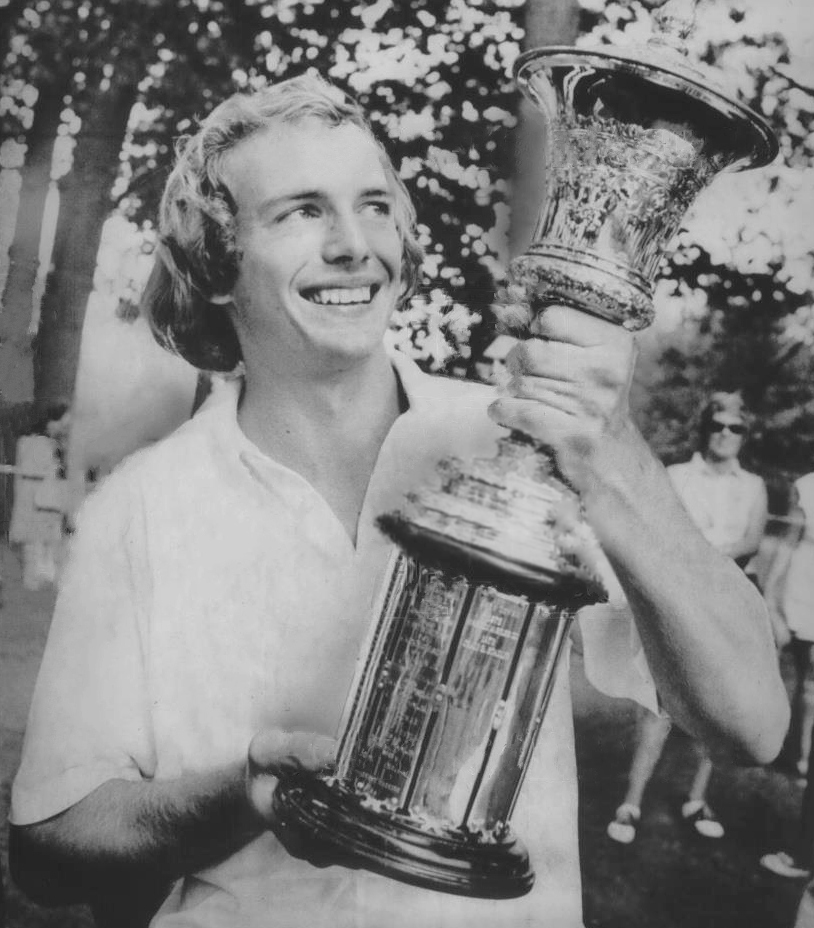
Pate had a distinguished amateur career with a win at the U.S. Amateur in 1974,[10][11][12] and was a member of victorious U.S. teams at the Eisenhower Trophy competition, also winning individually, later that year and at the Walker Cup in May 1975 at St Andrews in Scotland.[13] A few weeks later, he tied Walker Cup teammate Jay Haas of Wake Forest for low amateur at the U.S. Open, finishing in a six-way tie for eighteenth place at Medinah, outside Chicago.[14][15]
Professional career
[edit]In 1975, Pate turned professional.[7] Late in the year he was the medalist at Fall 1975 PGA Tour Qualifying School.[16][17] During his rookie season he won the 1976 U.S. Open.[3][4][5] He also won the Canadian Open that year. Pate closed with a 63 (−7) to defeat runner-up Jack Nicklaus by four strokes.[18][19]
Six more tour victories followed in ensuing years as well as several other titles around the world. He was a member of the victorious Ryder Cup team in 1981, but shoulder injuries curtailed his career. His final win on the PGA Tour came at age 28.[20] That final victory was at the 1982 Tournament Players Championship, the first held at TPC at Sawgrass. Pate celebrated by throwing course designer Pete Dye and PGA Tour commissioner Deane Beman into the lake adjacent to the 18th green, then jumped in himself.[21][22][23] He had also jumped in the water after a victory the previous June, after going nearly three years without a win.[24][25]
Later career
[edit]Pate later served as a golf broadcaster for ABC, CBS, and BBC. He also set up a golf course design practice and a turf and irrigation company.[20] He designed the Kiva Dunes in 1995 and the Ol' Colony Golf Complex in 2000,[26] which is the home course for the Alabama Crimson Tide golf team. In 2006, he earned his first Champions Tour win at the Outback Steakhouse Pro-Am. Pate has been forced by health problems, including arthroscopic left-knee surgery in 2010, to begin limiting his Champions Tour appearances.
Personal life
[edit]In the late 1990s, Pate returned to the University of Alabama to complete his bachelor's degree in administrative science.[7] His daughter, Jenni, received her degree at the same graduation ceremony in 2001.[20]
Awards and honors
[edit]Amateur wins
[edit]- 1974 U.S. Amateur, Florida Amateur[29]
Professional wins (15)
[edit]PGA Tour wins (8)
[edit]| Legend |
|---|
| Major championships (1) |
| Players Championships (1) |
| Other PGA Tour (6) |
| No. | Date | Tournament | Winning score | To par | Margin of victory |
Runner(s)-up |
|---|---|---|---|---|---|---|
| 1 | Jun 20, 1976 | U.S. Open | 71-69-69-68=277 | −3 | 2 strokes | |
| 2 | Jul 25, 1976 | Canadian Open | 69-67-68-63=267 | −13 | 4 strokes | |
| 3 | Jan 9, 1977 | Phoenix Open | 67-67-70-73=277 | −7 | Playoff | |
| 4 | Oct 23, 1977 | Southern Open | 64-67-69-66=266 | −14 | 7 strokes | |
| 5 | Sep 10, 1978 | Southern Open (2) | 67-67-66-69=269 | −11 | 1 stroke | |
| 6 | Jun 28, 1981 | Danny Thomas Memphis Classic | 69-70-66-69=274 | −14 | 2 strokes | |
| 7 | Oct 18, 1981 | Pensacola Open | 66-69-65-71=271 | −17 | 3 strokes | |
| 8 | Mar 21, 1982 | Tournament Players Championship | 70-73-70-67=280 | −8 | 2 strokes |
PGA Tour playoff record (1–2)
| No. | Year | Tournament | Opponent(s) | Result |
|---|---|---|---|---|
| 1 | 1977 | Phoenix Open | Won with birdie on first extra hole | |
| 2 | 1978 | PGA Championship | Mahaffey won with birdie on second extra hole | |
| 3 | 1980 | Sea Pines Heritage | Lost to par on first extra hole |
PGA of Japan Tour wins (2)
[edit]| No. | Date | Tournament | Winning score | To par | Margin of victory |
Runner(s)-up |
|---|---|---|---|---|---|---|
| 1 | Oct 10, 1976 | Taiheiyo Club Masters | 70-70-68-71=279 | −5 | 2 strokes | |
| 2 | Nov 9, 1980 | ABC Japan vs USA Golf Matches | 70-69-72-65=276 | −12 | 1 stroke |
South American Golf Circuit wins (2)
[edit]| No. | Date | Tournament | Winning score | To par | Margin of victory |
Runner-up |
|---|---|---|---|---|---|---|
| 1 | Nov 23, 1980 | Brazil Open | 69-70-69-66=274 | −10 | Playoff | |
| 2 | Dec 13, 1981 | Colombian Open | 64-67-66-65=262 | −26 | 21 strokes |
Other wins (1)
[edit]| No. | Date | Tournament | Winning score | To par | Margin of victory |
Runners-up |
|---|---|---|---|---|---|---|
| 1 | Dec 4, 1977 | Pepsi-Cola Mixed Team Championship (with |
61-70-69-70=270 | −18 | 1 stroke |
Champions Tour wins (2)
[edit]| No. | Date | Tournament | Winning score | To par | Margin of victory |
Runners-up |
|---|---|---|---|---|---|---|
| 1 | Feb 26, 2006 | Outback Steakhouse Pro-Am | 68-68-66=202 | −11 | 1 stroke | |
| 2 | Jan 27, 2008 | Turtle Bay Championship | 71-70-70=211 | −5 | 2 strokes |
Champions Tour playoff record (0–1)
| No. | Year | Tournament | Opponents | Result |
|---|---|---|---|---|
| 1 | 2005 | Senior PGA Championship | Reid won with birdie on first extra hole |
Major championships
[edit]Wins (1)
[edit]| Year | Championship | 54 holes | Winning score | Margin | Runners-up |
|---|---|---|---|---|---|
| 1976 | U.S. Open | 2 shot deficit | −3 (71-69-69-68=277) | 2 strokes |
Results timeline
[edit]| Tournament | 1975 | 1976 | 1977 | 1978 | 1979 |
|---|---|---|---|---|---|
| Masters Tournament | 37 | T14 | T18 | T41 | |
| U.S. Open | T18 LA | 1 | CUT | T16 | T2 |
| The Open Championship | CUT | T15 | WD | T26 | |
| PGA Championship | T4 | 5 | T2 | T5 |
| Tournament | 1980 | 1981 | 1982 | 1983 | 1984 | 1985 | 1986 | 1987 | 1988 | 1989 |
|---|---|---|---|---|---|---|---|---|---|---|
| Masters Tournament | T6 | T5 | T3 | |||||||
| U.S. Open | CUT | T26 | CUT | CUT | CUT | WD | CUT | |||
| The Open Championship | T16 | T19 | WD | |||||||
| PGA Championship | T10 | T11 | T9 | T23 | CUT |
| Tournament | 1990 | 1991 | 1992 | 1993 | 1994 | 1995 | 1996 | 1997 | 1998 | 1999 |
|---|---|---|---|---|---|---|---|---|---|---|
| Masters Tournament | ||||||||||
| U.S. Open | CUT | |||||||||
| The Open Championship | ||||||||||
| PGA Championship | CUT |
| Tournament | 2000 | 2001 | 2002 | 2003 | 2004 | 2005 | 2006 | 2007 | 2008 | 2009 |
|---|---|---|---|---|---|---|---|---|---|---|
| Masters Tournament | ||||||||||
| U.S. Open | ||||||||||
| The Open Championship | ||||||||||
| PGA Championship | CUT |
| Tournament | 2010 | 2011 |
|---|---|---|
| Masters Tournament | ||
| U.S. Open | ||
| The Open Championship | ||
| PGA Championship | CUT |
LA = Low amateur
CUT = missed the halfway cut (3rd round cut in 1976 Open Championship)
WD = withdrew
"T" indicates a tie for a place.
Summary
[edit]| Tournament | Wins | 2nd | 3rd | Top-5 | Top-10 | Top-25 | Events | Cuts made |
|---|---|---|---|---|---|---|---|---|
| Masters Tournament | 0 | 0 | 1 | 2 | 3 | 5 | 7 | 7 |
| U.S. Open | 1 | 1 | 0 | 2 | 2 | 4 | 13 | 5 |
| The Open Championship | 0 | 0 | 0 | 0 | 0 | 3 | 7 | 4 |
| PGA Championship | 0 | 1 | 0 | 4 | 6 | 8 | 12 | 8 |
| Totals | 1 | 2 | 1 | 8 | 11 | 20 | 39 | 24 |
- Most consecutive cuts made – 7 (1980 Open Championship – 1982 Masters)
- Longest streak of top-10s – 2 (twice)
The Players Championship
[edit]Wins (1)
[edit]| Year | Championship | 54 holes | Winning score | Margin | Runners-up |
|---|---|---|---|---|---|
| 1982 | Tournament Players Championship | 3 shot deficit | −8 (70-73-70-67=280) | 2 strokes |
Results timeline
[edit]| Tournament | 1978 | 1979 | 1980 | 1981 | 1982 | 1983 | 1984 | 1985 | 1986 | 1987 | 1988 | 1989 | 1990 | 1991 | 1992 |
|---|---|---|---|---|---|---|---|---|---|---|---|---|---|---|---|
| The Players Championship | T17 | T20 | CUT | T45 | 1 | CUT | T64 | CUT | CUT | CUT | CUT |
CUT = missed the halfway cut
"T" indicates a tie for a place.
U.S. national team appearances
[edit]Amateur
- Eisenhower Trophy: 1974 (team winners and joint individual leader)
- Walker Cup: 1975 (winners)
Professional
See also
[edit]References
[edit]- ^ a b McKenzie, Mike (June 21, 1976). "Soozi sunshine". Tuscaloosa News. (Alabama). p. 11.
- ^ Deason, Lauren (February 13, 2008). "Love stories from the Tour". PGA Tour. Retrieved May 11, 2017.
- ^ a b Jenkins, Dan (June 28, 1976). "You were great, Jerry Pate". Sports Illustrated. p. 18.
- ^ a b Husar, John (June 21, 1976). "Rookie Pate beats odds, wins Open". Chicago Tribune. p. 1, sec. 6.
- ^ a b Mizell, Hubert (June 21, 1976). "Pate clinches Open on perfect shot". St. Petersburg Times. (Florida). p. 1C.
- ^ McKenzie, Mike (June 21, 1976). "Drama got it!". Tuscaloosa News. (Alabama). p. 1.
- ^ a b c "Jerry Pate". PGA Tour. Retrieved November 7, 2013.
- ^ a b "Jerry Pate". Florida State Golf Association. Retrieved March 26, 2025.
- ^ "Pate: something extra in Pensacola". Daytona Beach Morning Journal. (Florida). Associated Press. October 27, 1977. p. 3C.
- ^ Tomashek, Tom (September 1, 1974). "Pate defeats Grace in U.S. Amateur". Chicago Tribune. p. 4, sec.3.
- ^ "Pate rallies by Grace". Sunday Star-News. (Wilmington, North Carolina). UPI. September 1, 1974. p. 1C.
- ^ "Collegian Jerry Pate wins amateur crown". Spokesman-Review. (Spokane, Washington). Associated Press. September 1, 1974. p. 3, sports.
- ^ "U.S. retains Walker Cup". Chicago Tribune. Associated Press. May 30, 1975. p. 4, sec. 4.
- ^ Tomashek, Tom (June 23, 1975). "Graham, Mahaffey in Open playoff". Chicago Tribune. p. 1, sec. 4.
- ^ "Medinah showdown". Tuscaloosa News. (Alabama). Associated Press. June 23, 1975. p. 9.
- ^ "Golf: PGA Fall Qualifying at Orlando, Fla". Chicago Tribune. November 9, 1975. p. 10, sec. 3.
- ^ "PGA Tour career". Jerry Pate's official site. Archived from the original on April 30, 2011. Retrieved April 29, 2011.
- ^ "Pate shoots 63 to beat Nicklaus". Chicago Tribune. Associated Press. July 26, 1976. p. 6, sec. 6.
- ^ "Jerry Pate adds another national title". Tuscaloosa News. (Alabama). Associated Press. July 26, 1976. p. 7.
- ^ a b c "Jerry Pate". PGA Tour. Retrieved November 7, 2013.
- ^ "Pate charges at end, then takes cool dip". Tuscaloosa News. (Alabama). Associated Press. March 22, 1982. p. 9.
- ^ Jenkins, Dan (March 29, 1982). "Last one in is a winner". Sports Illustrated. p. 24. Archived from the original on January 19, 2013.
- ^ "In the swim of things". Chicago Tribune. March 22, 1982. p. 4, sec. 4.
- ^ "Pate ends drought with Memphis swim". Chicago Tribune. June 29, 1981. p. 2, sec. 4.
- ^ "The dry spell ends with a splash for Jerry Pate". Eugene Register-Guard. (Oregon). Associated Press. June 29, 1981. p. 5C.
- ^ "Jerry Pate Golf Course Design". Retrieved April 29, 2011.
- ^ "Former Alabama Golfer Jerry Pate Named to Georgia State Golf Association Hall of Fame". Alabama Sports Hall of Fame. March 18, 2025. Retrieved March 26, 2025.
- ^ "Former Alabama Golfer Jerry Pate Named to Georgia State Golf Association Hall of Fame". University of Alabama. March 18, 2025. Retrieved March 26, 2025.
- ^ "Jerry Pate". Alabama Sports Hall of Fame. Retrieved March 26, 2025.
External links
[edit]- Official website
- Jerry Pate at the PGA Tour official site
Jerry Pate
View on GrokipediaEarly years
Family background
Jerry Pate was born on September 16, 1953, in Macon, Georgia.[1] His family relocated to Anniston, Alabama, in 1954 when Pate was just one year old, following his father's career opportunities in local businesses.[8][9] The Pate household was large, consisting of six children—four boys and two girls—with Jerry as the fourth-born, fostering a dynamic environment centered on family and physical activity.[8] Pate's father, Pat Pate, a University of Georgia alumnus who had played golf there, played a pivotal role in shaping the family's athletic inclinations, instilling a strong emphasis on sports from an early age.[9] This influence extended to encouraging participation in various physical pursuits during Pate's childhood in Anniston. In 1967, when Pate was 14, the family moved again to Pensacola, Florida, due to his father's job relocation, where the supportive home environment continued to nurture his growing interest in athletics.[7][10]Introduction to golf
Jerry Pate first encountered golf at the age of six, shortly after his family moved from Georgia to Anniston, Alabama, in 1954 and joined the Anniston Country Club. There, he learned the fundamentals of the game from his father, grandfather, and the club's golf professionals, with his family's support nurturing his budding interest in sports. By age 10, Pate had begun competing in junior tournaments, securing his first victory in a local Alabama event with a birdie on the final hole to claim a silver tea service as the prize.[11] In 1967, at age 14, Pate's family relocated to Pensacola, Florida, due to his father's job transfer, where he continued honing his skills through participation in local junior competitions. As a high school student at Booker T. Washington High School, he immersed himself in the area's vibrant golf scene, caddying for three years at the Pensacola Open and gaining invaluable insights by observing professional players up close.[12] This exposure to the Pensacola golf community significantly contributed to his early development, bridging informal family influences with competitive experience before formal instruction.Amateur career
College career
Jerry Pate enrolled at the University of Alabama in the fall of 1971, initially walking on to the men's golf team before earning a full golf scholarship during his collegiate career.[10][9] Under coach Conrad Rehling, Pate quickly became a key contributor to the Crimson Tide, serving as team captain in his senior year and helping elevate the program's profile during the early 1970s.[3][13] The Alabama team achieved notable success during Pate's tenure, including a runner-up finish at the Southeastern Conference (SEC) Championship in 1973, marking one of the program's strongest showings in the decade.[14] Nationally, the Crimson Tide posted a tied for third-place finish at the 1975 NCAA Championships, their best result since the tournament's expansion, with Pate as the squad's top performer, where he finished as runner-up individually.[15] These accomplishments underscored Alabama's rising status in collegiate golf, bolstered by Pate's leadership and individual prowess. On an individual level, Pate earned first-team All-SEC honors in 1974 and was selected as a first-team All-American in both 1974 and 1975, reflecting his consistent excellence.[16][13] He posted low scoring averages throughout his career, highlighted by a victory at the 1973 St. Andrews Intercollegiate Invitational, and balanced his athletic commitments with academic pursuits in administrative science, though he completed his bachelor's degree in 2001 after turning professional.[13][17]Major amateur wins
Jerry Pate achieved his most prominent amateur success in 1974 by winning the U.S. Amateur Championship at Ridgewood Country Club in Paramus, New Jersey.[2] In the 36-hole final, the 20-year-old University of Alabama senior defeated John Grace of North Carolina, 2 and 1, after trailing early but rallying with strong putting and recovery shots on the par-71 layout measuring 6,754 yards.[18] Pate's match-play run included victories over notable amateurs like future major winner Curtis Strange and the top-ranked George Burns, marking one of the most dominant debuts in the event's history.[2] Earlier that year, Pate captured the Florida State Amateur Championship at Grenelefe Country Club, posting a tournament-total score of 279 (5-under par) to secure the title.[19] This victory, held in June 1974, highlighted his rising form following his college performances and qualified him for the U.S. Amateur.[10] These triumphs, particularly the U.S. Amateur, elevated Pate's national reputation as a top amateur prospect and earned him spots on the victorious 1974 U.S. Eisenhower Trophy team.[3] The prestige of these achievements influenced his decision to turn professional in late 1975, after earning low amateur honors at that year's U.S. Open.[13]List of Major Amateur Victories
- 1974 Florida State Amateur: Grenelefe Country Club; winning score 279 (5-under par).[19]
- 1974 U.S. Amateur Championship: Ridgewood Country Club, Paramus, NJ; defeated John Grace 2 and 1 in the final.[18]
Professional career
PGA Tour years
Jerry Pate turned professional in 1975 following his victory in the U.S. Amateur, securing his PGA Tour card that fall by earning medalist honors at Qualifying School.[10] His strong amateur background, highlighted by the 1974 U.S. Amateur win, provided a solid foundation that eased his transition to the professional ranks.[20] In his rookie season of 1976, Pate quickly established himself with a stunning victory at the U.S. Open, where he overcame a two-stroke deficit entering the final round at Atlanta Athletic Club, culminating in a memorable 190-yard five-iron approach on the 72nd hole that set up a birdie to secure the title.[4] Later that year, he added the Canadian Open to his resume, closing with a course-record 63 for a four-shot win, which earned him PGA Tour Rookie of the Year honors and co-Player of the Year recognition.[13] These achievements marked him as one of the tour's emerging stars, demonstrating his ability to handle high-stakes pressure early in his career.[7] Throughout the late 1970s and into 1981, Pate maintained consistent contention, logging multiple top-10 finishes and securing victories at the 1977 Phoenix Open and Southern Open, the 1978 Southern Open, the 1981 Pensacola Open, and the 1981 Danny Thomas Memphis Classic.[4] His peak came in 1982 with a win at The Players Championship, the event's inaugural staging at the Stadium Course at TPC Sawgrass, where he birdied the famed 17th and 18th holes in the final round to claim the title despite the course's challenging design.[21] Pate's adaptation to professional demands was evident in his colorful on-course presence, including using an orange golf ball during tournaments, which helped him stay relaxed under scrutiny while amassing 70 career top-10 finishes.[20] Over his PGA Tour career, he accumulated $1,634,246 in earnings, reflecting his sustained impact through the 1980s before injuries curtailed his play.[4]International and senior tours
Following his early successes on the PGA Tour, Jerry Pate expanded his professional career to international circuits, where he secured four victories between 1976 and 1981. These wins on the PGA of Japan Tour and the South American Golf Circuit highlighted his adaptability and competitive edge abroad.[20] Pate claimed his first international title at the 1976 Taiheiyo Club Masters on the PGA of Japan Tour, firing rounds of 70-70-68-71 for a total of 279 (−5) to win by two strokes over Japan's Masashi Ozaki.[22] His second Japan Tour victory came in 1980 at the ABC Japan vs. USA Golf Matches, where he carded 70-69-72-65 for 276 (−12), edging out Norio Suzuki and Tom Purtzer by one stroke.[23][24] On the South American Golf Circuit, Pate triumphed at the 1980 Brazil Open, rallying from five strokes back to tie Manuel Pinero at 274 (−10) before defeating him on the fifth playoff hole.[25] He followed with a dominant performance at the 1981 Colombian Open, shooting a circuit-record 262 (−26) across four rounds of 64-67-66-65 to win by 21 strokes over Luis Arevalo.[20] Pate turned 50 in September 2003 and transitioned to the Champions Tour the following year, revitalizing his competitive play after a period sidelined by injuries.[13] He secured two senior victories, starting with the 2006 Outback Steakhouse Pro-Am, where he shot 68-68-66 for 202 (−11) to win by one stroke over Hale Irwin, Morris Hatalsky, and Mark James.[26] His second came at the 2008 Turtle Bay Championship, closing with a 70 for 211 (−5) and a two-stroke margin over Fulton Allem.[27] Across 175 Champions Tour starts through 2010, Pate earned $4,010,328, recorded 12 top-5 finishes, and notched 25 top-10 results, establishing himself as a consistent performer in senior golf.[26] Health challenges, including left-knee surgery in 2010, prompted him to scale back regular play thereafter, focusing instead on occasional appearances and his business ventures.[10]Tournament achievements
PGA Tour wins
Jerry Pate secured eight victories on the PGA Tour between 1976 and 1982, establishing himself as a prominent figure during his peak years. His wins included one major championship and showcased his ability to perform under pressure, often with memorable shots and celebrations. The following details each triumph, highlighting key aspects such as final scores, margins of victory, and notable moments.- 1976 U.S. Open (June 17–20, Atlanta Athletic Club, Duluth, Georgia): Pate posted a total score of 277 (−3), winning by two strokes over Al Geiberger and Tom Watson. In the final round, he birdied the par-5 16th with a famous 190-yard, 5-iron shot from rough over water to within two feet of the pin, helping him rally from three shots back entering the day.[28]
- 1976 Canadian Open (July 22–25, Essex Golf & Country Club, Windsor, Ontario): Pate finished at 267 (−13), claiming victory by four strokes ahead of Jack Nicklaus. He surged with a final-round course-record 63, erasing a two-shot deficit after 54 holes in windy conditions.[29][30]
- 1977 Phoenix Open (January 6–9, Phoenix Country Club, Phoenix, Arizona): Pate tallied 277 (−7) and defeated Dave Stockton in a sudden-death playoff after both finished regulation tied. This marked his first PGA Tour win of the year, coming on a firm, fast desert layout.[31][21]
- 1977 Southern Open (October 20–23, Green Island Country Club, Columbus, Georgia): With a dominant 266 (−14), Pate won by seven strokes over Andy Bean, the largest margin in tournament history at the time. He led wire-to-wire after an opening 64 in cool fall weather.[32][33]
- 1978 Southern Open (September 7–10, Green Island Country Club, Columbus, Georgia): Pate repeated as champion with 269 (−11), edging Phil Hancock by one stroke. This back-to-back success highlighted his course familiarity, as he birdied the final hole to seal the win.[34]
- 1981 Danny Thomas Memphis Classic (June 25–28, Colonial Country Club, Cordova, Tennessee): Pate shot 274 (−14) to win by two strokes over Tom Kite. Ending a nearly three-year drought, he held a one-shot lead after 54 holes and closed steadily before jumping into a lakeside pond in celebration.[35][36]
- 1981 Pensacola Open (October 15–18, Perdido Bay Golf Club, Pensacola, Florida): Pate dominated with 271 (−17), winning by three strokes over Steve Melnyk. As a local resident, he thrived on the marshy, wind-exposed course with consistent low rounds.[36]
- 1982 Players Championship (March 18–21, TPC Sawgrass Stadium Course, Ponte Vedra Beach, Florida): Pate finished at 280 (−8), two strokes ahead of Brad Bryant and Bruce Lietzke. In the tournament's debut at the new venue, he used an orange ball, birdied the famed 17th and 18th in the final round 67 to overcome a three-shot deficit, then playfully tossed PGA Tour Commissioner Deane Beman and designer Pete Dye into the 18th green's lake.[5]
Other professional wins
Jerry Pate achieved seven professional victories outside the PGA Tour during his career, spanning international tours and the Champions Tour. These successes highlighted his versatility and enduring competitiveness on global stages. On the Japan Golf Tour, Pate secured two titles early in his professional tenure. In 1976, he won the Taiheiyo Club Masters at Sobu Country Club in Chiba, Japan, finishing at 5-under-par 279, two strokes ahead of Isao Aoki.[37] Four years later, in 1980, Pate captured the ABC Japan vs USA Golf Match at Sports Shinko Country Club in Hyogo, Japan, posting a 12-under-par 276 to edge out Norio Suzuki and Tom Purtzer by one stroke.[38] Pate also triumphed twice on the South American Golf Circuit. At the 1980 Brazil Open (Aberto do Brasil) held at Sao Fernando Country Club, he rallied in the final round to finish at 10-under-par 274, tying Manuel Piñero after a dramatic birdie on the 72nd hole and winning in a playoff.[39] The following year, Pate dominated the 1981 Colombian Open at Club Los Lagartos in Bogotá, setting a course record with a 26-under-par 262, winning by an astonishing 21 strokes over Luis Arevalo in one of the largest margins in tournament history.[40] In team competition, Pate partnered with Hollis Stacy to win the 1977 Pepsi-Cola Mixed Team Championship, a co-sanctioned event between the PGA Tour and LPGA Tour, defeating the field by three strokes at 18-under-par 270.[26] Transitioning to the senior circuit, Pate claimed two Champions Tour victories later in his career. His first came at the 2006 Outback Steakhouse Pro-Am at TPC Tampa Bay, where he closed with a 5-under 66 to finish at 11-under-par 202, securing a one-stroke win over Brad Bryant and Scott Simpson—his first professional title in nearly 24 years.[41] In 2008, Pate navigated blustery conditions to win the Turtle Bay Championship at Turtle Bay Resort in Hawaii, carding a final-round 2-under 70 for a total of 5-under 211, two strokes clear of Jim Thorpe.[42]Major championships
U.S. Open victory
Jerry Pate entered the 1976 U.S. Open with considerable momentum from his distinguished amateur career, having won the 1974 U.S. Amateur Championship and finished low amateur at the 1975 U.S. Open while still in college at the University of Alabama.[28] Turning professional in September 1975, Pate qualified for the event as a PGA Tour rookie and arrived at Atlanta Athletic Club in Duluth, Georgia, as a 22-year-old underdog among established pros.[43] His preparation emphasized mental focus and course familiarity, drawing on his Southern roots near the venue to build confidence ahead of the June 17-20 tournament.[44] Pate's tournament performance showcased steady play and a strong finish, posting round scores of 71, 69, 69, and 68 for a total of 277 (-3), which held up as the winning score on the par-70 Highlands Course.[43] He entered the final round two strokes behind leader John Mahaffey, but birdies on the par-3 15th—where he stuck a 1-iron approach close to the pin—and the par-4 18th propelled his 68, allowing him to pull ahead without needing a playoff.[28] The 18th-hole birdie proved decisive, as Pate's caddie advised a 5-iron from 191 yards in the right rough, resulting in a shot that landed just two feet from the cup despite the adrenaline-fueled conditions; he calmly converted the putt for victory.[44] This edged out runners-up Al Geiberger and Tom Weiskopf, both at 279, while Mahaffey faltered with a bogey on 18 after finding the water.[43] As a first-year professional, Pate's triumph marked his sole major championship and the biggest win of his career to that point, earning him $42,000 and instant acclaim as the youngest U.S. Open champion since Jack Nicklaus in 1962.[45] The victory garnered widespread media coverage, including a Sports Illustrated feature, and provided a significant career boost, leading to his next PGA Tour win at the Canadian Open a month later and selection as PGA Rookie of the Year.[45] The iconic 18th-hole approach remains etched in golf history, commemorated by a plaque at Atlanta Athletic Club and frequently recalled by Pate as a defining moment of composure under pressure.[44]Results in other majors
Pate's performances in the Masters Tournament showcased some of his strongest major contention outside the U.S. Open, with a tied for third-place finish in 1982, where he carded rounds of 74-73-67-71 for a total of 285, two strokes behind winner Craig Stadler (who defeated Dan Pohl in a playoff at 284).[46] He also achieved a tied for seventh in 1978, finishing with 72-71-72-72 for 287 at Augusta National.[47] These results highlighted his accuracy and composure on the demanding layout, contributing to two top-10 finishes in 12 appearances from 1977 to 1994.[2] In the PGA Championship, Pate came closest to another major title with a second-place finish in 1978 at Oakmont Country Club, losing in a sudden-death playoff to John Mahaffey after tying Tom Watson at 276. His next-best result was a tied for fifth in 1977 at Pebble Beach, posting 73-70-69-73 for 285, four strokes behind champion Lanny Wadkins.[48] Over 15 starts from 1976 to 1992, he experienced several missed cuts later in his career but maintained competitive form in his prime years.[2] Pate's appearances in The Open Championship were limited to six between 1976 and 1981, reflecting the challenges of adapting to links golf and variable weather conditions. His best finish was a tied for 19th in 1981 at Royal St George's, with scores of 73-73-69-74 totaling 289, 13 strokes behind winner Bill Rogers.[49] In 1976 at Royal Birkdale, he struggled with an 87 in the third round amid windy conditions, missing the cut after starting level par through two rounds.[50] He withdrew after three rounds in 1978 at St Andrews.[51] Excluding the U.S. Open, Pate accumulated 33 starts across the other three majors from 1976 to 1994, achieving 6 top-10 finishes as part of his overall 7 top-10s in 40 major appearances, with a cuts-made rate around 60% in these events during his peak PGA Tour years from 1976 to 1982.[2]| Major | Best Finish (Year) | Top-10 Finishes | Total Starts (Approx.) |
|---|---|---|---|
| Masters Tournament | T3 (1982) | 2 | 12 |
| PGA Championship | 2nd (1978) | 2 | 15 |
| The Open Championship | T19 (1981) | 0 | 6 |
The Players Championship
1982 victory
The 1982 Players Championship, often regarded as the "fifth major" due to its prestige and strong field, marked the inaugural event at the newly designed Stadium Course at TPC Sawgrass in Ponte Vedra Beach, Florida. The tournament featured a $500,000 purse—the largest in PGA Tour history at the time—and attracted top competitors including Tom Watson, Jack Nicklaus, and Raymond Floyd, though several luminaries like Nicklaus, Gary Player, and Arnold Palmer missed the cut amid complaints about the course's punishing layout. Jerry Pate entered the event shortly after ending a three-year winless drought with victories at the 1981 Danny Thomas Memphis Classic and the 1981 Pensacola Open, following his last prior win at the 1978 Southern Open.[21][52] Pate delivered a steady performance across four rounds, posting scores of 70-73-70-67 to finish at 8-under-par 280. He started solidly with an even-par opening round, navigated a tougher second day with a 1-over 73 amid windy conditions, and maintained momentum with another 70 in the third round to sit three strokes back entering Sunday. His final-round 67, the low score of the day, featured a crucial birdie run on the back nine, including birdies on the iconic par-3 17th island green and the challenging 18th, where he drained a short putt for victory. This surge allowed him to overcome early deficits and secure a two-stroke margin over runners-up Brad Bryant and Scott Simpson.[53][54] The win, Pate's eighth on the PGA Tour, reaffirmed his status among the elite. In a memorable post-round celebration, Pate famously threw course designer Pete Dye and PGA Tour commissioner Deane Beman into the 18th hole's lake before diving in himself, capturing the event's spirited atmosphere despite the course's controversial difficulty.[21][52]Tournament results timeline
Jerry Pate debuted in The Players Championship in 1976, finishing tied for 22nd place after making the cut. Over the course of his career, he competed in 22 editions of the tournament through 2002, making the cut in about 70% of his starts and achieving several top-20 finishes in his early years. His performance peaked in the late 1970s and early 1980s, with his 1982 victory, before a decline in the 1990s attributed to recurring shoulder and back injuries that led to multiple withdrawals. He did not play the event after 1995.[4]| Year | Finish Position | Notes |
|---|---|---|
| 1976 | T22 | Debut appearance; made cut. |
| 1977 | T15 | Strong early showing. |
| 1978 | CUT | Missed cut. |
| 1979 | T10 | Top-10 finish. |
| 1980 | T28 | Made cut. |
| 1981 | T49 | Made cut. |
| 1982 | 1 | Victory; won by two strokes over Brad Bryant and Scott Simpson. |
| 1983 | T12 | Made cut. |
| 1984 | T30 | Made cut. |
| 1985 | WD | Withdrew due to injury. |
| 1986 | T40 | Made cut. |
| 1987 | CUT | Missed cut. |
| 1988 | T25 | Made cut. |
| 1989 | T35 | Made cut. |
| 1990 | WD | Injury withdrawal. |
| 1991 | T50 | Made cut; declining form. |
| 1992 | CUT | Missed cut. |
| 1993 | WD | Back injury. |
| 1994 | DNP | Did not play. |
| 1995 | T60 | Final appearance; made cut but poor finish. |
