Hubbry Logo
Dbx (noise reduction)Dbx (noise reduction)Main
Open search
Dbx (noise reduction)
Community hub
Dbx (noise reduction)
logo
8 pages, 0 posts
0 subscribers
Be the first to start a discussion here.
Dbx (noise reduction)
from Wikipedia
The logo represents both the company and its noise reduction system

dbx is a family of noise reduction systems developed by the company of the same name. The most common implementations are dbx Type I and dbx Type II for analog tape recording and, less commonly, vinyl LPs. A separate implementation, known as dbx-TV, is part of the MTS system used to provide stereo sound to North American and certain other TV systems. The company, dbx, Inc., was also involved with Dynamic Noise Reduction (DNR) systems.

History

[edit]
The Panasonic RQ-J20X portable cassette player from 1982 was the first device to implement the dbx integrated circuit

The original dbx Type I and Type II systems were based on so-called "linear decibel companding" - compressing the signal on recording and expanding it on playback. It was invented by David E. Blackmer of dbx, Inc. in 1971.[1][2]

A miniature dbx Type II decoder on an integrated circuit was created in 1982 for use in portable and car audio, although only a few devices took advantage of it, such as certain Panasonic portable cassette players and Sanyo car stereos.[3] dbx marketed the PPA-1 Silencer, a decoder that could be used with non-dbx players such as the Sony Walkman.[4] A version of this chip also contained a Dolby B-compatible noise reduction decoder, described as dbx Type B noise reduction; this was possible after the Dolby patent (but not the trademark) had expired.

Software implementations have been developed.[5][6][7][8]

How dbx works

[edit]

Tape hiss

[edit]

Magnetic tape consists of microscopic particles that can be magnetically charged to record signals. The size of the particles and the speed of the tape transport defines the maximum frequency that the media can record. For high fidelity recordings, reel-to-reel audio tape recording typically works at tape speeds of 15 or 7.5 inches-per-second (38 or 19 cm/s), but this requires a lot of tape for a given amount of recording. Lower fidelity recordings can be made at 3.75 or even 1.875 ips, which allows more recording time on a given tape, but at the cost of adding more high-frequency noise.[9]

The cassette tape was designed for convenience, not audio quality, and ran at 1.875 ips (4.75 cm/s) to maximize recording time in the relatively small (compared to open-reel) tapes. This resulted in significant tape hiss. Combined with their limited width, which limits the dynamic range of the signals, the hiss tended to overwhelm any high frequencies in the signal, especially low-volume ones.[9]

During the 1970s, several new types of magnetic recording films were introduced, notably "chrome" and "metal", that used smaller particles and thereby pushed the tape hiss to much higher frequencies. During the same period, noise reduction systems like dbx and Dolby attempted to do the same using conventional media and actively addressing the tape noise through electronics.[9]

Companding

[edit]
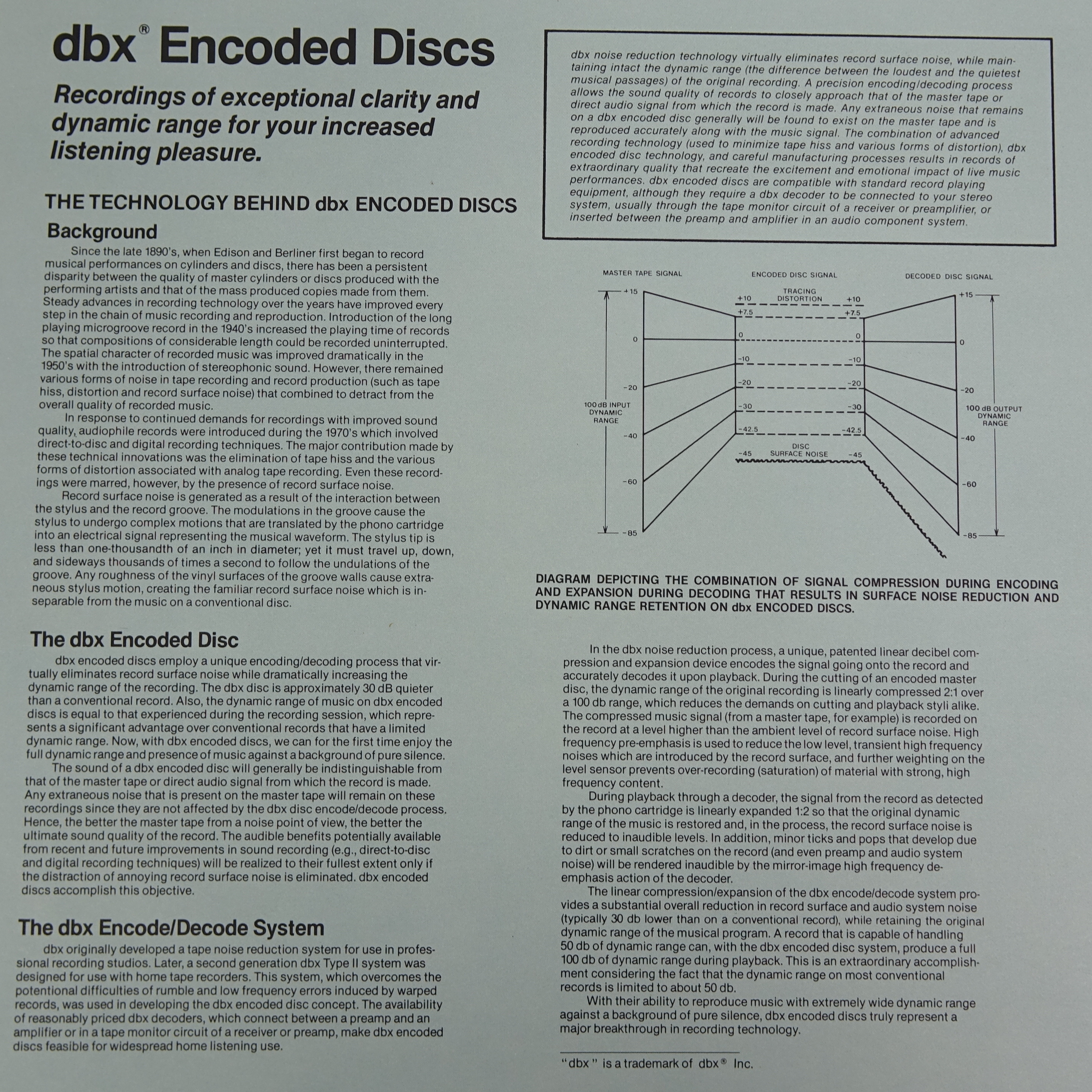
dbx companding compresses the original source (left) into a version with less dynamic range (middle), and then re-expands it (right). The tape hiss (pink) is also expanded by this process, but is overwhelmed by the now-expanded original signal.

dbx Type I and Type II are types of "companding noise reduction". These systems work by first compressing the dynamic range of the signal into a range that can be safely recorded on the tape. This type of compression, dynamic range compression, mutes down loud sounds and amplifies soft ones, making the volume of the recording much more even. On playback, the dynamic range is expanded by the same amount, causing the low-volume sounds to become low-volume again and vice versa. The combination of compression and re-expansion gives rise to the name companding. Companding is useful even outside the field of noise reduction; a cassette might have 40 decibels of dynamic range before the media saturates, while the original signal might use 70 for, say, a live recording of a concert. In this case, companding at 2-to-1 will result in a signal with 35 decibels of range, which can be recorded without clipping.[9]

The reason this technique works for noise reduction is that the tape hiss manifests itself as a constant low-volume signal. When the signal is recorded in its original form, without compression, the amount of hiss may be the same volume as softer sounds, masking them entirely. However, when the signal is compressed before recording, those soft sounds are recorded at a louder volume, so now even the soft sounds are louder than the noise. This improves the signal-to-noise ratio.[9]

When the signal is re-expanded, the tape hiss is expanded along with it, making it louder as well. However, the ratio of the signal to noise remains (close to) constant through this process, so the resulting output retains this higher signal-to-noise ratio. Ultimately, it means that while tape hiss does get louder during "soft" portions of the recording, the recording itself is (hopefully) always greater in volume and renders the hiss much less noticeable.[9]

Pre-emphasis

[edit]

Note that the tape hiss is limited to higher frequencies. That means a signal that is primarily low-frequency does not necessarily require noise reduction. Instead, one can simply roll off all the higher frequencies in a low-pass filter, and the hiss will largely disappear.[9]

Consider a signal that contains a high-volume section and then low-volume. During recording, these signals are compressed to be much closer together in level, so that the high-volume section does not saturate the tape and the low-volume section is louder than the tape hiss. On playback, the louder section has little or no muting applied, so the tape hiss is also left alone at its natural volume. When the softer section plays, having been amplified during recording, the expander mutes it down its original level. This also mutes down the tape hiss.[9]

This causes the volume of tape hiss to change during playback. This is not really noticeable when the original signal contains high frequencies that play over the hiss, but for lower frequencies, this can be easily heard. The rise and fall of the tape hiss was known as "breathing" because it sounded like something breathing into a microphone.[9]

To address this, dbx uses strong high-frequency "pre-emphasis" of the original signal. This amplifies high-frequency sounds before they are sent into the compressor. This causes the compressor to 'back off' the gain in certain circumstances and reduce the audibility of noise modulation – even with this pre-emphasis, noise modulation can become audible when using very noisy media to begin with, such as the cassette format.

dbx I and II

[edit]

dbx Type I system is meant to be used with professional recording media that have a signal-to-noise (S/N), before noise reduction, of at least 60 dB and a -3 dB frequency response of at least 30 Hz to 15 kHz. The system relies on the medium being fairly linear in volume and frequency response.

dbx Type-II is for more noisy media that have a lower S/N and much more restricted frequency response. In the control signal path, the dbx Type II process rolls off the high and low-frequency response to desensitize the system to frequency response errors – since the roll-off is only in the control path, it does not affect the audible sound. The dbx Type-II "disc" setting on consumer dbx decoders adds an additional 1–3 dB of low-frequency roll-off in both the audio path and control path. This protects the system from audible mistracking due to record warps and low-frequency rumble.

Both systems use 2:1 companding and provide exactly the same amount of noise reduction and dynamic range improvement – in other words, they provide the same end results, but are not compatible with each other.

dbx vs. Dolby

[edit]

Both dbx and the Dolby noise-reduction system use companding to control noise. They differ in the way they address the frequency response of the companding process. dbx uses a single frequency pre-emphasis system, whereas Dolby uses four separate pre-emphasis amplifiers, each for a different frequency band. Since tape hiss is primarily a problem for high-frequency sounds, Dolby uses much stronger pre-emphasis at high frequencies than low. This means that a low-volume, low-frequency signal may see little or no companding, whereas the same volume at high-frequencies will have been strongly pre-emphasized to a higher volume level before compression.[10]

The use of separate pre-emphasizing "encoding curves" allows the overall compression to be much less than it would be on dbx, where it is always 2 to 1. For lower frequency signals, like a conversation, Dolby may apply no compression at all. In contrast, dbx would continue to compand these signals, in which case the tape hiss is also re-expanded on playback, continually varying as the volume changes.[11]

Lack of dbx acceptance in marketplace

[edit]

Although it brought a wider dynamic range, and therefore diminished noise, to the cassette tape medium, dbx noise reduction did not achieve widespread popularity in the consumer marketplace, as compressed recordings did not sound acceptable when played back on non-dbx equipment. Dolby B was already widely used when dbx was introduced. Although Dolby noise reduction also used some companding, the level of compression and expansion was very mild, so that the sound of Dolby-encoded tapes was acceptable to consumers when played back on non-Dolby equipment.

  • dbx Type I was widely adopted in professional recording, particularly used with what is referred to in the industry as "semi-pro" formats such as half-inch 8 track and one-inch 16 track.
  • Tascam incorporated dbx Type II in their Portastudio four-track cassette recorders. Tascam's Portastudio family of 4 track cassette recorders became a standard for home hobbyists.
  • An advantage of dbx Type I and Type II compared to Dolby noise reduction is that it did not require calibration with the output level of the tape deck, which could cause incorrect tracking with Dolby B and C, leading to muffled high tones.
  • However, due to dbx's high compression and strong high-frequency preemphasis, dbx-encoded tapes were, unlike Dolby B, practically unplayable on non-dbx systems, sounding very harsh when played back undecoded. Undecoded dbx playback also exhibited large amounts of dynamic error, with audio levels going up and down constantly.

While dbx Type-II NR was eventually designed into a self-contained LSI chip, it was never cheap due to the extremely high precision required of the dbx VCAs and the RMS signal analysis, leading to further reluctance of manufacturers to use the dbx chips in their products.

dbx with vinyl phonograph records

[edit]

dbx was also used on vinyl records, which were labeled dbx disc.[12] While the earliest release is from 1971/1973[citation needed], their numbers peaked between 1977/1978[citation needed] until around 1982.[13] Billboard noted in August 1981 that the total number of releases with dbx encoding was expected to approach 200 albums.[14] Discogs mentions 1100 albums.[13] When employed on LPs, the dbx Type-II system reduced the audibility of dust and scratches, reducing them to tiny pops and clicks (if they were audible at all) and also completely eliminated record surface noise. dbx encoded LPs had, in theory, a dynamic range of up to 90 dB.[15] In addition, dbx LPs were produced from only the original master tapes, with no copies being used, and pressed only on heavy, virgin vinyl. Most were released in limited quantities with premium pricing.

dbx with pro reel tape recorders, as well as other professional/commercial audio production and reproduction

[edit]

The dbx K9 noise reduction card was designed to fit into the pro dolby-A series A-361 frames, already in wide use in pro reel-to-reel recording studios of the time.

The full designation of the card is K9-22, which is a dog vs. cat joke. The K9-22 is pin and form-factor compatible with the Dolby card designated and colloquially known as Cat. 22 (K9 is pronounced "canine").

The dbx 192 was an elegant design made especially for the Nagra IV-Stereo recorder. It had a single push-button for record/playback encode/decode and was integrated directly into the Nagra's internal signal path. It drew power from the Nagra supply.

dbx for television

[edit]

dbx-TV noise reduction, while having elements in common with Type I and Type II, is different in fundamental ways, and was developed by Mark Davis (then of dbx, now of Dolby Labs) in the early 1980s.

dbx-TV is included in multichannel television sound (MTS), the U.S. standard for stereo analog television transmission. Every TV device that decoded MTS originally required the payment of royalties, first to dbx, Inc., then to THAT Corporation which was spun off from dbx in 1989 and acquired its MTS patents in 1994; however, those patents expired worldwide in 2004.[16]

dbx in film production

[edit]

dbx noise reduction, capable of more than 20 dB of noise reduction, was used in the re-recording of the film Apocalypse Now in 1979. Dolby A-type noise reduction, capable of only 10-12 dB of noise reduction, was used only at the final stage for the mastering of the film's soundtrack to 70mm prints.

A modified version of dbx was also used in the Colortek stereo film system. In addition, dbx Type-II noise reduction was used in the Model-II and Model-III variants of MCA's Sensurround Special Effects System on the optical audio track and was a cornerstone of the entire system. MCA's Sensurround+Plus, used on the film Zoot Suit, employed dbx Type-II with the 4-track magnetic sound format on 35mm film prints, providing the motion picture with a stereo soundtrack capable of wide dynamic range and freedom from noise.

dbx for program delivery via the American NPR Public Radio Satellite System

[edit]

The first generation Public Radio Satellite System (PRSS), introduced in 1979 and used by the American National Public Radio for delivery of network programming to their member stations via satellite, was a single channel per carrier (SCPC) system that had about 40 dB of analog (recovered) signal to noise. dbx modules that were set for 3:1 were used to increase the dynamic range of the system. Typically this worked well but for some low frequencies the distortion exceeded 10 percent THD. Also the dbx modules varied in how they tracked the compressed audio so the expanded audio was not an exact representation of what was compressed at the uplink. Still, the use of dbx allowed NPR to be known for its high fidelity standards on its satellite system as commercial broadcasters chose NPR to up-link a number of commercial radio music programs and concerts by commercial radio networks who demanded high fidelity in the analog era. Many of these problems were resolved when the PRSS moved to their second-generation system in 1994, the SOSS (Satellite Operations Support System), in which the feeds were sent digitally.

See also

[edit]
  • Dolby noise reduction system
  • CX noise reduction system
  • High Com noise reduction system
  • UC noise reduction system

References

[edit]

Further reading

[edit]
[edit]
Revisions and contributorsEdit on WikipediaRead on Wikipedia
from Grokipedia
dbx is a family of analog systems developed by dbx Inc., utilizing techniques to significantly improve the in audio recordings by compressing the during encoding and expanding it during decoding. Invented by David E. Blackmer and introduced in 1972, dbx Type I was designed for professional studio applications, while Type II targeted consumer formats like cassette tapes and vinyl records. The system operates linearly in the domain across the full audio bandwidth, applying a 2:1 on recording to boost low-level signals and reduce noise by up to 30-35 dB, followed by precise 1:2 expansion on playback to restore the original dynamics without tonal alterations. Key components include voltage-controlled amplifiers (VCAs) with a 120 dB and pre-emphasis filtering up to 12 dB/, ensuring preservation of transient detail and from 30 Hz to 100 kHz. Widely adopted in the and , dbx enabled dynamic ranges exceeding 90 dB on analog media, rivaling early and making it a staple in recording studios alongside systems like Dolby A. Professional units such as the dbx 150 and 155 facilitated its use in , while consumer decks from brands like and Technics integrated Type II for home use, though precise alignment was critical to avoid artifacts like breathing or pumping. Despite its effectiveness, dbx's requirement for matched encode-decode hardware limited its longevity compared to single-ended systems, and playback without decoding results in heavily compressed, bright-sounding audio unsuitable for direct listening. The technology's influence persists in archival restoration efforts, where dbx-encoded tapes demand specialized decoders to recover full fidelity.

History and Development

Origins and Invention

The dbx noise reduction system was invented by audio engineer David E. Blackmer in the early 1970s, motivated by the inherent limitations of dynamic range in analog audio recording media such as magnetic tape, which restricted the ability to capture both quiet details and loud peaks without introducing significant noise or distortion. Blackmer's approach centered on a novel companding technique that compressed the dynamic range during recording and expanded it during playback, effectively extending the usable signal-to-noise ratio beyond what was possible with existing methods. Blackmer filed the foundational for this core technique on March 29, 1971 (U.S. 3,789,143, issued January 29, 1974), which described a system using RMS-based logarithmic control to achieve wideband specifically tailored for applications. The emphasized continuous, proportional gain adjustment to minimize while preserving audio , marking a significant advancement in professional recording technology. To commercialize the invention, Blackmer founded dbx Incorporated in 1971 in , with the explicit goal of producing expansion-compression noise reduction products for audio applications. The company quickly developed initial prototypes, which were tested and introduced in 1972, targeting environments where was essential for and . These early systems demonstrated up to 30 dB of noise reduction, establishing dbx as a key innovation in analog audio processing.

Key Milestones and Versions

dbx Type I noise reduction was released in 1973 as the company's first professional system, designed for use in recording studios to achieve noise suppression through linear . It gained rapid adoption among major facilities, where it facilitated high-fidelity tape mastering and with improved . In 1976, dbx introduced Type II, a variant tailored for consumer audio applications such as cassette and reel-to-reel decks, which incorporated RMS level detection for more stable performance across varying signal levels and limited bandwidth equipment. This version also briefly referenced pre-emphasis filtering to optimize high-frequency response, enhancing compatibility with home systems. The company underwent significant changes in the late 1970s, with its acquisition by BSR (Birmingham Sound Reproducers) in 1979, which broadened dbx's reach into consumer electronics and led to integrated noise reduction in turntables and tape machines. Subsequently, ownership changed in 1989 when the dbx division was acquired by Carillon Corporation and later by ELPJ (Edison Laser Player Japan). In 1994, the professional products division was sold to AKG Acoustics, which was acquired by Harman International the same year, further diversifying the product lineup with expanded compressor and limiter integrations. dbx noise reduction reached its peak adoption in the early , becoming a staple in both professional and consumer analog workflows, with widespread integration across studios and home setups. However, by the mid-, the rise of technologies, such as PCM and early production, contributed to its decline as these formats eliminated the need for analog by providing superior inherent signal-to-noise ratios.

Technical Principles

Sources of Noise in Audio Recording

In analog audio recording, the primary source of noise is tape hiss, a high-frequency random noise generated by the thermal agitation of magnetic particles on the tape and limitations in particle saturation during recording. This hiss typically manifests at levels 50-60 dB below the signal, degrading the (SNR) and masking subtle audio details. Other significant noise contributors in analog systems include vinyl surface noise, which arises from imperfections in the record groove, such as microscopic debris or wear that causes pops, clicks, and low-level rumble during playback. Amplifier hum, often at 60 Hz or 120 Hz, stems from ground loops, from power supplies, or vibrations in . In multi-track setups, occurs when signals from one channel bleed into adjacent tracks due to on the tape or insufficient shielding between heads. These noise sources impose strict dynamic range limitations on analog media, with consumer cassette tapes typically achieving only about 50-70 dB before noise overwhelms quiet signals, while professional reel-to-reel tapes can reach around 70 dB under optimal conditions, still requiring careful headroom management to avoid distortion on peaks. In the pre-digital era of the and 1970s, these challenges were particularly acute, as magnetic tape's inherent , combined with wow and flutter from mechanical transport, often obscured low-level details in music and speech recordings, prompting innovations like to expand effective dynamic range.

Companding Mechanism

Companding, a portmanteau of compression and expansion, is the core mechanism in dbx noise reduction systems, dynamically adjusting audio signal amplitudes to optimize use of the recording medium's limited dynamic range. Developed by David E. Blackmer, this process compresses the signal's dynamic range during encoding to minimize the impact of inherent noise, such as tape hiss, relative to the desired audio content, then expands it during decoding to restore the original amplitude relationships. In the encoding stage, the system applies a 2:1 compression ratio, where signal levels above a predefined threshold are attenuated such that a 20 dB increase in input amplitude results in only a 10 dB increase in output amplitude. This halves the dynamic excursions, effectively raising the signal above the medium's noise floor and allowing quieter passages to be recorded with less noise intrusion. The decoding stage performs complementary 1:2 expansion, amplifying the compressed signal to recover the full original range while suppressing noise that was proportionally reduced during recording. Central to this operation is the use of (RMS) level detection, which measures the average power of the over time for a smooth, logarithmic response that operates uniformly across the wideband . Unlike multiband systems that apply frequency-specific adjustments, dbx's RMS-based approach ensures consistent compression without introducing sliding bands or tonal shifts, enabling broad-spectrum noise suppression. This wideband design achieves up to 30 dB of overall hiss reduction, significantly extending the effective of analog media. The compression behavior above the threshold can be expressed simply in decibels as the output level equaling the input level divided by 2 for the excursion portion: Output (dB)=Threshold+Input (dB)Threshold2\text{Output (dB)} = \text{Threshold} + \frac{\text{Input (dB)} - \text{Threshold}}{2} To preserve transient response and avoid distortion, the system incorporates attack and release times of approximately 10 ms, allowing quick adaptation to signal changes while maintaining natural audio fidelity.

Pre-emphasis and De-emphasis

Pre-emphasis in the dbx noise reduction system boosts high frequencies during encoding to counter the concentration of noise above 5 kHz, where hiss tends to be more prominent due to the nature of analog recording. This adjustment increases the level of low-amplitude high-frequency signals relative to the , allowing the process to achieve more uniform across the . De-emphasis during decoding then applies a complementary to restore the original balance, preventing any net alteration to the when encode and decode are properly matched. The filter characteristics of the pre-emphasis in dbx II feature a 20 dB/ slope above 200 Hz, providing targeted boosting for frequencies prone to tape hiss while avoiding excessive emphasis at lower levels. In contrast, dbx I employs a flatter response with less aggressive high-frequency lift, better suited to professional formats with wider bandwidth. These filters are implemented using analog circuits, typically operational amplifiers (op-amps) combined with resistor-capacitor (RC) networks, ensuring precise 1:1 tracking between the encode and decode paths for accurate restoration. This design prevents high-frequency distortion and tape saturation during recording while delivering uniform noise reduction benefits, such as evenly suppressing hiss from 1 to 10 kHz without compromising or introducing pumping artifacts. By focusing emphasis on the upper audio band, dbx achieves up to 30 dB of broadband noise improvement tailored to the spectral characteristics of common recording media.

Variants: dbx I and dbx II

dbx I was the initial variant of the dbx noise reduction system, oriented toward professional use in studio environments such as mastering for reel-to-reel tape recordings. It employs a linear 2:1 companding mechanism without pre-emphasis, relying on the full dynamic range and flat frequency response of high-speed professional tape machines to achieve up to 30 dB of noise reduction. This design prioritizes transparency in controlled studio settings, where equipment calibration can be meticulously maintained, but it demands precise alignment, as level errors greater than 3 dB may introduce audible distortion during decoding. Early hardware implementations included standalone units like the dbx 150, introduced in the mid-1970s for integration with professional reel-to-reel recorders. In contrast, dbx II emerged as the consumer-oriented adaptation, incorporating additional pre-emphasis to specifically target high-frequency tape hiss prevalent in lower-fidelity media like cassettes. It retains the core 2:1 but enhances level tolerance through RMS (root-mean-square) detection, allowing operation within approximately ±6 dB of optimal recording levels without significant degradation, which suits variable conditions. A key feature is its , enabling playback of unencoded material with minimal alteration, though at reduced noise suppression. This variant found integration in consumer audio decks during the , such as the Teac V-500X cassette recorder, facilitating easier adoption in non-professional setups. The evolution to dbx II addressed the limitations of dbx I for , introducing these refinements for broader while maintaining compatibility for decoding dbx I-encoded material in contexts when properly aligned.

Comparisons with Competing Technologies

dbx Versus Dolby Systems

The dbx systems, particularly dbx I and II, employed a approach with a fixed 2:1 during encoding and 1:2 expansion during decoding, achieving up to 30 dB of across the full audio spectrum. In contrast, the A , introduced in the , utilized a multiband with four sliding bandpass filters that processed signals independently, providing 10-15 dB of reduction (typically 10 dB below 5 kHz) while minimizing interband interactions and sensitivity to level errors through variable, level-dependent compression. This made Dolby A less aggressive but more complex and forgiving in studio environments, where it excelled in handling speech and mixed program material without introducing audible artifacts from mismatches. For consumer applications, Dolby B and C systems focused on frequency-selective processing, with Dolby B applying pre-emphasis primarily to high frequencies above 400 Hz for low-level signals, yielding about 10 dB of noise reduction in the treble range to mask tape hiss without broadly altering dynamics. C extended this to a broader range starting from 100 Hz, incorporating anti-saturation features and achieving up to 20 dB reduction, but still emphasized compatibility by limiting compression to quieter passages. dbx II, however, offered wider-bandwidth noise suppression suitable for music with , but its full-spectrum 2:1 demanded precise encode-decode alignment, making it more prone to pumping or breathing artifacts if levels varied. Consequently, dbx II preserved greater transient in musical content, while B and C prioritized seamless playback for speech and general listening, with built-in when decoding was absent. The rivalry between dbx and intensified in the late and , driven by differing business models that influenced adoption. Laboratories licensed its technology at low royalties—such as 7 cents per tape player—to over 125 manufacturers, embedding circuits in 70 million consumer devices by 1982 and capturing 95% of the complementary noise-reduction market in consumer products. dbx, focusing on hardware sales, secured 70% of the professional recording equipment market in 1982 and innovated with a miniature circuit for portable Walkmans that delivered 40 dB reduction, outpacing 's 10 dB in that segment. However, dbx's higher pricing and lack of widespread licensing limited consumer penetration, prompting to counter with enhanced systems like C in 1980 and SR in 1986, ultimately sustaining its dominance in both professional and .

Performance Advantages and Limitations

The dbx noise reduction system offered significant performance advantages through its wideband approach, which compressed the by a 2:1 during recording and expanded it during playback, effectively extending the usable of analog tape recorders from typical levels of 60 dB to approximately 120 dB (SNR). This extension allowed for superior capture of low-level details without audible tape hiss, achieving up to 27 dB of in practical tests, far surpassing the high-frequency-limited reductions of competing systems like Dolby B (typically 10 dB). Additionally, the system's use of true RMS level detection minimized pumping artifacts—audible volume fluctuations during quiet passages—providing a more natural sound compared to frequency-selective methods, while its simplicity in operating across the full audio band (20 Hz to 20 kHz) eliminated the need for multi-band processing, reducing complexity in professional setups. Despite these strengths, dbx exhibited notable limitations, particularly its high sensitivity to misalignment between encoding and decoding stages. Even minor errors, such as phase shifts or tracking discrepancies in tape heads, could lead to mistracking, introducing or uneven that compromised audio . The wideband nature of the system also amplified imperfections in the recording medium; for instance, wow and flutter—speed variations in tape transport—were expanded during playback, exacerbating pitch instability in consumer environments where deck calibration was inconsistent. Furthermore, without a bypass mode for unencoded media, playback of non-dbx tapes resulted in over-expansion, causing unnatural brightness and loss of low-level detail, limiting its versatility outside dedicated workflows. In measured performance, dbx II demonstrated robust noise suppression, with improvements of 30-40 dB in SNR on open-reel tape under ideal conditions, enabling near-audiophile quality in controlled professional applications like studio . However, in variable home setups, factors like tape wear or slight misalignment often reduced effective to below 20 dB, while introducing subtle artifacts such as —faint modulation of —that were less prominent in systems but still audible on complex material. Overall, dbx excelled in environments with precise , delivering exceptional and transparency, but its unforgiving tolerance for mechanical inconsistencies made it less reliable for casual consumer use compared to more forgiving alternatives.

Applications in Consumer and Analog Media

Integration with Cassette and Reel-to-Reel Tape

dbx II noise reduction was adapted for consumer cassette decks in the late 1970s, notably in models like the Technics RS-B48R, which featured integrated encoding and decoding to achieve signal-to-noise ratios up to 90 dB—substantially surpassing the typical 50 dB of standard cassettes without . This improvement stemmed from dbx II's 2:1 compression during recording and 1:2 expansion on playback, providing over 30 dB of broadband while boosting headroom by 10 dB, enabling higher-fidelity home recordings on compact cassettes despite their inherent limitations like low tape speed and narrow . However, cassette implementations faced practical hurdles, including sensitivity to head misalignment and tape dropouts, which could introduce audible artifacts such as breathing if calibration was not precise. For reel-to-reel tape, dbx I was employed in professional 1/4-inch formats, particularly in mastering recorders like the Teac X-1000R series, where it enhanced for studio transfers and commercial reproductions. This variant, designed for lower-noise open-reel media, delivered 30-35 dB of with minimal artifacts when used at speeds like 7.5 or 15 ips, outperforming cassette applications due to better tape handling and . Integrations in semi-professional decks, such as Teac's A-7300RX and 25-2, often included dbx I circuitry to support high-quality archiving and duplication. A key challenge in both cassette and reel-to-reel dbx implementations was mitigating print-through, where adjacent tape layers magnetically imprint signals onto each other during storage; this necessitated dual-capstan transports for constant tension, as seen in various Teac and reel-to-reel models like the A77 paired with external dbx units. Overall, dbx elevated for home and semi-professional recording by virtually eliminating tape hiss, but its double-ended nature demanded matched encode/decode units for playback, limiting casual use without dedicated equipment.

Use in Vinyl Phonograph Records

dbx-encoded vinyl records were introduced in 1976 by audiophile labels such as Sheffield Lab, employing the dbx II system to compress audio signals during mastering. This compression allowed grooves to be cut with reduced velocity, minimizing surface noise and enabling a far exceeding standard LPs while fitting within the physical constraints of vinyl. Playback demanded dedicated dbx decoders, such as the Model 122, inserted into the signal path via a to expand the compressed audio and restore full dynamics without distortion from rumble or warpage. Some systems integrated decoding capabilities, though standalone units like the dbx 224 were common for disc-specific processing. Without decoding, records sounded unnaturally compressed and quiet. Notable releases focused on , where the technology provided approximately 10 dB of additional headroom for orchestral peaks and quiet passages, as seen in Lab's direct-to-disc titles. Production remained limited to around 200 titles by 1981, constrained by low consumer adoption of decoders, despite agreements with major labels like . The system preserved standard , applying solely during pre-cutting to maintain compatibility with conventional playback curves when decoded.

Applications in Professional and Broadcast Audio

Studio Production and Commercial Reproduction

In professional audio workflows during the 1980s, dbx Type I noise reduction played a key role in multitrack recording and mastering on analog tape machines connected to consoles like the SSL 4000 series, enabling engineers to perform noise-free overdubs and maintain signal integrity across multiple tracks. This system compressed the dynamic range during recording and expanded it on playback, effectively suppressing tape hiss while preserving audio fidelity for complex productions. For commercial reproduction, dbx noise reduction was incorporated into mass-production lines for prerecorded cassettes, where it reduced inherent hiss and enhanced overall clarity in duplicated tapes distributed to consumers. Record labels such as adopted dbx for album mastering, notably in Stevie Wonder's Songs in the Key of Life (), where the dbx 386 processor was used to achieve low-noise tape transfers during production. By the late 1980s, the dbx Model 700, an early processor developed by dbx Inc. using companded predictive , served as a precursor to DAT by encoding analog signals into a digital bitstream with expanded . The technology's primary benefit in professional reel-to-reel applications was extending the effective to approximately 96 dB, comparable to early digital formats, while enabling broadcast-quality dubs free from audible noise artifacts.

Television and Film Soundtracks

The dbx TV system, introduced in the early 1980s by dbx Inc., represented a key adaptation of dbx noise reduction for analog television audio, enabling high-fidelity stereo broadcasting within the constraints of NTSC/AM transmission. Developed in response to the Broadcast Television Systems Committee's (BTSC) need for noise-free stereo solutions, it employed companding techniques to compress the audio signal for transmission while expanding it on reception, thereby minimizing noise and preserving dynamic range in over-the-air and cable broadcasts. The system was unanimously selected by BTSC over competing proposals from Dolby, Telefunken, and CBS due to its superior performance in delivering clear stereo sound without perceptible artifacts, and it became the licensed standard for North American analog TV equipment manufacturers. This adoption facilitated enhanced audio quality in various programming, including PBS specials that showcased stereo enhancements for cultural and educational content. In film soundtracks, dbx Type I noise reduction found niche applications during post-production for 35mm magnetic tracks in the late 1970s and 1980s, particularly where extended dynamic range was prioritized over widespread compatibility. Though less prevalent than Dolby systems, dbx was integrated into workflows to reduce tape hiss and expand headroom on multi-track recordings destined for magnetic film prints. A notable example is its use in the re-recording of (1979), where dbx-encoded 24-track, 2-inch tapes were employed during premixes to fill console channels and maintain audio clarity amid complex layers. Similarly, the 1981 film utilized dbx Type II in conjunction with MCA's Sensurround+Plus format, applying noise reduction to the four-track magnetic soundtrack on 35mm prints to support immersive effects. Over time, dbx hardware was adapted for compatibility with emerging standards like , allowing hybrid use in professional stages for improved signal-to-noise ratios in both magnetic and optical transfers. dbx noise reduction units, such as rack-mounted Type I processors, were incorporated into film dubbers to encode and decode audio during the transfer from multi-track masters to 35mm magnetic stripes, ensuring low-noise reproduction in theatrical releases. These devices achieved signal-to-noise improvements of over 20 dB in magnetic formats, contributing to cleaner intermediate mixes before final optical printing. In optical soundtrack production, dbx encoding on magnetic intermediates helped attain up to 80 dB signal-to-noise ratios in prints, surpassing unprocessed optical limits and enabling more detailed soundscapes in cinema. A primary challenge in integrating dbx with and film workflows involved synchronization issues between audio and video elements, particularly when timecode like SMPTE was recorded on the same medium. The process could distort low-level timecode signals, causing drift or misalignment during playback from dubber sync heads. This was addressed through timecode integration techniques, such as dedicating separate tracks for unprocessed timecode or implementing bypass switches on dbx units to exclude from the synchronization signal, ensuring precise audio-video alignment in and broadcast.

Public Radio Satellite Distribution

In 1979, National Public Radio (NPR) adopted dbx II noise reduction for the newly launched Public Radio Satellite System (PRSS), utilizing it to compress audio signals for transmission over Ku-band links. This implementation marked a significant advancement in public radio distribution, enabling the delivery of high-quality programming across the without relying on traditional lines, which were limited in bandwidth and fidelity. The dbx system was integrated as a custom compander, specifically the dbx 321 model configured for a 3:1 , to expand the effective of the satellite channels from approximately 40 dB to over 100 dB. The operational process involved encoding audio at NPR's production facilities or affiliate studios contributing content, where the dbx II system compressed the signal to fit within the constraints of the satellite uplink. The compressed audio was then transmitted via the satellite to receiving earth stations at local public radio affiliates, where decoding restored the original and , typically up to 15 kHz for mono or stereo broadcasts. This companding approach effectively reduced the bandwidth demands for stereo transmission by a factor of 10:1 compared to uncompressed analog signals, minimizing noise accumulation and allowing multiple program channels to share transponder capacity on satellites like Western Union's Westar I. Affiliates decoded the signals in real time for immediate broadcast, ensuring for live programs. The dbx-enhanced PRSS remained in use through the 1990s, supporting key NPR programs such as feeds for All Things Considered, until the gradual transition to digital audio distribution systems in the late 1990s and early 2000s. This shift began with pilot digital implementations in the mid-1990s but accelerated with the rollout of the ContentDepot system around 2002, which replaced analog companding with uncompressed or lightly compressed digital streams for superior reliability and quality. During its tenure, the dbx system facilitated nationwide high-fidelity audio distribution with minimal added noise, even over long-haul satellite paths prone to interference, thereby revolutionizing public radio's ability to deliver consistent, professional-grade content to over 300 stations.

Market Adoption and Legacy

Barriers to Widespread Acceptance

One major technical barrier to dbx's widespread adoption was its requirement for precise encode-decode matching between recording and playback equipment. Unlike Dolby B, which employed a more forgiving sliding-band approach focused on high-frequency , dbx Type II used a full-bandwidth 2:1 compression/1:2 expansion process that demanded exact to avoid audible artifacts such as "" or pumping—modulation noises where background hiss swells and recedes with signal levels, particularly noticeable on transients like drums or piano notes. Economically, dbx decoders and integrated systems were costly in the 1980s, often priced at $200–$800 for standalone units like the dbx 4BX dynamic-range expander or high-end cassette decks such as the Teac Z-6000 ($1,400), deterring mass-market penetration. In contrast, Dolby's licensing model allowed manufacturers to embed directly into at lower incremental costs, fostering broader integration in affordable decks like the Technics RS-235X ($207). This disparity limited dbx to professional and enthusiast circles, as few budget devices included it. Industry resistance further hampered dbx, particularly for pre-recorded media. Record labels were reluctant to produce dbx-encoded vinyl, as it necessitated maintaining dual inventories—encoded discs requiring specialized decoders alongside standard LPs—despite only about 200 titles projected by 1981 and roughly 1,100 total releases over its run, a tiny fraction of the market. Similarly, by 1985, fewer than 1% of commercial cassette tapes were dbx-encoded, reflecting limited label commitment amid uncertain consumer demand. dbx reached its adoption peak around , with integration in select professional and hi-fi gear, but declined sharply by as compact discs and eliminated the need for analog , rendering companding systems obsolete for mainstream playback.

Influence on Modern Audio Processing

The companding principles underlying dbx have influenced the development of digital dynamics processing in modern digital workstations (DAWs), particularly through emulations of dbx hardware that preserve the original 2:1 compression and expansion curves for creative and restorative applications. For instance, Waves Audio's dbx 160 / plugin, released in 2015, models the VCA-based compression technology derived from dbx's systems, enabling producers to apply similar fast-attack transparency and dynamic control in software environments. This integration allows for precise replication of dbx's signal management in multiband contexts, extending the legacy of wideband to frequency-selective processing in DAWs like and . In the 2020s, software emulations of dbx have seen renewed use in archival restoration, facilitating the decoding of vintage analog tapes and discs to recover high-fidelity audio from media originally encoded with dbx Type I or Type II. Tools such as the DxI provide digital emulation of dbx-I and dbx-Disc , allowing users to encode or decode material with high accuracy for preservation workflows. Similarly, the DxII emulates dbx-II for tape and LP restoration, supporting real-time to mitigate while restoring on legacy recordings. These implementations, often used in conjunction with DAW tools like Audition's built-in expanders for custom 2:1 expansion, enable restorers to handle dbx-encoded sources without hardware, preserving audio quality in projects involving historical broadcasts and consumer media. As of , dbx maintains a niche role in remastering of analog-era recordings, where software decoders are employed to unlock extended from dbx-encoded tapes and vinyl, though active hardware production has ceased under the current dbx brand. Community-driven and commercial emulations, such as those in u-he's Satin tape emulator plugin, continue to support decoding for high-end playback and transfer, ensuring compatibility with modern digital formats without introducing artifacts. While not central to mainstream broadcast or streaming standards, these tools sustain dbx's contributions to optimization in specialized restoration and hi-fi reproduction.

References

Add your contribution
Related Hubs
User Avatar
No comments yet.