


Community hub
Recent from talks
Knowledge base stats:
Talk channels stats:
Members stats:
Complex dynamics
Complex dynamics, or holomorphic dynamics, is the study of dynamical systems obtained by iterating a complex analytic mapping. This article focuses on the case of algebraic dynamics, where a polynomial or rational function is iterated. In geometric terms, that amounts to iterating a mapping from some algebraic variety to itself. The related theory of arithmetic dynamics studies iteration over the rational numbers or the p-adic numbers instead of the complex numbers.
A simple example that shows some of the main issues in complex dynamics is the mapping from the complex numbers C to itself. It is helpful to view this as a map from the complex projective line to itself, by adding a point to the complex numbers. ( has the advantage of being compact.) The basic question is: given a point in , how does its orbit (or forward orbit)


behave, qualitatively? The answer is: if the absolute value |z| is less than 1, then the orbit converges to 0, in fact more than exponentially fast. If |z| is greater than 1, then the orbit converges to the point in , again more than exponentially fast. (Here 0 and are superattracting fixed points of f, meaning that the derivative of f is zero at those points. An attracting fixed point means one where the derivative of f has absolute value less than 1.)
On the other hand, suppose that , meaning that z is on the unit circle in C. At these points, the dynamics of f is chaotic, in various ways. For example, for almost all points z on the circle in terms of measure theory, the forward orbit of z is dense in the circle, and in fact uniformly distributed on the circle. There are also infinitely many periodic points on the circle, meaning points with for some positive integer r. (Here means the result of applying f to z r times, .) Even at periodic points z on the circle, the dynamics of f can be considered chaotic, since points near z diverge exponentially fast from z upon iterating f. (The periodic points of f on the unit circle are repelling: if , the derivative of at z has absolute value greater than 1.)




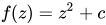
Pierre Fatou and Gaston Julia showed in the late 1910s that much of this story extends to any complex algebraic map from to itself of degree greater than 1. (Such a mapping may be given by a polynomial with complex coefficients, or more generally by a rational function.) Namely, there is always a compact subset of , the Julia set, on which the dynamics of f is chaotic. For the mapping , the Julia set is the unit circle. For other polynomial mappings, the Julia set is often highly irregular, for example a fractal in the sense that its Hausdorff dimension is not an integer. This occurs even for mappings as simple as for a constant . The Mandelbrot set is the set of complex numbers c such that the Julia set of is connected.


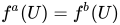
There is a rather complete classification of the possible dynamics of a rational function in the Fatou set, the complement of the Julia set, where the dynamics is "tame". Namely, Dennis Sullivan showed that each connected component U of the Fatou set is pre-periodic, meaning that there are natural numbers such that . Therefore, to analyze the dynamics on a component U, one can assume after replacing f by an iterate that . Then either (1) U contains an attracting fixed point for f; (2) U is parabolic in the sense that all points in U approach a fixed point in the boundary of U; (3) U is a Siegel disk, meaning that the action of f on U is conjugate to an irrational rotation of the open unit disk; or (4) U is a Herman ring, meaning that the action of f on U is conjugate to an irrational rotation of an open annulus. (Note that the "backward orbit" of a point z in U, the set of points in that map to z under some iterate of f, need not be contained in U.)



Complex dynamics has been effectively developed in any dimension. This section focuses on the mappings from complex projective space to itself, the richest source of examples. The main results for have been extended to a class of rational maps from any projective variety to itself. Note, however, that many varieties have no interesting self-maps.

Let f be an endomorphism of , meaning a morphism of algebraic varieties from to itself, for a positive integer n. Such a mapping is given in homogeneous coordinates by
Hub AI
Complex dynamics AI simulator
(@Complex dynamics_simulator)
Complex dynamics
Complex dynamics, or holomorphic dynamics, is the study of dynamical systems obtained by iterating a complex analytic mapping. This article focuses on the case of algebraic dynamics, where a polynomial or rational function is iterated. In geometric terms, that amounts to iterating a mapping from some algebraic variety to itself. The related theory of arithmetic dynamics studies iteration over the rational numbers or the p-adic numbers instead of the complex numbers.
A simple example that shows some of the main issues in complex dynamics is the mapping from the complex numbers C to itself. It is helpful to view this as a map from the complex projective line to itself, by adding a point to the complex numbers. ( has the advantage of being compact.) The basic question is: given a point in , how does its orbit (or forward orbit)
behave, qualitatively? The answer is: if the absolute value |z| is less than 1, then the orbit converges to 0, in fact more than exponentially fast. If |z| is greater than 1, then the orbit converges to the point in , again more than exponentially fast. (Here 0 and are superattracting fixed points of f, meaning that the derivative of f is zero at those points. An attracting fixed point means one where the derivative of f has absolute value less than 1.)
On the other hand, suppose that , meaning that z is on the unit circle in C. At these points, the dynamics of f is chaotic, in various ways. For example, for almost all points z on the circle in terms of measure theory, the forward orbit of z is dense in the circle, and in fact uniformly distributed on the circle. There are also infinitely many periodic points on the circle, meaning points with for some positive integer r. (Here means the result of applying f to z r times, .) Even at periodic points z on the circle, the dynamics of f can be considered chaotic, since points near z diverge exponentially fast from z upon iterating f. (The periodic points of f on the unit circle are repelling: if , the derivative of at z has absolute value greater than 1.)
Pierre Fatou and Gaston Julia showed in the late 1910s that much of this story extends to any complex algebraic map from to itself of degree greater than 1. (Such a mapping may be given by a polynomial with complex coefficients, or more generally by a rational function.) Namely, there is always a compact subset of , the Julia set, on which the dynamics of f is chaotic. For the mapping , the Julia set is the unit circle. For other polynomial mappings, the Julia set is often highly irregular, for example a fractal in the sense that its Hausdorff dimension is not an integer. This occurs even for mappings as simple as for a constant . The Mandelbrot set is the set of complex numbers c such that the Julia set of is connected.
There is a rather complete classification of the possible dynamics of a rational function in the Fatou set, the complement of the Julia set, where the dynamics is "tame". Namely, Dennis Sullivan showed that each connected component U of the Fatou set is pre-periodic, meaning that there are natural numbers such that . Therefore, to analyze the dynamics on a component U, one can assume after replacing f by an iterate that . Then either (1) U contains an attracting fixed point for f; (2) U is parabolic in the sense that all points in U approach a fixed point in the boundary of U; (3) U is a Siegel disk, meaning that the action of f on U is conjugate to an irrational rotation of the open unit disk; or (4) U is a Herman ring, meaning that the action of f on U is conjugate to an irrational rotation of an open annulus. (Note that the "backward orbit" of a point z in U, the set of points in that map to z under some iterate of f, need not be contained in U.)
Complex dynamics has been effectively developed in any dimension. This section focuses on the mappings from complex projective space to itself, the richest source of examples. The main results for have been extended to a class of rational maps from any projective variety to itself. Note, however, that many varieties have no interesting self-maps.
Let f be an endomorphism of , meaning a morphism of algebraic varieties from to itself, for a positive integer n. Such a mapping is given in homogeneous coordinates by