Hubbry Logo
Debbie Wasserman SchultzDebbie Wasserman SchultzMain
Open search
Debbie Wasserman Schultz
Community hub
Debbie Wasserman Schultz
logo
8 pages, 0 posts
0 subscribers
Be the first to start a discussion here.
Debbie Wasserman Schultz
from Wikipedia

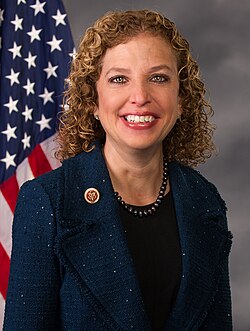
Deborah Wasserman Schultz (née Wasserman; /ˈwɑːsərmən/; born September 27, 1966) is an American politician serving as the U.S. representative for Florida's 25th congressional district, first elected to Congress in 2004. A member of the Democratic Party, she was the chair of the Democratic National Committee (DNC) from 2011 until her resignation in 2016.

Key Information

Wasserman Schultz served in the Florida House of Representatives and the Florida Senate and was a national co-chair of Hillary Clinton's 2008 campaign for president.[1] Her district covers much of southern Broward County, including a large part of Fort Lauderdale.

Wasserman Schultz was elected chair of the Democratic National Committee in May 2011, replacing Tim Kaine.[2][3] On July 28, 2016, she resigned from that position after WikiLeaks released leaked emails showing that she and other members of the DNC staff had expressed bias in preference of Hillary Clinton over Bernie Sanders in the 2016 Democratic primaries.[3][4] The emails showed that some DNC officials had discussed strategies to weaken Sanders’ campaign, questioning his viability, and even suggesting ways to discredit his supporters. She secured a senior surrogate spot on the Clinton campaign afterwards.[5]

Personal life and education

[edit]

Born in Forest Hills, Queens, New York, to a Jewish family,[6] Wasserman Schultz is the daughter of Ann and Larry Wasserman. Her father is a certified public accountant, and her brother, Steven Wasserman, is an assistant United States attorney for the District of Columbia.[7]

From 1968 to 1978, the family lived in Lido Beach on Long Island. In 1978, her family moved to Melville, also on Long Island, where she graduated from Half Hollow Hills High School East in 1984.[8] She received a Bachelor of Arts in 1988 and a Master of Arts with a certificate in political campaigning in 1990, both in political science, from the University of Florida.[9][10]

At the University of Florida, Wasserman Schultz was active in student government, serving as president of the Student Senate and the founder and president of the Rawlings Area Council Government.[9] She was also a member of the Omicron Delta Kappa honor society, the James C. Grimm chapter of the National Residence Hall Honorary, and the union Graduate Assistants United. She served as president of the Graduate Student Council and vice president of the UF College Democrats.[9][11] She has credited her experience in student politics with developing her "love for politics and the political process."[12]

Wasserman Schultz lives in Weston, near Fort Lauderdale. She is married to Steve Schultz; they have three children. She is an active member of the National Jewish Democratic Council, Planned Parenthood, and Hadassah.[13]

In March 2009, she revealed that she had undergone seven surgeries related to breast cancer in 2008 while maintaining her responsibilities as a member of the House. That year, she promoted efforts for early screening for breast cancer.[14]

Career

[edit]

Florida state legislature

[edit]
Wasserman Schultz with Suzanne Gunzburger and Steven Geller in April 2002

In 1988, Wasserman Schultz became an aide to Peter Deutsch at the beginning of his state legislative career.[10][15] In 1992, Deutsch successfully ran for United States Representative of Florida's 20th congressional district, and suggested to Wasserman Schultz that she run for his vacated seat in the Florida House of Representatives. Wasserman Schultz won 53% of the vote in a six-way Democratic primary, avoiding a runoff,[15] and won the general election. At 26, she became the youngest female legislator in the state's history.[10][16]

She served four terms in the Florida State House of Representatives, for eight years, leaving due to state term limits.[10] She became an adjunct instructor of political science at Broward Community College, as well as a public policy curriculum specialist at Nova Southeastern University.[citation needed]

Wasserman Schultz was elected to the Florida State Senate in 2000. She supported several bills, including the Florida Residential Swimming Pool Safety Act and one creating a Children's Services Council for Broward County. She received an award from the Save the Manatee Club for her commitment as a state senator in the 2002 legislative session to manatee protection.[17]

U.S. House of Representatives

[edit]
Wasserman Schultz with Christina Ricci in April 2007

Committee assignments

[edit]

For the 118th Congress:[18]

Caucus memberships

[edit]

Party leadership

[edit]

Wasserman Schultz was appointed to the Democratic Steering and Policy Committee in her first term. During the 2006 elections, she raised over $17 million in campaign contributions for her Democratic colleagues (third-most after Nancy Pelosi and Rahm Emanuel), was chosen as Chief Deputy Whip, and was appointed to the Appropriations Committee, a plum assignment for a sophomore representative.[29]

Wasserman Schultz chairs the committee's Subcommittee on Military Construction, Veterans Affairs, and Related Agencies. Shortly after joining the Appropriations Committee, she received a waiver necessary to sit on an additional committee (Appropriations is typically an exclusive committee), and she is now a member of the Committee on Oversight and Reform. Aside from her committee and leadership roles, she was a member of Nancy Pelosi's "30 Something" Working Group, which consists of congressional Democrats mostly under age 40. The group concentrates on issues affecting young people, including Social Security. She joined the bipartisan Congressional Cuba Democracy Caucus. According to the Congress.org 2008 Power Rankings, she was the 24th-most powerful member of the House, the 22nd-most powerful Democratic representative, and the most powerful Florida representative.[30]

In December 2019, Wasserman Schultz voted to impeach President Donald Trump.[31]

Political positions

[edit]

Wasserman Schultz is a proponent of gun control legislation and supporter of LGBT rights.

She initiated the 2007 Virginia Graeme Baker Pool and Spa Safety Act to address the safety risks posed by suction entrapment.

In 2011, Wasserman Schultz was one of the 23 co-sponsors of H.R. 3261, the Stop Online Piracy Act (SOPA).[32]

On April 25, 2018, 57 Representatives, including Wasserman Schultz,[33] condemned history-related legislation in Ukraine and Poland.[34] They criticized Poland's new Holocaust law, which they claimed would criminalize accusing Poles of complicity in the Holocaust,[35] as well as Ukraine's 2015 memory laws glorifying Ukrainian Insurgent Army (UPA) and its pro-Nazi leaders, such as Roman Shukhevych.[33]

During the 117th Congress, Wasserman Schultz voted with President Joe Biden's stated position 100% of the time according to a FiveThirtyEight analysis.[36]

Consumer Finance Protection Bureau and payday lending

[edit]

In December 2015, Wasserman Schultz was one of 24 co-sponsors of H.R. 4018, authored by Representative Dennis A. Ross, which would delay the implementation of CFPB regulations.[37][38] She was among a dozen Florida representatives who cosponsored the legislation that would delay the CFPB's payday lending rules by two years and void a "deferred presentment transaction" in states with laws similar to Florida's. She has drawn criticism for trying to delay those regulations.[39]

Terri Schiavo case

[edit]

The Terri Schiavo case concerned the fate of a young Florida woman who had suffered brain damage after a heart attack in 1990 and was in a coma on life support. Her husband, who was her legal guardian while engaged to another woman, and the medical team wanted to remove her feeding tube, as she was in an irreversible "persistent vegetative state" with no hope of improvement. Her parents opposed this decision for years, appealing to courts, Congress, and ultimately to President George W. Bush to intervene. Wasserman Schultz was one of the strongest opponents of congressional intervention, supporting the husband's view. The feeding tube was finally removed on 18 March 2005, resulting in Schiavo's death on 31 March.

Wasserman Schultz publicly accused Bush of hypocrisy for having signed a 1999 bill as governor of Texas that allows health care workers to remove life support for terminally ill patients if the patient or family is unable to pay the medical bills.[40]

Israeli–Palestinian conflict

[edit]

Wasserman Schultz is a supporter of Israel.[41]

Her predecessor and mentor Peter Deutsch was "among the most hawkish congressional Democrats on Middle East issues". Wasserman Schultz, who took over his seat for Florida's 20th district, "a heavily Jewish swath of Broward County", has taken a more centrist approach.[10] In 2005 she spoke in approval of President Bush's proposals to give financial aid to the Palestinian Authority in both the proposed supplemental and in the 2006 budgets, praising Bush's greater "engagement and involvement" on the issue.

She has disputed claims that the Democratic Party is anti-Israel, arguing that the House Democratic Caucus is more supportive of the state than its "far-right" Republican counterparts, and questioning Republican motivations on the issue.

Wasserman Schultz and other members of the US congressional delegation with Israeli President Isaac Herzog in Jerusalem, March 28, 2024

Wasserman Schultz supported Israel in the 2014 Gaza War and criticized MSNBC's coverage of it, saying: "Clearly [MSNBC was] highlighting what Israel had done to Gaza and the plight of Palestinians. My first thought was, where is the balance? Where is the spotlight on what Jewish children in Israel go through from being victims of rocket attacks?"[42]

She has continued to defend the state's military action in the Gaza Strip, including the ongoing Gaza war which has led to tens of thousands of Palestinian deaths. When the International Court of Justice ruled that Israel's operations in Gaza and the West Bank constitute illegal occupation, Wasserman Schultz claimed on Twitter that the court “discriminates against Israel.” She voiced support for a two-state solution to the conflict, although Israel's Knesset subsequently overwhelmingly rejected such a solution.[2]

Wasserman Schultz supported President Trump's decision to recognize Jerusalem as Israel's capital, saying: "We must work toward a day where the entire world recognizes Jerusalem as the capital of Israel, and that can be achieved through final status negotiations. I remain as committed as ever to safeguarding Israel's future as a Jewish and democratic state, at peace with its neighbors, with Jerusalem as its undisputed capital."[43]

In November 2023, she voted in favor of a bill that provided an additional $14.3 billion to support Israeli military operations in the Gaza Strip.[44]

Wasserman Schultz voted for the Antisemitism Awareness Act of 2023.[45]

Wasserman Schultz was one of 22 Democrats to vote to censor Rashida Tlaib.[46]

Wasserman Schultz voted for the Stop Terror-Financing and Tax Penalties on American Hostages Act.[47]

Wasserman Schultz voted for the "Israel Security Supplemental Appropriations Act, 2024" which was incorporated into Public Law 118-50.[48]

In 2025, Wasserman Schultz sent a letter to Wikimedia CEO Maryana Iskander "seeking answers on how the online encyclopedia will enforce its own rules, curb editor bias and prevent antisemitism and pro-terrorist content from infiltrating Wikipedia pages".[49]

Wasserman Schultz voted to sanction the International Criminal Court after it issued arrest warrants for Israeli leaders.[50]

Presidential signing statements

[edit]

Wasserman Schultz supports the use of appropriations for future control of presidential signing statements as revealed during questions in a July 26, 2008, House Judiciary Committee hearing on the constitutional limits of executive power.[51]

Debbie Wasserman Schultz receives award from Plantation Democratic Club President Marvin Quittner, May 5, 2013.

Support for the Iran Nuclear Deal In 2015, Rep. Wasserman Schultz announced her support for the Joint Comprehensive Plan of Action (JCPOA), commonly known as the Iran Nuclear Deal. This agreement has been a point of contention, with critics arguing it does not adequately prevent Iran from developing nuclear weapons.[52]

Jewish American Heritage Month

[edit]

Wasserman Schultz is Florida's first female Jewish member of Congress.[53][54]

In 2022, Wasserman Schultz convened a congressional hearing to investigate allegations that big tech media companies were not holding instances[clarification needed] of antisemitism on their respective platforms.[55]

She and Senator Arlen Specter were the driving forces behind the resolution that declared May Jewish American Heritage Month. The annual observance was created to recognize "the accomplishments of American Jews and the important role that members of the Jewish community have played in the development of American culture".[56] The observance is modeled after Black History Month, Hispanic Heritage Month and Women's History Month. Wasserman Schultz envisioned "classroom instruction, public ceremonies and broadcast announcements", saying, "There's a generation of children growing up with a fading memory of what happened during World War II or even an understanding of anyone who is Jewish or their culture and traditions. Through education comes tolerance."[57] The bill introducing the observance passed unanimously in both the House and the Senate and was signed by President George W. Bush. Wasserman Schultz said of the proclamation, "This is an historic occasion. Generations to come will have the chance to live without antisemitism through greater understanding and awareness of the significant role that American Jews have played in U.S. history. Jewish American Heritage Month is a reality because of the people gathered today in this room."[56]

The measure was criticized by Gary Cass, executive director of the now-defunct Center for Reclaiming America for Christ, a conservative Christian organization based in Fort Lauderdale, who objected to "teaching Jewish history without talk of religious practices and values", saying, "We cannot seem to have an honest discussion about the Christian roots of America". He added, "How much tolerance would [Wasserman Schultz] have for a Christian Heritage month?" She replied that the situation is different, that "Judaism is unique, because it is both a culture and a religion", and that she was not in favor of "teaching any religion in public schools".[57] Her father, Larry Wasserman, said that while she had not been particularly active in the Jewish community before entering politics, she has "forged ties with Jewish groups as a lawmaker. She helped to form the National Jewish Democratic Council and served on the regional board of the American Jewish Congress."[15]

2008 financial crisis

[edit]

On September 29, 2008, Wasserman Schultz voted for the Emergency Economic Stabilization Act of 2008,[58] and on October 3, 2008, for the revised version of that act.[59]

Hate crimes

[edit]

During an April 2009 House Judiciary Committee hearing on the Hate Crimes Prevention Act of 2009, Representative Tom Rooney, a former active duty U.S. Army JAG Corps officer, introduced an amendment that would make attacks against military veterans a hate crime. Wasserman Schultz remarked on the amendment:

I'm from a state, as Mr. Rooney is, that includes and represents the districts that include real victims. I represent a very large – one of the largest – gay populations in the United States of America. One of the largest Jewish populations in the United States of America. My region – our region – has a very large African-American population. It really is belittling of the respect that we should have for these groups to suggest that members of the armed services have somehow systematically been the victims of hate crimes.[60]

Death of Daniel Wultz

[edit]
Former House majority leader Eric Cantor, left, Rep. Debbie Wasserman Schultz, second from left, listen as Sheryl and Tuly Wultz talk about the impact of prayer in the life of their son, Daniel Wultz on May 1, 2014, in the Office of the House Majority Leader, Washington, D.C.

Wasserman Schultz became a vocal advocate for the family of Daniel Wultz, constituents of hers who were engaged in legal action against the Bank of China. They alleged it had a role in financing the terrorist attack that killed the 16-year-old from Weston, Florida, in 2006.[61]

In August 2013, Wasserman Schultz told the Miami Herald: "In South Florida, we all know too well of the tragic circumstances surrounding the cowardly terrorist attack that took Daniel Wultz's innocent life. I have been working hand in hand with the Wultz family and the state of Israel to ensure any and all of those involved in this terrorist activity, including the Bank of China, pay for their crimes so that justice can be served."[61]

On May 1, 2014, together with then-House majority leader Eric Cantor, Wasserman Schultz hosted the Wultz family at the U.S. Capitol in a National Prayer Day event.[62]

Identity theft

[edit]

On February 15, 2013, Wasserman Schultz introduced the Stopping Tax Offenders and Prosecuting Identity Theft Act of 2013 (H.R. 744; 113th Congress) into the House.[63] The bill would increase the penalties on identity thieves and change the definition of identity theft to include businesses and organizations instead of just individuals.[64]

Marijuana

[edit]

Wasserman Schultz opposed a 2014 medical marijuana amendment in Florida that narrowly failed to receive the 60% of votes needed to amend the Constitution of Florida. She angered medical marijuana activists and major Democratic donors over this and her comparisons of medical marijuana dispensaries to "pill mills", which overprescribe and overdispense painkillers to patients with dubious symptoms.[65] After Wasserman Schultz expressed interest in running for the United States Senate in 2016, medical marijuana activists vowed to thwart her ambition. Attorney and donor John Morgan said that her position on medical marijuana "disqualifies her from the [Democratic Senate] nomination... Her position denies terminally ill and chronically ill people compassion."[65]

In response, in February 2015, Wasserman Schultz's staff emailed Morgan, offering to change her position on medical marijuana if Morgan would stop criticizing her. Morgan declined her offer and released the emails to Politico, calling her a "bully".[66] Wasserman Schultz at first declined to comment,[66] then denied that her office had sent the emails.[67] Morgan responded: "What Debbie leaves out in her pushback was the crystal clear message that her potential support of the new amendment [that has been proposed for the ballot in 2016] was predicated upon me withdrawing my comments to Politico. I don't know how to view that as anything but an offer of a quid pro quo."[67]

Gun control

[edit]

In 2018, Wasserman Schultz co-sponsored a bill to "strengthen school safety and security", which required a two-thirds vote for passage, given it was brought up under an expedited process. The House voted 407–10 to approve the bill, which would "provide $50 million a year for a new federal grant program to train students, teachers and law enforcement on how to spot and report signs of gun violence". Named the STOP (Students, Teachers, and Officers Preventing) School Violence Act, it would "develop anonymous telephone and online systems where people could report threats of violence." At the same time, it would authorize $25 million for schools to improve and harden their security, such as installing new locks, lights, metal detectors and panic buttons." A separate spending bill would be required to provide money for the grant program.[68]

Political campaigns

[edit]

2004

[edit]

In 2004, Wasserman Schultz's mentor Peter Deutsch resigned his congressional seat to make an unsuccessful run for the Senate seat of fellow Democrat Bob Graham. Wasserman Schultz was unopposed in the Democratic primary election held to fill Deutsch's seat. Her Republican opponent was Margaret Hostetter, a realtor who had never held public office. The 20th is so heavily Democratic that Hostetter faced nearly impossible odds in November, but she gained notoriety for her attacks on Wasserman Schultz. For example, Hostetter's campaign site criticized Wasserman Schultz for protesting an American flag photograph with a Christian cross on it that was on display in the workstation of a secretary in a government building. Hostetter wrote, "Elect Margaret Hostetter to Congress November 2 and send the clear message that Americans respect and support... the foundational role Christianity has had in the formation of our great nation. Our rights come from God, not the state."[citation needed]

Wasserman Schultz won with 70.2% of the vote to Hostetter's 29.8%.[69]

2006

[edit]

Wasserman Schultz was unopposed for reelection in 2006.

2008

[edit]

In 2008 Wasserman Schultz defeated Independent Margaret Hostetter and Socialist write-in candidate Marc Luzietti.

She supported Hillary Clinton for her party's 2008 presidential nomination, and in June 2007 was named one of Clinton's national campaign co-chairs. Once Senator Barack Obama became the presumptive Democratic nominee, she endorsed him and joined Senator Ken Salazar and Representative Artur Davis to second his nomination at the 2008 Democratic National Convention.

On CBS's Face the Nation, she called Sarah Palin unready for the vice presidency. "She knows nothing...Quite honestly, the interview I saw and that Americans saw on Thursday and Friday was similar to when I didn't read a book in high school and had to read the CliffsNotes and phone in my report", Wasserman Schultz said of Palin's interview with ABC's Charlie Gibson the previous week. "She's Cliff-noted her performance so far."[70] Wasserman Schultz was also named a co-chair of the Democratic Party's Red to Blue congressional campaign group.[71] Controversy arose in March 2008 when she felt unable to campaign against South Florida Republican representatives Ileana Ros-Lehtinen, Mario Díaz-Balart, and the now-retired Lincoln Díaz-Balart because of her good friendship with them.[72] Wasserman Schultz and Ros-Lehtinen are both on the LGBT Equality Caucus of which Wasserman Schultz was a vice chair. Ros-Lehtinen has been the sole Republican on the 112-member caucus since 2013.

2010

[edit]

Wasserman Schultz defeated Republican nominee Karen Harrington, Independents Stanley Blumenthal and Bob Kunst, and Florida Whig Party candidate Clayton Schock with 60.1% of the vote.

2012

[edit]

After the 2010 census, Wasserman Schultz's district was renumbered the 23rd and pushed further into Miami-Dade County, taking in most of Miami Beach and a portion of Miami itself. Harrington ran again.[73] Wasserman Schultz won with 63.2% of the vote to Harrington's 35.6%. When she was sworn in, she became the first white Democrat to represent a significant portion of Miami since 1993.

2014

[edit]

In the general election, Wasserman Schultz defeated Republican Joe Kaufman, 62.7% to 37.3%.

2016

[edit]

After a court-ordered redistricting in 2015, Wasserman Schultz lost much of her share of Miami-Dade County, including her portions of Miami and Miami Beach.

Economist and law professor Tim Canova challenged Wasserman Schultz in the August 30, 2016, Democratic primary.[74] He was endorsed by Senator Bernie Sanders.[75][76] Wasserman Schultz won the primary with 57% of the vote.[77][78][79]

On August 8, 2016, in the wake of the WikiLeaks Democratic National Committee email disclosures, Canova filed a Federal Election Commission (FEC) violations of regulations complaint against Wasserman Schultz, alleging "interference" with his campaign, contending that on her behalf "the DNC paid a team of national, senior communications and political professionals significant sums of money for their consulting services and the Wasserman Schultz for Congress Campaign utilized these services free of charge."[80] A spokesman for Wasserman Schultz said that the complaint was without merit and that it was "based on stolen, cherry-picked information".[81]

In the general election, Wasserman Schultz defeated Republican nominee Joe Kaufman with 56.7% of the vote.[82]

2018

[edit]

Wasserman Schultz ran unopposed in the Democratic primary and was challenged by Kaufman and Independent candidates Tim Canova and Don Endriss. She won the general election with 58.48% of the vote.[83]

2020

[edit]

Wasserman Schultz was challenged by Florida attorney Jen Perelman in the August 2020 Democratic primary.[84]

On August 16, 2020, Martina Velasquez, a 16-year-old volunteer for Perelman's campaign, filed a police report alleging that Wasserman Schultz had shoved her more than once when both were talking to voters.[85] Velasquez declined to press charges but asked for a public apology.[86] In the August 18 primary Perelman won 28% of the vote to Wasserman Schultz's 72%.[87]

Chair of the Democratic National Committee

[edit]
Chair Wasserman Schultz speaking to the College Democrats of America

On April 5, 2011, President Barack Obama chose Wasserman Schultz to succeed Tim Kaine as the 52nd chair of the Democratic National Committee. Until she assumed office, Donna Brazile served as interim DNC chair. Wasserman Schultz was confirmed at a May 4 DNC meeting in Washington, D.C.[88]

During an appearance on Face the Nation, Wasserman Schultz said, "The Republicans have a plan to end Medicare as we know it. What they would do is they would take the people who are younger than 55 years old today and tell them, 'You know what? You're on your own. Go and find private health insurance in the health-care insurance market.'"[89] Four nonpartisan fact-checkers called her claim false.[90] She then came under criticism for saying on Washington Watch with Roland Martin, "You have the Republicans, who want to literally drag us all the way back to Jim Crow laws and literally—and very transparently—block access to the polls to voters who are more likely to vote for Democratic candidates than Republican candidates". The next day, she said that "Jim Crow was the wrong analogy to use".[91]

In 2012, many of Obama's advisers questioned the move to select Wasserman Schultz as DNC chair, feeling she came across as too partisan on television. An internal focus study of the popularity of top Obama campaign surrogates ranked Wasserman Schultz at the bottom.[92] She was ultimately reelected to Chair on January 22, 2013.[93] In February 2015, Politico, citing unnamed sources, reported that Wasserman Schultz had lined up supporters in 2013 to portray any decision by Obama to replace her as DNC chair as "anti-woman and anti-Semitic".[94]

In 2011, she missed 62 votes of Congress, placing her 45th of 535 in missing Congressional votes.[95][96]

2016 presidential election

[edit]

Clinton's opponents Martin O'Malley and Bernie Sanders both criticized Wasserman Schultz's decision to schedule only six debates in the 2016 presidential primary, fewer than in previous election cycles, as well as the timing of the debates.[97][98]

Ultimately, there were nine debates that both Clinton and Sanders participated in during the primaries, as well as a number of town halls.[99]

Some of Wasserman Schultz's actions that the news covered during the primaries were reducing the debate schedule;[100][101][102] uninviting former DNC vice chair Tulsi Gabbard to the first primary debate;[103][104] halting the Sanders campaign's access to DNC databases after a staffer from his campaign attempted to exploit a security breach;[105][106] defending the superdelegate system used in the Democratic primaries;[107] rescinding a prior ban on corporate donations;[108][109] and accusing Sanders supporters of violence at the Nevada Convention.[110][111][112]

Resignation/controversies

[edit]

After WikiLeaks published DNC emails that showed that some DNC staffers had expressed strong preference for Clinton against Sanders in the primary,[113][114][115] Wasserman Schultz tendered her resignation as head of the DNC, to become effective as of the close of the nominating convention in Philadelphia. According to reports in The Washington Post, Wasserman Schultz strongly resisted suggestions she resign until a phone call from Obama persuaded her.[116]

After a speech at the convention before the Florida delegation during which Wasserman Schultz was "booed off stage" by Sanders supporters, the DNC decided that she would not open the convention.[117][118][119]

2017 House IT staff accused

[edit]

In February 2017 Politico and BuzzFeed reported Capitol Police accused five IT staffers (who worked for more than 30 House Democrats including Wasserman Schultz) of trying to steal House computer equipment and violating House security policies.[120][121][122]

As of February 6, 2017, Politico noted that Wasserman Schultz was one of several House members who did not terminate the suspected staffers after the criminal complaints.[123] In July 2017, one of the accused staffers, Imran Awan, was arrested for making a false statement on a bank loan application.[124][125] After his arrest, Wasserman Schultz's office fired Awan.[126] Wasserman Schultz later defended her decision not to fire Awan earlier, saying, "I believe that I did the right thing, and I would do it again."[127]

In 2018, The Washington Post reported:[124]

Federal prosecutors concluded an 18-month investigation into a former congressional technology staffer on Tuesday by publicly debunking allegations — promoted by conservative media and President Trump — suggesting he was a Pakistani operative who stole government secrets with cover from House Democrats. As part of an agreement with prosecutors, Imran Awan pleaded guilty to a relatively minor offense unrelated to his work on Capitol Hill: making a false statement on a bank loan application. U.S. prosecutors said they would not recommend jail time.

According to The New York Times:[128]

In the plea agreement, federal prosecutors debunked conspiracy theories about the case that had circulated online. They said that the government had interviewed about 40 witnesses, examined the House Democratic Caucus server and other data and devices, reviewed electronic communications and interviewed Mr. Awan on numerous occasions. They found no evidence that Mr. Awan had engaged in illegal conduct involving House computer systems.

October 2018 mail bomb attempt

[edit]

On October 24, 2018, a pipe bomb device sent to former U.S. attorney general Eric Holder, which had the wrong address, was instead delivered to the Florida office of Wasserman Schultz, whose name and address was on the return labels of all the packages.[129] During this time, similar pipe bomb devices had been sent to various influential Democratic politicians.[129] The packages containing the devices, as well as envelopes containing mysterious white powder, also labeled Schultz's office in Sunrise, Florida, as the sender,[129] but the person who sent these devices and envelopes misspelled her name as "Shultz."[129] The same day, a similar device was found at Wasserman Schultz's office in Aventura, Florida, as well.[130] Fingerprint DNA helped identify the suspect as Florida resident and right-wing conspiracist Cesar Sayoc,[131][132] who was arrested in a parking lot, in Plantation, Florida, on October 26, 2018.[133]

Stock trading

[edit]

In 2022 Schultz's stock portfolio was up 50.8%, the second-highest gain in Congress that fiscal year[134] following Rep. Patrick Fallon. Schultz made a large portion of this gain from trading energy stocks including a $45,000 purchase of Patterson-UTI Energy. Schultz did all this while on the House Natural Resources Committee.

From December 2023 to December 2024 Schultz's stock portfolio saw an increase of 142.3%, the second-highest gain in Congress that fiscal year. In this same span of time the S&P500 saw an increase of 24.9%

Electoral history

[edit]

Florida House of Representatives

[edit]
1992 Florida House of Representatives election, 97th district[135][136]
Primary election
Party Candidate Votes %
Democratic Debbie Wasserman Schultz 4,260 53.38
Democratic Pat Ernst 1,748 21.90
Democratic John Scism 679 8.51
Democratic Andrew Salvage 570 7.14
Democratic Carmen Diaz Fabian 366 4.59
Democratic Norris H. Barr 358 4.49
Total votes 7,981 100.00
General election
Democratic Debbie Wasserman Schultz 31,345 64.11
Republican Mark W. Casteel 17,550 35.89
Total votes 48,895 100.00
Democratic hold
1996 Florida House of Representatives election, 97th district[137]
Party Candidate Votes %
Democratic Debbie Wasserman Schultz (incumbent) 38,971 66.19
Republican George W. Gardner 19,909 33.81
Total votes 58,880 100.00
Democratic hold
1998 Florida House of Representatives election, 97th district[138]
Party Candidate Votes %
Democratic Debbie Wasserman Schultz (incumbent) 32,725 72.31
Republican Peter "Pete" Ierardi 12,534 27.69
Total votes 45,259 100.00
Democratic hold

Florida Senate

[edit]
2000 Florida Senate election, 32nd district[139]
Party Candidate Votes %
Democratic Debbie Wasserman Schultz 107,052 66.39
Republican Ken Jennings 54,191 33.61
Total votes 161,243 100.00
Democratic hold
2002 Florida Senate election, 34th district[140]
Party Candidate Votes %
Democratic Debbie Wasserman Schultz 65,311 63.63
Republican Art Waganheim 37,323 36.37
Total votes 102,634 100.00
Democratic gain from Republican

U.S. House of Representatives

[edit]
2004 U.S. House of Representatives election, Florida's 20th district[141]
Party Candidate Votes %
Democratic Debbie Wasserman Schultz 191,195 70.19
Republican Art Waganheim 81,213 29.81
Total votes 272,408 100.00
Democratic hold
2006 U.S. House of Representatives election, Florida's 20th district
Party Candidate Votes %
Democratic Debbie Wasserman Schultz 124,554 100%
Total votes 124,554 100.00
Democratic hold
2008 U.S. House of Representatives election, Florida's 20th district[142]
Party Candidate Votes %
Democratic Debbie Wasserman Schultz (incumbent) 202,832 77.48
independent (politician) Margaret Hostetter 58,958 22.52
write-in Marc Luzietti 9 0.00
Total votes 261,799 100.00
Democratic hold
2010 U.S. House of Representatives election, Florida's 20th district[143]
Party Candidate Votes %
Democratic Debbie Wasserman Schultz (incumbent) 100,787 60.15
Republican Karen Harrington 63,845 38.10
independent (politician) Stanley Blumenthal 1,663 0.99
independent (politician) Robert Kunst 1,272 0.76
write-in Clayton Schock 3 0.00
Total votes 167,570 100.00
Democratic hold
2012 U.S. House of Representatives election, Florida's 23rd district[144]
Party Candidate Votes %
Democratic Debbie Wasserman Schultz 174,205 63.25
Republican Karen Harrington 98,096 35.62
independent (politician) Ilya Katz 3,129 1.14
Total votes 275,430 100.00
Democratic hold
2014 U.S. House of Representatives election, Florida's 23rd district[145]
Party Candidate Votes %
Democratic Debbie Wasserman Schultz (incumbent) 103,269 62.67
Republican Joseph "Joe" Kaufman 61,519 37.33
Total votes 164,788 100.00
Democratic hold
2016 U.S. House of Representatives election, Florida's 23rd district[146][147]
Primary election
Party Candidate Votes %
Democratic Debbie Wasserman Schultz (incumbent) 28,809 56.80
Democratic Tim Canova 21,907 43.20
Total votes 50,716 100.00
General election
Democratic Debbie Wasserman Schultz 183,225 56.70
Republican Joseph "Joe" Kaufman 130,818 40.49
independent (politician) Don Endriss 5,180 1.60
independent (politician) Lyle Milstein 3,897 1.21
Total votes 323,120 100.00
Democratic hold
2018 U.S. House of Representatives election, Florida's 23rd district[148]
Primary election
Party Candidate Votes %
Democratic Debbie Wasserman Schultz (incumbent) 161,611 58.48
Republican Joseph "Joe" Kaufman 99,446 35.98
independent (politician) Tim Canova 13,697 4.96
independent (politician) Don Endriss 1,612 0.58
Total votes 276,366 100.00
Democratic hold
2020 U.S. House of Representatives election, Florida's 23rd district[149][150]
Primary election
Party Candidate Votes %
Democratic Debbie Wasserman Schultz (incumbent) 55,729 72.04
Democratic Jennifer "Jen" Perelman 21,631 27.96
Total votes 77,360 100.00
General election
Democratic Debbie Wasserman Schultz (incumbent) 221,239 58.19
Republican Carla Spalding 158,874 41.79
write-in Jeff Olson 46 0.01
write-in Demetrius "DB" Fugate 37 0.01
Total votes 380,196 100.00
Democratic hold
2022 U.S. House of Representatives election, Florida's 25th district[151][152]
Primary election
Party Candidate Votes %
Democratic Debbie Wasserman Schultz (incumbent) 50,554 89.01
Democratic Robert Millwee 6,241 10.99
Total votes 56,795 100.00
General election
Democratic Debbie Wasserman Schultz (incumbent) 129,113 55.09
Republican Carla Spalding 105,239 44.91
Total votes 234,352 100.00
Democratic hold
2024 U.S. House of Representatives election, Florida's 25th district[153][154]
Primary election
Party Candidate Votes %
Democratic Debbie Wasserman Schultz (incumbent) 36,479 83.23
Democratic Jennifer "Jen" Perelman 7,349 16.77
Total votes 43,828 100.00
General election
Democratic Debbie Wasserman Schultz (incumbent) 186,942 54.47
Republican Chris Eddy 156,208 45.52
write-in Eric Goldfarb 41 0.01
Total votes 343,191 100.00
Democratic hold

Awards

[edit]
  • Crime Fighter of the Year Award, Rape Abuse and Incest National Network (RAINN), 2008[155]
  • Giraffe Award, Women's Advocacy Majority Minority (WAMM), 1993
  • Outstanding Family Advocacy award, Dade County Psychol. Assn., 1993
  • Rosemary Barkett award, Academy of Florida Trial Lawyers, 1995
  • Woman of the Year, AMIT, 1994
  • Outstanding Legislator of the year, Florida Federation of Business & Professional Women, 1994
  • Quality Floridian, Florida League of Cities, 1994
  • Woman of Vision, Weizmann Institute of Science
  • One of Six Most Unstoppable Women, South Florida Magazine, 1994.[156]

See also

[edit]

References

[edit]
[edit]
Revisions and contributorsEdit on WikipediaRead on Wikipedia
from Grokipedia
Debbie Wasserman Schultz (born September 27, 1966) is an American politician serving as the U.S. Representative for , a position she has held since 2017 after representing the 23rd district from 2005 to 2017. A Democrat, she previously chaired the from 2011 until her resignation in July 2016, following the publication of over 19,000 DNC emails that revealed internal efforts by party officials, including herself, to undermine ' 2016 presidential primary campaign in favor of . Born in , New York, Wasserman Schultz graduated from the with a in , where she served as president of the Student . She entered politics early, becoming the youngest woman elected to the in 1992 at age 26, later serving in the from 2000 to 2004 before her election to Congress. In the House, she has focused on appropriations as of subcommittees on military construction, , and related agencies, as well as energy and water development. Her tenure has included notable controversies, such as her defense of IT staffer , whom she retained on payroll despite investigations into unauthorized access to congressional data systems by him and family members; Awan pleaded guilty to in 2018 but was cleared of allegations. Wasserman Schultz has been a vocal advocate for Democratic priorities including healthcare access and support for , while facing criticism for her role in the 2016 DNC impartiality lapses that fueled perceptions of party establishment bias.

Early Life and Education

Upbringing and Family Background

Debbie Wasserman Schultz was born Deborah Wasserman on September 27, 1966, in , New York, to parents Lawrence Wasserman, a , and Ann Wasserman. The family was Jewish, though Wasserman Schultz later described her upbringing as not highly religious, with her parents nonetheless instilling an awareness of Judaism's significance. From 1968 to 1978, the Wassermans lived in Lido Beach on , where she spent much of her childhood before the family relocated within the region. Raised in a middle-class household on , Wasserman Schultz attended public schools, graduating from Half Hollow Hills High School East in 1984. Her early environment emphasized education and professional achievement, influenced by her father's career in , though specific details on family dynamics or parental political involvement remain limited in public records. This New York suburban setting provided the backdrop for her initial exposure to Democratic-leaning values, as Long Island's Nassau County has historically supported moderate Democrats amid a mix of conservative suburbs.

Academic and Early Professional Experience

Wasserman Schultz attended the in Gainesville, where she served as president of the Student Senate. She earned a degree in from the university in 1988. She subsequently obtained a degree from the in 1990. Prior to her election to the , Wasserman Schultz worked as a staff aide to U.S. Representative from 1989 to 1992. This role marked her initial entry into professional political work immediately following her undergraduate studies.

State Legislative Career

Service in the

Debbie Wasserman Schultz was first elected to the on November 3, 1992, becoming the youngest woman in the chamber's history at age 26. She represented a district in northern Broward County, serving from 1993 to 2000 across four terms, with re-elections in 1994, 1996, and 1998. During her time in the , Wasserman , a Democrat operating in a Republican-majority , focused her work on committees addressing key areas. In the 1998–2000 term, she served on the Health & Family Services Council, the Services Committee, the & Taxation Committee, the General Appropriations Committee, and the Regulated Industries Committee. These assignments positioned her to influence appropriations, , and fiscal matters, though detailed records of sponsored bills from this period emphasize her preparatory role for later state senate leadership rather than standalone House enactments.

Tenure in the Florida Senate

Wasserman Schultz was elected to the in November 2000, representing District 32, which encompassed parts of Broward and Miami-Dade counties. She served from November 2000 to November 2004, transitioning to District 34 following after the 2000 . As a Democrat in a Republican-controlled , her tenure focused on issues affecting families, children, and local communities in . During the 2000-2002 session, Wasserman Schultz held committee assignments including vice chair of the , Local and Military Affairs Committee, and membership on the Banking and Committee and the Health, Aging and Committee. In the 2002-2004 term, she served as co-chair of the Democratic Committee, influencing minority party priorities on policy development. Wasserman Schultz sponsored several bills aimed at consumer protection and family support, including S 158, the Florida Infant Crib Safety Act, which established standards for crib safety to prevent infant injuries. She also introduced S 160, named the Debbie Wasserman Schultz Act of 2002, requiring dog racing permitholders to maintain adoption booths at facilities to promote post-racing careers; the bill passed as CS/SB 160. Other sponsored measures included S 200 on regulations for motorized scooters and S 202 extending unemployment compensation benefits related to birth and . These efforts reflected her emphasis on practical safeguards for vulnerable populations, though passage rates varied in the GOP-majority chamber.

Congressional Career

Path to Congress and Electoral Successes

Following her service in the Florida Senate from 2000 to 2004, where term limits prevented further tenure, Debbie Wasserman Schultz announced her candidacy for the U.S. House of Representatives in Florida's 20th congressional district in early 2004. The district, encompassing parts of Broward and Palm Beach counties, had been held by Republican incumbent E. Clay Shaw Jr. since 1981. Wasserman Schultz secured the Democratic nomination without opposition in the August 31, 2004, primary. In the November 2, 2004, , Wasserman Schultz defeated Shaw, capturing 162,780 votes (70.2 percent) to Shaw's 67,217 votes (29.0 percent), flipping the seat from Republican to Democratic control amid a year when Democrats gained only three net seats nationwide. She was sworn into office on January 4, 2005, beginning her tenure representing a with a strong Democratic lean due to its urban and suburban demographics in . Wasserman Schultz has since achieved consistent electoral success through multiple re-elections, often in districts redrawn after census-based reapportionments. Following the 2010 redistricting, she transitioned to the newly configured for the , which retained a Democratic tilt. Her margins remained substantial in early cycles, reflecting the district's voter composition favoring Democratic candidates on issues like and .
Election YearGeneral Election Vote SharePrincipal Opponent
200620th61.2%Joe Sanberg (R)
200820th62.7%Margaret Hostetter (R)
201020th60.1%Allen West (R, write-in challenge post-primary)
23rd63.2%Karen Harrington (R)
201423rd62.7%Joe Kaufman (R)
201623rd56.7%Joe Kaufman (R)
201823rd58.5%Joe Kaufman (R)
202023rd58.2%Carla Spalding (R)
202225th55.1%Carla Spalding (R)
202425th54.5%Chris Eddy (R)
Margins narrowed in later years, particularly after the Republican-led shifted boundaries to include more competitive areas in Broward County, yet she retained the seat each time with pluralities exceeding 50 percent. This record underscores her entrenched position in a politically polarized region where Democratic advantages have sustained incumbency despite national Republican gains in .

Committee Assignments and Internal Leadership Roles

Upon entering the U.S. in January 2005 as part of the 109th , Wasserman Schultz was assigned to the House Budget Committee, where she focused on matters. She was also appointed to the House Democratic Steering and Policy Committee during her first term, a body responsible for recommending committee assignments and shaping party strategy. In the 110th Congress (2007–2009), following Democratic control of the House, Wasserman Schultz continued her leadership ascent within the party caucus; she had been elected vice chair of the Steering and Policy Committee after the 2006 elections. By 2009, in the 111th Congress, she was selected as one of four Chief Deputy Whips, assisting the Majority Whip in enforcing party discipline and advancing legislative priorities, a role she retained into the 112th Congress (2011–2013). Wasserman Schultz transitioned to the House Appropriations Committee in the 111th Congress, securing a position on this influential panel that controls federal spending allocations; she has remained a member since, serving on subcommittees including Agriculture, Rural Development, Food and Drug Administration, and Related Agencies; Energy and Water Development and Related Agencies; and Military Construction, Veterans Affairs, and Related Agencies, where she holds the position as the leading Democrat. In the 117th Congress (2021–2023), she became the first woman to chair the State and Foreign Operations Subcommittee, overseeing billions in foreign aid and diplomatic funding. More recently, in the 118th Congress, she assumed the role on the Legislative Branch Subcommittee, influencing congressional operations and funding. In House Democratic leadership, Wasserman Schultz advanced to co-chair of the Steering and Policy Committee starting in the 118th (2023–2025), a position she continues to hold in the 119th , aiding in candidate recruitment, policy development, and committee placements. This role builds on her earlier vice chair service and underscores her influence in party infrastructure without formal whip duties post-2013. Wasserman Schultz has sponsored 167 bills during her congressional tenure through the 119th Congress. Most have not advanced beyond committee or enactment in original form, a pattern common for individual House sponsors whose provisions often integrate into larger measures. Notable exceptions include the Virginia Graeme Baker Pool & Spa Safety Act (H.R. 3001), enacted August 14, 2007, which requires anti-entrapment drain covers and safety standards in public pools and spas to prevent suction-related drownings, motivated by the 2007 death of a former president's granddaughter. In September 2025, the bipartisan Fallen Servicemembers Religious Heritage Restoration Act, which she co-sponsored with Rep. Max Miller, passed the House to mandate accurate religious identifiers (such as Magen David symbols) on grave markers for deceased Jewish U.S. servicemembers, addressing historical inaccuracies in Department of Veterans Affairs practices. Her sponsored legislation frequently addresses health, public safety, and Israel-related security. Examples include H.R. 4752, the Reducing Hereditary Cancer Act (introduced July 2025), directing the Department of Health and Human Services to study coverage barriers for genetic testing like /2 mutations; H.R. 6038, the PROTECT Act (2023), enhancing safeguards against child exploitation online; and H.R. 7555, the RETRO GSP Act (2024), extending trade preferences under the program. Resolutions like H. Res. 352 (2025) condemn and urge leaders to counter it. Personal experience with in 2011 has informed bills on early detection and research funding, such as reauthorizations of the EARLY Act for young women's cancer awareness. Wasserman Schultz's voting record demonstrates strong alignment with Democratic priorities, with near-perfect party unity on partisan votes per analyses from nonpartisan trackers. She supported the (H.R. 3590) in November 2010, voting yea on final passage (219-212). In financial regulation, she backed the Dodd-Frank Wall Street Reform Act (H.R. 4173) in 2010. On fiscal matters, she opposed the (H.R. 1) in December 2017, voting nay amid Democratic critiques of added deficits. Foreign policy votes reflect pro- stances, including yea on the Israel Security Supplemental Appropriations Act, 2024 (incorporated into Public Law 118-50). She opposed expanding in H.R. 1130 (2022, passed 394-18) per freedom-oriented scorecards, but supported aid packages. Labor-aligned groups rate her highly (e.g., ), while conservative indices like score her at 0-5% for the 118th Congress on issues like voter eligibility proof (opposed SAVE Act) and anti-CBDC measures. Recent votes include nay on H.R. 5371 (September 2024 appropriations continuing resolution) and opposition to REINS Act regulatory constraints.

Political Positions

Economic Policy and Financial Regulation

Wasserman Schultz has advocated for increasing the federal , cosponsoring legislation in prior Congresses to raise it to $15 per hour by 2020, arguing it would boost worker earnings and stimulate without significantly harming levels. She supported the American Recovery and Reinvestment Act of 2009, which allocated approximately $800 billion in federal spending on infrastructure, unemployment benefits, and tax credits to counteract the , crediting it with preserving jobs in her district. In 2022, she backed the , which included investments in clean energy and manufacturing projected to create over 139,000 jobs in Florida's 23rd district through tax incentives and subsidies, though critics contended it exacerbated inflation via deficit spending. On taxation, Wasserman Schultz opposed the of 2017, which reduced the corporate tax rate from 35% to 21% and individual rates for higher earners, describing it as favoring the wealthy and increasing the federal deficit by an estimated $1.9 trillion over a decade. She has consistently supported Democratic efforts to protect programs, including condemning proposals to adjust Social Security benefits for solvency, prioritizing expanded entitlements over fiscal restraint measures like means-testing. In financial regulation, Wasserman Schultz voted for the Dodd-Frank Reform and Act in June 2010, which established the (CFPB) and imposed stricter capital requirements on banks to prevent future crises like , ending what she termed the era of "too big to fail" bailouts. She opposed the Financial Act of 2017, which sought to repeal key Dodd-Frank provisions and weaken CFPB authority, voting against its passage and amendments. However, she cosponsored H.R. 4018, the and Act of 2015, a bipartisan measure allowing states to exempt themselves from federal CFPB rules on payday lending for up to five years, which critics, including consumer advocates, argued undermined uniform protections against high-interest loans averaging over 300% APR and shielded an industry donating substantially to her campaigns—commercial banks contributed $128,550 to her committees from 2006 to 2016. Wasserman Schultz defended the bill as preserving state regulatory flexibility, particularly relevant in where payday lending volumes exceed $1 billion annually.

Social Issues and Domestic Affairs

Wasserman Schultz has consistently advocated for expansive abortion rights, supporting legislation such as the Ensuring Women's Right to Reproductive Freedom Act to codify protections against state-level restrictions. She voted against measures prohibiting federal health coverage that includes abortion funding, aligning with opposition to taxpayer-funded restrictions domestically and internationally. Following the 2022 Supreme Court decision in Dobbs v. Jackson Women's Health Organization, she pledged to combat the overturn of Roe v. Wade "until my last breath," criticizing state bans like Florida's six-week limit as threats to women's autonomy. Pro-life organizations have highlighted her opposition to partial-birth abortion bans and other gestational limits, interpreting her record as endorsing procedures up to full term in certain cases. On gun control, Wasserman Schultz has endorsed "commonsense" violence prevention measures, including expanded background checks and restrictions on assault weapons, earning praise from advocates for her consistent support amid Florida's history of mass shootings. Her voting record reflects alignment with Democratic priorities, such as backing the in 2022, while receiving failing grades from gun groups like for opposing Second Amendment protections. She has rated 0% by the on worker but maintained a pro-regulation stance on firearms, prioritizing public safety over expansive carry . As vice chair of the , Wasserman Schultz has promoted LGBTQ+ equality through initiatives like supporting asylum access for persecuted individuals and families, and opposing state-level restrictions on transgender youth healthcare and participation in sports. She has publicly defended against discrimination, including policies targeting LGBTQ+ tourism promotion and same-sex adoption bans, framing them as precursors to broader national regressions under Republican governance. In healthcare policy, Wasserman Schultz has been a staunch defender of the (ACA), crediting it with reducing uninsured rates in via subsidies and cost reductions, and warning that expiration of enhanced tax credits in 2025 could double premiums for 24 million enrollees nationwide. She has criticized Republican efforts to repeal or undermine the law, arguing they would increase hospital uncompensated care and raise costs for all insured individuals by reducing the risk pool. Regarding immigration as a domestic affair, she supports comprehensive reform including a pathway to citizenship for undocumented immigrants, protections for Dreamers via DACA, and extensions of (TPS) for and fleeing instability. Wasserman Schultz has opposed expanded detention facilities and criticized Trump-era policies as rooted in "white supremacist ideology," advocating instead for and fair treatment under law while acknowledging legal immigrants' contributions. On education, Wasserman Schultz has prioritized access to quality public schooling, co-sponsoring bills for education studies and advocating against federal funding cuts that threaten programs like Latinos in Action in Broward County schools. In 2025, she led Democrats in urging the Department of Education to restore funding for local initiatives amid perceived Trump administration threats, emphasizing equitable opportunities for minority students.

Foreign Policy and National Security

Debbie Wasserman Schultz has consistently advocated for strong U.S. support for , including cosponsoring resolutions reaffirming the U.S. commitment to 's security and opposing efforts to undermine it. In January 2017, she cosponsored and voted for a bipartisan resolution expressing unbreakable support for as a key ally. Following the October 7, 2023, attacks, she supported H.Res. 771, which condemned and affirmed 's right to self-defense, stating that opponents of such measures "don't have a soul." She has also backed supplemental security aid packages, criticizing partisan Republican bills in November 2023 while emphasizing bipartisan funding needs. Additionally, Wasserman Schultz supported the Stop Terror-Financing and Tax Penalties on American Hostages Act, aimed at countering funding for groups like . On Iran, Wasserman Schultz endorsed the 2015 (JCPOA) nuclear deal, announcing her support in September 2015 as DNC chairwoman, arguing it advanced U.S. interests by curbing 's nuclear program without military action. This position drew criticism from pro- advocates and prompted primary challenges, given her district's demographics and her vocal support, highlighting tensions between party loyalty and hawkish views. In Latin American policy, Wasserman Schultz has taken a hardline stance against the Venezuelan regime under , cosponsoring legislation in September 2024 with Rep. to impose a $100 million bounty on Maduro and senior officials for extradition to face U.S. justice. She has praised Venezuelan opposition leader , supporting her 2024 nomination and calling for sustained sanctions to pressure the regime, while opposing Biden administration easings that she viewed as rewarding authoritarianism. On , she has backed measures tightening sanctions and countering regime influence, aligning with Florida's anti-Castro consensus by opposing unilateral concessions. Regarding broader national security, Wasserman Schultz voted in favor of the National Defense Authorization Act for Fiscal Year 2019, which authorized military funding and reforms. She has supported initiatives for global democratic governance, nuclear non-proliferation, and ending violence against children abroad, framing these as extensions of U.S. security interests. Her positions reflect a blend of interventionist support for allies like Israel and selective multilateralism on threats like Iran, tempered by domestic political pressures in a district with significant Jewish and Latin American populations.

Leadership as DNC Chair

Appointment and Initial Responsibilities

President Barack Obama selected U.S. Representative Debbie Wasserman Schultz to serve as chairwoman of the Democratic National Committee on April 5, 2011, following the decision of incumbent chair Tim Kaine to pursue a U.S. Senate seat in Virginia. Wasserman Schultz, who retained her congressional seat while assuming the DNC role, was formally elected by the Democratic National Committee members on May 4, 2011, in a vote that marked her as the first woman chosen for the position through election by the committee. Obama described her as a "tireless fighter for the values and priorities of the Democratic Party" and praised her communication skills in announcing the selection. In her initial capacity as DNC chairwoman, Wasserman Schultz oversaw the organization's core functions, including , for upcoming elections, and coordination with state Democratic parties to rebuild after the midterm defeats that cost Democrats the House majority. The chairperson's responsibilities encompassed presiding over DNC meetings, directing national campaign operations, recruiting candidates, and shaping party messaging to counter Republican narratives, with a primary focus on supporting Obama's 2012 reelection bid. Early efforts included launching aggressive public communications to highlight contrasts with GOP policies and initiating drives, as the party sought to amass resources for the presidential and congressional races. Wasserman Schultz's first months involved adapting to the DNC's operational demands, which differed from her congressional experience, while emphasizing mobilization and media engagement to energize the Democratic base. She participated in high-profile events, such as DNC gatherings where Obama commended her dedication, underscoring her role in unifying party operatives around a forward-looking agenda. These initial steps aimed at positioning the DNC to compete effectively in battleground states and expand voter outreach programs.

Management of the 2016 Democratic Primaries

As chair of the (DNC), Debbie Wasserman Schultz oversaw the establishment of rules and procedures for the 2016 presidential primaries, which began with the on February 1, 2016, and concluded with the District of Columbia primary on June 14, 2016. The process involved 57 contests across states, territories, and the District of Columbia, allocating approximately 4,051 delegates, with pledged delegates awarded based on primary and caucus results and superdelegates comprising unpledged party leaders and elected officials. Under DNC guidelines, states could select primaries or caucuses, leading to securing victories in most primaries while prevailed in several caucuses, such as those in , , and Washington; overall, captured about 55% of the popular vote and a majority of pledged delegates. A key decision under Wasserman Schultz's leadership was the primary debate schedule, announced on August 6, 2015, sanctioning six debates from October 13, 2015 (in ), to April 2016. She defended the limited number, stating in September 2015 that "we’re going to have six debates. Period," arguing it prevented the process from becoming "out of control" and was proportional to the field of candidates compared to the Republican schedule. Critics, including Sanders supporters and DNC vice chairs like , contended the schedule restricted opportunities for non-establishment candidates to gain visibility, especially given unsanctioned forums did not carry the same DNC weight; in practice, ten debates occurred, but only the six counted officially toward party metrics. The role of superdelegates—around 700 unpledged delegates representing about 15% of the total—also fell under DNC rules managed by Wasserman Schultz, allowing them to vote on the first convention ballot regardless of primary outcomes. Many superdelegates pledged early to , contributing to her perceived lead before voting began; Wasserman Schultz asserted in March 2016 that superdelegates "have never been a determining factor" in selecting a nominee since their introduction in , a claim rated mostly true by fact-checkers, as historical analyses showed they did not decisively sway outcomes post- despite aiding in that year. Additionally, on August 26, 2015, the DNC under Wasserman Schultz signed a funding agreement with the Hillary for America campaign via the Hillary Victory Fund, committing at least $1.2 million monthly transfers starting October 1, 2015, for DNC operations like data and communications, in exchange for Clinton campaign input on staffing (e.g., hiring the communications director by , 2015), budget, and strategic decisions. The agreement included a neutrality affirming DNC in the primaries, though Sanders' campaign later highlighted it as evidence of preferential treatment, enabling Clinton's team joint authority over certain DNC functions before the contest fully unfolded. These arrangements, while legally permissible under DNC charter provisions prioritizing party interests over strict candidate neutrality, fueled perceptions among Sanders supporters that the process structurally advantaged the perceived establishment frontrunner.

Email Leak Scandal and Resignation

On July 22, 2016, published approximately 19,252 emails and 8,034 attachments from the Democratic National Committee's server, covering communications from July 2015 to May 2016. The release included messages from DNC Chair Debbie Wasserman Schultz and other officials that revealed internal favoritism toward Hillary Clinton's presidential campaign over during the Democratic primaries. Specific examples included Wasserman Schultz stating in an April 2016 email that campaign was "not a real campaign" but rather a vehicle for debate practice against Clinton, and DNC staffers mocking Jewish faith or suggesting ways to discredit his campaign, such as questioning his religious observance. These disclosures violated the DNC's charter, which mandated neutrality among candidates during primaries, prompting accusations of partisan interference. The leak intensified preexisting tensions, as Sanders had previously criticized Wasserman Schultz for perceived bias, including her resistance to scheduling debates and joint fundraising appearances that disadvantaged his campaign. Sanders condemned the emails as "outrageous" and renewed calls for her resignation, stating they confirmed the DNC's lack of impartiality. In response, the DNC issued an apology to Sanders on , 2016, acknowledging "inexcusable remarks" in the emails that breached neutrality rules, though it maintained that no official actions had altered the primary outcome, which won with a delegate majority. The campaign attributed the hack to Russian actors, a claim later corroborated by U.S. intelligence assessments attributing the breach to GRU operatives, but the contents' authenticity was not disputed by the DNC. Facing mounting pressure from party leaders, including Senate Minority Leader and House Minority Leader , Wasserman Schultz announced her resignation as DNC chair on July 24, 2016, effective at the conclusion of the on July 28. She did not preside over the convention proceedings, which were instead led by interim figures, and was replaced on an interim basis by . In her statement, Wasserman Schultz expressed regret over the distraction caused by the leaks but defended the DNC's overall operations, while praised her service and offered her a role on the campaign's joint fundraising committee, which Wasserman Schultz accepted post-resignation. The scandal eroded trust among Sanders supporters, contributing to visible dissent at the convention, including boos during 's nomination, though it did not derail her nomination.

Key Controversies and Criticisms

House IT Staff Scandal

In 2017, a scandal emerged involving , a longtime aide to Representative Debbie Wasserman Schultz (D-FL), along with his brothers and Awan, and other family members, who provided shared IT services to over two dozen Democratic members of . The aides, who began working for Wasserman Schultz around 2005, faced allegations of procurement fraud, of House equipment valued at up to $1 million, unauthorized access to congressional data systems, and wiring large sums—potentially millions—to , raising concerns due to lax oversight such as shared server logins and waived background checks for some hires. The investigation began in early 2017 when House authorities probed irregularities, leading to the Awans' removal from the congressional network on February 2, 2017, amid suspicions of equipment theft and cybersecurity breaches; most affected offices terminated the aides immediately, but Wasserman Schultz retained Imran Awan on her payroll at approximately $15,000 per month for consulting work until his arrest, paying him over $80,000 post-ban despite the ongoing probe. Over their tenure, the Awan family collectively earned nearly $4 million from congressional offices, often with limited qualifications and amid reports of poor performance and family nepotism. Wasserman Schultz vociferously defended Awan, asserting his innocence and rights, even threatening the House Sergeant at Arms with "consequences" for potential damage to an Awan-linked held as evidence in July 2017, and criticizing the investigation as discriminatory. On July 24, 2017, federal authorities arrested Awan at as he attempted to board a flight to , charging him and his wife with for falsely claiming a rental as their to secure a $165,000 from the Congressional Federal in 2016; additional charges against Awan and associate Rao Abid Alvi included conspiracy and false statements on loan applications. The case concluded on July 3, 2018, when Awan pleaded guilty to one count of making a on the application as part of a deal, receiving a sentence of (three months detained pre-trial), three months of home detention, and $50,000 in restitution, with federal prosecutors stating there was no evidence of House data misuse, espionage, or links to the 2016 DNC email leaks—claims amplified in conservative media but unsubstantiated by the Department of Justice. Despite the resolution on charges, questions persisted regarding unrecovered , potential cover-ups in the 's internal probe, and systemic IT vulnerabilities exposed by the incident, including the use of a single login for multiple offices accessing sensitive .

Stock Trading Disclosures and Allegations

Debbie Wasserman Schultz has violated the multiple times by failing to disclose stock transactions within the required 45-day period. The law, enacted in 2012, aims to curb by mandating timely reporting of trades over $1,000 by members of , their spouses, and dependent children to promote transparency. In July 2025, she disclosed a purchase of up to $15,000 in shares of New Gold Inc., a Canadian firm, executed on February 28, 2024—more than 14 months late. This marked her fourth documented violation, following prior instances in 2021, 2023, and 2024, including a half-year delay on her dependent child's stock sale. Earlier breaches include October 2020 purchases of up to $15,000 in Westell Technologies Inc., a telecommunications company, disclosed in 2021, prompting a from the watchdog group Foundation for Accountability and Civic Trust. Her dependent child also acquired up to $45,000 in the same stock around the same time. In 2021, disclosures involving an investment of $100,001 to $250,000 in , a stratospheric company, were flagged as potentially non-compliant with reporting timelines. Such violations carry maximum fines of $200 but are seldom enforced, leading critics to question the law's deterrent effect. These disclosure lapses have fueled allegations of conflicts of interest, particularly as Wasserman Schultz serves on the House Appropriations Committee, which influences federal funding allocations that can affect industries like defense, technology, and resources. Watchdog analyses and media reports highlight her pattern of trading in sectors potentially impacted by legislative actions, including over 117 transactions since 2019 with a total volume exceeding $1.39 million. For example, an August 2025 purchase in Ltd. (a firm) preceded a share increase, marking the first congressional in the stock in years and drawing scrutiny for possible informational advantages. Similarly, a 2024 buy in Viasat Inc. (satellite communications) occurred amid committee oversight of related budgets. No charges of have been filed against Wasserman Schultz, and her office has not publicly commented on the allegations beyond filing belated reports. Conservative outlets and online commentators have amplified claims of impropriety, citing the timing of trades relative to influence, while broader congressional trading scandals have prompted calls for bans on lawmakers' individual . The repeated delays, however, underscore systemic issues in , as dozens of lawmakers across parties have similarly flouted disclosure rules without significant repercussions.

Allegations of Primary Interference and Party Bias

During her tenure as chair of the (DNC) from 2011 to 2016, Debbie Wasserman Schultz faced allegations of interfering in the 2016 Democratic presidential primaries by favoring over , including through biased internal operations and structural decisions that disadvantaged Sanders' campaign. Critics, including Sanders himself, pointed to the DNC's scheduling of only six primary debates—fewer than in previous cycles and timed to minimize conflicts with Clinton's fundraising events—as evidence of favoritism, arguing it limited Sanders' exposure to voters early in the race when he was building momentum. Additionally, a joint fundraising agreement between the Clinton campaign and the DNC, established before the primaries began, allowed Clinton's team preferential access to funds and voter data, which Sanders' campaign described as "heavy-handed favoritism" in a December 2015 lawsuit over alleged improper . The most prominent allegations arose from the July 22, 2016, WikiLeaks release of approximately 20,000 DNC emails spanning 2015–2016, which revealed internal communications demonstrating bias against Sanders. In one email, Wasserman Schultz described Sanders' campaign as "a mess" and questioned its viability, stating it had "just gone from bad to worse" after a data breach incident. Other DNC staff emails mocked Sanders' supporters as driven by "angry white people" or suggested portraying him as an atheist to alienate Southern voters, while discussing strategies to question his Democratic credentials despite his independent status. The DNC issued an apology to Sanders on July 25, 2016, acknowledging that some emails did not reflect appropriate neutrality, though it maintained the leaks were the result of Russian hacking. These revelations intensified claims of party under Wasserman Schultz's leadership, with Sanders renewing calls for her resignation on July 23, 2016, asserting the emails confirmed "clear evidence" of DNC efforts to undermine his candidacy. A 2017 federal court ruling in a class-action by Sanders supporters affirmed that the DNC and Wasserman Schultz exhibited "palpable " toward Clinton but dismissed claims of , noting the party's allowed it discretion as a private entity to favor candidates it deemed electable. Wasserman Schultz resigned as DNC chair on July 24, 2016, effective at the end of the , amid pressure to preserve party unity; she denied personal favoritism, insisting no evidence supported claims of impropriety beyond staff-level communications. While the emails evidenced internal prejudice, subsequent analyses found no proof of direct vote tampering or outcome-altering interference, attributing Sanders' primary loss primarily to Clinton's superior delegate math from early wins and endorsements.

Electoral History

Florida State Legislature Elections

Debbie Wasserman Schultz entered elective office in 1992, winning the Democratic nomination and general election for District 100 in Broward County, succeeding following his election to the U.S. . At age 26, she became the youngest woman elected to the . She was re-elected to the in the 1994, 1996, and 1998 general elections, serving continuously through 2000 without recorded significant opposition in the Democratic-leaning district. In 2000, Wasserman Schultz successfully ran for the Florida Senate, securing District 32—which included portions of Broward and Miami-Dade counties—and held the seat until 2004.

U.S. House of Representatives Elections

Wasserman Schultz won election to the on November 2, 2004, representing after defeating Republican Margaret Hostetter in the general election. In Broward County, which comprised the bulk of the district, she secured 164,451 votes to Hostetter's 71,333. The victory marked her transition from the to federal office, succeeding retiring Democrat Peter Deutsch in a district with a strong Democratic lean centered in Broward County. Following after the 2010 , her constituency shifted to encompass for the 2012 , which she retained through subsequent cycles until further after the 2020 assigned her to the 25th district starting in 2023. Wasserman Schultz has faced Republican challengers in every but has consistently prevailed, benefiting from the districts' demographic advantages for Democrats, including high concentrations of Jewish, , and urban voters in . Her margins have varied but remained comfortable, reflecting limited Republican inroads in these areas.
YearDistrictOpponentWasserman Schultz Vote Share
2004FL-20Margaret Hostetter (R)Won decisively (district-wide results dominated by Broward County tally)
2016FL-23Joe Kaufman (R)Won by 16 percentage points
2020FL-23Carla Spalding (R)58.2% (221,239 votes)
2024FL-25Chris Eddy (R)Won
In Democratic primaries, Wasserman Schultz has occasionally faced intra-party challenges, such as in 2024 when she defeated Jen Perelman for the FL-25 nomination, but these contests have not threatened her prospects. Her fundraising dominance, raising millions per cycle from donors including political action committees and individuals, has supported robust campaign operations. No general election losses have occurred in her congressional career, underscoring the structural advantages of her base.

Notable Personal Events

Health Challenges and Security Incidents

Debbie Wasserman Schultz was diagnosed with on December 7, 2007. The diagnosis prompted her to undergo a double and prophylactic removal of her ovaries, influenced by her status as a carrier of the , which elevates hereditary cancer risk particularly among Ashkenazi Jewish individuals. She maintained privacy about her condition for approximately 15 months, continuing her congressional responsibilities without public disclosure until March 2009, when she revealed the battle to emphasize early detection's importance. Following her treatment and recovery, Wasserman Schultz emerged as a prominent advocate for and survivorship programs. She has co-sponsored targeting hereditary cancers, including the Reducing Hereditary Cancer Act, and hosted annual Cancer Survivorship Summits starting in 2023 to address post-treatment challenges such as long-term health management and access to care. In 2025, she secured federal funding for cancer initiatives at institutions like , drawing on her experience to prioritize BRCA testing and survivor support. Wasserman Schultz has faced security concerns amid broader threats to members of Congress, particularly following high-profile incidents targeting lawmakers. In September 2025, after the killing of a fellow representative, she advocated for a comprehensive security enhancement plan, including dedicated personnel and resources for all House members to mitigate personal risks. She co-introduced the Doxing Threat Assessment Act in 2023, requiring federal assessment of doxing risks to public officials, reflecting ongoing vulnerabilities from online harassment and targeted disclosures. These efforts underscore her push for systemic protections without documented public details of specific personal breaches or threats directed at her beyond general political backlash.

References

Add your contribution
Related Hubs
User Avatar
No comments yet.