Hubbry Logo
Deceleration parameterDeceleration parameterMain
Open search
Deceleration parameter
Community hub
Deceleration parameter
logo
8 pages, 0 posts
0 subscribers
Be the first to start a discussion here.
Deceleration parameter
from Wikipedia

The deceleration parameter in cosmology is a dimensionless measure of the cosmic acceleration of the expansion of space in a Friedmann–Lemaître–Robertson–Walker universe. It is defined by: where is the scale factor of the universe and the dots indicate derivatives by proper time. The expansion of the universe is said to be "accelerating" if (recent measurements suggest it is), and in this case the deceleration parameter will be negative.[1] The minus sign and name "deceleration parameter" are historical; at the time of definition was expected to be negative, so a minus sign was inserted in the definition to make positive in that case. Since the evidence for the accelerating universe in the 1998–2003 era, it is now believed that is positive therefore the present-day value is negative (though was positive in the past before dark energy became dominant). In general varies with cosmic time, except in a few special cosmological models; the present-day value is denoted .

The Friedmann acceleration equation can be written as where the sum extends over the different components, matter, radiation and dark energy, is the equivalent mass density of each component, is its pressure, and is the equation of state for each component. The value of is 0 for non-relativistic matter (baryons and dark matter), 1/3 for radiation, and −1 for a cosmological constant; for more general dark energy it may differ from −1, in which case it is denoted or simply .

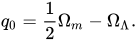
Defining the critical density as and the density parameters , substituting in the acceleration equation gives where the density parameters are at the relevant cosmic epoch. At the present day is negligible, and if (cosmological constant) this simplifies to where the density parameters are present-day values; with ΩΛ + Ωm ≈ 1, and ΩΛ = 0.7 and then Ωm = 0.3, this evaluates to for the parameters estimated from the Planck spacecraft data.[2] (Note that the CMB, as a high-redshift measurement, does not directly measure ; but its value can be inferred by fitting cosmological models to the CMB data, then calculating from the other measured parameters as above).

The time derivative of the Hubble parameter can be written in terms of the deceleration parameter:
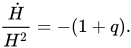
Except in the speculative case of phantom energy (which violates all the energy conditions), all postulated forms of mass-energy yield a deceleration parameter Thus, any non-phantom universe should have a decreasing Hubble parameter, except in the case of the distant future of a Lambda-CDM model, where will tend to −1 from above and the Hubble parameter will asymptote to a constant value of .

The above results imply that the universe would be decelerating for any cosmic fluid with equation of state greater than (any fluid satisfying the strong energy condition does so, as does any form of matter present in the Standard Model, but excluding inflation). However observations of distant type Ia supernovae indicate that is negative; the expansion of the universe is accelerating. This is an indication that the gravitational attraction of matter, on the cosmological scale, is more than counteracted by the negative pressure of dark energy, in the form of either quintessence or a positive cosmological constant.

Before the first indications of an accelerating universe, in 1998, it was thought that the universe was dominated by matter with negligible pressure, This implied that the deceleration parameter would be equal to , e.g. for a universe with or for a low-density zero-Lambda model. The experimental effort to discriminate these cases with supernovae actually revealed negative , evidence for cosmic acceleration, which has subsequently grown stronger.

References

[edit]
Revisions and contributorsEdit on WikipediaRead on Wikipedia
from Grokipedia
The deceleration parameter, denoted qq, is a dimensionless quantity in cosmology that measures the rate at which the expansion of the universe is slowing down or speeding up, defined mathematically as q=a¨aa˙2q = -\frac{\ddot{a} a}{\dot{a}^2}, where a(t)a(t) is the scale factor describing the relative size of the universe as a function of cosmic time tt. This parameter arises from the second-order Taylor expansion of the scale factor around the present epoch, a(t)=a(t0)[1+H0(tt0)q02H02(tt0)2+]a(t) = a(t_0) \left[ 1 + H_0 (t - t_0) - \frac{q_0}{2} H_0^2 (t - t_0)^2 + \cdots \right], where H0H_0 is the present-day Hubble parameter and q0q_0 is the current value of qq. A positive qq indicates deceleration (as expected from gravitational attraction in matter-dominated models), while a negative qq signifies acceleration, as observed in the modern universe due to dark energy. Introduced in the 1970s by astronomer as one of two fundamental cosmological observables alongside the Hubble parameter H0H_0—with cosmology framed as the quest to measure these "two numbers"—the deceleration parameter originally encapsulated expectations of a decelerating expansion driven by gravity. In the Friedmann-Lemaître-Robertson-Walker (FLRW) framework of , qq connects directly to the energy content of the via the , expressed for a flat with , radiation, and components as q0=12Ωm,0ΩΛ,0+Ωr,0q_0 = \frac{1}{2} \Omega_{m,0} - \Omega_{\Lambda,0} + \Omega_{r,0}, where Ωm,0\Omega_{m,0}, ΩΛ,0\Omega_{\Lambda,0}, and Ωr,0\Omega_{r,0} are the present-day density parameters for , the (or ), and radiation, respectively. For a single-component flat , it simplifies to q=12(1+3w)q = \frac{1}{2} (1 + 3w), with ww as the equation-of-state parameter (e.g., w=0w = 0 for , w=1w = -1 for a ). The discovery of cosmic acceleration in 1998, through observations of Type Ia supernovae, revolutionized the field by revealing q0<0q_0 < 0, implying that dark energy dominates the universe's expansion today and challenging the "deceleration" nomenclature. Measurements as of 2024, constrained by datasets such as cosmic microwave background observations, baryon acoustic oscillations, and Hubble diagrams, yield q00.5q_0 \approx -0.5 to 0.6-0.6, consistent with a flat Λ\LambdaCDM model where dark energy contributes about 70% of the energy density. Beyond its diagnostic role, qq informs model-independent approaches like cosmography, where higher-order parameters (e.g., jerk j=1j = 1 in Λ\LambdaCDM) test deviations from general relativity, and it influences calculations of luminosity distances, dL(z)zH0[1+12(1q0)z+]d_L(z) \approx \frac{z}{H_0} \left[ 1 + \frac{1}{2} (1 - q_0) z + \cdots \right], essential for probing dark energy evolution. Despite its name, the parameter remains central to understanding the universe's kinematic history, from early deceleration in the radiation- and matter-dominated eras to late-time acceleration.

Definition and Basics

Conceptual Overview

The deceleration parameter, denoted as qq, is a dimensionless quantity in cosmology that characterizes the dynamics of the universe's expansion by indicating whether it is decelerating or accelerating at a given epoch. Specifically, a positive value (q>0q > 0) signifies that the expansion is slowing down due to the dominant influence of attractive gravitational forces from and , while a negative value (q<0q < 0) implies an accelerating expansion driven by repulsive effects, such as those attributed to dark energy. This parameter provides a simple yet powerful metric for assessing the evolving balance of cosmic components that govern the large-scale structure and fate of the universe. At its core, qq captures the second time derivative of the cosmic scale factor, which describes the acceleration or change in the expansion rate over time, beyond the mere linear stretching captured by the Hubble parameter. In the framework of the Friedmann-Lemaître-Robertson-Walker (FLRW) metric, which models a homogeneous and isotropic universe, qq thus reveals how the acceleration (or deceleration) of spatial distances between galaxies changes as the cosmos evolves. To intuit its significance, consider an analogy to a vehicle's motion on a cosmic scale: just as a car decelerating on a flat road (positive qq) loses speed due to friction or braking, the early universe's expansion slowed under the pull of gravity, whereas an accelerating car downhill (negative qq) mirrors the current epoch where expansion hastens, propelling galaxies apart faster over time. In practice, qq is not fixed but varies as a function of cosmic time or redshift zz, reflecting transitions in the universe's composition—such as from matter-dominated deceleration in the past to dark energy-driven acceleration today—allowing cosmologists to trace the overall expansion history through q(z)q(z).

Mathematical Definition

The deceleration parameter q(t)q(t) provides a kinematic measure of the second-order behavior of the cosmic expansion and is defined as q(t)=a¨aa˙2=a¨/a(a˙/a)2,q(t) = -\frac{\ddot{a} a}{\dot{a}^2} = -\frac{\ddot{a}/a}{(\dot{a}/a)^2}, where a(t)a(t) is the scale factor describing the expansion of the universe, dots denote derivatives with respect to cosmic time tt, a˙=da/dt\dot{a} = da/dt, and a¨=d2a/dt2\ddot{a} = d^2a/dt^2. This expression quantifies the ratio of the proper acceleration a¨\ddot{a} to the square of the expansion rate, normalized by the scale factor. The present-day value, denoted q0q_0, corresponds to q(t)q(t) evaluated at the current cosmic time t0t_0, which aligns with redshift z=0z = 0 (where z=1/a1z = 1/a - 1 and a(t0)=1a(t_0) = 1 by convention). As a dimensionless quantity, qq has no units, since the Hubble parameter H(t)=a˙/aH(t) = \dot{a}/a sets the intrinsic timescale for expansion, rendering the parameter scale-invariant. This parameter emerges naturally in the Taylor series expansion of the scale factor around the present epoch: a(t)a0[1+H0(tt0)q02H02(tt0)2+],a(t) \approx a_0 \left[ 1 + H_0 (t - t_0) - \frac{q_0}{2} H_0^2 (t - t_0)^2 + \cdots \right], where H0=H(t0)H_0 = H(t_0) is the present Hubble constant and higher-order terms involve additional cosmographic parameters like the jerk. The linear term describes uniform Hubble flow, while the quadratic term, governed by q0q_0, encodes the curvature of the expansion history—positive q0q_0 implies deceleration (slowing expansion), and negative q0q_0 implies acceleration.

Historical Development

Early Concepts

The early concepts of the deceleration parameter arose within the framework of applied to cosmology in the 1920s, as theorists grappled with the implications of an expanding universe. In 1922, derived solutions to for a homogeneous, isotropic universe filled with matter, demonstrating that the expansion would naturally decelerate due to gravitational attraction, with the rate of slowdown characterized by what would later be formalized as q ≈ 1/2 in a matter-dominated scenario. Georges Lemaître independently developed a similar dynamic model in 1927, proposing an expanding universe from a dense initial state where gravity causes the expansion to slow over time, again implying q ≈ 1/2 under matter dominance. Before these expanding models, Albert Einstein's 1917 static universe incorporated a cosmological constant to balance gravitational collapse, maintaining a constant scale factor with no expansion or contraction, rendering the deceleration parameter undefined since the Hubble parameter H = 0. This equilibrium was disrupted by Edwin Hubble's 1929 observations of redshift-distance relations among galaxies, confirming an expanding universe and leading to the abandonment of the static model. From the 1930s through the 1960s, competing theories highlighted divergent views on deceleration. The steady-state theory, introduced by and in 1948 and refined by , envisioned a universe of constant average density maintained by ongoing matter creation, resulting in exponential expansion akin to de Sitter space and a predicted deceleration parameter q = -1, implying no slowdown but rather coasting expansion. In opposition, evolving Big Bang models rooted in Friedmann-Lemaître solutions assumed gravitational deceleration, with q > 0: specifically q = 1/2 for matter-dominated phases and q = 1 for radiation-dominated early epochs. In 1970, astronomer described cosmology as the search for two fundamental numbers: the present-day Hubble parameter H0H_0 and the deceleration parameter q0q_0, emphasizing the need for precise measurements of these quantities to test cosmological models. Prior to the late 1990s, the dominant cosmological paradigm held that the universe's expansion decelerates indefinitely under gravity's influence, with q > 0 throughout its history in standard matter- and radiation-filled models, shaping expectations for an eventual recollapse or asymptotic slowdown.

Discovery of Acceleration

In 1998, two independent teams announced groundbreaking observations using Type Ia supernovae as standard candles to measure cosmic distances, revealing that the 's expansion is accelerating rather than decelerating as previously assumed. The High-Z Supernova Search Team, led by , analyzed 16 Type Ia supernovae at redshifts between 0.16 and 0.62, finding that these distant events appeared fainter than expected in a decelerating universe, indicating a negative deceleration parameter q0<0q_0 < 0 and evidence for a positive cosmological constant. Simultaneously, the Supernova Cosmology Project, led by Saul Perlmutter, reported similar results from 42 high-redshift supernovae, confirming accelerated expansion with high statistical significance and favoring a flat universe dominated by a cosmological constant. These findings were robustly confirmed in subsequent years, notably by Riess et al. in 2004, who used Hubble Space Telescope observations of Type Ia supernovae at redshifts greater than 1 to delineate the transition from deceleration to acceleration, providing conclusive evidence against systematic errors in the earlier data. Other teams, including the Supernova Legacy Survey, corroborated these results through larger samples, solidifying the paradigm shift in cosmology. The profound impact of these discoveries was recognized with the 2011 Nobel Prize in Physics awarded to Perlmutter, Brian Schmidt (of the High-Z team), and Riess for providing observational evidence of the accelerating universe. The observations indicated a transition redshift zt0.60.7z_t \approx 0.6-0.7, where the deceleration parameter q(z)q(z) shifts from positive (deceleration during matter domination) to negative (acceleration driven by dark energy), marking the end of the matter-dominated era approximately 5-6 billion years ago. In response to this empirical breakthrough, theorists revived Einstein's cosmological constant Λ\Lambda as the simplest explanation for the negative qq, consistent with the supernova data favoring ΩΛ0.7\Omega_\Lambda \approx 0.7. Alternatives, such as quintessence—a dynamic scalar field with evolving energy density—were also proposed to account for the acceleration without a constant Λ\Lambda, offering potential resolutions to the coincidence problem of dark energy's late-time dominance.

Formulation in Cosmology

Relation to Friedmann Equations

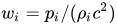
The second Friedmann equation, derived from the Einstein field equations applied to a homogeneous and isotropic universe, governs the acceleration of the cosmic scale factor a(t)a(t) and is expressed as a¨a=4πG3i(ρi+3pic2),\frac{\ddot{a}}{a} = -\frac{4\pi G}{3} \sum_i \left( \rho_i + \frac{3 p_i}{c^2} \right), where GG is the gravitational constant, cc is the speed of light, ρi\rho_i is the energy density of the ii-th component, and pip_i is its associated pressure. This equation highlights how the universe's expansion dynamics depend on the total energy content, with positive pressure contributing to deceleration and negative pressure potentially driving acceleration. The deceleration parameter qq has a kinematic interpretation through its definition q=a¨aa˙2=a¨aH2q = -\frac{\ddot{a} a}{\dot{a}^2} = -\frac{\ddot{a}}{a H^2}, where H=a˙/aH = \dot{a}/a is the Hubble parameter, describing the second-order behavior of the scale factor without direct reference to physical contents. Dynamically, this connects to the Friedmann framework by substituting the acceleration equation, yielding q=4πG3H2i(ρi+3pic2).q = \frac{4\pi G}{3 H^2} \sum_i \left( \rho_i + \frac{3 p_i}{c^2} \right). This form embeds qq within the universe's matter-energy budget, revealing how gravitational attraction from density and pressure influences expansion. For fluids characterized by equation-of-state parameters wi=pi/(ρic2)w_i = p_i / (\rho_i c^2), the expression simplifies to q=4πG3H2iρi(1+3wi)q = \frac{4\pi G}{3 H^2} \sum_i \rho_i (1 + 3 w_i). In a flat universe, where the first Friedmann equation relates H2H^2 to the critical density ρcrit=3H2/(8πG)\rho_{\rm crit} = 3 H^2 / (8 \pi G) such that iΩi=1\sum_i \Omega_i = 1 with Ωi=ρi/ρcrit\Omega_i = \rho_i / \rho_{\rm crit}, it further reduces to q=12iΩi(1+3wi).q = \frac{1}{2} \sum_i \Omega_i (1 + 3 w_i). This demonstrates q>0q > 0 for matter (w=0w = 0, yielding q=Ωm/2>0q = \Omega_m / 2 > 0) or (w=1/3w = 1/3, yielding q=Ωr>0q = \Omega_r > 0), implying deceleration, while (w=1w = -1) contributes negatively with 1+3w=21 + 3 w = -2, potentially driving q<0q < 0 and acceleration when dominant.

Expression in Terms of Density Parameters

In the standard flat ΛCDM model, the present-day deceleration parameter is expressed as q0=12Ωm0ΩΛ0q_0 = \frac{1}{2} \Omega_{m0} - \Omega_{\Lambda 0}, where Ωm0\Omega_{m0} denotes the present-day matter density parameter (including both baryonic and dark matter) and ΩΛ0\Omega_{\Lambda 0} represents the present-day dark energy density parameter contributed by the cosmological constant, satisfying the flatness condition Ωm0+ΩΛ0=1\Omega_{m0} + \Omega_{\Lambda 0} = 1. More generally, the deceleration parameter as a function of redshift zz takes the form q(z)=12Ωm(z)+1+3wde2Ωde(z),q(z) = \frac{1}{2} \Omega_m(z) + \frac{1 + 3 w_{\rm de}}{2} \Omega_{\rm de}(z), where Ωm(z)\Omega_m(z) and Ωde(z)\Omega_{\rm de}(z) are the redshift-dependent density parameters for matter and dark energy, respectively, and wdew_{\rm de} is the equation-of-state parameter for dark energy (neglecting the negligible radiation contribution at low z); curvature does not contribute to this expression, as it effectively has wk=1/3w_k = -1/3 yielding zero contribution, though the standard ΛCDM case assumes wde=1w_{\rm de} = -1 and a flat universe (Ωk=0\Omega_k = 0). This expression implies that q(z)q(z) was positive in the early universe during matter domination, where Ωm(z)1\Omega_m(z) \approx 1 and thus q(z)12q(z) \approx \frac{1}{2}, indicating deceleration. In the present epoch, with ΩΛ00.7\Omega_{\Lambda 0} \approx 0.7, the value shifts to q00.55q_0 \approx -0.55, signifying acceleration dominated by dark energy. These relations stem from the Friedmann equations describing the universe's expansion dynamics. In extensions beyond the flat ΛCDM paradigm, such as non-flat geometries or dark energy models with wde1w_{\rm de} \neq -1, the formula incorporates the additional curvature (which does not affect q) or modifies the dark energy contribution, though the standard case provides the foundational benchmark for interpretations.

Observational Measurements

Methods of Determination

One of the primary methods for determining the deceleration parameter q(z)q(z) involves observations of Type Ia supernovae as standard candles. These events provide luminosity distances dL(z)d_L(z) as a function of redshift zz, which can be used to reconstruct the Hubble parameter H(z)H(z) and subsequently fit for q(z)q(z) through kinematic relations derived from the expansion history. This approach was pioneered by the High-Z Supernova Search Team, whose measurements of distant supernovae enabled the first constraints on cosmic deceleration. Subsequent analyses, such as those using the Pantheon+ sample, refine q(z)q(z) by combining supernova data with model fits to the distance-redshift relation. Baryon acoustic oscillations (BAO) serve as a standard ruler, imprinted in the cosmic microwave background and observable in the clustering of galaxies at various redshifts. By measuring the angular scale of BAO features in large-scale structure surveys like the (SDSS) and the (DESI), researchers constrain the comoving distance DV(z)D_V(z) and H(z)H(z), allowing inference of q(z)q(z) via the expansion history without assuming a specific dark energy model. The initial detection of BAO by SDSS provided early constraints on deceleration, while recent DESI results extend these measurements to higher redshifts, tightening bounds on q0q_0. The cosmic microwave background (CMB) anisotropies, observed by satellites like Planck, offer integrated constraints on the deceleration parameter through the present-day matter density Ωm\Omega_m and dark energy density ΩΛ\Omega_\Lambda, via the relation q0=12ΩmΩΛq_0 = \frac{1}{2} \Omega_m - \Omega_\Lambda. Planck's high-precision temperature and polarization maps determine these densities from the positions of acoustic peaks, indirectly yielding q0q_0 in the context of flat Λ\LambdaCDM cosmology. The 2018 Planck release provided robust limits on Ωm0.315\Omega_m \approx 0.315, implying q00.53q_0 \approx -0.53. Other probes contribute indirect estimates of the deceleration parameter. Hubble constant H0H_0 measurements using Cepheid variables, calibrated via the cosmic distance ladder and refined with James Webb Space Telescope (JWST) observations, help constrain q0q_0 when combined with low-redshift expansion data, as q0q_0 influences the local Hubble diagram. Gravitational lensing surveys, such as those from the Dark Energy Survey (DES), measure weak lensing shear to probe matter clustering and Ωm\Omega_m, providing complementary bounds on deceleration. Galaxy cluster counts, observed in X-ray or Sunyaev-Zel'dovich surveys like the South Pole Telescope (SPT), constrain Ωm\Omega_m through abundance evolution, indirectly informing q(z)q(z) across cosmic history. Model-independent approaches, such as cosmography, expand the luminosity distance dL(z)d_L(z) in a Taylor series around z=0z=0: dL(z)=czH0[1+12(1q0)z16(1q03q02+j0)z2+],d_L(z) = \frac{c z}{H_0} \left[ 1 + \frac{1}{2} (1 - q_0) z - \frac{1}{6} (1 - q_0 - 3 q_0^2 + j_0) z^2 + \cdots \right], where cc is the speed of light, H0H_0 is the present Hubble constant, and j0j_0 is the jerk parameter. Fitting this series to supernova or BAO data extracts q0q_0 directly without presupposing a cosmological model like Λ\LambdaCDM, reducing bias from parametric assumptions. This method has been applied to datasets like Union2.1 to yield unbiased kinematic parameters.

Historical and Current Values

Prior to 1998, the deceleration parameter was generally assumed to be positive, with dynamical estimates derived from the virial theorem applied to galaxy clusters yielding q_0 ≈ 0.5, indicative of a decelerating, matter-dominated universe. This value aligned with expectations from the Einstein-de Sitter model, where the cosmic density parameter Ω_m ≈ 1 implied q_0 = 0.5. The discovery of cosmic acceleration in 1998, confirmed by subsequent observations, shifted estimates to negative values. Between 1998 and 2010, Type Ia supernova data combined with cosmic microwave background (CMB) measurements indicated q_0 ≈ -0.5 to -0.6. For instance, high-redshift supernova observations reported q_0 = -0.53 ± 0.12, providing evidence for a transition from past deceleration to current acceleration. The Planck 2013 CMB results refined this to q_0 ≈ -0.53, derived from Ω_m = 0.315 ± 0.018 in the flat ΛCDM model, where q_0 = \frac{3}{2} \Omega_m - 1. From the 2010s to 2023, measurements converged on q_0 ≈ -0.53 ± 0.02, reinforcing acceleration within ΛCDM. Planck 2018 data, with Ω_m = 0.315 ± 0.007, yielded a similar value, while early baryon acoustic oscillation results from 2023 upheld this consistency. Recent 2024–2025 analyses reveal emerging tensions. Standard ΛCDM predictions give q_0 ≈ -0.53, but age-bias corrections to supernova progenitor ages suggest q_0 ≈ +0.178 ± 0.061, implying a possible shift to current deceleration—though this interpretation remains controversial and debated within the community. Preliminary data analyses as of mid-2025 hint at evolving dark energy, with q(z) showing potential deviations from constant-Λ behavior at low redshifts. These discrepancies are compounded by the Hubble tension, where local H_0 measurements exceed CMB-inferred values by ~5–10%, indirectly affecting q_0 estimates through inconsistencies in density parameters.

Implications and Applications

In Standard Cosmological Models

In the standard ΛCDM model, the present-day deceleration parameter is expressed as q0=12Ωm0ΩΛ0q_0 = \frac{1}{2} \Omega_{m0} - \Omega_{\Lambda 0}, where Ωm0\Omega_{m0} and ΩΛ0\Omega_{\Lambda 0} are the present-day density parameters for non-relativistic matter and the cosmological constant, respectively. With Ωm00.31\Omega_{m0} \approx 0.31 and ΩΛ00.69\Omega_{\Lambda 0} \approx 0.69 as determined from cosmic microwave background observations, this yields q00.55q_0 \approx -0.55. The model further predicts a transition from decelerated to accelerated expansion at redshift zt0.67z_t \approx 0.67, the point where q(zt)=0q(z_t) = 0. These predictions align well with supernova and baryon acoustic oscillation data, though the Hubble tension—discrepancies between local measurements of the Hubble constant (H073H_0 \approx 73 km s1^{-1} Mpc1^{-1}) and those inferred from early-universe physics (H067H_0 \approx 67 km s1^{-1} Mpc1^{-1})—places interpretive strain on the model's parameter fits. Alternative cosmological models modify the dark energy component and alter q0q_0 accordingly. In the wCDM model, featuring a constant equation-of-state parameter w0w_0 for dark energy, q0=12Ωm0+1+3w02(1Ωm0)q_0 = \frac{1}{2} \Omega_{m0} + \frac{1 + 3 w_0}{2} (1 - \Omega_{m0}) in a flat universe, making q0q_0 highly sensitive to deviations of w0w_0 from 1-1. For phantom dark energy with w<1w < -1, the term 1+3w2\frac{1 + 3 w}{2} becomes more negative than 1-1, resulting in q0<0.55q_0 < -0.55; sufficiently strong phantom behavior (w1.4w \lesssim -1.4) can drive q0<1q_0 < -1, implying super-acceleration where the expansion rate increases faster than linearly. The steady-state model, predicting a constant q=1q = -1 due to continuous matter creation maintaining uniform density, has been definitively ruled out by the discovery of the cosmic microwave background radiation and the observed redshift evolution of quasars and galaxies. The redshift evolution q(z)q(z) provides a key discriminator for model validation, as ΛCDM forecasts a smooth transition from q(z)>0q(z) > 0 at high zz (matter-dominated deceleration) to q(z)<0q(z) < 0 at low zz (dark energy domination). Modified gravity theories, such as f(R) models that alter the Einstein-Hilbert action with higher-order curvature terms, predict distinct q(z)q(z) profiles—often with delayed or oscillatory transitions—that deviate from ΛCDM's behavior and can be tested against supernova distance moduli and growth rate data. Relaxing the flatness assumption introduces a curvature density parameter Ωk0\Omega_{k0}, modifying the relation ΩΛ0=1Ωm0Ωk0\Omega_{\Lambda 0} = 1 - \Omega_{m0} - \Omega_{k0} and thus affecting q00.55+Ωk0q_0 \approx -0.55 + \Omega_{k0} (or approximately Ωk0/2-\Omega_{k0}/2 for small deviations in certain parameter regimes). Current constraints from Planck data indicate Ωk00.01|\Omega_{k0}| \lesssim 0.01, supporting near-flatness with minimal impact on q0q_0.

Relation to Dark Energy and Future Evolution

The deceleration parameter q0q_0 at the present epoch serves as a key indicator of the influence of dark energy on cosmic expansion, where a negative value implies that the repulsive effects of dark energy dominate over the attractive pull of matter, necessitating a component with an equation-of-state parameter w1w \approx -1 to drive acceleration. This relation arises because dark energy's negative pressure counteracts gravitational deceleration, and measurements of q00.5q_0 \approx -0.5 align with models where ww is close to 1-1, as in the cosmological constant Λ\Lambda. Deviations from w=1w = -1 would alter q0q_0; for instance, if w>1w > -1, the acceleration weakens, potentially making q0q_0 less negative, while w<1w < -1 enhances it, providing a probe for distinguishing Λ\Lambda from dynamical dark energy. In models of evolving dark energy, such as quintessence, the deceleration parameter q(z)q(z) varies with redshift zz, reflecting changes in the dark energy density and equation of state over cosmic time. Quintessence fields, which behave like slowly rolling scalar fields, can lead to w(z)w(z) evolving from values greater than 1-1 in the past to near 1-1 today, influencing q(z)q(z) to transition from positive (deceleration) to negative (acceleration) at low zz. Recent analyses from the Dark Energy Spectroscopic Instrument (DESI), including the DR2 data release in late 2025, strengthen hints at such dynamics, with studies suggesting that dark energy may be evolving in a way that could increase ww toward zero in the future, potentially driving q(z)>0q(z) > 0 in the future and signaling a slowdown in acceleration ahead. These DESI-inspired models, including thawing quintessence, predict that if ww continues to rise, the might re-enter a decelerating phase, contrasting with the constant w=1w = -1 of Λ\LambdaCDM. The sign and evolution of q0q_0 also inform projections for the universe's long-term fate under different scenarios. If q0q_0 remains negative with w=1w = -1, the universe will undergo eternal , culminating in a "heat death" where expansion dilutes and to an asymptotically cold, dilute state. Conversely, for phantom with w<1w < -1, persistent negative q0q_0 could lead to a "Big Rip," where accelerating expansion tears apart galaxies, stars, and eventually atoms in finite time, estimated at around 22 billion years from now in some models. However, in quintessence or other dynamical models where ww increases over time, a transition back to q>0q > 0 is possible, potentially halting and allowing deceleration to resume, averting both extreme fates. Upcoming observational efforts will refine measurements of q(z)q(z) and constrain dark energy properties to distinguish these scenarios. The James Webb Space Telescope (JWST), Euclid, and Nancy Grace Roman Space Telescope are poised to provide high-precision data on galaxy clustering, weak lensing, and supernovae, enabling tighter bounds on w(z)w(z) and tests of evolving dark energy models. For example, Euclid's spectroscopic surveys aim to map baryon acoustic oscillations out to z2z \approx 2, directly probing deviations in q(z)q(z) from Λ\LambdaCDM predictions, while Roman's supernova observations will complement these to achieve percent-level precision on dark energy parameters. These missions, operational through the late 2020s and beyond, are expected to resolve whether q0q_0 hints at dynamical evolution or supports a static cosmological constant.

References

Add your contribution
Related Hubs
User Avatar
No comments yet.