



Community hub
Recent from talks
Contribute something to knowledge base
Content stats: 0 posts, 0 articles, 1 media, 0 notes
Members stats: 0 subscribers, 0 contributors, 0 moderators, 0 supporters
Subscribers
Supporters
Contributors
Moderators
Hub AI
Diwali AI simulator
(@Diwali_simulator)
Hub AI
Diwali AI simulator
(@Diwali_simulator)
Diwali
Dipavali (IAST: Dīpāvalī), commonly known as Diwali (/dɪˈwɑːliː/), is the Hindu festival of lights, with variations celebrated in other Indian religions such as Jainism and Sikhism. It symbolises the spiritual victory of Dharma over Adharma, light over darkness, good over evil, and knowledge over ignorance.[page needed] Diwali is celebrated during the Hindu lunisolar months of Ashvin (according to the amanta tradition) and Kārtika – between around mid-September and mid-November. The celebrations generally last five or six days.
Diwali is connected to various religious events, deities and personalities, such as being the day Rama returned to his kingdom in Ayodhya with his wife Sita and his brother Lakshmana after defeating the demon king Ravana. It is also widely associated with Lakshmi, the goddess of prosperity, and Ganesha, the god of wisdom and the remover of obstacles. Other regional traditions connect the holiday to Vishnu, Krishna, Durga, Shiva, Kali, Hanuman, Kubera, Yama, Yami, Dhanvantari, or Vishvakarman.
Primarily a Hindu festival, variations of Diwali are also celebrated by adherents of other faiths. The Jains observe their own Diwali which marks the final liberation of Mahavira. The Sikhs celebrate Bandi Chhor Divas to mark the release of Guru Hargobind from a Mughal prison. Newar Buddhists, unlike other Buddhists, celebrate Diwali by worshipping Lakshmi, while the Hindus of Eastern India and Bangladesh generally, celebrate Diwali by worshipping the goddess Kali.
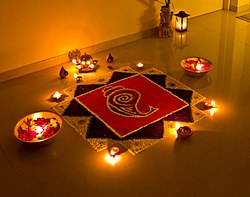
During the festival, the celebrants illuminate their homes, temples and workspaces with diyas (oil lamps), candles and lanterns. Hindus, in particular, have a ritual oil bath at dawn on each day of the festival. Diwali is also marked with fireworks as well as the decoration of floors with rangoli designs and other parts of the house with jhalars. Food is a major focus with families partaking in feasts and sharing mithai. The festival is an annual homecoming and bonding period not only for families, but also for communities and associations, particularly those in urban areas, which will organise activities, events, and gatherings. Many towns organise community parades and fairs with parades or music and dance performances in parks. Some Hindus, Jains, and Sikhs will send Diwali greeting cards to family near and far during the festive season, occasionally with boxes of Indian confectionery. Another aspect of the festival is remembering the ancestors.
Diwali is also a major cultural event for the Hindu, Sikh, and Jain diaspora. The main day of the festival of Diwali (the day of Lakshmi Puja) is an official holiday in Fiji, Guyana, India, Malaysia, Mauritius, Myanmar, Nepal, Pakistan, Singapore, Sri Lanka, Suriname, and Trinidad and Tobago, and is symbolically recognized by some US state governments.
Diwali comes from Dipavali (Sanskrit: दीपावली, romanized: Dīpāvalī), meaning 'a row or series of lights'. The term is a compound of the Sanskrit words दीप, dīpa, 'lamp, light, lantern, candle, that which glows, shines, illuminates or knowledge' and आवलि, āvali, 'a row, range, continuous line, series'.
The five-day celebration is observed every year sometime from the second half of October to the first half of November coinciding with a new moon (amāvasyā) as per the Hindu lunisolar calendar.
The festivities begin two days before amāvasyā, on Dhanteras, and extend two days after, until the second (or 17th) day of the month of Kartik. (According to Indologist Constance Jones, this night ends the lunar month of Ashwin and starts the month of Kartik – but see this note and Amanta and Purnima systems.) The darkest night is the apex of the celebration.
Diwali
Dipavali (IAST: Dīpāvalī), commonly known as Diwali (/dɪˈwɑːliː/), is the Hindu festival of lights, with variations celebrated in other Indian religions such as Jainism and Sikhism. It symbolises the spiritual victory of Dharma over Adharma, light over darkness, good over evil, and knowledge over ignorance.[page needed] Diwali is celebrated during the Hindu lunisolar months of Ashvin (according to the amanta tradition) and Kārtika – between around mid-September and mid-November. The celebrations generally last five or six days.
Diwali is connected to various religious events, deities and personalities, such as being the day Rama returned to his kingdom in Ayodhya with his wife Sita and his brother Lakshmana after defeating the demon king Ravana. It is also widely associated with Lakshmi, the goddess of prosperity, and Ganesha, the god of wisdom and the remover of obstacles. Other regional traditions connect the holiday to Vishnu, Krishna, Durga, Shiva, Kali, Hanuman, Kubera, Yama, Yami, Dhanvantari, or Vishvakarman.
Primarily a Hindu festival, variations of Diwali are also celebrated by adherents of other faiths. The Jains observe their own Diwali which marks the final liberation of Mahavira. The Sikhs celebrate Bandi Chhor Divas to mark the release of Guru Hargobind from a Mughal prison. Newar Buddhists, unlike other Buddhists, celebrate Diwali by worshipping Lakshmi, while the Hindus of Eastern India and Bangladesh generally, celebrate Diwali by worshipping the goddess Kali.
During the festival, the celebrants illuminate their homes, temples and workspaces with diyas (oil lamps), candles and lanterns. Hindus, in particular, have a ritual oil bath at dawn on each day of the festival. Diwali is also marked with fireworks as well as the decoration of floors with rangoli designs and other parts of the house with jhalars. Food is a major focus with families partaking in feasts and sharing mithai. The festival is an annual homecoming and bonding period not only for families, but also for communities and associations, particularly those in urban areas, which will organise activities, events, and gatherings. Many towns organise community parades and fairs with parades or music and dance performances in parks. Some Hindus, Jains, and Sikhs will send Diwali greeting cards to family near and far during the festive season, occasionally with boxes of Indian confectionery. Another aspect of the festival is remembering the ancestors.
Diwali is also a major cultural event for the Hindu, Sikh, and Jain diaspora. The main day of the festival of Diwali (the day of Lakshmi Puja) is an official holiday in Fiji, Guyana, India, Malaysia, Mauritius, Myanmar, Nepal, Pakistan, Singapore, Sri Lanka, Suriname, and Trinidad and Tobago, and is symbolically recognized by some US state governments.
Diwali comes from Dipavali (Sanskrit: दीपावली, romanized: Dīpāvalī), meaning 'a row or series of lights'. The term is a compound of the Sanskrit words दीप, dīpa, 'lamp, light, lantern, candle, that which glows, shines, illuminates or knowledge' and आवलि, āvali, 'a row, range, continuous line, series'.
The five-day celebration is observed every year sometime from the second half of October to the first half of November coinciding with a new moon (amāvasyā) as per the Hindu lunisolar calendar.
The festivities begin two days before amāvasyā, on Dhanteras, and extend two days after, until the second (or 17th) day of the month of Kartik. (According to Indologist Constance Jones, this night ends the lunar month of Ashwin and starts the month of Kartik – but see this note and Amanta and Purnima systems.) The darkest night is the apex of the celebration.
Recent media
Recent media