Hubbry Logo
Deera SquareDeera SquareMain
Open search
Deera Square
Community hub
Deera Square
logo
8 pages, 0 posts
0 subscribers
Be the first to start a discussion here.
Deera Square
Deera Square
from Wikipedia

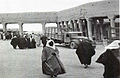
Deera Square (Arabic: ساحة الديرة, romanizedSāḥat ad-Dayrah), also known as Justice Square (ميدان العدل, Maydān al-ʿAdl), Safa Square (ساحة الصفاة, Sāḥat aṣ-Ṣafāh)[1] or informally as Chop-Chop Square,[2][3][4] is a public space in the Ad-Dirah neighborhood of Riyadh, Saudi Arabia. It is located adjacent to the al-Hukm Palace compound and Imam Turki bin Abdullah Grand Mosque in the Qasr al-Hukm District. It is known as the historic site of public executions, where those sentenced to death in Saudi Arabia were publicly beheaded.[5][6]

Key Information

At unannounced times, Saudi security forces and other officials cleared the area to make way for executions to take place. After the beheading of the condemned, the head was stitched to the body, which was wrapped up and taken away for the final rites. It was a crime to record, with photos or videos, the executions, despite the number of attendees witnessing such public events.[7]

Saudi Arabia remains the only country with legal capital punishment by decapitation (beheading)[8] – in 2022, recorded executions in Saudi Arabia reached 196, the highest number recorded in the country in 30 years – but beheadings are no longer carried out in public, with no public executions having been recorded in the country in 2022,[9] after Red Crescent criticism and comparison between Saudi Arabia's and the Islamic State's practices.[10]

Publicity of the executions

[edit]

In 2009, Canadian journalist Adam St. Patrick, who witnessed a public execution in the square, reported: "[T]he process is less overtly public now than it once was. Corpses aren’t hung for display in the square as often, and beheadings drew much bigger crowds when they were a regular event, held on Fridays after noon prayers. No formal event or fanfare begins or ends them now, and nothing indicates awareness or concern about how alien this is to outsiders."[11]

In 2015, it was reported that filming the public beheadings in Saudi Arabia had been forbidden. There was speculation that this was due to the international repercussion of public beheadings then carried out by the Islamic State, and the alleged "irony" of the fact that Saudi Arabia, being a key ally in the US-led coalition against the group, carried out the same sort of "brutal" punishments as the militant group.[10]

[edit]

See also

[edit]

References

[edit]
[edit]
Revisions and contributorsEdit on WikipediaRead on Wikipedia
from Grokipedia
Deera Square, situated in the al-Dirah neighborhood of central , , serves as the primary venue for public executions under the kingdom's -based legal system. These executions, often by beheading with a , target crimes such as , drug trafficking, and sorcery, as prescribed by punishments in Islamic jurisprudence, and require royal approval following Sharia court convictions. The square's stark role in enforcing capital and corporal penalties—earning it the expatriate nickname "Chop-Chop Square"—exemplifies 's adherence to traditional Islamic penal codes, which prioritize deterrence through public spectacle over modern rehabilitative approaches. Historically integrated into Riyadh's old market district, Deera Square has undergone renovations in recent years, incorporating public amenities and events as part of broader urban modernization efforts, while preserving its function for judicial proceedings. This duality underscores tensions between cultural preservation and contemporary reforms, with executions continuing amid criticisms from international observers regarding human rights standards, though Saudi authorities maintain the practices align with religious imperatives and yield low crime rates.

Location and Physical Description

Geographical Position in Riyadh

Deera Square occupies a central position in 's Al-Dirah district, a historic neighborhood in the southern part of the city's old quarter. This placement situates it amid Riyadh's foundational urban core, surrounded by traditional structures that reflect the area's longstanding role as a hub of administrative and communal activity. The square's precise coordinates are 24°37′51″N 46°42′43″E, anchoring it within the densely woven fabric of central . It lies adjacent to key landmarks including Al-Masmak Fort and the Imam Turki bin Abdullah Grand Mosque, enhancing its connectivity to significant historical and religious sites. Proximity to bustling souks like Souq Al Zel further integrates the square into the neighborhood's commercial pathways. Accessibility to Deera Square is provided via Al Imam Turki Ibn Abdullah Street, a primary artery in the Qasr al-Hukm area that links it to broader road networks in . This strategic positioning facilitates pedestrian and vehicular approach from surrounding districts, positioning the square as a focal point within the urban layout. Its nearness to mosques, such as the Imam Turki bin Abdullah Grand Mosque, aligns with patterns of public assembly tied to religious observances in the vicinity.

Architectural and Urban Features

Deera Square comprises an open plaza layout in Riyadh's Al-Dirah neighborhood, defined by a expansive paved expanse with sparse permanent fixtures to enable substantial public congregations. Encompassing the periphery are low-rise edifices reflecting traditional Najdi architecture, including mud-brick constructions that preserve regional vernacular styles. Characteristic elements include aligned palm trees along the borders, furnishing shade and integrating vegetation into the urban setting amid the desert environment. Contemporary refurbishments have embedded rudimentary facilities such as walkways and benches, augmenting its viability for pedestrian leisure while maintaining the foundational open configuration. As one of Riyadh's principal expansive public squares, it sustains diverse communal utilizations within the city's fabric.

Historical Development

Origins and Early Riyadh Context

Deera Square is situated within the Al-Dirah neighborhood, the historic core of , whose development began in the mid-18th century during the consolidation of local power structures preceding the full establishment of Saudi governance. The neighborhood's origins align with the fortification efforts around 1737 under Deham bin Dawas al-Shalaan, who strengthened 's defenses amid regional rivalries, laying the groundwork for its role as a burgeoning urban center. As the First Saudi State centered in faced Ottoman incursions leading to its destruction in 1818, and its Al-Dirah district gained prominence as a refuge and base for Al Saud loyalists. In 1824, Imam Turki bin Abdullah Al Saud recaptured and designated Al-Dirah as the nucleus of the Second Saudi State (1824–1891), transforming the area into a vital administrative and social hub. Deera Square, named after the surrounding Al-Dirah quarter, functioned primarily as an open marketplace and communal space, facilitating trade in goods like dates, textiles, and livestock essential to economy during this era of intermittent Al Saud rule interspersed with Rashidi dominance. Prior to the unification of , the square served as a focal point for daily gatherings, reflecting 's evolution from a walled settlement into a key political contender in central Arabia. Following Abdulaziz bin Abdul Rahman Al Saud's seizure of Riyadh on January 15, 1902, Deera Square played a foundational role in the early phases of power consolidation, hosting public assemblies and markets that bolstered loyalty and economic stability amid campaigns against rival factions. This period marked the square's integration into the emerging Third Saudi State, underscoring its enduring significance as ascended to become the capital of the unified Kingdom of Saudi Arabia in 1932.

Evolution as a Public Gathering Space

Deera Square, located in the heart of Riyadh's Al-Dirah district, functioned as a primary communal hub in the early , integrating with adjacent traditional markets such as Souq Al-Zal, which spanned 38,000 square meters and preserved over a century of trading activity by the 1930s. This central positioning near Al-Masmak Fort supported daily commerce and social exchanges, reflecting Riyadh's evolution from a walled oasis town to a burgeoning capital post-1902 reconquest by Abdulaziz Al Saud. The square witnessed pivotal public events, including the formal proclamation of the Kingdom of Saudi Arabia's unification on September 23, 1932, where announcements drew crowds for celebrations amid the consolidation of , , and other regions under one banner. Its proximity to the Friday Mosque further enabled religious assemblies, with the open space accommodating gatherings tied to Islamic observances and community rituals before the intensification of state oversight. By the mid-20th century, as Saudi governance formalized following oil discovery in 1938 and subsequent infrastructure growth, Deera Square transitioned toward accommodating structured state activities, diminishing its informal market and festive roles in favor of centralized administrative presence. This shift paralleled 's expansion beyond its pre-1930s walled confines, where the central square had long served multifunctional public needs.

Judicial and Punitive Role

Integration with Sharia Law Enforcement

Deera Square is embedded within Saudi Arabia's -derived legal system, serving as a venue for enforcing —fixed punishments mandated by the for offenses including theft, highway robbery, and illicit sexual relations—and , retributive penalties for intentional crimes against persons such as . These categories form the core of the kingdom's criminal jurisprudence, where supersedes codified statutes, with judges (qadis) deriving rulings directly from Islamic sources like the and . The square's role aligns with the establishment of the modern Saudi state in 1932, when public corporal and capital sanctions became institutionalized to uphold Wahhabi interpretations of Islamic law across the unified territories. Public executions in Deera Square have historically occurred immediately after Friday noon prayers (Jumu'ah), a timing selected to coincide with peak attendance at mosques, thereby maximizing witness exposure as prescribed in for to establish the penalty's evidentiary and deterrent validity before the community. This practice reflects the doctrinal emphasis on collective observation to reinforce social norms, with announcements often made via the religious police to draw crowds from nearby markets and worship sites. Administration involves coordination between the Ministry of Interior's executioners—specialized sword-wielders appointed by royal decree—and the former religious police (mutawa'een), who historically proclaimed verdicts and maintained order, though their enforcement powers were curtailed in 2016. Verdicts from courts require evidentiary thresholds like confession or witness testimony, with capital sentences often subject to royal ratification by the king to commute or confirm, ensuring alignment with state oversight amid the absence of a comprehensive penal code.

Specific Punishments Administered

Public beheadings constitute the primary form of administered in Deera Square, targeting offenses under law such as intentional under qisas retaliation, ( for married individuals), and terrorism-related activities including affiliation with groups like or . These executions, performed by sword after Friday prayers, have been a longstanding practice in the square, with documented instances dating back decades for crimes warranting death, such as the beheading of individuals convicted of or armed robbery in the 1980s. Saudi Arabia's execution rates surged to over 100 annually during 2019–2024, encompassing peaks of 184 in 2019 and 196 in 2022, primarily for drug trafficking, murder, and terrorism, with public beheadings in Deera Square continuing for select high-profile capital cases amid this trend. Floggings for ta'zir offenses, including alcohol consumption and sorcery, have been conducted publicly in Riyadh's central squares like Deera, though less emphasized than executions, with such punishments numbering in the hundreds annually prior to their abolition in 2020. Amputations of the right hand for (sariqa) under provisions occurred publicly into the early 2000s, with cases such as three judicial amputations in 1991 for repeat , though specific Deera Square instances are sparsely detailed in compared to beheadings.

Procedures and Public Aspects of Executions

Traditional Execution Protocols

Convicted individuals were transported from detention facilities to Deera Square, often in police vans, with executions customarily scheduled for Fridays immediately after noon prayers to coincide with peak public attendance. Upon arrival at the execution site, officials publicly proclaimed the convict's crimes and sentence to the assembled crowd, ensuring communal awareness of the judicial outcome. The preparation phase involved administering tranquillizers to sedate the , followed by blindfolding to restrain resistance, before escorting them to the designated area where they assumed a position with their exposed, typically shrouded in white cloth except for the head. A specialized then delivered via a single, swift of a curved , approximately four feet in length, honed for precision to sever the head cleanly. , who held the role from onward and performed multiple beheadings daily at times, exemplified the trained personnel required for such duties, emphasizing ritualistic efficiency in his accounts. Immediately after severance, the executioner raised the severed head by the hair for public view, placing it beside the torso amid pooling blood, allowing brief observation by onlookers before the remains were cleared for prompt burial. The gathered spectators, numbering in the hundreds or more depending on the case, subsequently dispersed, marking the conclusion of the public ritual.

Deterrent Effects and Empirical Outcomes

Saudi Arabia records one of the lowest intentional rates globally, at 1.0 per 100,000 in 2019, significantly below the world average of 5.61 per 100,000 in 2022. This empirical outcome aligns with broader low metrics in the kingdom, where overall criminal activity remains limited compared to industrialized nations, primarily involving drug-related offenses rather than interpersonal violence. Prior to the 1932 unification under King Abdulaziz Al Saud, the Arabian Peninsula endured pervasive tribal feuds, banditry, and regional warfare across entities like and , fostering an environment of chronic instability and elevated violence without centralized deterrence. Post-unification, the establishment of a unified Sharia-based legal framework, including of and punishments, coincided with marked societal stabilization, as evidenced by the absence of large-scale intertribal conflicts and the imposition of order over disparate territories. While direct causation remains debated, Saudi rehabilitation programs for extremism report rates of 3-4%, underscoring the potential long-term effects of severe punitive measures in curbing repeat offenses.

Reforms and Contemporary Changes

Influence of Vision 2030 Initiatives

Vision 2030, launched in 2016 by Crown Prince , emphasizes economic diversification, social liberalization, and urban revitalization, including transformations in public spaces like Deera Square to align with tourism and entertainment goals. By December 2019, as part of the events under the program's Program, the square hosted recreational activities such as mocktail cafes and family-friendly gatherings, marking a departure from its predominant association with punitive spectacles and reflecting efforts to reframe central as a vibrant urban hub. Despite this softening of public imagery, execution numbers overall escalated under Vision 2030's reform umbrella, reaching 345 in 2024—the highest in over three decades—primarily for drug trafficking and terrorism-related offenses, even after bin Salman's 2022 pledge to restrict the death penalty to cases. In 2025, at least 100 executions occurred by April, with surges continuing into mid-year for similar charges, though reports indicate a reduced frequency of high-profile public beheadings at Deera Square itself, with some proceedings shifted to prisons or less publicized venues to mitigate international scrutiny amid modernization drives. Deera Square's evolution ties into 's broader beautification initiatives within Vision 2030, such as the Green Riyadh Program aiming to plant 7.5 million trees by 2030 and enhance urban livability, positioning the area within a network of renewed public zones to attract domestic and tourist footfall while downplaying its judicial legacy. This policy pivot supports the kingdom's image as progressing toward a post-oil society, though persistent capital punishments underscore tensions between reform rhetoric and Sharia-based enforcement.

Transition to Multifunctional Public Space

In the years following 2019, Deera Square experienced urban revitalization aligned with broader modernization efforts in , incorporating features such as illuminated pathways, water fountains, and vendor stalls offering like mocktails to attract evening visitors. These additions shifted portions of the square toward recreational use, enabling casual strolls and social gatherings amid its central location in the ad-Dirah neighborhood. By the early 2020s, the square had evolved into a multifunctional plaza prioritizing pedestrian-friendly amenities over its prior emphasis on judicial proceedings, with reports noting its integration into local walking tours that highlight nearby historic sites like Souk Al Zal. Vendor interactions and public access during daytime and evenings became commonplace, fostering utility as a community hub for markets and leisure without altering the site's underlying layout. From 2023 to 2025, enhancements focused on improved , benefiting from Riyadh-wide initiatives that included better for diverse users, while preserving visible markers of the square's judicial past to maintain historical continuity. This period saw no erasure of the punitive legacy, as occasional activities persisted alongside expanded civilian functions like informal events and proximity to commercial souks. The result balanced deterrence heritage with contemporary vibrancy, positioning Deera Square as a hybrid space for daily urban life.

Debates and Perspectives

Criticisms from Human Rights Frameworks

Human rights organizations such as and have criticized public executions in Deera Square as violations of international standards prohibiting , arguing that beheadings constitute due to their visibility and brutality. These groups contend that the public nature of the punishments in Deera Square, often attended by crowds, exacerbates on witnesses and fails to meet prohibitions under the International Covenant on Civil and Political Rights (ICCPR), which has signed but not fully implemented regarding limitations. Amnesty International reported a surge in executions to 198 by September 2024—the highest toll in decades—followed by further increases in 2025, with documenting over 300 by October 2025, many for non-lethal offenses like drug trafficking, asserting these reflect inefficacy as deterrents since crime rates have not demonstrably declined despite the volume. Critics from these frameworks claim the lack of empirical proof for deterrence, combined with the spectacle in Deera Square, serves more as state theater than effective , though such assertions stem from abolitionist advocacy rather than comparative longitudinal studies. Concerns over due process include allegations of coerced confessions via and trials lacking independence, with noting that many 2025 executions involved defendants without access to legal representation or evidence review, contravening fair trial rights under Article 14 of the ICCPR. Prior to 2020, juvenile executions occurred despite Saudi commitments to the UN Convention on the Rights of the Child; for instance, cases like that of a man executed in 2021 for crimes committed as a minor highlighted ongoing discrepancies, and documented seven such imminent risks in 2023, with a 2025 execution of Jalal Labbad for juvenile offenses underscoring unfulfilled reform pledges. Executions of foreign nationals, comprising a significant portion of drug-related cases—such as the 35% of recent totals flagged by —raise sovereignty and consular access issues, with UN experts in 2024 expressing alarm over 28 on death row facing potential beheadings without adequate notification to home states, violating the . Western media outlets have amplified these critiques by depicting Deera Square events as barbaric relics, often omitting the Sharia-based rationale of retribution () and emphasizing universal norms over contextual Islamic . These portrayals, while sourced from NGO data, reflect a framework prioritizing secular , potentially underrepresenting procedural elements like victim family pardons in Saudi practice.

Arguments for Efficacy in Maintaining Social Order

Proponents of Sharia-based punishments in argue that the principle embodies by mandating equivalent retaliation for crimes like or bodily harm, thereby restoring moral equilibrium disrupted by the offense. This eye-for-an-eye framework, derived from Quranic injunctions, prioritizes proportionality to affirm the sanctity of life and deter through state-enforced balance rather than unchecked vengeance. Consequentialist defenses highlight Saudi Arabia's empirically low violent crime rates as evidence of efficacy, with the intentional homicide rate at approximately 0.8-1.0 per 100,000 population in recent years, compared to 6.5 in the United States—over 49 times higher per capita. This disparity persists despite Saudi's large expatriate population and rapid urbanization, with scholars attributing part of the outcome to hudud and qisas enforcement, including public administration, which reinforces deterrence beyond incarceration alone. Public visibility of punishments in venues like Deera Square serves as a direct mechanism for norm reinforcement in a conservative Islamic society, where communal witnessing cultivates collective adherence to shared moral codes and reduces by eliminating reoffense risk for capital cases—achieving a 0% rate for executed individuals. Studies on specific applications, such as for , indicate reduced attack frequency post-implementation, supporting causal links between visible severity and sustained social order.

Cultural and Societal Impact

Role in Saudi National Identity

Deera Square embodies the adherence to punishments prescribed by law, a cornerstone of Saudi governance since the Kingdom's unification on September 23, 1932, under King Abdulaziz Al Saud, who forged the state through alliances rooted in Wahhabi doctrine emphasizing strict Islamic orthodoxy. Public executions at the square reinforce the national commitment to divine law over secular alternatives, distinguishing Saudi identity from neighboring Gulf states with more hybridized legal systems and symbolizing the unbroken continuity of religious authority in state legitimacy. This practice aligns with the foundational pact between the Al Saud rulers and Wahhabi scholars, where enforcement of corporal and capital penalties serves as a visible affirmation of the realm's Islamic purity, integral to collective self-conception as custodians of true . Within Saudi society, the square's role fosters communal reinforcement of moral order, with executions typically conducted on Fridays following congregational prayers, integrating judicial acts into the rhythm of religious observance and underscoring Sharia's role in ethical formation. Known domestically as Justice Square, it manifests public retribution as a collective ritual, where attendance by locals—often including families—demonstrates acceptance of these spectacles as legitimate expressions of under Islamic , rather than mere punishment. Surveys of Muslim attitudes in the Middle East-North Africa region, encompassing Saudi cultural context, reveal medians of 57% favoring severe hudud measures like hand amputation for and 56% supporting execution for , reflecting broader endorsement of such penalties as bolstering societal morality and family integrity. This embedding in extends to moral education, positioning Deera Square as a didactic where the immediacy of consequences instills adherence to prohibitions against crimes like , , and , thereby perpetuating Wahhabi values of deterrence through visibility and communal witnessing. Unlike private judicial processes, the public dimension cultivates a shared of , aligning individual conduct with the state's religious mandate and sustaining legitimacy amid modernization pressures, as evidenced by the persistence of these protocols despite Vision 2030's social reforms.

Global Media and Perception Dynamics

have commonly dubbed Deera Square "Chop-Chop Square," a term that graphically highlights the public beheadings once performed there, fostering an emphasis on the punitive spectacle rather than the legal or societal framework underpinning such practices. Outlets including and have employed this moniker in reports portraying the site as emblematic of Saudi severity, often without delving into the historical role of centralized enforcement in curbing the tribal vendettas and raids that dominated the prior to the Kingdom's unification in 1932. This selective framing, recurrent in coverage from sources like The Atlantic, amplifies cultural dissonance by prioritizing visceral imagery over comparative analysis of stability outcomes in a region historically prone to decentralized chaos. Such narratives reflect a broader tendency in Western reporting to apply external moral lenses, sidelining causal factors like the deterrence of severe penalties in maintaining order amid tribal legacies, where pre-unification feuds exacted far higher informal tolls through endless cycles of retaliation. Saudi Arabia's relative internal cohesion during upheavals like the Arab Spring, attributable in part to robust structures drawing on tribal networks, contrasts with the instability in neighboring states lacking similar mechanisms, yet media emphasis on "Chop-Chop" executions frequently omits this stabilizing context. This dynamic underscores a perceptual where graphic traditions are decontextualized, potentially exaggerating horror at the expense of acknowledging enforced peace in a volatile geopolitical expanse. With the advent of Vision 2030 reforms under Crown Prince , global coverage has begun incorporating notes of transformation, depicting Deera Square as evolving into a pedestrian-friendly zone with cafes and non-alcoholic beverages, where public executions have ceased since 2022. Publications such as and have highlighted this duality—modern leisure amid lingering conservative elements—signaling a shift from outright condemnation to qualified recognition of modernization efforts, though critiques of residual harshness persist alongside acknowledgments of societal order. This evolving portrayal aligns with Saudi's tourism push and social openings, tempering earlier sensationalism while still reflecting underlying tensions between Western norms and the Kingdom's pragmatic retention of authority structures proven effective against disorder.

References

Add your contribution
Related Hubs
User Avatar
No comments yet.