Hubbry Logo
Demitasse spoonDemitasse spoonMain
Open search
Demitasse spoon
Community hub
Demitasse spoon
logo
8 pages, 0 posts
0 subscribers
Be the first to start a discussion here.
Contribute something
Demitasse spoon
Demitasse spoon
from Wikipedia
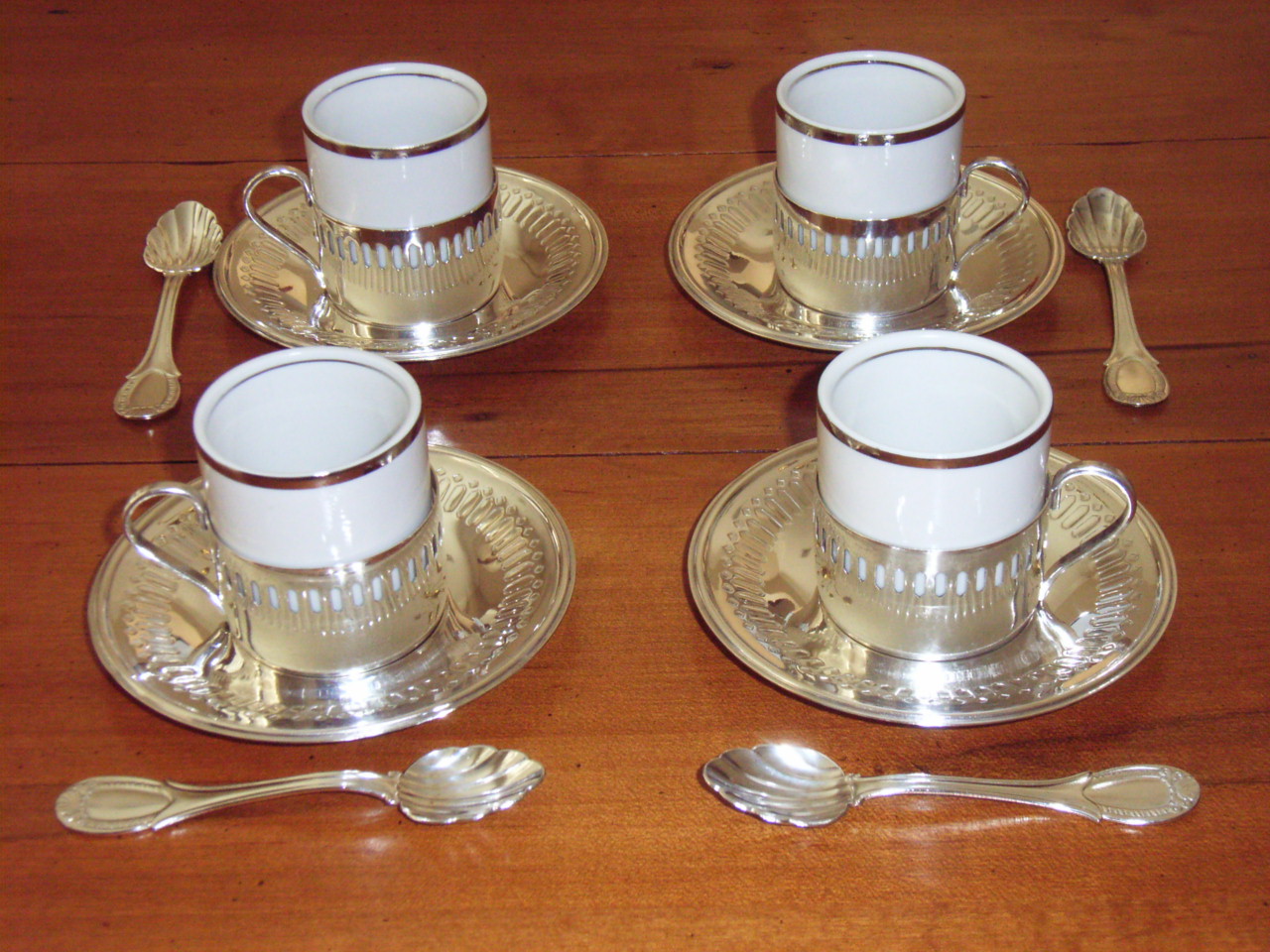
Demitasse spoons with matching demitasse cups

A demitasse spoon is a diminutive spoon, smaller than a teaspoon.[1] It is traditionally used for coffee drinks in specialty cups, such as a demitasse, and for spooning cappuccino froth. It is also used as a baby spoon,[2][3] and in some surgical procedures.[4]

References

[edit]
Revisions and contributorsEdit on WikipediaRead on Wikipedia
from Grokipedia
A demitasse spoon is a small utensil, smaller than a standard , designed for stirring and serving beverages in cups, which are small vessels holding 2 to 3 ounces (60 to 90 ml) of strong black coffee, such as , typically enjoyed after dinner. The spoon's bowl is proportionately narrow and shallow to suit the petite cup, allowing for precise handling without overwhelming the limited liquid volume. These spoons measure approximately 3 to 5 inches (7.6 to 12.7 cm) in length, making them ideal for the intimate scale of demitasse service. The term "demitasse" originates from the French demi-tasse, meaning "half cup," referring to the reduced portion size compared to full cups, and the shares this as its complementary tool. Emerging in during the 1800s, demitasse spoons developed alongside the European adoption of after-dinner rituals, influenced by Middle Eastern traditions of serving hot, black coffee in small quantities. By the mid-19th century, silversmiths across began producing these spoons in greater numbers to match the growing popularity of among the affluent classes, often as part of elaborate sets with matching cups and saucers. Traditionally crafted from or silver plate for durability and elegance, demitasse spoons feature varied designs, from simple beaded handles to ornate patterns reflecting contemporary styles like in the late 19th and early 20th centuries. In American contexts, they appeared in silverware collections by the 1880s, serving not only but also small desserts or as tasting spoons in formal settings. As of 2025, while versions are common for practicality, silver examples remain prized for their historical and aesthetic value in traditions.

Definition and Etymology

Definition

A demitasse spoon is a diminutive utensil, typically 3 to 4 inches in length, designed for serving and stirring small portions of black coffee or espresso known as demitasse, which equate to half-cup servings of approximately 2 to 2.5 fluid ounces. This spoon's compact size ensures it pairs precisely with the narrow dimensions of demitasse cups, facilitating easy handling during formal or casual coffee service. Distinguishing it from other cutlery, the demitasse spoon is notably smaller than a standard , which measures 5 to 6 inches long. Its bowl is typically oval or round in shape, with a capacity of about 2 to 4 milliliters, optimized for efficient stirring in confined cup spaces without overshooting the rim. The primary purpose of the demitasse spoon lies in its ability to reach the bottom of a 2- to 2.5-ounce cup without excess protrusion, allowing users to fully incorporate additives like or a of into the concentrated beverage. This functional precision makes it indispensable for savoring the robust flavors of or similar strong coffees in traditional settings.

Etymology

The term "demitasse" originates from French demi-tasse, literally meaning "half-cup," where demi- denotes "half" and tasse refers to "," the latter borrowed into from ṭašt via Persian tasht (a basin or cup). This compound was coined around to describe a small designed for serving strong black coffee after meals, reflecting the French tradition of portioning such beverages in halves of a standard size. The earliest recorded English usage of demitasse appears in , in reference to coffee service in Parisian contexts, marking its adoption into English alongside the import of French culinary practices. The designation "demitasse spoon" adapts this terminology to the utensil customarily paired with the demitasse cup, denoting a implement for stirring or serving the concentrated . This English term emerged in the mid-19th century, paralleling the cup's introduction as part of formal French-inspired coffee sets, where the spoon's scale matched the vessel's reduced capacity. In contemporary usage, it is sometimes interchangeably termed a "coffee spoon" or "espresso spoon," though the "demitasse" variant specifically underscores its French linguistic and cultural roots in postprandial coffee rituals.

History

European Origins

The demitasse spoon emerged in 19th-century alongside the development of after-dinner coffee rituals influenced by Middle Eastern traditions of serving strong black coffee in small quantities, which reached in the . In 19th-century , the demitasse spoon was formalized as a distinct utensil in the 1800s to accompany small cups of after-dinner black coffee, known as café noir. The term "," meaning "half-cup," was coined in 1842 to describe the cup, with the matching spoon sharing the nomenclature. The invention of the by Angelo Moriondo in 1884 prompted further adaptations to the demitasse spoon, as the concentrated brew required an even smaller utensil for stirring and serving. Moriondo's patented device in , , used to produce quick shots of strong , necessitating spoons scaled down to handle the intense, smaller servings without overwhelming the palate. This shift marked a transition to coffee-specific functionality in European culinary practices. Early demitasse spoons featured ornate silver prototypes crafted by French silversmiths, often with intricate engravings on the bowl's reverse to symbolize post-meal and luxury. These designs prioritized aesthetic appeal, incorporating motifs like floral patterns or gilded accents to complement the era's opulent silverware traditions, distinguishing them from utilitarian teaspoons.

Adoption and Evolution

The demitasse spoon reached the by the 1880s, drawing influence from English upper-class tea ceremonies that emphasized refined table settings. American silver manufacturers, such as Tiffany & Co., began producing specialized flatware including demitasse spoons during the , capitalizing on increased silver availability from sources like the mine discovered in 1859. By the , these spoons were commonly manufactured in sets of six to eight, often featuring intricate designs like carved handles or coffee bean motifs, making them accessible to the emerging as symbols of . In the , the demitasse spoon's role expanded alongside the rising popularity of , which gained traction in the after through Italian immigrant communities and the introduction of commercial espresso machines patented as early as 1901. This period saw a transition from its use in formal after-dinner settings to everyday cafe culture, particularly with the 1933 invention of the that brought espresso-style brewing into American homes. The spoon's compact size proved ideal for stirring small cups of strong black coffee, aligning with the shift toward casual coffee consumption in urban environments. Global adaptations emerged in the early 1900s, with Brazilian silversmiths crafting ornate demitasse spoons featuring tropical figurative designs for local coffee traditions. In Scandinavia, Norwegian and Danish examples, often in with regional motifs, became cherished family heirlooms passed down through generations, reflecting the region's strong coffee-drinking heritage. By the mid-20th century, demitasse spoons saw declining use in formal dining as postwar lifestyles favored simpler tableware and instant coffee options. However, they experienced a revival in the 1980s amid the specialty coffee movement, which emphasized high-quality espresso and artisanal brewing, prompting renewed interest in traditional tools for tasting and presentation.

Design and Materials

Dimensions and Shape

The demitasse spoon typically measures 3 to 4.5 inches (7.6 to 11.4 cm) in length, a compact size designed for precise stirring within the small volume of a cup, which has a depth of approximately 2 to 3 inches (5 to 7.6 cm), ensuring the utensil fits without overhanging the rim or dominating the vessel. The bowl of the demitasse spoon features a pointed oval or round shape, measuring about 0.5 to 1 inch (1.3 to 2.5 cm) in width, which facilitates scooping small quantities such as a pinch of or a bit of froth from without excess volume. The is often slender with a slight or double swell for ergonomic grip, and high-end models may incorporate decorative motifs like coffee beans or shells to enhance both aesthetics and handling comfort. These proportions represent a scaled-down version of the standard , which is roughly 6 inches long, tailored specifically to the cup's modest dimensions for balanced functionality in service.

Construction and Variations

Demitasse spoons are primarily constructed from , valued for its purity and luster, or silver-plated alternatives using a base of electroplated with a thin layer of silver, denoted by hallmarks such as "EPNS" (electroplated ), which emerged in the as a more affordable option to . Modern variations often employ 18/10 , an alloy containing 18% and 10% for enhanced corrosion resistance and durability, sometimes finished with to prevent tarnishing and add ornamental appeal. Craftsmanship in demitasse spoons has evolved from labor-intensive hand-forging, where artisans heat and hammer solid metal bars into shape before adding intricate engravings such as beaded edges, shell motifs, or chased floral designs like lily blossoms, as seen in early 20th-century pieces from makers like Gorham Manufacturing. In contrast, contemporary production favors machine-stamping, where steel ribbons are punched and tempered for efficiency and uniformity, resulting in more accessible yet less textured items. Stylistic variations reflect historical influences and regional aesthetics, including the Gothic pattern with its pointed, arch-inspired handles evoking ; the Queen Anne style, characterized by elegant, curved lines and subtle flourishes; and the design, featuring delicate floral motifs for a romantic touch. Contemporary iterations introduce vibrant, colorful electroplated finishes, blending functionality with playful modern appeal. Quality is indicated by factors like weight and plating thickness: sterling silver examples typically range from 7 to 12 grams per spoon, providing a substantial feel, while silver-plated pieces often feature thicker coatings of 40 to 60 microns for , differing from the lighter, thinner (10 to 30 microns) modern stainless variants.

Usage

In Coffee and Espresso Service

The demitasse spoon serves primarily as a tool for stirring into small servings of black demitasse or , typically around 2 ounces, allowing for precise mixing without overwhelming the delicate beverage. In formal coffee service, it accompanies the and , enabling guests to incorporate sweeteners into black coffee served after dinner to aid . Proper dictates that the is not included in initial place settings but is brought separately during post-dinner service, often one per guest in sets of 6 to 12 for entertaining. After stirring, the should be placed on the rather than left in the cup to avoid accidents while sipping, and it is not used for eating during service. To signal completion and decline further , the is positioned across the top of the cup or . This protocol emphasizes the spoon's role in refined, unobtrusive service. Historically, in French service from the 1800s, the spoon accompanied black coffee in small cups as a digestive following meals, with the term "" deriving from the French for "half cup." Italian traditions, evolving with espresso's invention in , similarly pair the spoon with strong, unadorned for post-prandial rituals. In modern cafes, it remains essential for specialty drinks like macchiato, where its size matches the demitasse cup for stirring, blending tradition with contemporary .

Other Culinary and Practical Uses

Beyond its primary role in coffee service, the demitasse spoon finds versatile application in dessert serving due to its compact size, which allows for precise handling of small portions. It is particularly ideal for scooping , , or other creamy treats like , , and , where the diminutive utensil enhances the sensory experience by encouraging slower consumption and portion control. Similarly, chefs and home cooks use it for tasting sauces or condiments during preparation, as the small provides just enough capacity to sample without excess, maintaining flavor accuracy in delicate recipes. In modern household adaptations, the demitasse spoon promotes mindful eating practices by slowing the pace of bites for appetizers or small meals, fostering greater enjoyment and awareness of flavors, much like its role in desserts. Professionally, demitasse spoons appear in coffee cupping sessions, where tasters use them or similar small utensils to sample multiple brews side-by-side, assessing flavors through precise sips without overwhelming the . In mixology, the spoon's fine proportions enable subtle stirring in small glasses of cordials or liqueurs, preventing over-mixing in delicate spirit preparations. Practically, the demitasse spoon's modest dimensions—typically around 4 to 5 inches—render it invaluable for travel kits or compact kitchens, fitting easily into bags or drawers while avoiding over-stirring in sensitive culinary tasks like emulsifying sauces.

Cultural Significance

Symbolism and Social Role

In 19th-century Europe, particularly in France, the demitasse spoon emerged as a subtle status indicator during after-dinner coffee service, where ornate silver examples showcased the host's wealth and refined taste in formal entertaining. Adopted in the United States by the late 19th century, these spoons similarly signified sophistication among affluent households, often featured in elaborate place settings to impress guests and extend social gatherings. The spoon plays a central role in French digestif culture, where it accompanies small cups of strong black coffee served post-meal to aid and promote leisurely conversation among companions. In Italian traditions, the spoon is essential for stirring into the diminutive shots, embodying the of communal pauses that foster social bonds in daily life and cafes. These practices highlight the spoon's function in marking moments of relaxation and connection after dining. Across global contexts, the demitasse spoon adapts to local customs, such as in Brazilian coffee culture, where simpler, everyday versions facilitate the quick stirring of cafezinho, reflecting the nation's pervasive habit of sharing small, strong coffees in informal settings. In contemporary trendy cafes, the demitasse spoon evokes a sense of elegance, transforming routine service into a mindful that encourages savoring flavors and presence.

Collectibility and Modern Appeal

Demitasse spoons hold significant appeal in the antique market, especially rare examples from the late 18th and 19th centuries, crafted by renowned silversmiths such as Hester Bateman or early American makers, which can fetch $50 to $500 per spoon based on rarity, condition, and provenance. Hallmarks like "Sterling," "925," or specific maker's marks from firms such as or & Son greatly enhance their value by verifying authenticity and craftsmanship. Features such as hand-engraved details or gem inlays further elevate prices for these historical pieces. Among collectors, souvenir demitasse spoons depicting landmarks like or state capitols tend to have lower market values, with most examples selling for under $60 due to their commonality. Complete sets, however, are highly prized for their uniformity and display potential, often commanding premiums such as $495 for an boxed set from circa 1924. Contemporary trends favor spoons with thematic motifs, including coffee beans or figural designs, which attract enthusiasts seeking pieces that blend functionality with decorative flair. The preservation of demitasse spoons is aided by their specialized role in formal service, resulting in many surviving in near-pristine condition with intact plating or engravings. 20th-century productions from U.S. manufacturers like provide affordable starting points for collectors, often featuring hammered finishes or styles from the early 1900s. In modern contexts, demitasse spoons enjoy renewed popularity within the movement, serving as essential tools for cupping sessions where tasters slurp samples to evaluate flavors. Artisanal brands like Umeshiso have introduced diverse lines, including colorful "Little Dipper" models with deep bowls for optimal tasting, which double as versatile utensils for everyday rituals. These items appeal as thoughtful gifts to coffee aficionados, combining practicality with inclusive, vibrant designs that promote in professional and home settings.

References

Add your contribution
Related Hubs
Contribute something
User Avatar
No comments yet.