Hubbry Logo
SpoonSpoonMain
Open search
Spoon
Community hub
Spoon
logo
8 pages, 0 posts
0 subscribers
Be the first to start a discussion here.
Spoon
Spoon
from Wikipedia
Wooden spoons, Betsileo people, Madagascar, 19th century
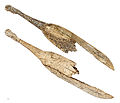
Sasanian spoon and fork (4th century)

A spoon (UK: /ˈspn/, US: /ˈspun/ SPOON) is a utensil consisting of a shallow bowl (also known as a head), oval or round, at the end of a handle. A type of cutlery (sometimes called flatware in the United States), especially as part of a place setting, it is used primarily for transferring food to the mouth (eating). Spoons are also used in food preparation to measure, mix, stir and toss ingredients and for serving food. Present day spoons are made from metal (notably stainless steel, flat silver or silverware, plated or solid), wood, porcelain or plastic. There are many different types of spoons made from different materials by different cultures for different purposes and food.

Terminology

[edit]

The spoon consists of a bowl and a handle. A handle in the shape of a slender stick is frequently called a stem. The stem can end in a sharp point or be crowned with a knop, a decorative knob.[1] The knop-top spoons with a variety of knop shapes described by colorful terms like "acorn", "writhen-end" (spiral ornament on a ball), "maidenhead" (a bust), "diamond point," "apostle" were particularly popular in England in the 14th to 17th centuries.[2]

The name spoon came from Old English spon, 'chip'.[3][4]

History

[edit]
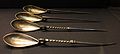
Assorted spoons of the Roman world (British Museum)
Medieval spoons with seal top

Preserved examples of various forms of spoons used by the ancient Egyptians include those composed of ivory, flint, slate and wood, many of them carved with religious symbols.[5] During the Neolithic Ozieri civilization in Sardinia, ceramic ladles and spoons were already in use. In Shang dynasty China, spoons were made of bone. Early bronze spoons in China were designed with a sharp point, and may have also been used as cutlery.[6] The spoons of the Greeks and Romans were chiefly made of bronze and silver and the handle usually takes the form of a spike or pointed stem.[5] There are many examples in the British Museum from which the forms of the various types can be ascertained, the chief points of difference being found in the junction of the bowl with the handle.[5] The ancient Greeks called the spoon mystron (μύστρον), and they also used pieces of bread scooped out in the shape of a spoon, which they called, mystile (μυστίλη).[7][8]

A 2024 study by archaeologist Andrzej Kokowski and biologists from Maria Curie-Skłodowska University in Lublin, Poland, identified 241 small, spoon-shaped objects at 116 archaeological sites across Scandinavia, Germany, and Poland, dating back to the Roman era. These sites primarily consisted of marshes and graves. The study proposes that these objects, often found alongside items associated with warfare and featuring a small disk 10-20 millimeters in diameter, were likely used to administer drugs, especially stimulants, before battles. Germanic peoples of the era had access to various substances with potential medicinal or psychoactive properties, including poppy, hops, hemp, henbane, belladonna, and certain fungi.[9]

A Crusade-era spoon from 1017 that was found on archaeological excavation of Tursiannotko in Pirkkala, Finland

In the early Muslim world, spoons were used for eating soup.[10] Medieval spoons meant for domestic use were commonly made of cow horn or wood, but brass, pewter, and latten spoons appear to have been common in about the 15th century.[5] The full descriptions and entries relating to silver spoons in the inventories of the royal and other households point to their special value and rarity.[5] The earliest English reference appears to be in a will of 1259.[5] In the wardrobe accounts of Edward I for the year 1300 some gold and silver spoons marked with the fleur-de-lis, the Paris mark, are mentioned.[5] One of the most interesting medieval spoons is the Coronation Spoon used in the anointing of the English and later British sovereign; this 12th-century object is the oldest surviving item in the British royal regalia.[5]

The sets of Apostle Spoons, popular as christening presents in Tudor times, the handles of which terminate in heads or busts of the apostles, are a special form to which antiquarian interest attaches.[5] The earlier English spoon-handles terminate in an acorn, plain knob or a diamond; at the end of the 16th century, the baluster and seal ending becomes common, the bowl being fig-shaped.[5] During The Restoration,[citation needed] the handle becomes broad and flat, the bowl is broad and oval and the termination is cut into the shape known as the hind's foot.[5]

In the first quarter of the 18th century, the bowl becomes narrow and elliptical, with a tongue or rat's tail down the back, and the handle is turned up at the end. The modern form, with the tip of the bowl narrower than the base and the rounded end of the handle turned down, came into use about 1760.[5]

Types and uses

[edit]
A selection of Georgian-Victorian English sterling silver tableware spoons (c. 1790 – c. 1850)

Spoons are used primarily for eating liquid or semi-liquid foods, such as soup, stew or ice cream, and very small or powdery solid items which cannot be easily lifted with a fork, such as rice, sugar, cereals and green peas. In Southeast Asia, spoons are the primary utensil used for eating; forks are used to push foods such as rice onto the spoon as well as their western usage for piercing the food.[11][12]

Spoons are also widely used in cooking and serving. In baking, batter is usually thin enough to pour or drop from a spoon;[13] a mixture of such consistency is sometimes called "drop batter".[14] Rolled dough dropped from a spoon to a cookie sheet can be made into rock cakes and other cookies, while johnnycake may be prepared by dropping spoonfuls of cornmeal onto a hot greased griddle.

A spoon is similarly useful in processing jelly, sugar and syrup. A test sample of jelly taken from a boiling mass may be allowed to slip from a spoon in a sheet, in a step called "sheeting". At the "crack" stage, syrup from boiling sugar may be dripped from a spoon, causing it to break with a snap when chilled. When boiled to 240 °F. and poured from a spoon, sugar forms a filament, or "thread". Hot syrup is said to "pearl" when it forms such a long thread without breaking when dropped from a spoon.

Used for stirring, a spoon is passed through a substance with a continued circular movement for the purpose of mixing, blending, dissolving, cooling, or preventing sticking of the ingredients. Mixed drinks may be "muddled" by working a spoon to crush and mix ingredients such as mint and sugar on the bottom of a glass or mixer. Spoons are employed for mixing certain kinds of powder into water to make a sweet or nutritious drink. A spoon may also be employed to toss ingredients by mixing them lightly until they are well coated with a dressing.

For storage, spoons and knives were sometimes placed in paired knife boxes, which were often ornate wooden containers with sloping tops, used especially during the 18th century. On the table, an ornamental utensil called a nef, shaped like a ship, might hold a napkin, knife and spoon.

Language and culture

[edit]

Spoons are mentioned in the Bible (KJV): God in the Book of Exodus[15] tells Moses to make for Tabernacle, among other things, spoons of gold.[16]

The expression "born with a silver spoon in his mouth" (born into privilege) formed due to the mediaeval custom of gifting a "baptismal spoon" to a child; well-to-do families were able to afford spoons made of precious metals.[16]

Spoons can be used as a musical instrument.

Spoon-feeding

To spoon-feed oneself or another can simply mean to feed by means of a spoon. Metaphorically, however, it often means to present something to a person or group so thoroughly or wholeheartedly as to preclude the need for independent thought, initiative or self-reliance on the part of the recipient; or to present information in a slanted version, with the intent to preclude questioning or revision. Someone who accepts passively what has been offered in this way is said to have been spoon-fed.[citation needed]

A spoonful is the amount of material a spoon contains or can contain. It is used as a standard unit of measure for volume in cooking, where it normally signifies a teaspoonful.[citation needed] It is abbreviated coch or cochl, from Latin: cochlearium, a small Roman spoon. "Teaspoonful" is often used in a similar way to describe the dosage for over the counter medicines. Dessert spoonful and tablespoonful may also be found in drink and food recipes. A teaspoon holds about 5 ml and a tablespoon about 15 ml.

The souvenir spoon generally exists solely as a decorative object commemorating an event, place, or special date.

Manufacture

[edit]

For machine-made spoons, the basic shape is cut out from a sheet of sterling silver, nickel silver alloy or stainless steel. The bowl is cross rolled between two pressurized rollers to produce a thinner section. The handle section is also rolled to produce the width required for the top end. The blank is then cropped to the required shape, and two dies are used to apply the pattern to the blank. The flash is then removed using a linisher, and the bowl is formed between two dies and bent.

The stages of the hand forging process

To make a spoon the traditional way by way of hand forging, a bar of silver is marked up to the correct proportions for the bowl and handle.

It is then heated until red hot and held in tongs, and using the hammer and anvil, beaten into shape. The tip of the bar is pointed to form the tip of the bowl, then hammered to form the bowl. If a heel is to be added, a section down the centre is left thicker. The edges of the bowl and the tip of the spoon are left thicker as this is where most of the thickness is needed. The handle is then started and hammered out to length going from thick at the neck and gradually tapering down in thickness giving a balanced feel. During this process, the piece becomes very hard and has to be annealed several times, then worked again until the final shape is achieved.

Wooden spoon carving steps

The bowl is filed to shape, often using a metal template. The bowl is then formed using a tin cake and spoon stake. The molten tin is poured around the spoon stake and left to harden. The handle is then bent down to 45 degrees, and the spoon is hammered into the tin using the spoon stake and a heavy hammer, to form the bowl. The bend in the handle is then adjusted to match the other spoons in the set so that it sits correctly on the table. The bowl is then filed level, a process called striking off. The surfaces are filed, first with a rough file to remove the fire stain from the surface, then with a smooth file. It is then buffed to remove any file marks and fire stain from inside the bowl and is polished to the desired finish.

Derivatives

[edit]

Both the spork and the sporf are derived from the spoon: they combine the bowl of the spoon with the tines of the fork and with both tines and the cutting edge of the knife, respectively.

See also

[edit]

Notes

[edit]

References

[edit]
[edit]
Revisions and contributorsEdit on WikipediaRead on Wikipedia
from Grokipedia
A spoon is an eating and cooking utensil consisting of a small, shallow, or round bowl attached to a relatively long handle, designed primarily for scooping, stirring, and serving liquids, semi-liquids, and soft foods. Spoons have been in use since times, when early humans fashioned them from natural materials such as shells [or] wood chips to consume soups and porridges. The word "spoon" derives from the spon, meaning "chip of wood" or "splinter," reflecting its primitive origins as a simple carved implement before evolving into more refined tools. Over millennia, spoons have varied in materials to suit cultural, economic, and practical needs, starting with organic substances like and shell in prehistoric eras and progressing to metals such as silver for users and for the general populace by the in medieval . In modern contexts, common materials include for durability and hygiene in eating and cooking, for non-reactive stirring in hot pots, and plastics for lightweight, inexpensive serving options, though wooden and metal variants are preferred to avoid scratching cookware or leaching chemicals. Spoons serve diverse functions beyond dining, including measuring ingredients in recipes—such as teaspoons (about 5 ml) and tablespoons (about 15 ml)—and specialized roles like slotted spoons for draining liquids or ladles for portioning soups. Their enduring design underscores a balance of and utility, making them a staple in global cuisines from ancient rituals to contemporary kitchens.

Terminology and Design

Etymology

The word "spoon" in English derives from spon, which in turn comes from spōn meaning "chip," "sliver," "shaving," or " of wood," referring originally to a wooden fragment used as a rudimentary scooping tool. This term evolved from Proto-Germanic *spe-nu-, a root shared with cognates like spōnn ("chip, , spoon") and span ("chip, "), denoting thin pieces of wood. Further tracing back, it connects to the *spe- (2), signifying a "long, flat piece of wood" or , as seen in related Greek terms like spathe ("") and sphēn (""). By around 1300, the meaning shifted in to denote a metal or wooden eating utensil, influenced by sponn, reflecting the transition from wooden chips to crafted implements for scooping liquids and soft foods. In classical languages, spoon terminology emphasized shell-like shapes, paralleling early uses of natural shells as scoops. The Latin cochleāre (a small spoon or ladle) derives from cochlea ("snail" or "spiral shell"), evoking the concave form of shells adapted for eating, as in Roman cochlear spoons for shellfish or eggs. Similarly, the Greek precursor traces to kokhlias or related forms from kochlias ("snail shell"), highlighting the utensil's resemblance to a shell's curve rather than wood. These terms underscore a semantic evolution from natural objects to purpose-built tools, distinct from the Germanic focus on wood shavings. Regional variations illustrate diverse linguistic paths for the concept of a scooping utensil. In French, cuillère stems from Latin cochleārium ("spoon"), a diminutive of cochlear ("shell-shaped spoon" or ladle), entering as cuilliere by the medieval period and retaining the shell connotation. Outside , the Chinese term sháo (勺), meaning "spoon" or "ladle," originates from *tʰewk, denoting a or scoop, often used for measuring or serving liquids in ancient vessels. Trade and colonization spread European terminology, adapting "spoon" to describe indigenous scooping tools. In colonial , English settlers applied "spoon" to Native American utensils like mussel shell ladles (e.g., among Algonquian groups, where shells served as feast spoons), integrating the term into records of local practices despite cultural differences. This adoption reflects how English linguistic dominance via routes and settlement imposed familiar words on diverse implements worldwide.

Anatomy

A spoon's fundamental anatomy consists of three primary components: the bowl, the concave scooping area designed to hold liquids or semi-solids; the , an elongated grip for user control; and, in some designs, a stem connecting the bowl to the handle, often slender and functional. An optional knop, or decorative terminal, may adorn the end of the handle, enhancing aesthetic appeal without altering core utility. The bowl's shape varies to suit specific functions, with an oval form common in soup spoons to efficiently contain and transport broths and thin liquids. Pointed bowl tips appear in designs intended for piercing and lifting soft or sticky foods, such as grains in certain Asian-style utensils, allowing precise portioning. Handle designs prioritize balance and usability to distribute weight evenly and prevent tipping during use. Ergonomic features, such as a gentle along the , provide leverage for scooping motions, reducing wrist strain by aligning with natural hand contours. Material choice influences anatomical properties, with spoons offering flexibility that permits slight bending under pressure for durability in casual settings, contrasted by the inherent rigidity of metal spoons, which maintain structural integrity for precise control.

History

Prehistoric and Ancient Periods

The earliest evidence of spoons dates to the period, with examples appearing in Early Neolithic settlements in around 6500–6000 BCE. At Barcın Höyük in northwestern , archaeologists have uncovered numerous V-shaped spoons crafted from animal long bones, primarily from metapodials, used for cooking, eating, and various kitchen tasks. These artifacts, found in domestic contexts such as pits and platforms, represent a key in prehistoric food preparation, transitioning from natural scoops like shells or to purpose-made implements. In , spoons emerged by the late Predynastic and early periods, circa 3100–2649 BCE, often carved from or for practical and ritual purposes. One such example, a spoon from this era, has been identified through advanced species analysis confirming its cow ( ) construction, highlighting early mastery of organic materials for scooping liquids or powders. By the Middle and New Kingdoms (circa 2000–1070 BCE), these evolved into elaborate cosmetic spoons, typically made of or wood, used to mix and apply fragrant oils, unguents, and kohl eye makeup—essential for daily hygiene and religious rituals among both men and women. Designs often featured symbolic motifs like swimmers or lotuses, reflecting cultural values of and . During the , spoon production advanced in with the in (circa 1600–1046 BCE), where bronze examples from northwestern sites served both culinary and ceremonial functions. A preserved bronze spoon from this period, measuring about 4 inches in height, exemplifies the era's metallurgical sophistication, likely used for serving food or ritual offerings in ancestral worship, as bronze vessels dominated elite dining and sacrificial practices. Sharp-pointed variants facilitated precise handling of solids or liquids in communal meals. In the classical world, spoons proliferated among Greek and Roman societies from the 1st millennium BCE onward, often inspired by natural shell forms for ergonomic scooping. The termed them mystron, employing them alongside scoops for liquids at symposia, while Romans favored cochlearia—small, pointed-handled spoons of , silver, or —for banquets, where they consumed soups, eggs, and sauces reclining on couches. A 2024 analysis of 241 spoon-shaped artifacts from 116 sites across (1st–5th centuries CE) reveals their widespread use in Roman-influenced contexts, crafted from , metal, and , possibly for measuring and consuming stimulants like during rituals or warfare preparations among Germanic groups.

Medieval to Modern Eras

In medieval , spoons evolved from utilitarian items to symbols of religious and ceremonial significance. The Coronation Spoon, a artifact dating to the (first recorded in 1349), remains the oldest surviving piece of the British and is used in the of monarchs during coronations at . By the 15th century, apostle spoons emerged as popular christening gifts among the elite, typically produced in sets of thirteen—twelve representing the apostles with their emblems and one "master" spoon depicting Christ—first documented in a 1494 will. These spoons, often bestowed by godparents, underscored familial and spiritual bonds in Tudor England. During the in (14th to 17th centuries), spoon designs became more ornate, reflecting artistic and social aspirations. Silversmiths crafted elaborate knop-topped spoons, featuring motifs such as acorns, seals, or maidenheads—female busts symbolizing purity—which served both functional and decorative purposes at noble tables. These intricate silver pieces, hand-forged with symbolic terminals, marked a shift toward personalized that displayed wealth and craftsmanship among the upper classes. The 18th and 19th centuries brought standardization through the , transforming spoons from bespoke luxury items to mass-produced essentials. Innovations in and mechanized stamping, pioneered by firms like Gorham Manufacturing in the United States and English silversmiths, enabled affordable silver-plated for middle-class households. advancements in further specialized spoons, with distinct designs for —shallower and rounded—and , often paired with dedicated forks to prevent cross-contamination in multi-course meals. This era's focus on and uniformity democratized dining practices across and America. In the 20th and 21st centuries, spoons adapted to convenience and environmental concerns. Post-World War II material shortages spurred the rise of plastic cutlery in the 1960s, with disposable polystyrene spoons enabling low-cost, single-use dining in fast-food settings and households. By the late 20th century, this throwaway culture proliferated globally, but 21st-century sustainability trends have promoted alternatives like bamboo spoons, which biodegrade rapidly and draw from renewable resources to counter plastic pollution.

Types and Materials

By Shape and Function

Spoons are classified by their shape and function to optimize their use in dining, serving, and specialized tasks, with variations primarily in bowl size, contour, depth, and handle proportions tailored to the or delicacy of the or involved. These adaptations ensure efficient handling, such as scooping thick soups or stirring tall beverages, while minimizing disruption to flavors or textures. Among eating spoons, the soup spoon features a large, round, and relatively deep bowl to efficiently gather liquids like broths or stews, typically with a length of 6 to 8 inches and a capacity under 1 tablespoon. In contrast, the teaspoon has a smaller, oval-shaped bowl suited for stirring beverages such as tea or coffee, or for consuming small portions, with a standard volume of about 4.9 mL and an overall length around 6 inches. The dessert spoon serves as an intermediate size, with an oval bowl roughly twice that of a teaspoon, designed for eating layered or soft desserts without overwhelming the portion. Serving spoons vary in bowl design to accommodate different serving needs; solid versions have deep, rounded bowls for scooping dense foods like mashed potatoes, while slotted types incorporate perforations or gaps in the bowl to drain excess liquid when retrieving items such as poached eggs or pasta from boiling water. These are generally longer, ranging from 10 to 12 inches, to reach into serving dishes comfortably. Specialized spoons incorporate unique shapes for precise functions. The grapefruit spoon has a pointed, shallow with serrated or toothed edges along one side to segment and scoop fruit from its rind without tearing the flesh, typically measuring 5 to 8 inches long with about 1 capacity. The mustard spoon features a small, shallow, often scalloped bowl on a long, thin handle, ideal for extracting condiments from narrow pots without scooping excess, usually around 5 inches in total length. For beverages in tall , the iced tea spoon employs a small bowl paired with an extended handle of 7 to 10 inches to stir ice and sweeteners effectively. Functional adaptations also address sensory preservation in niche uses. The , with its diminutive size of 3 to 4 inches and a under 1 , is shaped for stirring and sipping small servings of or strong , often with ornate detailing for formal settings. Similarly, the has a shallow, elongated on a short (2 to 5 inches) and is traditionally crafted from inert materials like mother-of-pearl to prevent any metallic reaction that could impart an off-taste to the delicate , thereby preserving its pure flavor profile.

By Construction Material

Spoons have been crafted from a diverse array of materials over , each chosen for its functional properties, availability, and cultural significance, with historical shifts driven by and resource constraints. Early examples relied on natural substances like and , while metals emerged for and prestige, and modern synthetics prioritize convenience and sustainability. Among metals, silver holds a prominent place due to its historical association with wealth and refinement, particularly in ancient Greek and Roman societies where it was reserved for elite use. Sterling silver, an alloy composed of 92.5% pure silver and 7.5% other metals (typically copper) for added strength, originated in 12th-century England as a standard for coinage and was applied to silverware by the 14th century, enabling intricate designs that symbolized status. However, silver tarnishes through oxidation when exposed to sulfur-containing compounds in air or food, requiring regular polishing to maintain its luster. Silver-plated spoons, featuring a thin silver coating over base metals like nickel, emerged in the 19th century as a more affordable alternative, democratizing access to the material's aesthetic appeal without the full cost of solid sterling. In contrast, stainless steel revolutionized spoon production from the 1910s onward, becoming the dominant modern material for its exceptional corrosion resistance and longevity. This iron-chromium alloy forms a protective oxide layer that prevents rust, making it ideal for everyday cutlery that withstands frequent use and dishwashing without degrading. Non-metallic materials like wood, horn, and bone represent some of the earliest spoon constructions, valued for their accessibility in prehistoric and ancient contexts. Wooden spoons, dating back to Paleolithic times, were carved from available hardwoods and remain popular today for their eco-friendly biodegradability and renewability as a byproduct of sustainable forestry. Olive wood, in particular, is favored for its dense grain structure, which resists absorbing odors and flavors better than softer woods, while providing natural antibacterial properties that inhibit bacterial growth on the surface. However, general wooden spoons can become porous over time, potentially absorbing flavors from acidic or strongly seasoned foods, which may transfer subtle tastes to future meals if not properly seasoned and maintained. Horn and bone spoons, sourced from animal byproducts, were common in ancient Egyptian and medieval European households, offering insulating qualities that prevent rapid heat transfer and keep handles cool during use. These materials provided natural durability and were often shaped from cattle horns or long bones, though they required careful processing to avoid cracking. Plastic spoons gained prominence as a disposable option following their introduction in the , with mass production accelerating in the amid post-World War II industrial expansion and the rise of fast-food culture. Made from polymers like , they offered lightweight convenience and non-porous surfaces that resist staining and simplify hygiene through easy sterilization. Yet, their environmental drawbacks, including slow decomposition and contribution to , prompted regulatory responses such as the European Union's 2021 ban on single-use cutlery to curb litter from the 10 most common beach pollutants. Composites and alternatives have since addressed these issues; spoons, developed for use in the late , provide heat resistance up to 500°F (260°C), making them suitable for stirring hot pots without melting or scratching cookware. spoons, often produced since ancient times in regions like for elite ceremonial purposes, serve primarily ornamental roles today due to their fragility and aesthetic glaze finishes that enhance table settings. Recent innovations include bioplastics derived from plant starches like (PLA) and 3D-printed spoons from recycled materials, emerging post-2010 as part of a push to replace petroleum-based plastics with compostable options that degrade in industrial facilities, as well as seaweed-based spoons introduced in the early and spoons made from grains or rice, which fully biodegrade or are consumable, reducing waste further. Material selection influences spoon performance through key properties like thermal conductivity, hygiene, and ecological footprint. Metallic spoons, especially silver and stainless steel, efficiently conduct heat, allowing them to warm liquids quickly but risking burns if handled directly from hot sources. Non-metallic options like wood, horn, and silicone act as insulators, maintaining comfortable grip temperatures during cooking. For hygiene, plastic's smooth, non-porous nature prevents bacterial harboring and facilitates thorough cleaning, outperforming porous woods that may retain moisture despite their inherent antimicrobial traits. Environmentally, metals and wood score favorably for recyclability and renewability, whereas traditional plastics exacerbate waste accumulation—prompting shifts toward bioplastics, which reduce carbon footprints by up to 70% compared to conventional petroleum derivatives in lifecycle assessments.

Culinary and Practical Uses

Eating and Serving

Spoons are essential utensils for semi-liquid foods such as soups and cereals, as well as soft solids like and , where their shape facilitates scooping and conveying small portions to the mouth without requiring cutting or piercing. In many Southeast Asian cultures, spoons function as the primary eating utensil, often used in conjunction with a to push or other foods onto the spoon for consumption, reflecting adaptations to rice-based diets and differing from Western fork-dominant practices. For serving, larger spoons such as ladles are employed to portion and distribute liquids like gravies, sauces, soups, and stews, ensuring even distribution at the table. Slotted serving spoons, with perforations in the bowl, allow for draining excess liquid while transferring solids, commonly used for items like boiled , fried foods, or vegetables to prevent sogginess on plates. In formal dining , spoons are positioned to the right of the plate, aligned with knives and ordered from the outermost (for or appetizer courses) to the innermost (for the ), with diners progressing inward as the meal advances. spoons, typically featuring a rounded, elongated , are placed farthest right for initial courses involving broths or creams. Spoons also aid in portion control during eating and serving, with standardized sizes like the , holding 5 milliliters, and the , holding 15 milliliters, providing precise volumes for recipes and consistent servings of ingredients or condiments.

Cooking and Preparation

Spoons play a vital role in food preparation, enabling precise tasks such as mixing, measuring, and tasting that ensure consistent results in recipes. In professional and home kitchens alike, their design variations—ranging from solid bowls for stirring to slotted edges for straining—facilitate efficient handling of ingredients without damaging cookware or altering flavors. Wooden spoons are particularly favored for mixing and stirring batters or doughs, as their soft, non-reactive surfaces prevent scratching non-stick pots and pans while providing sturdy leverage for folding ingredients. Made from dense hardwoods like or , these spoons can withstand vigorous stirring of thick mixtures, such as cake batters or bread doughs, without splintering or absorbing odors. Slotted spoons, conversely, are essential for skimming foam or impurities from soups and during , allowing liquids to drain while capturing solids for removal. Their perforated ensures clarity in broths by efficiently lifting away or froth without disturbing the underlying contents. Measuring spoons standardize portioning in , where accuracy is crucial for achieving proper texture and rise in recipes. In the U.S. customary system, sets typically include sizes from 1/4 up to 1 , calibrated to level off dry or liquid ingredients like spices, , or for reproducible outcomes. These tools promote precision, as even small deviations in measurements can affect chemical reactions in doughs or batters. For tasting and sampling, long-handled spoons allow chefs to safely extract small amounts from hot pots or vats in settings, minimizing burns and . Their extended reach facilitates quick assessments of flavor balance during cooking, often with a shallow to hold just enough for evaluation. Specialized spoons, such as those with spatula-like flat edges, combine scooping and scraping functions for tasks like gathering remnants from mixing bowls or testing sauces. These hybrid designs, often in heat-resistant , enable thorough extraction of viscous mixtures while conforming to curved surfaces for complete yields.

Cultural and Symbolic Roles

In Language and Idioms

The idiom "born with a silver spoon in one's mouth" refers to being born into wealth and privilege, originating from the 18th-century European tradition among affluent families of gifting silver spoons to infants during christening ceremonies as symbols of prosperity and . This practice underscored class distinctions, with silver utensils signifying inherited advantages unavailable to the lower classes. "Spoon-feeding," in its figurative sense, describes providing information or instruction in an overly simplistic or hand-holding manner, implying a lack of independent thinking; this usage emerged in the , building on the literal act of feeding infants with a spoon to denote excessive nurturing. In the , spoons are referenced in Exodus 25:29 as part of the sacred furnishings for the , where they are described alongside dishes, covers, and bowls made of pure gold for ritual use, often interpreted as small vessels or censers for holding during offerings. These spoons symbolized devotion and purity in worship, with their incense-filled form representing prayers ascending to , a motif echoed in broader scriptural of offerings as conduits for spiritual and . The term "spooning" denotes a cuddling position where partners lie side by side with one person's front against the other's back, akin to nested spoons; this usage dates to the late , evolving from earlier connotations of affectionate embracing to describe intimate physical closeness in the . A is a involving the accidental transposition of initial sounds in words, such as saying "queer old dean" instead of "dear old queen"; the term derives from Reverend (1844–1930), an scholar reputed for such verbal slips, with the word entering common usage by the early . The "" serves as an informal measurement, particularly in for dosing liquids like syrups or elixirs, where a teaspoonful approximates 5 milliliters and a tablespoonful 15 milliliters, though variability in household spoons has led to recommendations for using standardized medical droppers to avoid errors.

In Art, Rituals, and Society

In 17th-century Dutch still-life paintings, spoons appeared alongside other everyday objects such as fruits, vases, and to symbolize the transience of and the futility of pleasures, reminding viewers of mortality amid depictions of domestic abundance. These compositions, popular during the , used such utensils to evoke the impermanence of worldly goods, often contrasting gleaming silverware with wilting flowers or extinguished candles. In modern art, spoons have inspired sculptures that repurpose discarded utensils to explore themes of extravagance and decay, echoing vanitas motifs. British artist Ann Carrington crafts elaborate floral bouquets from hundreds of nickel-plated and silver spoons, forks, and brooches, as in her "Bouquets" series works like Sugarland and Southern Belle, which critique the illusion of wealth by transforming humble kitchen items into opulent yet fragile forms. Similarly, spoons feature in contemporary jewelry, where vintage silverware is reshaped into rings and pendants, blending sustainability with artistic expression; for instance, makers like Midnight Jo upcycle antique spoons into adjustable oxidized sterling silver rings that retain historical engravings. Spoons hold ceremonial significance in rituals, particularly within the British monarchy, where the silver-gilt Coronation Spoon—first recorded in 1349 and possibly dating to the —has been used since James I's crowning to anoint the with holy oil during the sacred rite, symbolizing divine authority and the monarch's spiritual role. In Christian traditions, apostle spoons emerged as christening gifts from the , with Tudor-era customs (noted as early as 1631) involving godparents presenting sets of silver spoons topped with apostle figures, such as St. Peter, to bestow blessings on newborns. Socially, spoons served as 19th-century tourism souvenirs, often featuring twisted-wire handles for decorative appeal, as seen in American examples like those commemorating Hawaiian royalty with a twist-wire stem and engraved from the 1880s. In , particularly Appalachian traditions, spoons became rhythmic percussion instruments from the 18th century onward, played by pinching two together and striking the thigh to accompany tunes and ballads, a practice popularized in early 20th-century recordings and the mid-century folk revival. Beyond Western contexts, spoons carry symbolic weight in non-Western cultures. Among the Dan people of Côte d'Ivoire and Liberia, wunkirmian (or wakemia) feasting spoons are ceremonial wooden ladles used in village feasts and masquerades, serving as emblems of prestige for the wunkirle, the most hospitable woman, symbolizing generosity, fertility, and community status. In Zulu culture of South Africa, spoon carving is a traditional male craft with deep symbolic value; spoons, often stylized as female figures, are exchanged during bride price negotiations alongside a goat known as the "goat of the spoon," representing familial bonds and ceremonial occasions. In Bulgarian folklore, wooden spoons feature in rituals to ward off evil, such as using multiple spoons in incantations to break the evil eye, in matchmaking customs, and for postpartum protection by tying one with a red thread to banish demons. Contemporary society highlights spoons in eco-activism against waste, with campaigns promoting reusable metal or alternatives to single-use disposables; initiatives like the "Bring Your Own" movement, advocated by organizations such as , encourage carrying personal spoons to cut down on the billions of utensils discarded annually. Spoon collecting, akin to in its focus on commemorative items, surged in the late as tourists amassed engraved spoons from European travels, a that persists today with dedicated conventions and valuations based on rarity and .

Manufacturing

Traditional Techniques

Hand-forging represented a primary artisanal method for crafting metal spoons in medieval Europe, particularly within organized guilds such as the Pewterers’ Guild in London. Artisans began by heating silver or pewter bars in a forge to make the metal malleable, then repeatedly hammering the heated material over an anvil to elongate it into a rough stem and form the basic outline of the handle and bowl. The handle was typically hammered from a thicker neck section tapering to a thinner end for improved balance during use, with the metal annealed—heated and slowly cooled—multiple times to relieve stresses and prevent cracking. For the bowl, a tin cake served as a swage to shape the concave form, while a specialized spoon stake provided support during hammering; the rim of the bowl and the tip of the handle were often fabricated separately and soldered onto the main body to achieve precision. This labor-intensive process, overseen by guild masters to ensure quality and adherence to standards, produced durable spoons suitable for everyday elite use, with silver reserved for prestige items denoting status. Casting emerged as a complementary technique from the onward, enabling the creation of more ornate spoon designs, such as the iconic spoons popular as christening gifts among the affluent. Molten metal, often silver or a silver , was poured into two-part molds carved from materials like or clay, capturing intricate details such as the figural representations of apostles or Christ at the handle's . These molds allowed for the replication of symbolic emblems—each apostle with an attribute like Saint Peter's keys or eagle—producing sets of up to thirteen spoons that combined religious with functional utility. Once cooled, the cast handle finials were frequently soldered to a forged stem and , blending the precision of with forging's strength for elaborate, prestige-oriented pieces. This method, documented in English sources from the late , facilitated of decorative variants while maintaining artisanal control over mold design. Wood carving offered a simpler, more accessible approach for spoons in prehistoric and folk traditions, relying on a single piece of wood into the complete utensil without joins or metal components. Artisans selected hardwoods like for its fine grain and density, which resisted splitting during carving, or olive wood in Mediterranean regions for its durability and subtle figuring. Using basic tools such as a hooked , straight gouge, and axe, carvers first split a green log billet—freshly cut to minimize waste—then roughly shaped the and hollowed the by scoring and paring away material in controlled strokes. This lap-carving technique, evident in archaeological remnants from prehistoric European sites and persisting in Scandinavian folk practices, produced lightweight, hygienic spoons ideal for communal eating or cooking in rural settings. The process emphasized intuitive , with the wood's natural curves guiding the final form, and required no heat or complex setups, making it a of pre-industrial domestic . Finishing techniques elevated raw spoons to refined artifacts, involving for luster, for , and the application of hallmarks for authenticity, particularly on silver pieces from the in . After shaping, surfaces were burnished with abrasives like or pads to achieve a smooth, reflective sheen that highlighted the metal's purity and prevented accumulation. added decorative motifs, such as knop-tops—baluster-shaped finials resembling acorns, maidens, or seal ends—incised with burins to inscribe initials, crests, or symbolic patterns, often on the handle's reverse for subtle elegance. For silver spoons, hallmarks were introduced in via a royal statute establishing the sterling standard (92.5% silver), with the Goldsmiths' of stamping symbols like the leopard's head for purity, a for the , and later date letters to verify origin and quality. These steps, performed by guild-trained finishers, ensured spoons not only functioned well but also served as verifiable markers of wealth and craftsmanship in .

Contemporary Methods

Contemporary methods of spoon production have largely shifted to mechanized and automated processes, building on the industrial advancements of the that introduced stamping and pressing techniques. These methods involve cutting and shaping , such as or silver, using precision dies in hydraulic or mechanical presses to form the and from flat . This approach became dominant in factories during the , enabling high-volume production of uniform spoons for both household and commercial use. Injection molding emerged as a key technique for spoons following the widespread adoption of resins after the , revolutionizing the production of disposable . The process entails heating pellets, typically or , until molten, then injecting the material under high pressure into a cooled mold cavity shaped like a spoon, where it solidifies before ejection. This method facilitates rapid cycles—often under 30 seconds per unit—supporting the mass manufacture of billions of single-use spoons annually for fast-food and industries. In the 2010s, 3D printing, or additive manufacturing, introduced innovative possibilities for custom and prototype spoon designs, particularly emphasizing sustainability. This layer-by-layer deposition uses materials like polylactic acid (PLA) filaments or metal powders, such as titanium, to create intricate, on-demand spoons without traditional tooling waste. Applications include eco-friendly prototypes from recycled or bio-based feedstocks, allowing for personalized shapes and reduced material overuse in small-batch production. Modern quality controls in spoon manufacturing incorporate to enhance durability, especially for metal variants, by depositing a thin layer of silver or onto the base material via in an bath. This coating improves corrosion resistance and wear tolerance, extending the lifespan of everyday flatware while maintaining aesthetic appeal. Additionally, 2020s innovations integrate through biodegradable composites, such as PLA derived from or reinforced fibers, which decompose in industrial composting facilities within months, addressing plastic waste concerns in disposable production.

Derivatives and Innovations

Hybrid Utensils

Hybrid utensils integrate the spoon's bowl with elements of forks, knives, or ladles to enable multifunctional eating or serving, enhancing convenience in various settings. The , featuring a shallow spoon bowl terminating in fork tines, exemplifies this design for scooping and piercing foods simultaneously. Invented by physician Samuel W. Francis, the utensil received U.S. Patent 147,119 on February 3, 1874, describing a handle-attached bowl with tines at one end for combined spoon-fork , including a edge for cutting. The gained widespread adoption in the mid-20th century, particularly in institutional and portable contexts. The term was trademarked by Hyde W. Ballard in 1951, with the Van Brode Milling Company patenting a version in 1970 and later supplying sporks for U.S. , including Meals Ready to Eat (MREs) from the 1980s onward, where their lightweight, disposable nature suited field rations. In fast food, chains like popularized sporks in the early 1970s to streamline service for mixed-consistency meals such as salads and desserts. The splade, or splayd, extends the hybrid concept into serving by blending spoon, fork, and knife functions in a ladle-like form with slotted tines and a sharpened edge. Invented in 1943 by Australian industrial designer William McArthur in , it was mass-produced from the 1960s onward. Its popularity surged in the 1970s amid rising and culture in , where it facilitated easy portioning and cutting of grilled meats and sides without multiple tools. These tools highlight the spoon's foundational bowl as the base for such innovations, promoting in communal dining.

Specialized Adaptations

Specialized adaptations of spoons address specific , or functional challenges, incorporating materials and designs tailored for portability, precision dosing, industrial handling, or needs. These variants extend beyond everyday or hybrid uses, prioritizing in extreme conditions, for safety, or ergonomic support for users with impairments. Travel spoons, often collapsible or pocket-sized, cater to hikers and outdoor enthusiasts requiring lightweight, compact utensils that withstand rugged conditions. models, prized for their low weight—such as the TOAKS long-handle spoon at 18.5 g (0.65 oz)—and corrosion resistance, are popular in . For instance, folding spoons from brands like TOAKS and Vargo feature polished heads for comfort and can fold to under 4 inches for easy packing. These designs emerged from aerospace-derived applications adapted for outdoor use in the late and . Medical dosing spoons provide accurate measurement of liquid medications, particularly for pediatric use, featuring etched volume lines in milliliters to minimize errors associated with household utensils. These tools, often made from durable plastic or stainless steel, became more common in the late 1990s and 2000s, aligned with FDA efforts to improve pediatric dosing accuracy, such as 2018 guidance recommending calibrated spoons or droppers to ensure volumes like 5 mL are administered correctly. Studies indicate that using calibrated dosing devices can reduce medication dosing errors by more than 50% compared to imprecise kitchen spoons. In pediatric medicine, such spoons are essential for administering syrups or suspensions, with regulatory oversight ensuring biocompatibility and clarity of markings. Industrial spoons, typically large scoops or spatulas, facilitate safe handling of chemicals, powders, or bulk materials in laboratories and factories, emphasizing prevention through inert materials. variants, such as those in 304 grade, offer high chemical resistance and mechanical strength, allowing for mixing without reacting to acids or solvents. These tools, often 6-12 inches long with broad bowls, are autoclavable and designed for sterile environments, as seen in Fisher Scientific's lab scoops used for transfer. In chemical processing, they prevent cross- by providing smooth, non-porous surfaces that avoid residue buildup, supporting compliance with safety standards in pharmaceutical and industrial settings. Accessible spoon designs incorporate ergonomic features to aid users with mobility limitations, such as , promoting independent eating through weighted handles or angled bowls. Weighted models, adding 1-2 ounces to the handle, stabilize tremors and enhance grip control for conditions like Parkinson's. These spoons, often with built-up rubber grips increasing diameter to 1.5 inches, reduce strain during use, as evidenced in studies showing improved for patients. Angled variants, bent at 45-90 degrees, enable one-handed feeding by aligning the bowl with the mouth without wrist extension, further supporting conditions like post-stroke recovery. Such innovations, like those from Sammons Preston, prioritize heads with non-slip bases for safety and ease. In recent years, innovations include biodegradable sporks made from plant-based materials, introduced in the for sustainable, disposable use in and events.

References

Add your contribution
Related Hubs
User Avatar
No comments yet.