Hubbry Logo
BaristaBaristaMain
Open search
Barista
Community hub
Barista
logo
8 pages, 0 posts
0 subscribers
Be the first to start a discussion here.
Barista
Barista
from Wikipedia

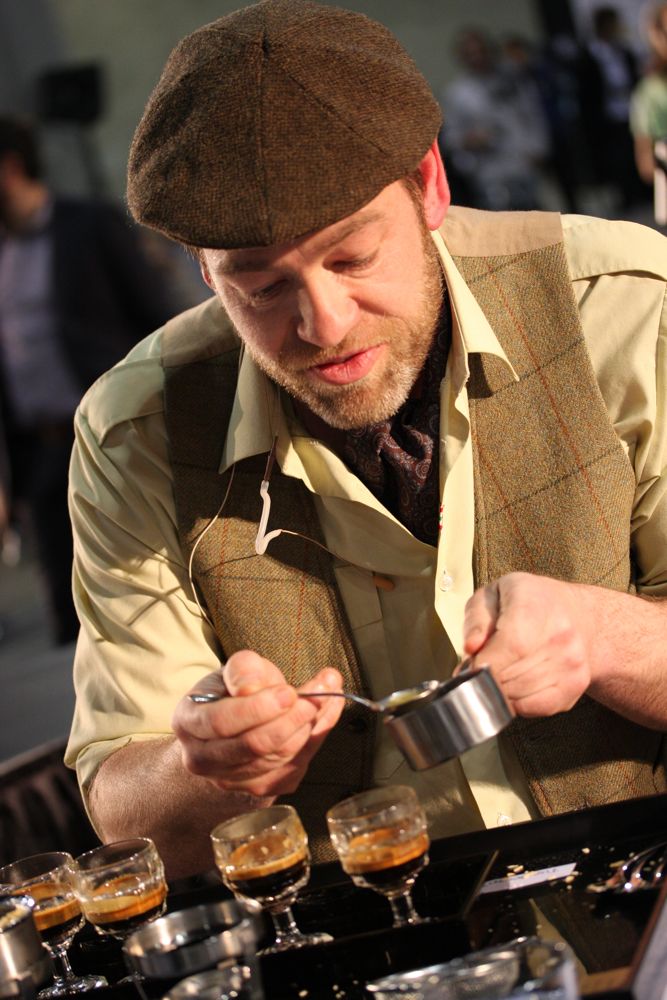
Gwilym Davies, World Barista Championship winner 2009

A barista (/bəˈrstə, -ˈrɪs-/ bə-REE-stə, bə-RIST, Italian: [baˈrista]; lit.'bartender') is a person, usually a coffeehouse employee, who prepares and serves espresso-based coffee drinks and other beverages.

Etymology and inflection

[edit]

The word barista comes from Italian, where it means a "bartender" who typically works behind a counter,[1] serving hot drinks (such as espresso), cold alcoholic and non-alcoholic beverages, and snacks.[2] The Italian plural is baristi for masculine (lit.'barmen' or 'bartenders') or bariste for feminine (lit.'barmaids'), while English and Spanish use "baristas".

Application of the title

[edit]
Good espresso-making is essential to a barista's role. The term espresso comes from the Italian esprimere, which means 'to express', and refers to the process by which hot water is forced under pressure through ground coffee.[3]
Latte art is a visible sign of a trained barista and well-frothed milk.

Baristas generally operate a commercial espresso machine, and their role is preparing and pulling the shot; the degree to which this is automated or done manually varies significantly, ranging from push-button operation to an involved manual process. Good manual espresso-making is considered a skilled task. The preparation of other beverages, particularly milk-based drinks such as cappuccinos and caffè lattes, but also non-espresso coffee such as drip or press pot, requires additional work and skill for effective frothing, pouring, and latte art.

The barista is usually trained to prepare coffee by the roaster or shop owner. Experienced baristas may have the discretion to vary the preparation or experiment.

Beyond the preparation of espresso and other beverages and general customer service, skilled baristas acquire knowledge of the entire process of coffee to effectively prepare a desired cup of coffee, including maintenance and programming of the machine, grinding methods, roasting, and coffee plant cultivation, similar to how a sommelier is familiar with the entire process of winemaking and consumption. A barista can acquire these skills by attending training classes, but they are more commonly learned on the job.

Competition

[edit]

Formal barista competitions originated in Norway,[4] and one such is the World Barista Championships, held annually at varied international locations.[5] The knowledge sharing at WBC is credited with spreading the beverage espresso and tonic to North America.[6]

See also

[edit]

Media related to Baristas at Wikimedia Commons

References

[edit]
Revisions and contributorsEdit on WikipediaRead on Wikipedia
from Grokipedia
A barista is a skilled , typically employed in coffeehouses or cafés, who prepares and serves espresso-based drinks such as lattes, cappuccinos, and Americanos, along with other beverages like teas and hot chocolates. Baristas possess specialized knowledge of beans, grinding, , frothing, and flavor profiles to ensure consistent quality and . The term originates from Italian, where "barista" literally means "" or a person working behind the bar, derived from "bar" (borrowed from English) combined with the "-ista" indicating a practitioner or ; it entered English usage around 1982 to specifically denote coffee preparers. The profession traces its roots to early 20th-century , coinciding with the invention and commercialization of the —first patented in rudimentary form by Angelo Moriondo in 1884 and refined into a practical device by Luigi Bezzera in 1901—which revolutionized by allowing quick extraction under pressure. Initially focused on serving hot drinks in bars, the role evolved in the mid-20th century as culture spread globally, particularly after when coffeehouses proliferated in and the . In modern contexts, especially within the specialty coffee movement, baristas serve as creative ambassadors for the industry, educating customers on sustainable sourcing, origin stories, and tasting notes while innovating through techniques like and signature drink creation. is supported by organizations like the Specialty Coffee Association, which hosts competitions such as the to showcase expertise in coffee handling, presentation, and sensory evaluation. Today, baristas balance technical precision with hospitality, contributing to coffee's status as a global cultural and economic staple.

Etymology and Terminology

Etymology

The term "barista" originates from Italian, where it denotes a or the individual who serves drinks from behind a counter. Derived from "bar," referring to the serving counter (itself borrowed from English around 1905), combined with the "-ista" indicating an agent or practitioner, the word first appeared in Italian in 1938 to describe counter service workers in bars serving and other beverages. In English, "barista" first appeared in 1982, initially describing a specifically in a coffee shop context. As culture spread in the United States during the 1980s and 1990s, coinciding with the rise of the movement—marked by chains like adopting the term for their staff—the meaning narrowed to emphasize a skilled preparer of espresso-based drinks rather than a general . This evolution aligned with the movement's focus on artisanal quality and expertise, transforming "barista" into a title denoting mastery in and presentation by the late 1990s.

Modern Usage and Variations

In modern contexts, a barista is defined as a trained who prepares and serves beverages, particularly espresso-based drinks, in coffee shops or cafés. This role emphasizes expertise in , flavor profiling, and drink customization, setting it apart from general servers who primarily handle orders, payments, and basic food service without specialized knowledge. In environments, baristas often act as educators on origins and , contributing to the movement's focus on quality and craftsmanship. The term "barista" is inherently -neutral in English, applying to individuals of any , unlike its original Italian usage where it could specify masculine or feminine forms. Informal variations occasionally include "baristo" as a nonstandard, hypercorrect reference to a barista, though this is not widely accepted. In regional adaptations, Spanish-speaking countries commonly borrow "barista" directly, with equivalents like "camarero de café" used in some contexts to describe similar roles, reflecting the global spread of . Linguistic inflections of "barista" vary by language: in English, the standard plural is "baristas," maintaining simplicity for borrowed terms. In Italian, the plural becomes "baristi" for masculine or "bariste" for feminine, aligning with the word's roots as a designation. These forms highlight how the term has evolved from its Italian origins into a versatile, international label for specialists.

History

Origins in Italy

The introduction of to in the 16th century laid the groundwork for the development of coffee service roles, as Venetian merchants imported beans from the East through the city's bustling port, sparking curiosity and eventual widespread adoption of the beverage. The first coffee houses, known as caffè, emerged in in the 17th century, serving as social hubs where attendants prepared and served the drink using simple methods. These early establishments proliferated in the 17th and 18th centuries, transforming coffee from a novelty into a cultural staple and requiring staff skilled in and customer interaction. By the , coffee preparation advanced technologically, particularly with early inventions that demanded greater expertise from workers. In , Moriondo patented a rudimentary steam-powered device for coffee under , marking an initial step toward modern . This was refined in 1901 when Milanese Luigi Bezzera patented the first commercial , a steam-powered device capable of producing concentrated shots quickly under , revolutionizing efficiency and flavor extraction. Bezzera's , soon commercialized by Desiderio Pavoni, shifted coffee service from slow to rapid, on-demand preparation, elevating the attendant's responsibilities in urban s of , such as those in and , where became a of modernity and speed. This era saw workers evolve from general servers to technicians proficient in machine operation, contributing to the distinct Italian culture centered on standing-room service and quick consumption. The post-World War II period from the 1940s to 1950s witnessed a significant boom in Italian espresso bars, further solidifying the specialized status of coffee preparers amid economic recovery and cultural resurgence. The 1948 introduction of the lever-operated , which produced a richer crema-topped shot, fueled the rapid expansion of bar across , turning them into everyday social institutions frequented by all classes. This era's proliferation— with thousands of new espresso venues opening in cities like and —highlighted the pivotal role of skilled workers in mastering precise extraction techniques and fostering the ritualistic, communal aspect of Italian consumption.

Global Spread and Evolution

The barista profession began its global expansion in the mid-20th century following , particularly to the in the and 1960s through Italian immigrants and early coffee shops, accelerating in the 1970s and 1980s with the second-wave coffee movement that emphasized higher-quality beans and -based beverages, drawing inspiration from Italian traditions. , founded in 1971 in , initially focused on selling whole-bean but evolved under Howard Schultz's influence after his 1983 , transforming into espresso bars that popularized the barista role as a skilled preparer of lattes, cappuccinos, and other drinks. This shift was supported by exports from Italian brands like , established in 1933, and , dating to 1895, which introduced premium blends and training programs to American markets, elevating baristas from mere servers to coffee experts. By the 2000s, the movement further refined the barista's role worldwide, positioning it as an artisanal craft focused on single-origin beans, precise , and direct relationships, which demanded advanced sensory and technical expertise. In , Japan's culture, originating in the early , adapted the barista profession by blending Western techniques with meticulous pour-over and methods, creating a serene, ritualistic service style that influenced modern specialty cafes across the region. Meanwhile, in and , baristas innovated during the with the —a velvety drink with microfoam—claiming its creation in places like and , which showcased creative milk texturing and contributed to the global menu diversification. As of 2025, the barista profession faces evolving challenges and opportunities from initiatives and technologies. Baristas increasingly incorporate eco-friendly practices, such as sourcing fair-trade beans and reducing through reusable systems, aligning with consumer demands for ethical production that trace back to farm-level impacts. , including robotic milk frothers and self-serve kiosks, has streamlined operations in high-volume shops, potentially displacing routine tasks but allowing baristas to focus on complex customizations and , though it raises concerns about job accessibility in traditional roles.

Role and Responsibilities

Core Duties in Coffee Preparation

A barista's core duties in coffee preparation center on executing precise techniques to produce high-quality beverages, ensuring consistency in flavor, texture, and presentation through hands-on processes like extraction, milk steaming, and pour-over brewing. These responsibilities require attention to detail in every step, from selecting and preparing ingredients to monitoring extraction parameters, all while maintaining equipment and managing supplies to support efficient workflow. Espresso extraction begins with grinding fresh coffee beans to a fine consistency, typically dosing 18 grams for a double shot into the portafilter. The grounds are then evenly distributed and tamped with consistent —around 30 pounds—to create a puck that prevents channeling during extraction. The portafilter is locked into the group head of a preheated , and hot water at approximately 93°C (199°F) is forced through under 9 bars of , yielding about 36 grams of in 25-30 seconds for optimal flavor balance. If the extraction runs too fast or slow, the barista dials in by adjusting the grind finer or coarser, respectively, while keeping dose and yield constant to refine taste profiles like acidity and body. For milk-based drinks like lattes and cappuccinos, steaming involves filling a metal pitcher with cold to about one-third capacity, positioning the wand tip just below the surface to create a vortex, and aerating briefly for —stretching for 3-5 seconds until the pitcher's side vibrates softly—before submerging deeper to and texture the to 55-65°C (131-149°F) without . This produces microfoam with a glossy, paint-like consistency ideal for lattes (more liquid , 1:8 -to- ratio) or thicker for cappuccinos (equal parts , , and ). The barista wipes and purges the after each use to avoid cross-contamination. Pour-over brewing starts with placing a paper filter in a dripper, rinsing it with hot (around 93-96°C or 199-205°F) to remove paper taste and preheat the vessel, then adding 20-30 grams of medium-coarsely ground , leveled evenly. A bloom pour of twice the coffee weight in saturates the grounds for 30-45 seconds to release gases, followed by a slow, circular pour in stages—totaling 300-400 grams of over 2-3 minutes—to achieve even extraction and a clean, bright . Quality control underpins these processes, with baristas regularly calibrating grinders for uniformity to avoid under- or over-extraction, and tamping to ensure even resistance across the puck. Dialing in shots involves iterative testing: pulling sample extractions, evaluating yield, time, and sensory attributes like crema thickness and bitterness, then tweaking one variable (e.g., ) until the target 1:2 input-to-output is met. Hygiene and workflow maintenance are integral, requiring daily cleaning of grinders by brushing out residue and backflushing machines with detergent solutions, alongside purging wands after every use to prevent . Baristas also manage inventory by tracking bean freshness (using within 2-4 weeks of roast), rotating stock via FIFO method, and monitoring syrup levels to avoid shortages during peak hours, often logging usage to forecast reorders.

Customer Service and Shop Operations

Baristas play a pivotal in managing customer interactions by accurately taking orders, accommodating customizations, and providing menu education to enhance the overall experience. This involves listening attentively to preferences, such as adjusting sweetness levels or substituting ingredients, while ensuring quick turnaround in busy environments. For instance, with the rise in dietary needs, baristas frequently customize drinks using vegan alternatives like oat or , which require specific techniques to maintain texture and flavor without compromising quality. Educating customers on menu items, such as explaining the differences between espresso-based drinks or highlighting seasonal offerings, fosters loyalty and informed choices, turning routine transactions into engaging dialogues. In addition to direct service, baristas handle essential shop operations to ensure smooth daily functioning, including opening and closing procedures as well as . Opening tasks typically encompass verifying equipment functionality, stocking supplies like cups and syrups, brewing initial batches of , and balancing the cash drawer to a set starting amount, often around 100100-200 depending on the shop's volume. Closing procedures involve reconciling sales against receipts, counting and securing deposits, cleaning surfaces and equipment, and restocking for the next day to prevent shortages during peaks. Cash handling requires meticulous record-keeping to minimize errors, such as using point-of-sale systems to track transactions and noting any discrepancies for managerial review, which is crucial for financial accuracy in both small independents and larger operations. Maintaining a welcoming ambiance is a key operational duty, particularly in high-volume settings where baristas balance efficiency with creating an inviting atmosphere. In coffee shops, standardized protocols help sustain consistent energy through quick service and uniform , handling hundreds of customers per hour during rushes while keeping levels manageable with layout designs that facilitate flow. Independent shops, by contrast, often emphasize personalized touches like curated playlists or communal seating to cultivate a cozy vibe, allowing baristas more flexibility in engaging patrons amid lower but steadier traffic. This dual approach ensures the space remains appealing, encouraging repeat visits regardless of scale. Conflict resolution forms a critical aspect of barista operations, especially when addressing complaints or navigating peak-hour pressures. During rushes, baristas prioritize multitasking—such as prepping mobile orders alongside in-person ones—to minimize wait times, often exceeding 100 orders per hour in busy locations, while communicating delays politely to temper frustration. For complaints, such as incorrect orders or long lines, effective strategies include , apologizing sincerely, and offering immediate remedies like remakes or discounts, which de-escalate situations and rebuild trust without halting . These skills are honed through training focused on and problem-solving, ensuring positive outcomes even in high-stress scenarios.

Skills and Training

Essential Technical Skills

Baristas must master latte art techniques to enhance the visual appeal of espresso-based beverages, particularly through the creation and manipulation of microfoam. Microfoam, a finely textured steamed with a consistency akin to wet paint, serves as the medium for intricate designs such as hearts, , and tulips, achieved by controlled pouring from a specific height and angle to etch patterns on the surface. These skills require precise wrist movements and an understanding of 's protein structure to maintain foam stability without bubbles, enabling baristas to pour consistent patterns that integrate seamlessly with the espresso crema. In professional settings, such as those outlined in the Specialty Coffee Association (SCA) Barista Skills Intermediate curriculum, trainees practice etching at least two distinct designs, like a heart and a , to demonstrate control over foam depth and distribution. Sensory skills form the foundation of a barista's to evaluate and refine quality, involving systematic tasting to assess balance among key attributes like acidity, body, and aroma. Acidity contributes a bright, lively sensation often likened to notes, while body refers to the or weight of the , ranging from light and tea-like to full and creamy; aroma encompasses volatile compounds detected orthonasally before and retronasally during tasting. Baristas use these evaluations during cupping protocols to identify imbalances, such as under-extraction yielding sour acidity or over-extraction producing bitter notes, as standardized by the SCA Sensory Skills program. To optimize extraction, they adjust grind size—finer for under-extracted brews to increase contact time and surface area and coarser for over-extracted ones to reduce contact time—ensuring a harmonious profile without relying solely on timers or scales. Effective multitasking distinguishes proficient baristas, who balance multiple orders through precision timing to maintain efficiency during peak hours. This involves sequencing tasks like grinding, tamping, and in parallel, often preparing up to five drinks within 10 minutes while adhering to extraction times of 25-30 seconds per shot. In the SCA Barista Skills framework, workflow management emphasizes prioritizing orders, splitting milk pitchers for simultaneous lattes, and minimizing idle time to deliver consistent quality without errors. Such abilities prevent bottlenecks, as baristas track customizations and timings mentally or via tickets, ensuring beverages like cappuccinos are served at optimal temperatures around 65-70°C.

Professional Development and Certification

The Specialty Coffee Association (SCA) provides a globally recognized framework for barista education through its Coffee Skills Program, which includes the Barista Skills module structured across three progressive levels: Foundation, Intermediate, and . The Foundation level introduces core concepts such as extraction, milk frothing, and basic equipment maintenance, suitable for beginners entering the field. Intermediate courses build on this by exploring efficiency, drink customization, and , while the level delves into advanced topics like , recipe development, and business operations within shops. Participants must pass practical and theoretical assessments to earn certificates, which accumulate toward the SCA Coffee Skills Diploma—a 100-point credential that validates comprehensive expertise across coffee disciplines. Apprenticeships offer practical entry points for aspiring baristas, often hosted by coffee roasteries or dedicated schools where hands-on complements formal instruction. In roasteries, programs typically span 6 to 18 months and integrate barista with fundamentals, green handling, and quality assessment to foster well-rounded professionals. Barista schools, such as those affiliated with independent roasters or urban centers, emphasize immersive cafe simulations and , enabling apprentices to develop proficiency in high-volume service environments. Complementing these, platforms like Barista Hustle deliver flexible apprenticeships through courses such as Barista One, which includes over 40 video lessons on extraction techniques and customer interaction, culminating in an accredited certificate for lifetime access subscribers as of 2025. Career advancement for baristas follows a structured path from entry-level roles to positions, often accelerated by certifications and demonstrated . Entry-level baristas, after 6 to 12 months of , may progress to shift supervisors overseeing daily operations, followed by head barista roles involving menu innovation and team training within 1 to 2 years. Further opportunities include trainer or educator positions, where certified professionals conduct workshops or develop curricula for cafes and schools, leveraging SCA credentials to influence industry standards.

Tools and Techniques

Equipment and Utensils

Professional baristas utilize a range of specialized equipment to achieve precise and consistent in commercial settings. The serves as the cornerstone of this toolkit, with renowned models like the Linea Classic and Strada series favored for their dual-boiler systems, temperature stability, and durable construction, enabling multiple simultaneous extractions during peak hours. These machines, handmade in since 1927, are staples in high-volume shops worldwide due to their reliability and ability to maintain optimal brewing conditions. Complementing the espresso machine are precision grinders, such as those from Mahlkönig, which feature flat burrs and stepless adjustments to produce uniform grind sizes essential for balanced flavor extraction. Models like the Mahlkönig E65S are designed for barista efficiency, offering high throughput and minimal retention to ensure fresh grounds for each shot. Distribution tools, such as WDT needles or leveling devices, are used to evenly spread grounds and eliminate clumps before tamping, preventing channeling. Tampers, typically made of with ergonomic handles, are critical for evenly compressing the coffee dose in the portafilter basket, promoting uniform water flow and preventing channeling during brewing. Essential accessories further support workflow and , including milk pitchers for frothing and texturing milk to create lattes and cappuccinos, knock boxes for safely discarding spent coffee pucks without mess, and digital scales for accurate dosing of grounds and measuring extraction yields. These tools, often calibrated to 0.1-gram precision, help baristas replicate recipes consistently. As of 2025, innovations like Bluetooth-enabled scales (e.g., Acaia models) and automated distributors (e.g., Autocomb) enhance precision and efficiency in professional workflows. is vital for longevity and performance; baristas conduct daily descaling with solutions to remove from boilers and pipes, alongside calibration checks for pressure (typically 9 bars) and temperature (around 93°C for ) to uphold extraction standards.

Coffee Preparation Methods

Baristas employ precise techniques to prepare espresso-based drinks, starting with the extraction of a shot of . This process involves dosing 18-20 grams of finely ground into a portafilter, distributing the grounds evenly using a tool like a WDT to break up clumps, tamping it evenly with firm, consistent (typically around 30 pounds of force as a guideline, though evenness is key), and extracting under 9 bars of for 25-30 seconds to yield approximately 36.5 grams of liquid, resulting in a balanced flavor profile with crema on top. For drinks like the macchiato, baristas froth a minimal amount of to create a small dollop of —typically 0.5-1 (15-30 ml)—using a steam wand positioned just below the surface to introduce air with short bursts, creating microfoam at around 140-150°F without scalding, then dolloping it over or "staining" the shot to highlight its intensity. Alternative brewing methods allow baristas to showcase single-origin s through immersion or . In the technique, baristas use 17 grams of medium-fine ground with 200-250 grams of at 195-205°F, stirring for 10 seconds, for 30-60 seconds, and pressing for 20-30 seconds to produce a clean, full-bodied brew. For pour-overs with a Chemex, they grind 30 grams of medium-coarse , bloom with 50 grams of off-boil (around 205°F) for 30-45 seconds to release gases, then pour the remaining 400-450 grams in a slow spiral over 3-4 minutes to achieve clarity and . brew preparation involves coarsely ground in a 1:8 ratio (e.g., 1 part to 8 parts ) for 12-24 hours at or refrigerated, then filtering to yield a smooth, low-acidity concentrate that can be diluted or served straight. Signature drinks extend these methods into creative presentations. An is assembled by placing a scoop of or in a chilled and immediately pouring a 1-2 hot shot over it, creating a contrast of hot and cold with melting creaminess. Nitro cold brew starts with a standard cold brew concentrate, which is then infused with gas using a pressurized or at 40-60 psi, dispensing through a nitro tap to form a cascading, velvety head similar to , enhancing without dairy.

Competitions and Recognition

Barista Championships

The World Barista Championship (WBC), established in 2000 in Monte Carlo, Monaco, serves as the premier global competition for baristas, organized annually by the Specialty Coffee Association (SCA). It brings together national champions from SCA-affiliated competition bodies worldwide, typically hosting 50 to 60 participants each year, to showcase expertise in espresso preparation, milk-based drinks, and innovative beverage creation. The event rotates locations, with the 2025 edition held in Milan, Italy, marking its 25th anniversary and emphasizing the global coffee value chain in competitor routines. National qualifiers, such as the U.S. Barista Championship (), form the pathway to the WBC, where baristas from each country or region compete to represent their SCA chapter. These events mirror the international format but occur domestically, with winners advancing based on performance scores. For instance, the USBC evaluates competitors on their ability to execute a 15-minute service routine under simulated bar conditions. The WBC competition structure consists of three progressive rounds: an open service round, semifinals, and finals. In the open service round, all participants perform a 15-minute routine preparing and serving four espressos, four milk-based beverages (such as cappuccinos), and four signature drinks to a panel of judges, while delivering a on their coffee's origin and . The top 15 scorers, plus one wild-card competitor, advance to semifinals, where the same format applies but without technical judges; the top six proceed to finals for the title. Judging involves sensory, technical, and head judges: sensory judges assess taste attributes like balance, aroma, and flavor clarity on a 0-6 scale per beverage; technical judges evaluate workflow efficiency, , and handling, including cleanliness and ; head judges oversee consistency and overall presentation. National events like the apply similar criteria, prioritizing taste balance in espresso and milk drinks alongside cleanliness in station setup and service. Over its history, the WBC has evolved to incorporate broader industry priorities, including waste management limits to promote sustainability, reflecting the SCA's focus on ethical sourcing, environmental impact, and social responsibility in coffee production. This shift underscores the competition's role in advancing sustainable practices within the barista profession. Winners of the WBC, such as Australia's Jack Simpson in 2025, often influence global coffee standards through their innovations.

Notable Figures and Achievements

James Hoffmann, the 2007 World Barista Championship winner from the United Kingdom, has significantly influenced modern coffee education and home brewing practices through his authorship and online content. His book, The World Atlas of Coffee, published in 2014, provides an accessible overview of coffee origins, processing, and preparation, becoming a standard reference for enthusiasts and professionals alike. Hoffmann's YouTube channel, with millions of subscribers, has popularized techniques such as precise pour-over brewing and grinder calibration, democratizing specialty coffee knowledge beyond professional circles. Charles Babinski, co-founder of the acclaimed coffee shop Go Get Em Tiger in 2013, won the 2015 United States Barista Championship and placed second at the 2015 . His innovative approach to beverages, including the development of a signature using a homemade almond-macadamia milk syrup, elevated standards and influenced West Coast cafe menus. Babinski's emphasis on and creative drink construction helped redefine barista roles in high-volume urban settings. Pete Licata holds the record for the most appearances in the United States Barista Championship with seven participations, culminating in two national wins in 2011 and 2013, followed by his 2013 victory. His routines often highlighted Hawaiian coffees, showcasing sustainable sourcing and processing from small farms, which advanced the visibility of regional U.S. origins in global competitions. A landmark in diversity, Rojewska of became the first woman to win the in 2018 after three national titles, breaking a 19-year male-dominated streak and inspiring greater female participation in the field. Her winning presentation emphasized sustainable Polish-grown and precise extraction, further promoting ethical sourcing in competitive barista culture.

Cultural and Professional Impact

Influence on Coffee Culture

Baristas have significantly shaped the third wave coffee movement, which emerged in the early 2000s and emphasizes coffee as an artisanal craft akin to fine wine or . In this era, baristas transitioned from mere servers to skilled artisans who meticulously control brewing variables—such as grind size, water temperature, and extraction time—to highlight the inherent qualities of high-quality beans. By educating consumers on flavor nuances and pairing recommendations, they elevated coffee beans from commodity status to premium, terroir-driven products, fostering a culture of appreciation for coffee's complexity. A key aspect of baristas' influence involves promoting single-origin sourcing, where beans from specific farms or regions are showcased to reveal unique taste profiles influenced by , , and processing methods. Through tastings, menu descriptions, and direct engagement, baristas advocate for transparency in the , encouraging roasters and consumers to prioritize ethical origins over blended, mass-produced varieties. This shift has democratized access to specialty s, inspiring a global network of micro-roasteries and cafes that prioritize and quality over volume. Baristas have also driven sustainability efforts within coffee culture, leading advocacy for fair trade practices that ensure farmers receive equitable prices and community support. By partnering with certifications like Fairtrade International, baristas in specialty shops highlight ethically sourced beans, raising awareness of labor issues and environmental challenges in producing regions. Additionally, barista-initiated programs for waste reduction, such as reusable cup discounts and composting systems, have become standard in third-wave cafes. These efforts align with broader industry goals, as seen in awards from the Specialty Coffee Association recognizing innovative sustainability in cafes. Economically, baristas' expertise has fueled the growth of the specialty coffee sector, contributing to a global coffee market projected to reach US$473.10 billion in revenue by 2025. Their role in curating premium experiences has propelled the expansion of shops, with the market expected to grow by USD 50.8 billion from 2025 to 2029 at a CAGR of 7.1%, driven by demand for artisanal brews and ethical consumption. This barista-centric model has transformed into a high-margin industry pillar, attracting and elevating on quality over quantity. Baristas frequently appear in film and television as relatable, everyday figures who embody the hustle of urban life and creative aspirations. In the sitcom Friends (1994–2004), Gunther, portrayed by James Michael Tyler, serves as the sarcastic yet endearing manager and barista at Central Perk, the iconic coffee shop that acts as a communal hub for the protagonists, highlighting the barista's role in fostering social connections. Similarly, in the musical film La La Land (2016), the character Mia Dolan, played by Emma Stone, works as a barista at a Warner Bros. studio lot coffee shop while pursuing her acting dreams, illustrating the profession as a temporary stepping stone for ambitious young adults in Los Angeles. A common trope in popular media is the romanticized "hipster barista," depicting these workers as stylish, countercultural artists with tattoos, vintage attire, and a passion for artisanal , often juxtaposed against their low-wage realities. This gained traction in the early through memes and satirical portrayals that critiqued the commodification of culture, portraying baristas as pretentious yet creatively vibrant individuals. In broader society, baristas are often perceived as emblematic of the , where flexible scheduling appeals to students and creatives but leads to inconsistent income, minimal benefits, and high turnover in the hospitality sector. Unionization efforts have intensified this visibility, particularly through , which has organized over 11,000 employees at more than 550 U.S. stores since December 2021, advocating for better pay, safer conditions, and fair scheduling amid widespread strikes in the . In November 2025, the union launched the "Red Cup Rebellion" strike at over 65 stores across more than 40 cities, involving over 1,000 baristas protesting stalled contract negotiations and alleged union-busting. Gender dynamics in the profession reveal a that is predominantly —approximately 74% of baristas —yet faces barriers to advancement, with men more likely to secure promotions to supervisory or roles despite comprising a minority of frontline staff. By 2025, has elevated baristas' societal role, with influencers like and amassing millions of followers through viral videos and brewing tutorials that democratize coffee expertise and inspire a new generation of home enthusiasts.

References

Add your contribution
Related Hubs
User Avatar
No comments yet.