Hubbry Logo
MousseMousseMain
Open search
Mousse
Community hub
Mousse
logo
8 pages, 0 posts
0 subscribers
Be the first to start a discussion here.
Mousse
Mousse
from Wikipedia

Mousse
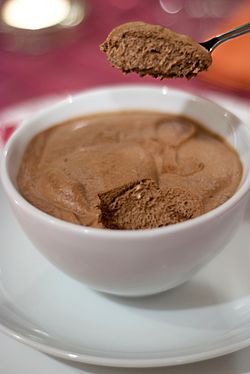
Chocolate mousse garnished with ground cinnamon.
CourseDessert
Place of originFrance
Main ingredientsWhipped egg whites or whipped cream, chocolate or puréed fruit
VariationsChocolate, vanilla, strawberry, choco vanilla, etc.
  •   Media: Mousse

A mousse (/ˈms/, French: [mus]; lit.'foam') is a soft, prepared food that incorporates air bubbles to give it a light and airy texture. Depending on preparation techniques, it can range from light and fluffy to creamy and thick. A mousse may be sweet or savory.[1]

History

[edit]

Various desserts consisting of whipped cream in pyramidal shapes with coffee, liqueurs, chocolate, fruits, and so on either in the mixture or poured on top were called crème en mousse ('cream in a foam'), crème mousseuse ('foamy cream'), mousse ('foam'), and so on,[2][3] as early as 1768.[4][5][6] Modern mousses are a continuation of this tradition.

Types

[edit]

Sweet

[edit]

Sweet mousses are typically made with whipped egg whites, whipped cream,[7] or both, and flavored with one or more of chocolate, coffee, caramel,[8] puréed fruits, or various herbs and spices, such as mint or vanilla.[9] In the case of some chocolate mousses, egg yolks are often stirred into melted chocolate to give the final product a richer mouthfeel. Mousses are also typically chilled before being served, which gives them a denser texture. Additionally, mousses are often frozen into silicone molds and unmolded to give the mousse a defined shape. Sweetened mousse is served as a dessert or used as an airy cake filling.[10] It is sometimes stabilized with gelatin.[11][12] When making a new flavor of mousse, an important rule is the body is formed of whipping cream and either separated egg yolks or whites (almost never both in the same dish), and frequently, gelatin.

Savory

[edit]

Savory mousses can be made from meat, fish, shellfish, foie gras, cheese, or vegetables. Hot mousses often receive their light texture from the addition of beaten egg whites.[1]

Molded and shaped fish mousse with bread and butter remains a popular meal of American cuisine, if not a party dip, although it is not as common as it was in the 1950s.[13][14]

[edit]

See also

[edit]

Media related to Mousse at Wikimedia Commons Chocolate Mousse at the Wikibooks Cookbook subproject

References

[edit]
Revisions and contributorsEdit on WikipediaRead on Wikipedia
from Grokipedia
Mousse is a light, airy dish, either sweet or savory, characterized by its foamy texture achieved through the incorporation of whipped egg whites, cream, or both into a flavored base, often stabilized with gelatin and served chilled. Originating in during the , the term "mousse" derives from the French word for "foam," reflecting its signature aerated consistency that distinguishes it from denser desserts like pudding or custard. Historically, mousse began as a savory preparation, typically featuring puréed meats, fish, or vegetables folded into beaten egg whites to create an elegant, molded dish popular among French aristocracy. By the 19th century, sweet variations emerged, with chocolate mousse becoming a staple; early recipes sometimes referred to it as "mayonnaise de chocolat" due to similarities in emulsification techniques with the savory sauce. Today, sweet mousses dominate culinary applications, commonly featuring bases like melted chocolate, fruit purees, or custards, while savory versions persist in gourmet contexts such as or mousse. The preparation of mousse relies on careful and stabilization to maintain its structure without collapsing, often involving folding techniques to preserve trapped air bubbles. Common flavors for sweet mousses include , , , and , with modern adaptations since the 2010s incorporating vegan alternatives like in place of egg whites. In professional , mousse serves as a versatile component in layered cakes, entremets, and plated desserts, prized for its silky and ability to balance richness with lightness.

Etymology and Definition

Origins of the Term

The term "mousse" in its culinary sense originates from French, where it denotes "" or "froth," a meaning rooted in mous(se), which referred to or the frothy that forms on fermenting liquids. This etymological connection evokes the light, aerated texture central to the , drawing from the natural froth observed in liquids like or wine. The earliest recorded culinary application of the term appears in 1768, in the treatise L'Art de bien faire les glaces d'office by and confectioner M. Emy, who dedicated a section to mousses and described "crème en mousse" as a characterized by its foamy consistency, often flavored and chilled without full freezing. Emy's work, the first book devoted exclusively to frozen desserts and confections, included approximately twenty recipes for such mousses, emphasizing through vigorous beating to incorporate air. Adoption into English occurred during the 19th century, primarily through translations and adaptations of French culinary texts that popularized in Britain and America. Early English references, such as those in 1863, borrowed the term directly from French to describe light, frothy preparations, with the sense solidifying by 1897; one of the first published recipes for mousse appeared in the Boston Daily Globe in 1897. This integration distinguished "mousse" from related terms like "," which relies on oven heat for its puffed rise rather than mechanical aeration alone.

Key Characteristics

Mousse is distinguished by its light and airy texture, which arises from aeration processes that incorporate air into a base , creating a structure characterized by small, uniform air bubbles evenly dispersed throughout. This provides the signature fluffiness and increased volume. The stability of this structure depends on surface-active agents like proteins and emulsifiers that form a protective around each bubble, preventing drainage and coalescence over time. A key sensory quality of mousse is its smooth, velvety , delivered by the fine integration of air and the lubricating effect of fats and solubilized components in the continuous phase. This texture melts luxuriously on the , contrasting with coarser preparations. Mousses are generally served chilled to preserve the 's integrity and heighten refreshment. Visually, mousse offers a glossy surface sheen from the refractive properties of its emulsified fats and smooth matrix, enhancing its elegant appearance. Its enables it to hold precise shapes when molded, piped, or layered, supporting intricate designs in plated desserts. The of mousse is low, reflecting substantial air incorporation relative to the base material. In comparison to related preparations, mousse differs from , a thicker, starch-based that achieves through gelatinization during heating rather than . Likewise, unlike plain , which forms an unstable prone to rapid without additives, mousse integrates a flavored or gelled base with stabilizing elements for prolonged hold and complexity.

History

Early Origins

Mousse originated in 18th-century as a savory dish, consisting of puréed meats, fish, or vegetables lightened with whipped egg whites to create a foamy texture, often molded for elegant presentation among the . The sweet dessert form emerged later in the century, credited to M. Emy, who in published L'art de bien faire les glaces d'office, introducing "crème en mousse" as an iced cream foam. This preparation involved whipping cream to incorporate air, then freezing it with flavors such as , , or fruits like strawberries to create a light, foamy texture suitable for elegant frozen desserts. During the 19th century, renowned chef advanced the dish through refinements that enhanced its versatility and presentation. Carême incorporated into mousse mixtures to achieve greater stability, enabling the creation of molded forms that held intricate shapes without collapsing, a technique he detailed in his influential works on French patisserie. Initially a luxury item favored by the French aristocracy for its delicate aeration and exotic flavors, mousse reflected the opulence of elite dining in pre-Revolutionary and Napoleonic . Its dissemination to began in the early via culinary texts, popularizing it among British upper classes through accessible recipes for home preparation.

Modern Developments

In the mid-20th century, particularly in the post-World War II , savory mousses gained prominence as convenient party dishes, reflecting the era's emphasis on gelatin-based molds and canned ingredients for effortless entertaining. Examples include molded salmon mousse, made with flaked canned , cream , and , and ham mousse variations using ground ham combined with and seasonings, which appeared in popular American cookbooks and became staples at cocktail parties due to advances in home and the availability of affordable processed foods. During the 1970s and 1980s, the movement in France revitalized mousse preparations, shifting toward lighter, more refined presentations that highlighted fresh ingredients and precise techniques. Chefs such as Michel Guérard incorporated mousses into terrines, such as delicate fish or versions layered with herbs and subtle sauces, emphasizing and natural flavors over heavy classical sauces. This period also saw the popularization of frozen mousses, including elegant chocolate bombes—domed desserts of iced or encased in thin chocolate shells—adapted for gourmet dining to offer chilled, airy textures without excessive richness. In the , innovations in mousse have focused on inclusivity and textures, with vegan versions emerging as a key trend. , the viscous liquid from cooked chickpeas, was popularized in 2014 by French cook Joël Roessel as an substitute, enabling fluffy vegan chocolate mousses whipped to stable peaks without animal products. Concurrently, techniques, pioneered by at elBulli in the early , applied —using sodium alginate and calcium baths to gel liquids into bursting spheres—to create innovative mousse presentations that encapsulate creamy interiors in a thin, caviar-like membrane, transforming the dessert's sensory experience. Global adaptations have further diversified mousse in contemporary cuisine, blending traditional flavors with modern aeration methods. In , post-2000s fusion desserts feature mousse, incorporating powdered into light whipped bases for an earthy, umami-infused treat often layered in cakes or parfaits. Similarly, Indian interpretations use ripe puree in chilled mousses, stabilized with or , to capture the tropical sweetness of varieties like Alphonso in elegant, no-bake presentations popular at urban patisseries and fusion eateries.

Ingredients

Core Components

The core components of mousse form the foundational elements that create its signature light, airy texture and stable structure, primarily through aeration, moisture provision, and stabilization. Aerating agents are essential for incorporating air bubbles, with egg whites serving as a primary option when whipped into a base. In classic dark chocolate mousse recipes, for example, 4-6 egg whites are beaten to stiff peaks with a pinch of salt before being gently folded into the mixture to achieve the light and airy texture. Alternatively, acts as an aerator when whipped, relying on its high fat content of at least 36% to form a stable that traps air effectively, contributing to a creamy while the fat globules help maintain integrity. Base liquids provide the necessary moisture and serve as carriers for other elements, ensuring the mixture remains fluid enough for even without compromising the . Common examples include , which offers a neutral dairy base for hydration; , adding subtle tang and thickness through its protein content; or purees, which supply natural liquids and initial flavor foundations while contributing to the overall volume. Proteins dedicated to structure are crucial for gelling the mixture post-aeration, transforming the foam into a set . , derived from , is widely used for this purpose, with a bloom strength typically ranging from 200 to 250 indicating its gelling power; this strength allows it to form a firm yet tender network when bloomed and dissolved, holding the aerated structure without syneresis. For plant-based alternatives, agar-agar, extracted from , functions similarly as a vegetarian gelling agent, requiring to activate but providing a heat-stable set suitable for mousses. Fats play a pivotal role in enhancing stability by coating the air bubbles formed during , which helps prevent their collapse under gravitational drainage or temperature changes. In formulations, provides saturated fats that solidify partially to reinforce the foam walls, while introduces , a complex composed mainly of palmitic, stearic, and oleic acids, which melts at body temperature and envelops bubbles for added resilience. In classic dark chocolate mousse, for instance, 200-250 g of dark chocolate with 70-80% cocoa solids is typically used, often melted with an optional 50 g of butter to enhance richness and stability.

Flavorings and Additives

In sweet mousses, flavorings such as Dutch-processed cocoa powder are commonly incorporated to provide a rich taste with milder acidity compared to natural cocoa, resulting in a smoother profile when blended into the cream base. Fruit purees, like those made from raspberries containing approximately 10% added sugar, offer tartness and natural fruit intensity that balances the overall sweetness without overpowering the airy texture. imparts a subtle aromatic depth, while liqueurs such as introduce citrusy orange notes that enhance complexity in or fruit-based varieties. In dark chocolate mousse recipes, minimal added sugar—ranging from 0 to 3 tablespoons—is often used to preserve the intense cocoa flavor while maintaining the light, airy structure. Savory mousses rely on flavorings that emphasize umami and freshness, including smoked fish like , whose fat content contributes to a creamy when pureed. Herbs such as or add bright, herbaceous layers that cut through richness, often finely chopped and folded in for even distribution. Spices like provide warmth and depth in preparations such as chicken liver mousse, where a small amount grounds the earthy flavors. Additives in mousses primarily serve to enhance and appearance while maintaining structural integrity alongside core components like . Granulated sugar dissolves readily during mixing to sweeten uniformly, whereas is preferred in whipped elements for its finer texture and quicker incorporation. Salt is added in trace amounts to balance sweetness or savoriness, heightening overall flavor perception without dominating. Natural colorants, such as beet juice, impart vibrant or hues in or vegetable-infused mousses, offering a synthetic-free alternative for visual appeal. Allergenic considerations are crucial in mousse preparation, particularly with nut-based flavorings like paste, which can trigger reactions in those sensitive to tree nuts—a common affecting up to 1% of the . Modern recipes increasingly incorporate dairy alternatives, such as or cream, to accommodate while preserving the emulsion's lightness.

Preparation Techniques

Aeration Methods

One primary method of aeration in mousse preparation involves whipping to incorporate air, typically achieving a volume increase of approximately 100% when reaching soft peaks. This process destabilizes the fat globule membranes, allowing partial coalescence where fat crystals protrude and bridge adjacent globules, forming a network that traps air bubbles while maintaining stability. The is then gently folded into the mousse base to preserve the incorporated air, avoiding deflation through minimal shear. Over-whipping risks full coalescence, resulting in separation and loss of lightness. Another common technique is beating egg whites to stiff peaks, where mechanical agitation denatures proteins like ovalbumin and conalbumin, enabling them to form a viscoelastic around air bubbles for . The natural of egg whites, ranging from 7.6 to 9.3, contributes to foam stability by promoting protein unfolding without excessive aggregation. Using a bowl enhances this by releasing Cu²⁺ ions that bind to conalbumin's sulfur groups, inhibiting unwanted disulfide bonds and yielding a glossier, more stable foam less prone to overbeating and graininess. Alternative aeration methods include using a dispenser, such as the iSi whipper, charged with (N₂O) cartridges to create instant foams. The process involves adding the liquid base to the siphon, inserting 1-2 cartridges (each 8 g N₂O) to build —typically reaching 8-10 bar—and shaking vigorously for 5-10 seconds to dissolve the gas, which then expands upon dispensing to form fine bubbles. This method suits quick preparations but requires thickeners like for sustained structure in low-fat bases. For vegan options, —the viscous cooking liquid from chickpeas—can be whipped similarly to egg whites, offering comparable to lightly whisked egg whites and producing stable peaks through protein-like like . The underlying science of aeration in mousses relies on partial coalescence of fat globules during whipping, where crystalline protrudes through the milk-fat globule to aggregate at the air-liquid interface, trapping air and preventing bubble coalescence for a light texture. In dairy-based mousses with 6-7% , this process adsorbs at the interface without forming a full network, but protein desorption during (reducing interfacial coverage by 2-3 times) aids stability; excessive shear, however, promotes complete coalescence and breakdown.

Assembly and Stabilization

Assembly of mousse begins with the careful integration of aerated components, typically after initial methods have incorporated air into elements like or . The folding technique employs a rubber to gently combine the lightened mixture with the denser base, such as melted or fruit purée, minimizing shear forces to preserve volume. This involves scooping from the bottom of the and sweeping over the top in a , rotating the bowl as needed to ensure even distribution without deflating the . An example of this assembly method is the classic dark chocolate mousse, which relies on folding beaten egg whites into a melted chocolate base to achieve a light, airy texture through aeration. Ingredients typically include 200-250 g dark chocolate (70-80% cocoa), 4-6 separated eggs, 50 g butter (optional for added richness), a pinch of salt, and 0-3 tablespoons sugar (minimal or none for less sweetness). The steps involve melting the chocolate with butter (if using), stirring in the egg yolks, beating the egg whites to stiff peaks with salt (and sugar if desired), gently folding the whites into the chocolate mixture to preserve the incorporated air, and refrigerating for several hours until set. This process emphasizes the role of aeration in creating and maintaining the mousse's characteristic light structure. Stabilization primarily relies on for cold-set mousses, where powdered or sheet is first bloomed by soaking in cold at a of approximately five times its weight to allow hydration without clumping. The bloomed is then dissolved into the warm base mixture at around 50–60°C (122–140°F) to ensure complete solubilization while preserving its gelling properties, followed by cooling to about 25°C (77°F) before folding in the whipped elements. The assembled mousse is then chilled at 4°C (39°F) or below for 2–4 hours until firm, as the sets below 15°C (59°F) to form a stable gel network that holds the structure. For hot savory mousses, stabilization occurs through gentle cooking, which denatures proteins in ingredients like or to create a cohesive texture without additional gelling agents. Molding involves pouring or layering the mixture into forms such as rings or straight-sided molds lined with strips for clean release and precise shapes. molds facilitate easy unmolding due to their flexibility, while metal rings require gentle warming. To unmold, the mold is briefly dipped in warm water for 1–2 seconds or heated with a to loosen the edges, then inverted onto a serving surface, ensuring the mousse retains its aerated form. Common troubleshooting focuses on preventing weeping, or the separation of excess liquid, which can result from improper handling. Selecting with a bloom strength of 225 grams—the standard for applications—ensures sufficient gelling power without rubberiness, as lower strengths may fail to bind effectively, while avoiding overheating during dissolution (above 85°C/185°F) preserves the gelatin's integrity. Overmixing during folding or excessive acidity in the base can also contribute to instability, so precise ratios and temperatures are essential.

Types

Sweet Mousses

Sweet mousses represent a category of chilled or frozen desserts characterized by their light, airy texture achieved through and sweet flavor profiles derived from ingredients like , fruits, or . These desserts evolved from French culinary traditions in the 18th and 19th centuries, transitioning from savory preparations to indulgent sweets by incorporating whipped creams and stabilizers for enhanced volume and stability. The classic mousse exemplifies the foundational sweet mousse, originating in with recipes dating back to at least the late . It typically features melted —often around 70% cocoa for a balanced bittersweet intensity—combined with egg yolks tempered over gentle heat to form a sabayon-like base, then lightened by folding in whipped and sometimes whipped egg whites for added lift. This preparation yields a velvety, rich texture that sets firmly yet remains spoonable when chilled. Traditionally served in individual ramekins, it allows for portion control and elegant presentation, often garnished simply with cocoa powder or fresh berries. A modern, egg-free variation simplifies this recipe, using 200g dark chocolate (70%+ cocoa), 400ml cold whipping cream, and optionally 2-4 tbsp powdered sugar, by melting the chocolate and folding it into the whipped cream. Fruit-based sweet mousses, such as or varieties, emerged as adaptations in the latter half of the , building on earlier purées by incorporating for aeration and for stabilization to prevent separation. These use a base—prepared by cooking or purée with yolks and sugar—to provide tangy acidity and creaminess, which is then lightened with and set with bloomed sheets or powder dissolved in warm liquid. For instance, mousse reflects 19th-century innovations, where fresh purée replaces , often folded into a stabilized variant for a vibrant, seasonal that balances sweetness with natural tartness. mousse similarly employs for its bright zing, stabilized to hold shape in molds or glasses. Frozen variations of sweet mousses include mousses and , which offer a scoopable, semi-frozen consistency ideal for warmer climates. , an Italian innovation from the late 19th to early as a lighter take on French parfaits, is aerated by folding —whipped whites stabilized with hot sugar syrup—into a flavored base of yolks, cream, and additions like or , then frozen without churning to maintain its mousse-like fluffiness. This method traps air for a dense yet tender texture that softens quickly at , distinguishing it from denser s. Ice cream mousses follow similar principles, often whipped to incorporate more air before freezing. In modern interpretations since the , sweet mousses have diversified to include tiramisu-inspired coffee mousse, which adapts the classic Italian layered —originated in the in —into a single, aerated form using espresso-soaked elements blended with and for a caffeinated, creamy profile evoking the original's coffee and cocoa notes. Vegan coconut mousse has also gained prominence, leveraging —the protein-rich liquid from cooked chickpeas, first documented in vegan meringues around 2014-2015—as a whipped substitute to aerate coconut cream and melted , creating a dairy-free alternative that mimics traditional lightness while aligning with plant-based diets. Yogurt mousse cake represents another contemporary variation, featuring a yogurt-based mousse layer that imparts a slight sour taste to relieve greasiness, with a light and smooth cool texture that is almost not sweet, mainly relying on yogurt's freshness. Popular in summer due to its refreshing qualities but suitable year-round, it often incorporates fruits like strawberries for added vibrancy and can be prepared with visually appealing layers suitable for inserting candles, making it ideal for celebrations.

Savory Mousses

Savory mousses represent a category of light, aerated preparations primarily built around protein-rich bases such as , , or , serving as elegant starters, spreads, or components in larger dishes. Unlike their sweet counterparts, these mousses emphasize and savory profiles, often stabilized with or whites to achieve a fluffy yet stable texture suitable for cold or warm presentations. Their versatility allows them to function as canapés, dips, or terrines, highlighting seasonal ingredients and regional traditions. Fish and mousses, particularly those featuring , gained prominence in mid-20th-century as convenient yet sophisticated appetizers. mousse typically combines smoked or canned with and , molded into shapes like fish for visual appeal and served chilled with crackers or toast points. This preparation became a staple at buffets and potlucks, reflecting post-war trends in home entertaining and the promotion of canned by government agencies. Similarly, mousse serves as a contemporary dip, blending lump crabmeat with and seasonings for a creamy, spreadable consistency ideal for parties, often garnished with herbs and paired with or slices. Meat-based savory mousses draw from classic French charcuterie techniques, utilizing or organ meats for rich, pâté-like results. liver mousse, a refined take on traditional , incorporates sautéed livers with , shallots, and , then blended smooth and chilled; its roots trace to French culinary practices where such preparations elevated humble ingredients into luxurious spreads. terrine mousses, often layered with and steamed or baked in molds, feature deveined or liver pureed with , offering a decadent texture prized in since the when techniques were refined in southwestern . These are commonly sliced and served as part of boards. Vegetable-forward savory mousses provide lighter, often gluten-free alternatives, relying on puréed bases aerated with whipped egg whites for volume. Avocado mousse, a modern iteration, purees ripe avocados with lemon juice, parsley, Worcestershire sauce, and salt to create a vibrant green spread that mimics guacamole's creaminess but with a silkier finish, suitable for bruschetta or as a dip for vegetables. Mushroom mousses, using wild or cultivated varieties like portobello or cremini, involve sautéing the fungi with onions and cream before blending and chilling, yielding a deeply earthy flavor profile that pairs well with toasted bread or as a filling in pastries; this preparation highlights the ingredient's natural umami without dairy overload in vegan adaptations. Hot soufflé-style savory mousses, such as those with mushroom or vegetable bases, are folded with beaten egg whites and baked briefly for immediate service, offering a dramatic, airy contrast to chilled versions.

Culinary Applications

Serving Suggestions

Mousses are typically portioned at 100-150 grams per serving for desserts, often piped into individual glasses or layered for visual appeal. Sweet varieties, such as chocolate mousse, benefit from garnishes like fresh berries or mint leaves to add contrasting color and freshness. Yogurt mousse cakes, with their layered structures and colorful fruit elements, offer significant decorative potential, allowing for pretty appearances suitable for inserting candles in celebratory settings like birthdays. Sweet mousses pair well with for a balanced bitterness or to enhance their lightness. Savory mousses complement crackers, sliced , or white wines like , which provide acidity to cut through their creaminess. Plating techniques emphasize elegance, such as shaping mousse into quenelles using two spoons for a smooth, oval form that highlights the texture. is essential: mousses are served chilled to maintain their airy structure, while savory ones are best at to preserve flavors. In French culinary tradition, mousses are often presented in coupes for a refined , evoking classic service. During the American , molded salads incorporating and elements like chicken mousse became popular for luncheons, reflecting post-war domestic trends.

Storage and Variations

Sweet mousses, such as varieties, should be stored in airtight containers in the at around 4°C to maintain their light texture and prevent absorption of odors from other foods; under these conditions, they typically remain fresh for 2-3 days, though they are best consumed within the first two days. Savory mousses, particularly meat-based ones like or , can last up to 5 days when refrigerated in similar airtight conditions at 4°C, provided they are kept away from strong-smelling items to preserve flavor integrity. Freezing is a viable option for extending the of sweet mousses, where they can be stored in airtight containers or freezer bags at -18°C for up to one month; thawing should occur slowly in the to minimize separation and texture changes, such as graininess from formation. In contrast, freezing savory mousses is generally not recommended, as it often leads to significant texture loss in protein-rich components like meats or , resulting in a watery or separated consistency upon thawing. Recipe adaptations allow mousses to accommodate dietary needs or regional preferences while preserving their aerated structure. For low-fat versions, substituting with Greek yogurt—typically in a 1:1 ratio after whipping—reduces calorie content without compromising creaminess, as seen in recipes blending melted with plain yogurt and cocoa powder. Allergen-free options, particularly dairy-free, can use coconut cream as a base; chilled coconut cream is whipped and folded into melted to achieve a vegan mousse that mimics the original's lightness and holds well when stabilized. A notable regional variation is the Spanish-style chocolate mousse, which incorporates extra virgin for added silkiness and a subtle fruity note, often drizzled atop the set mousse and paired with flakes for contrast. Food safety is paramount in mousse preparation, especially for savory types that may incorporate raw eggs; these pose a risk of enteritidis contamination, which can cause , so or alternatives like whipped should be used instead to eliminate this hazard while maintaining volume.

Nutritional Profile

Composition Breakdown

Mousses typically exhibit a macronutrient profile dominated by fats, derived primarily from dairy cream and chocolate in sweet varieties or from animal proteins in savory ones. Per 100 grams of chocolate mousse prepared from a recipe, fat content ranges from 16 to 20 grams, contributing approximately 20-40% of the caloric value through sources like heavy cream and cocoa butter. Protein levels are moderate at 4-5 grams per 100 grams, mainly from eggs or gelatin stabilizers, while carbohydrates account for 10-20% of the composition, often 15-16 grams per 100 grams from sugars and minimal fruit elements. Micronutrient content in mousses varies with base ingredients, particularly components that provide essential minerals and vitamins. mousses supply calcium at levels around 50-100 milligrams per 100 grams and at approximately 100-150 micrograms per 100 grams, supporting and vision through cream and solids. Fruit-based variants, such as mousses, incorporate antioxidants like , with concentrations of 20-40 milligrams per 100 grams from pureed berries, enhancing oxidative stability. Variations in composition occur between sweet and savory types, reflecting their flavor profiles and primary ingredients. mousses are richer in sugars, typically 15-25 grams per 100 grams from added sweeteners or reductions, amplifying their appeal. In contrast, savory mousses like varieties elevate protein to 10-15 grams per 100 grams from or bases, with lower content around 4-5 grams per 100 grams. The aerated structure of mousses reduces overall compared to non-aerated desserts, yet maintains a high caloric profile for , with mousse averaging about 225-260 kilocalories per 100 grams. This balance arises from the incorporation of air during whipping, which lightens texture without proportionally diluting .

Health and Dietary Considerations

Dairy-based mousses often contain high levels of from ingredients like and , which can contribute to elevated LDL cholesterol levels and increased risk of when consumed in excess. However, emerging research on dairy fats suggests that saturated fats from these sources may have a neutral or even protective effect against cardiometabolic risks compared to other saturated fats. Traditional mousses incorporating raw eggs pose a small risk of infection, estimated at approximately 1 in 20,000 eggs being internally contaminated, though this can be effectively mitigated through the use of . On the positive side, the protein content in - and dairy-based mousses promotes , helping to regulate appetite and support by enhancing feelings of fullness. Fruit-infused sweet mousses can provide , which aids and contributes to overall gut . Additionally, the process in mousse preparation results in a lighter texture with lower per volume compared to denser desserts like custards, potentially allowing for greater satisfaction with smaller portions. Mousses can be adapted for various dietary needs, such as keto-friendly versions using low-carb sweeteners like and high-fat bases like to minimize net carbohydrates. Vegan adaptations replace and eggs with plant-based milks, such as cream, and foaming agents like to maintain structure without animal products. Savory mousses can be formulated to be low in sodium, making them suitable for individuals managing by using and minimal salt. Due to their calorie density, moderation through portion control is recommended to avoid excessive intake, particularly for those monitoring weight or blood sugar levels. Allergies to or eggs, which affect about 2-3% of young children, necessitate avoidance or substitution to prevent adverse reactions ranging from mild discomfort to .

References

Add your contribution
Related Hubs
User Avatar
No comments yet.