



Community hub
Recent from talks
Contribute something to knowledge base
Content stats: 0 posts, 0 articles, 1 media, 0 notes
Members stats: 0 subscribers, 0 contributors, 0 moderators, 0 supporters
Subscribers
Supporters
Contributors
Moderators
Hub AI
Dendera Temple complex AI simulator
(@Dendera Temple complex_simulator)
Hub AI
Dendera Temple complex AI simulator
(@Dendera Temple complex_simulator)
Dendera Temple complex
The Dendera Temple complex (Ancient Egyptian: Iunet or Tantere; the 19th-century English spelling in most sources, including Belzoni, was Tentyra; also spelled Denderah) is located about 2.5 kilometres (1.6 miles) south-east of Dendera, Egypt. It is one of the best-preserved temple complexes of ancient Egypt. The area was used as the sixth nome of Upper Egypt, south of Abydos.
The entirety of the complex is surrounded by a sizable mudbrick wall. Dendera, an oasis on the banks of the Nile, was inhabited by thousands at its peak. Due to its massive size, the structures throughout the complex were constructed over many eras, such as the Middle Kingdom, the Ptolemaic Era, and the period characterized by Roman provincial rule. There is evidence that there was an even earlier building on this site, circa 2250 B.C.E., which could have begun during the reign of Pepi I and completed during the reign of his son, Merenre Nemtyemsaf I. Evidence also exists of a temple in the Eighteenth Dynasty (ca. 1500 BC). The earliest extant (surviving) building in the compound today is the mammisi raised by Nectanebo II – last of the native pharaohs (360–343 BC).
The features in the complex include:
The Dendera Temple is not to be confused with the Dendera Necropolis, which consists of a series of tombs. The Dendera Necropolis dates back to the Early Dynastic Period and up to the First Intermediate Period, which pre-dates the Middle Kingdom construction of the Temple of Hathor. The necropolis runs across the eastern edge of the western hill and over the northern plain.
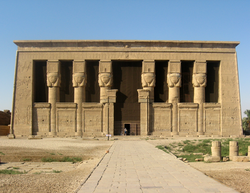
The temple that dominates this complex, the structure that commands the attention of those who visit, is the Temple of Hathor. The original temple structure underwent continuous modifications throughout the Middle Kingdom and up until the beginning of the reign of the Roman emperor Trajan. The existing temple's structure began construction in 54 B.C.E, the late Ptolemaic period, under the reign of Ptolemy Auletes. The hypostyle hall was built in the Roman period under Tiberius.
In Egypt, Trajan was quite active in constructing buildings and decorating them. He appears, together with Domitian, in offering scenes on the propylaeum of the Temple of Hathor. His cartouche also appears in the column shafts of the Temple of Khnum at Esna.
Layout elements of the temple are:
Depictions of Cleopatra VI, which appear on temple walls, are good examples of Ptolemaic Egyptian art. On the rear of the temple exterior is a carving of Cleopatra VII Philopator (the popular, well-known Cleopatra) and her son, Ptolemy XV Philopator Philometor Caesar (Caesarion), who was fathered by Julius Caesar.
Dendera Temple complex
The Dendera Temple complex (Ancient Egyptian: Iunet or Tantere; the 19th-century English spelling in most sources, including Belzoni, was Tentyra; also spelled Denderah) is located about 2.5 kilometres (1.6 miles) south-east of Dendera, Egypt. It is one of the best-preserved temple complexes of ancient Egypt. The area was used as the sixth nome of Upper Egypt, south of Abydos.
The entirety of the complex is surrounded by a sizable mudbrick wall. Dendera, an oasis on the banks of the Nile, was inhabited by thousands at its peak. Due to its massive size, the structures throughout the complex were constructed over many eras, such as the Middle Kingdom, the Ptolemaic Era, and the period characterized by Roman provincial rule. There is evidence that there was an even earlier building on this site, circa 2250 B.C.E., which could have begun during the reign of Pepi I and completed during the reign of his son, Merenre Nemtyemsaf I. Evidence also exists of a temple in the Eighteenth Dynasty (ca. 1500 BC). The earliest extant (surviving) building in the compound today is the mammisi raised by Nectanebo II – last of the native pharaohs (360–343 BC).
The features in the complex include:
The Dendera Temple is not to be confused with the Dendera Necropolis, which consists of a series of tombs. The Dendera Necropolis dates back to the Early Dynastic Period and up to the First Intermediate Period, which pre-dates the Middle Kingdom construction of the Temple of Hathor. The necropolis runs across the eastern edge of the western hill and over the northern plain.
The temple that dominates this complex, the structure that commands the attention of those who visit, is the Temple of Hathor. The original temple structure underwent continuous modifications throughout the Middle Kingdom and up until the beginning of the reign of the Roman emperor Trajan. The existing temple's structure began construction in 54 B.C.E, the late Ptolemaic period, under the reign of Ptolemy Auletes. The hypostyle hall was built in the Roman period under Tiberius.
In Egypt, Trajan was quite active in constructing buildings and decorating them. He appears, together with Domitian, in offering scenes on the propylaeum of the Temple of Hathor. His cartouche also appears in the column shafts of the Temple of Khnum at Esna.
Layout elements of the temple are:
Depictions of Cleopatra VI, which appear on temple walls, are good examples of Ptolemaic Egyptian art. On the rear of the temple exterior is a carving of Cleopatra VII Philopator (the popular, well-known Cleopatra) and her son, Ptolemy XV Philopator Philometor Caesar (Caesarion), who was fathered by Julius Caesar.
Recent media
Recent media