Hubbry Logo
KhnumKhnumMain
Open search
Khnum
Community hub
Khnum
logo
8 pages, 0 posts
0 subscribers
Be the first to start a discussion here.
Khnum
Khnum
from Wikipedia
Khnum
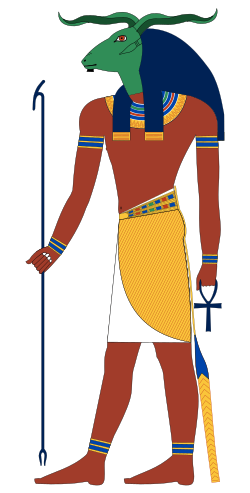
The Egyptian god Khnum was usually depicted with the head of a ram.
Name in hieroglyphs
W9E10
Major cult centerElephantine, Esna
Symbolthe potter's wheel
ConsortHeqet, Satis, Neith, Menhit, and Nebtuwi
OffspringHeka, Serket and Anuket
Equivalents
Lower EgyptianBanebdjedet

Khnum, also romanised Khnemu (/kəˈnm/; Ancient Egyptian: 𓎸𓅱𓀭 ẖnmw, Koine Greek: Χνοῦβις Chnoûbis),[citation needed] was one of the earliest-known Egyptian deities in Upper Egypt, originally associated with the Nile cataract. He held the responsibility of regulating the annual inundation of the river, emanating from the caverns of Hapi, the deity embodying the flood. Since the annual flooding of the Nile brought with it silt and clay, and its water brought life to its surroundings, he eventually became known as the creator of human bodies and the life force kꜣ ("ka"). Using a potter's wheel and clay, he fashioned these entities and placed them within their mothers' wombs. Often, his creative endeavors were overseen by another god. He was later described as having moulded the other deities, and was revered as the creator of the animal kingdom.[1][2][3] Banebdjedet was the equivalent god in Lower Egypt.[4]

Worship of Khnum spanned from the First Dynasty and persisted even into the Greco-Roman period when rule by native dynasties had ended. Initially, his primary cult center was at Herwer in Middle Egypt. While his presence on the island of Elephantine dates back to the Early Dynastic Period, it wasn't until the New Kingdom that he ascended to become the principal deity of the island, acquiring the title as the overseer of the First Cataract of the Nile River. At Elephantine, Khnum formed a divine triad alongside the goddesses Satis and Anuket. His religious significance also extended to Esna, located south of Thebes.[2][5][6]

Khnum's primary function in the inception of human beings was typically portrayed with the horns of a ram, one of the sacred animals worshiped in Ancient Egypt, representing aspects such as fertility, rebirth, regeneration, and resurrection. He was originally illustrated with horizontally spiraled horns (based on the Ancient Egyptian corkscrew-horned sheep, an extinct subspecies of the barbary sheep), but his representation later evolved to feature the down-turned horns of Ammon in the New Kingdom (based on the extinct sheep subspecies Ovis platyra palaeoaegyptiacus). Khnum's imagery also includes the crocodile head, denoting his dominion over the Nile. He can additionally be found wearing the atef crown adorned with two feathers, or the white crown of Upper Egypt.[2][7][8][9]

Etymology

[edit]

The hieroglyphic symbol hnm (𓎸 ) often appearing in Khnum's name is derived from the word hnmt, signifying "well", or "spring". His name can also be connected to a Semitic root meaning "sheep". Alternatively, the formation of the name can be interpreted as "the beloved divine being". Khnum is also often described with the term iw m hapy, meaning "the coming of the Nile". Additionally, he is called Khnum-Ra, representing his role in the Nile cataract as the soul of the sun-god, Ra. Khnum's positions and powers are described through various titles such as the "Creator god", "Potter god", "Lord of Life", "Lord of the Field", "Lord of Esna", "the good protector", and "Lord of the crocodiles".[2][5][6][8][10]

Over time, the Egyptian word khn.m was later created to mean "shape" or "build", akin to Khnum's divine powers in creation.[10] His significance also led to early theophoric names of him, for children, such as Khnum-Khufwy "Khnum is my Protector", the full name of Khufu, builder of the Great Pyramid of Giza.[11]

Worship

[edit]

The worship of Khnum centered on two principal riverside sites, Elephantine and Esna, which were regarded as sacred sites. At Elephantine, he was worshipped alongside Satis and Anuket, while at Esna, he was worshipped alongside Menhit, Nebtu, Neith and Heka. Banebdjedet was the equivalent god in Lower Egypt. Khnum has also been related to the deity Min.[3][11][12]

At the Temple at Elephantine and the Temple at Esna, ancient rituals and festivals would take place. Among these was a fertility rite, exclusively participated in by women seeking to conceive, with male priests disallowed. Held late in the evening at the Temple of Esna, this ceremony featured women presenting a potter’s wheel and offering chants before a concealed statue in honor of Khnum.[6] The "Installation of the Potter's Wheel" culminated in a celebrated with a feast, occurring on the first day of the month of Paremhat.[13]

Temple at Elephantine

[edit]
Coffin of a Ram associated with Khnum in the Egyptian Museum.

The original cult center of Khnum was situated in the town of Elephantine, with the temple dating back to the Middle Kingdom era. Khnum, along with his consort Satis and daughter Anuket, were all documented at Elephantine by the Eleventh Dynasty. During the New Kingdom period, leaders expanded existing temples and erected additional structures on the island of Elephantine. Notable additions included the Temples of Khnum and Satet, overseen by Hatshepsut and Thutmose III, along with a way-station for the festival barque dedicated to Khnum. Subsequent Ptolemaic and Roman rulers also imposed their own embellishments later on.[14][15][16][17][18]

Remains of the temple house of the Khnum Temple on Elephantine Island in Aswan, Egypt

Rams revered by Khnum have been unearthed on the Elephantine Island, mummified, embellished with golden headgear, and placed in stone coffins.[2] There is also evidence discovered of tensions between the staff at the Temple of Elephantine and a nearby Jewish temple, arising from a desire of the Elephantine staff to enlarge the temple, causing detriment to the Jewish community.[19]

Remnants from the Thirteenth Dynasty, such as limestone fragments, provide evidence of architectural features including an entrance, an ornamented room featuring ceremonial depictions, and a sacred boat shrine. Portions of the Greco-Roman Temple of Khnum are believed to have originated from the Middle Kingdom Temple of Satet.[14] Opposite Elephantine, on the east bank at Aswan, Khnum, Satis and Anuket are shown on a chapel wall dating to the Ptolemaic Kingdom.[15]

Presently, one of the few remaining sections of the Temple of Khnum is a grand monumental entrance.[11]

Temple at Esna

[edit]
Khnum on the right with Menhit on the left, shown on the outside wall of the temple at Esna

In Esna, a temple was dedicated to Khnum, Neith and Heka, among other deities. Although construction of this temple commenced during the Ptolemaic era, the majority of its surviving sections were erected during Roman times. The temple rested in a field, which Khnum is regarded as the lord of, and was responsible for maintaining the land's fertility, ensuring the continuation of life. The Temple of Esna emphasizes his role as a divine potter through numerous hymns that attribute the creation of deities, mankind, plants, and animals to him. The north temple's wall features depictions of the favor shown by Roman rulers, showcasing offerings made by emperors and their encounters with deities.[2][6][15][16]

At the Temple of Esna, Emperor Tiberius is depicted led by the deities Buto and Nekhbet to Khnum.
Khnum (left) fashions the god Ihy (middle) on a potter's wheel, with the help of the goddess Heqet, Dendera Temple.
Horus, emperor Commodus and Khnum drawing a net with birds of the marshs and fishes, inner north wall, Temple of Khnum, Esna, Egypt.
Scene at the south wall, king offers feathers to Khnum and Nepthys, Temple of Khnum, Esna, Egypt

Within the temple, Khnum is occasionally depicted with the head of a crocodile. His primary consorts are Nebt-uu and Menhit, while Heka is recognized as his eldest son and successor. Khnum is sometimes referred to as the "father of the fathers" and Neith as the "mother of the mothers". They later become the parents of Ra, who is also referred to as Khnum-Re.[20]

The completion of hieroglyphic embellishments in Egyptian temples culminated with the Temple of Esna.[6] Esna-A, built in the Ptolemaic era, later gained modern renown as the first ancient Egyptian structure to formally record a connection between the zodiac and the two decan lists.[21]

Presently, much of the site lies in ruins, as many blocks had been repurposed to build a canal.[21] The remnants of the temple lie largely obscured beneath modern residential areas.[11]

Portrayal in Art and Literature

[edit]

Khnum is commonly depicted seated beside a potter's wheel, with a formed entity standing upon it, symbolizing his act of creation.[2] Khnum is often portrayed alongside the frog-headed fertility goddess Heqet, who can be seen assisting him at the pottery wheel, as seen in the wall relief of the mammisi of Nectanebo II. Khnum and Heqet can also be found together molding the god Ihy at the Dendera Temple.[22]

Statues of Khnum, Satis, and Anuket, along with Isis and Horus, adorned the Temple of Beit el-Wali of Ramesses II.[15] In Karnak's Great Hypostyle Wall, Khnum stands beside Pharaoh Ramses II and Horus, employing a net to ensnare water fowl. This is also similarly depicted on the inner north wall of the Temple at Esna with Khnum alongside the Roman emperor Commodus.[6][19]

Throughout ancient texts, Khnum is depicted as a creator. In the Pyramid Texts of the later Old Kingdom, he crafts ferryboats and a ladder ascending to heaven.[5] The Fifth Dynasty portrays him specifically as the creator of the vessels used by the sun god Ra, known as the solar barque. In the Middle Kingdom, Khnum is credited as the creator of humans in spell 214 of the Coffin Texts.[8] Khnum is mentioned as an inactive god during a famine in the Ipuwer Papyrus of the 12th dynasty, where it is said he "does not fashion because of the state of the land."[16] In the Papyrus d'Obriney of Seti II of the New Kingdom, or Tale of Two Brothers, Khnum is responsible for creating Bata's wife.[23] Khnum's role extends to the Book of the Dead, as part of the formula spell to prevent the heart of the deceased from opposing them in the Necropolis.[24]

Stelas

[edit]

Khnum features prominently in an inscription and relief of the Ptolemaic Kingdom known as the Famine Stela, located on the island of Sehel, south of Elephantine. The stela recounts a seven-year period of drought and famine during the reign of King Djoser of the Third Dynasty. According to the inscription, Djoser receives a vision of Khnum, who promises to end the famine. In response, the king issues a decree of one-tenth of all revenue to be allocated to the Temple of Khnum as an offering of gratitude. Above the stela, King Djoser is depicted offering tributes to Khnum, as well as the goddesses Satis and Anuket.[11][23]

The Famine Stela, on the island of Sehel.

Khnum is also portrayed in the Stela of Seti I. The king is depicted presenting an offering to Khnum, bowing while holding two nw-pots. Khnum holds a was-scepter in his left hand and an ankh in his right, adorned in a kilt and an atef crown topped with a solar disk. Both figures stand on a mA-sickle and are equally sculpted. Above Khnum, it states, "Beloved of Khnum, lord of the West."[25]

In the Stela of Tutankhamun from Sinn el-Kabid, Tutankhamun is depicted incensing the god Khnum. Khnum is seated on a throne, dressed in a kilt, chest piece, and wide collar, holding an ankh and a was-scepter. Khnum, revered at Kumma, holds an epithet indicative of his protective role over riverine and desert passes, symbolized by opposing bows at the entrances. The text above Khnum designates him as the "Lord of the Cataract."[26]

Hymns

[edit]

Khnum is a recurring figure in numerous of the hymns within the temples at Elephantine and Esna, showcasing his significance. Distinctively, The Morning Hymn to Khnum aligns him with the gods Amun and Shu, venerating him as the "Lord of life" and attributing him the ability to shape the bodies of humans. Another revered hymn, The Great Hymn to Khnum, celebrates him as the creator of all men, gods, and animals, as well as the provider of minerals and nurturer of plant life. This hymn delves into Khnum's intricate craftsmanship in forming body parts and assigning their functions. Additionally, Khnum is also acknowledged for creating a diversity of languages across regions, contrasting with Egyptian speech. In this hymn, Khnum is further depicted as the "Ba-of" many different deities scattered throughout Egypt, merging with the gods and representing the embodiment of their souls.[13] In The Great Second Hymn to Khnum, the hymn depicts Khnum-Ra sailing across the sky to establish pillars with goddesses in the south, north, and east, and possibly the west.[27]

Further linking Khnum to the divine narrative, he is mentioned in The Hymn to Hapy, connecting him to the Nile-god.[16]

Divine Birth Scenes

[edit]
Khnum, Setos I and Amun in the mortuary temple of Seti I in Abydos

The god Khnum plays a significant role in the birth narratives of Egyptian leaders, often serving to legitimize their rule. In the Old Kingdom, King Sahure of the Fifth Dynasty can be seen suckling on the goddess Nekhbet at his birth, with Khnum presiding beside them.[28] In the Middle Kingdom, the Westcar Papyrus, recounts the birth of three triplet kings by the woman Ruddedet. Khnum and the other deities disguise themselves to assist with the birth, and Khnum infuses "health" into the life of the bodies of the future kings, receiving a sack of barley as payment.[2][16] Queen Hatshepsut of the New Kingdom was similarly illustrated being created on Khnum's potter's wheel in the depiction of her Divine Birth, at the Temple of Deir el-Bahari, bestowing "life, health, and strength, and all gifts," upon her. It is also carved that Khnum made "her appearance above the gods". Additionally, reliefs in the Luxor Temple illustrate Khnum crafting the body and ka of King Amenhotep III in a comparable manner.[8]

[edit]
[edit]

See also

[edit]

References

[edit]
[edit]
Revisions and contributorsEdit on WikipediaRead on Wikipedia
from Grokipedia
Khnum was an ancient Egyptian , typically represented as a man with the head of a ram, revered as a creator who molded humans, animals, and the gods on a using clay from the River. Associated with the Nile's annual inundation, Khnum embodied , the life-giving floods, and the craftsmanship of , reflecting his role in shaping both the physical landscape and living beings essential to Egyptian sustenance and cosmology. As a prominent member of the Elephantine Triad, Khnum was worshipped alongside his consort Satis, the goddess of the Nile cataracts, and their daughter , who together oversaw the waters of the First . His cult centers were primarily at (modern ), where a major temple dedicated to him stood as a focal point for rituals tied to the 's source, and at in , where Ptolemaic-era temples preserved elaborate hymns and reliefs depicting his creative acts. In mythological narratives, particularly from the Middle Kingdom's (ca. 2050–1710 BCE), Khnum fashioned the divine and human forms, underscoring themes of birth and renewal central to Egyptian . He collaborated with the midwife goddess , who assisted in breathing life into the clay figures. Reliefs from the New Kingdom, such as those at Deir el-Bahri commemorating Queen Hatshepsut's divine birth (ca. 1479–1458 BCE), portray Khnum personally crafting royal offspring on his wheel, highlighting his enduring significance in royal ideology and legitimacy. Over time, Khnum was syncretized with solar deities like , forming composite figures such as Khnum-Ra, which extended his influence into broader aspects of cosmic order and kingship across pharaonic history.

Etymology and Iconography

Etymology

The name of the god Khnum derives from the ancient Egyptian word ẖnm(w), which carries the meaning "to join," "unite," or "build," a connotation that aligns with his mythological function as a creator who molds humanity and the world on a potter's wheel. This root appears in hieroglyphic writings as early as the Predynastic Period (c. 6000–3100 BCE), where the deity's name is typically rendered with the signs for the ram (E10) followed by phonetic complements for m and w, emphasizing his formative role in cosmic and human assembly. Scholars have also proposed a possible etymological link to a denoting "ram" or "sheep," which connects to Khnum's traditional zoomorphic representation as a ram-headed , though this interpretation remains debated among Egyptologists due to the primarily Egyptian linguistic context. Key epithets of Khnum further illuminate his identity and attributes, often inscribed in hieroglyphs alongside his name in temple reliefs and stelae from onward (c. 2686–2181 BCE). The title "Lord of the Cataracts" (nb ḫbḥ.w), written with hieroglyphs for "lord" (G5) and "cataract" (N26), underscores his association with the Nile's southern sources and protective dominion over the first cataract region, appearing prominently in Nubian and Upper Egyptian contexts. Similarly, "Divine Potter" (ḥnṯr n p3 ḫr), featuring signs for "god" (R8) and "potter's wheel" (D21), highlights his creative craftsmanship and is attested in hymns from the New Kingdom (c. 1550–1070 BCE), such as those at . The epithet "Ba of Ra" (bꜣ n rꜥ), combining the soul-bird hieroglyph (G1) with solar references, portrays Khnum as the vital manifestation or soul of the sun god , a syncretic title emerging in Late Period texts (c. 664–332 BCE) to signify his role in solar renewal and life-giving forces. In later periods, Khnum's name underwent phonetic adaptations in foreign scripts, reflecting cultural interactions. The Greeks rendered it as Cnuphis or Knephis in Ptolemaic-era (c. 305–30 BCE) accounts, associating the god with fertility and the Nile's inundation, as seen in classical writings by authors like . In Coptic sources from the Christian era (c. 4th–7th centuries CE), the name evolved to Kneph or Chnuphis, often interpreted through a lens of with biblical or hermetic concepts of creative spirit, preserving traces of his ancient potency in monastic and magical texts.

Iconography and Symbols

Khnum is most commonly depicted in as a ram-headed man, embodying his role as a , or occasionally in fully zoomorphic form as a ram. His ram head features distinctive horizontal, twisting horns characteristic of the ancient Egyptian domesticated sheep Ovis longipes palaeoaegypticus, symbolizing virility and the life-giving forces of . These horns, often rendered as corkscrew-like and curving outward, distinguish Khnum from other ram-headed gods like , whose horns curve inward. In his anthropomorphic representations, Khnum typically holds symbolic attributes that underscore his creative and protective powers, such as a on which he molds human figures from clay, an signifying life, or a was-scepter denoting dominion and stability. He is frequently shown wearing the atef crown—a white crown of flanked by feathers—or simply the , the plain white crown associated with southern Egypt, emphasizing his origins in and guardianship over the 's inundation. A flowing jar at his feet further symbolizes his control over the river's fertile . The ram form carries profound symbolism tied to , renewal, and the 's source, as Khnum was revered as the guardian of the river's origin at , ensuring the annual floods that enriched the land. This association linked the ram's potent reproductive imagery to the god's role in shaping life from the earth's clay, mirroring the 's transformative . Rare variants include depictions with a head, reflecting syncretic aspects of his dominion over waters and dangerous aquatic forces, or even four ram heads representing cosmic totality as Sheft-hat. Over time, Khnum's evolved, with early representations favoring the full ram or simple ram-headed man, while later periods, particularly in Ptolemaic art, emphasized more detailed anthropomorphic forms with elaborate regalia like the atef crown and to highlight his creative agency amid Greco-Egyptian influences. These variations maintained the core ram motif but adapted to broader theological contexts, such as solar or chthonic associations.

Mythological Role

Creation and Fertility

Khnum, revered as the "Divine Potter" in ancient , was central to creation narratives where he fashioned humans and gods from the fertile clay of the Nile River on his , particularly in the Middle Kingdom's (ca. 2050–1710 BCE). Using the silt deposited by the river's annual floods, Khnum molded the physical forms of living beings. This process symbolized the god's role in originating all life, from ordinary individuals to divine entities, emphasizing a crafted, deliberate act of rooted in the Nile's regenerative powers. Khnum's dominion extended to controlling the Nile's inundation, which ensured agricultural fertility across by depositing nutrient-rich on the riverbanks. Originating in predynastic times as a deity of the Nile's source and the cataracts near , he was believed to regulate the floodwaters, releasing them to nourish the land and sustain life cycles. This association positioned Khnum not only as a creator but as a guardian of renewal, linking the river's rhythms to the prosperity of human society and the earth's productivity. In specific creation myths, Khnum played a pivotal role in forming the bodies of pharaohs, meticulously shaping their physical forms and endowing them with strength and longevity to embody divine kingship. He also assisted in the birth of major deities, such as contributing to the emergence of , the sun god, either through direct molding or as a parental figure in Esna traditions where Khnum and were seen as Ra's progenitors. These narratives highlighted Khnum's specialized craftsmanship in royal and cosmic genesis, ensuring the continuity of order (ma'at) through his potter's art. Khnum's ties to procreation were particularly evident in his partnership with the frog-headed goddess Heket, the deity of , where they collaboratively fashioned royal offspring from clay. In these myths, Khnum shaped the child's body on his wheel while Heket breathed life into it, placing the formed infant into the mother's womb to facilitate safe delivery and divine inheritance. This duo underscored Khnum's influence over , especially for to the , blending creation with the sacred act of birth.

Associations with Other Deities

In ancient , Khnum formed a prominent triad at with his consort Satis, the archer goddess associated with the floods and protection of Egypt's southern borders, and their daughter , the goddess who nurtured the waters and oversaw the cataracts. This familial grouping emphasized Khnum's role in regulating the 's life-giving inundation, with Satis embodying the forceful ascent of the waters and Anuket their nourishing flow. At , Khnum's associations shifted to include pairings with , the weaver and war goddess linked to creation and primordial waters, alongside the lioness war deity , the goddess Nebtu, and Heka, the personification of magic as their son. These connections highlighted Khnum's creative potency intertwined with protective and magical forces, reflecting local emphases on weaving fate and warding off chaos. Khnum exhibited syncretism as the "Ba of Ra," representing the soul or manifestation of the sun god that aided his journey through the , often depicted in ram form to symbolize renewal and nocturnal vitality. He also occasionally appeared as consort to Heket, the frog-headed goddess of and rebirth, who assisted in animating the forms he molded on his . Regional variations in the late period linked Khnum to , the Memphite creator god, as fellow artisans of the who shaped the world through divine craftsmanship. Similarly, associations with emerged, portraying Khnum as a supporter of fertility and resurrection and as the Ba of .

Worship and Cult Centers

Historical Development

Khnum's cult first emerged during the Early Dynastic Period (c. 3100–2686 BCE) in , particularly in Nubian-influenced regions near the cataracts, where he was venerated as the guardian of the river's source and controller of its inundation. Early evidence of his worship appears in artifacts from , associating him with water and fertility from the Early Dynastic Period. In the (c. 2686–2181 BCE), Khnum's prominence increased, as seen in the of the Fifth and Sixth Dynasties, where he is invoked as a creator who fashions boats for the and aids in royal rituals. His role as a potter shaping humanity from clay began to solidify, though his cult remained regionally focused in the south. The Middle Kingdom (c. 2050–1710 BCE) marked an expansion of Khnum's worship, driven by intensified Nubian trade routes that elevated his associations with fertility and resource distribution from the Nile's southern origins. Inscriptions from this era, including those at , highlight his integration into broader Egyptian theology as a protector of the inundation. Khnum attained his peak during the New Kingdom (c. 1550–1070 BCE), particularly under pharaohs like , who rebuilt and expanded temples in his honor at sites such as to emphasize divine kingship and Nile prosperity. further patronized his cult, incorporating Khnum into royal propaganda as a . The Ptolemaic and Roman periods (c. 332 BCE–395 CE) saw the continuation of Khnum's cult through Greco-Egyptian , where he was equated with the Greek form Cnuphis (or Chnuphis) in magical papyri and gem amulets, blending his potter imagery with Hellenistic concepts of creation and protection. Following Egypt's in the 4th century CE, Khnum's organized worship declined sharply, supplanted by monotheistic traditions.

Temple at Elephantine

The Temple at Elephantine, situated on Island at the Nile's first cataract near modern , represented the primary cult center for Khnum, reflecting the god's association with the river's source and inundation. Construction of the temple began during (c. 2686–2181 BCE), with evidence of early structures dedicated to Khnum integrated into the sacred landscape alongside shrines to related deities. The complex underwent multiple phases of rebuilding and expansion, particularly in the Middle and New Kingdoms, where Thutmosis I founded a key structure completed or enlarged by Thutmosis II, positioned west of the main sanctuary. A major Late Period reconstruction occurred under (c. 360–343 BCE), who erected a grand temple on elevated terraces using local granite, preserving and incorporating predynastic and earlier dynastic foundations to emphasize continuity. This development highlighted Elephantine's strategic role as Egypt's southern frontier, blending Egyptian and Nubian elements in its design. Architecturally, the temple featured a central triad shrine honoring Khnum alongside his consort Satis and daughter (or sister) , forming the Elephantine Triad central to local worship. Notable elements included a nilometer, a well-like structure used to gauge the Nile's annual flood levels, essential for predicting agricultural fertility and linked to Khnum's domain over the waters. Nubian influences appeared in the robust gateways and pylons, reflecting the region's cultural exchanges and the use of hard stones quarried nearby, which added durability against the cataract's turbulent currents. The layout incorporated cultic installations for offerings and processions, with surrounding enclosures for sacred animals, underscoring the temple's function as a hub for divine interaction and regional administration. Rituals at the temple focused on ensuring fertility, with priests performing daily offerings of , , and libations to invoke Khnum's control over the inundation. Ram sacrifices were prominent, as the ram symbolized Khnum; archaeological evidence includes a dedicated for mummified rams adjacent to the temple, attesting to their and to honor the and promote prosperity. These ceremonies also tied into Elephantine's in defense, where the temple oversaw military garrisons protecting trade routes to , including the exchange of , , and , with Khnum invoked for safeguarding these vital economic lifelines. Excavations revealing the temple's predynastic roots and Ptolemaic-era additions were initiated by early 20th-century efforts, including German-led work from 1906 to 1913 that uncovered foundational layers and reused blocks. Systematic modern investigations began in 1969 under the in collaboration with the Swiss Institute for Egyptian Building Archaeology, yielding insights into the temple's evolution through stratigraphic analysis and reconstruction of decorative programs. Ongoing seasons, such as those in 2012–2013, focused on cultic uses and Ptolemaic modifications, confirming the site's continuous significance into the Greco-Roman period.

Temple at Esna

The Temple of , a well-preserved Ptolemaic-Roman structure dedicated primarily to Khnum, was constructed beginning under around 180 BCE and extended through the Roman period up to the reign of Emperor circa 50 CE. This late-period sanctuary, located on the of the about 60 kilometers south of , exemplifies Greco-Roman influences blended with traditional Egyptian architecture, particularly in its hypostyle hall featuring 24 columns adorned with elaborate hieroglyphic inscriptions and a depicting astronomical motifs. The hall's uniquely combines Egyptian celestial figures on one side with Roman zodiac signs on the other, symbolizing the syncretic cultural exchanges of the era. The temple was dedicated to the triad of Khnum, , and Heka, alongside Khnum's consorts and Nebtu, reflecting his role as a and guardian of the Nile's fertility. Reliefs carved on the walls and columns illustrate Khnum's mythological functions, including scenes of him shaping the world and humanity on his as part of creation myths, as well as his control over the Nile's annual inundation to ensure agricultural prosperity. These depictions emphasize Khnum's dominion over the river's floodwaters, portraying him as a ram-headed figure wielding a staff to regulate the inundation. Rituals at the temple centered on festivals celebrating the 's inundation, which were vital for the region's agriculture and economy; these events featured grand processions of priests carrying Khnum's along the , accompanied by , offerings, and communal feasts to invoke the god's blessings for a bountiful . The temple's cult also supported local potters' guilds, whose members venerated Khnum as the divine artisan and contributed to the site's economy through crafts tied to his potter-god identity, including the production of ceremonial vessels used in rituals. Ongoing restoration efforts, initiated in 2018 by the ian-German cooperation project under the American Research Center in Egypt, have continued through 2025, uncovering layers of soot and grime to reveal the temple's original vibrant polychrome decorations in shades of red, blue, yellow, and green. Key archaeological finds include detailed zodiac inscriptions on the ceiling, depicting the 12 astrological signs alongside Egyptian deities like Nut and planetary symbols, providing insights into late-antique astronomical knowledge and religious iconography. These discoveries have enhanced understanding of the temple's role in late-period worship, highlighting Khnum's enduring significance in a multicultural religious landscape.

Other Sites

Khnum's veneration extended beyond the primary cult centers, with secondary shrines and references appearing in several locations along the , particularly in and . On Biga Island near , an early site linked to guardianship featured prayers and processions invoking Khnum, including the use of a ram-headed staff symbolizing the during rituals. This association underscores Khnum's role in protecting Nile navigation through the challenging cataracts. At , rock-cut chapels and minor shrines from the New Kingdom included inscriptions honoring Khnum alongside other Nile-related deities such as , , , , , and Shaï, reflecting his integration into local pantheons during the Ramesside period. Similarly, in Karnak's Hall, reliefs from the reign of (c. 1279–1213 BCE) depict the pharaoh interacting with Khnum, who purifies him with water, highlighting the god's enduring presence in major Theban complexes. In Nubian temples like those at and nearby Beit el-Wali, built under , Khnum appears in inscriptions as the controller of the Nile's inundation, emphasizing his vital function in sustaining fertility in southern regions. Archaeological evidence from the , including sites like Naukratis, reveals widespread secondary veneration through artifacts such as scarabs and amulets bearing Khnum's ram-headed iconography, often used for protection and among diverse populations. These portable items indicate Khnum's influence permeated beyond , adapting to regional practices without major temple foundations.

Representations in Art and Literature

Hymns and Texts

In the of , Khnum is invoked as a protective who creates the and ferries the deceased king across the waters of the , emphasizing his role in ensuring safe passage and . For instance, Utterance 300 refers to the "Ikhet which Khnum made," portraying him as the builder of vessels essential for cosmic navigation. These references, inscribed in royal pyramids such as that of (ca. 2350 BCE), highlight Khnum's early association with creation of inanimate forms like boats and his guardianship in the . Middle Kingdom texts from Elephantine, including hieratic papyri and temple inscriptions, feature hymns praising Khnum as lord of the cataract, reflecting his role in the Nile's inundation and the region's prosperity. Documents from the Eleventh and Twelfth Dynasties (ca. 2050–1800 BCE), such as those from the Khnum temple archives, include adorations of Khnum as a creator god. The Ptolemaic temple at Esna preserves extensive hymns to Khnum, inscribed during the Greco-Roman period (ca. 305 BCE–30 CE), which exalt him as the "Father of the Gods" and master potter who molds deities and humanity from clay. The Great Hymn to Khnum, carved on the temple's pronaos columns, details his creative process: "You who join in secret, who builds soundly... fashioning the gods upon your wheel," highlighting his origination of divine forms and the benevolent flow of the Nile. Another hymn praises his role in sustaining life through the river's waters: "Hail to you, Khnum, who opens the inundation, bearer of moisture to the thirsty land," connecting his pottery to the annual flood's regenerative power. These compositions, recited during festivals like the "installing of the potter's wheel," integrate Ptolemaic cosmology with traditional Egyptian theology, reinforcing Khnum's primacy in cosmic and terrestrial fertility. Thematically, these hymns and texts emphasize Khnum's etymological essence of (from the root khnem, meaning "to join" or "unite"), portraying him as the integrator of disparate elements into coherent life forms, from divine bodies to the unified flow of waters. Across periods, the avoids conflict, focusing instead on harmonious creation and protection, echoing broader Egyptian views of divine benevolence in sustaining cosmic order.

Reliefs and Stelae

Reliefs depicting Khnum from the 18th Dynasty at the Temple of Khnum on Island frequently portray the god as part of the divine triad alongside Satet and , with pharaohs shown offering , libations, or other gifts to the deities. These scenes emphasize Khnum's role in controlling the Nile's inundation and fertility, often positioning the king in a reciprocal act of devotion to ensure prosperity. For instance, scenes from the temple illustrate pharaohs presenting offerings to the triad, highlighting the temple's function as a center for the cataract region's guardian deity. A notable example is the stela of discovered at Sinn el-Kaddab in the region of Kurkur Oasis, dating to the king's reign in the late 18th Dynasty. The upper register shows incensing Khnum, who is depicted in ram-headed form, symbolizing the pharaoh's role in maintaining divine order and the 's life-giving floods. In New Kingdom temples at and , reliefs portray Khnum, often in ram-headed form, emphasizing his dominion over the Nile cataracts and integration into broader Theban theology. Such representations appear on temple walls and pylons, integrating Khnum with deities while affirming pharaonic control over Egypt's southern frontiers. These depictions typically employ sunken techniques, where figures are carved below the stone surface for durability in temple environments, a style prevalent from the 18th Dynasty onward. Dating relies on pharaonic cartouches inscribed alongside the scenes. Pigments like , derived from copper silicates, were used to color water elements and Khnum's attire, evoking associations with the Nile's vital floods and the god's aquatic domain.

Divine Birth Scenes

In ancient reliefs, Khnum played a central role in divine birth scenes, where he fashioned the pharaoh's physical body and royal ka from clay on his , underscoring the god's function in providing the material form essential for divine kingship legitimacy. These depictions emphasized a sequential divine intervention, with Khnum contributing the corporeal essence, often followed by other gods bestowing attributes like vitality and protection, thereby affirming the pharaoh's predestined rule as a living god. This motif drew on Khnum's broader identity as a , adapting his primordial molding of humanity to the specific context of royal nativity. Prominent examples appear in the Ptolemaic-era temple at , where reliefs portray Khnum seated at his shaping the royal ka of the pharaoh, highlighting his oversight of fetal modeling and childbirth within the Esna cosmology. At , commissioned by in the 18th Dynasty, Khnum features in the divine birth sequence on the temple's inner walls, where he infuses health and vitality into the infant pharaoh's clay-formed body, standing alongside —who nurses and protects the child—and —who embodies maternal joy and royal nourishment. This New Kingdom portrayal, part of a larger narrative of Amun's conception through the queen, positions Khnum's act as the foundational step in endowing the ruler with physical robustness for earthly dominion. Such divine birth scenes evolved across periods, emerging in textual references during the Middle Kingdom and proliferating in monumental reliefs from the New Kingdom through the Roman era, consistently symbolizing the unbroken continuity of pharaonic authority as divinely ordained.

Legacy

Khnum has appeared in various video games, often drawing on his mythological role as a . In (2017), players retrieve a of Khnum during the side quest "A Dream of Ashes" in the Sunken Temple of Ramses, used in a by the Seer. Separately, an Isu (ancient precursor race) messenger named after Khnum and delivers a message related to creation themes in the game's lore. In literature, Khnum features as a potter deity in Rick Riordan's series (2010–2012). Specifically, in (2011), Khnum manifests as one of the three aspects of the sun god 's soul—the ram-headed evening form—guarding a path and allowing passage to protagonists Carter and Sadie Kane after they recite from the of , emphasizing his role in creation and divine hierarchy. The Stargate franchise includes Khnum as a Goa'uld System Lord in its . In the comic : Rebellion 2 (2005), Khnum is depicted as a godling based at the Tuat facility, who attempts to assassinate for her defiance but is killed by her in retaliation, highlighting his authoritative yet short-lived presence among the parasitic alien overlords posing as Egyptian gods. Contemporary art has drawn inspiration from Khnum's iconography as the ram-headed potter god. British ceramicist Dick Martin's sculpture Khnum – Ram Headed Ancient Egyptian God (2024) reinterprets the deity in modern clay form, blending ancient symbolism with abstract contemporary techniques to evoke themes of creation and guardianship of the Nile.

Modern Interpretations

In the 20th century, scholars such as Aylward M. Blackman and Harold W. Fairman interpreted Khnum as a personification of the Nile's hydrological dynamics, particularly its annual inundation that deposited fertile silt across Egypt's lands. Their analyses of inscriptions and reliefs from the Esna temple depict Khnum as the "gripping bull" who controls the floodwaters, symbolizing a divine engineering of the river's flow from its source at Elephantine to ensure agricultural abundance. This view underscores Khnum's role in ancient Egyptian perceptions of the Nile as a managed, life-giving force rather than a chaotic natural phenomenon. Modern Egyptological scholarship has noted Khnum's collaboration with the midwife goddess in creation myths, where she assists in bringing life to his clay figures. Post-2000 archaeological reevaluations at , including conservation efforts by the American Research Center in Egypt, have illuminated Khnum's syncretism with Greco-Roman deities during the Ptolemaic and Roman periods. The temple's inscriptions and astronomical ceilings portray Khnum-Re, blending the ram-headed creator with solar aspects of . These findings, derived from cleaning soot-covered reliefs as of 2025, reveal how Khnum's cult adapted to Hellenistic influences, incorporating zodiac motifs and hybrid divine forms.

References

Add your contribution
Related Hubs
User Avatar
No comments yet.