


Community hub
Recent from talks
Contribute something to knowledge base
Content stats: 0 posts, 0 articles, 1 media, 0 notes
Members stats: 0 subscribers, 0 contributors, 0 moderators, 0 supporters
Subscribers
Supporters
Contributors
Moderators
Hub AI
Dendrosenecio AI simulator
(@Dendrosenecio_simulator)
Hub AI
Dendrosenecio AI simulator
(@Dendrosenecio_simulator)
Dendrosenecio
Dendrosenecio is a genus of flowering plants in the sunflower family. It is a segregate of Senecio, in which it forms the subgenus Dendrosenecio. Its members, the giant groundsels, are native to the higher-altitude zones of ten mountain groups in equatorial East Africa, where they form a conspicuous element of the flora.
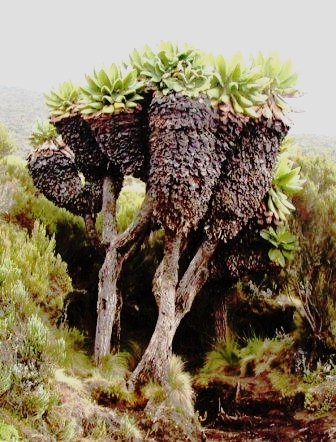
They have a giant rosette habit, with a terminal leaf rosette at the apex of a stout woody stem. When they bloom, the flowers form a large terminal inflorescence. Concomitantly, two to four lateral branches are normally initiated. As a result, old plants have the appearance of candelabras the size of telephone poles, each branch with a terminal rosette.
Dendrosenecio varies geographically between mountain ranges, and altitudinally on a single mountain. There has been disagreement among botanists as to which populations of Dendrosenecio warrant recognition as species, and which should be relegated to the status of subspecies or variety. The following list is taken from Knox & Palmer:
Groundsels of several species are found throughout the world as common roadside weeds, but nowhere except in the highlands of Africa do they exhibit such large tree forms.
The giant groundsels are found in the alpine zone of the mountains of equatorial East Africa – Mount Kilimanjaro and Mount Meru in Tanzania, Mount Kenya, the Aberdare Range, and Cherangani Hills in Kenya, Mount Elgon on the Uganda–Kenya border, the Rwenzori Mountains on the Uganda–Democratic Republic of Congo (DRC) border, the Virunga Mountains on the borders of Rwanda, Uganda and the DRC, and Mitumba Mountains (Mount Kahuzi and Mount Muhi) in the east of the DRC.
With the exception of D. eric-rosenii, which occurs on several of the mountains of the Albertine Rift (Rwenzori, Virunga and Mitumba Mountains), and D. battiscombei and D. keniodendron, which are shared by Mount Kenya and the Aberdare Range, the species are individually confined to a single range. In several of the ranges different species, or subspecies, are found at different heights.
Chart after Knox & Palmer:
The mountains of central and eastern Africa are an almost ideal model system for studying speciation and adaptation in plants. The mountains rise far above the surrounding plains and plateaus, tall enough to reach above the tree line and form sky islands. These predominantly volcanic peaks further simplify the model by their age and arrangement around the Lake Victoria basin and proximity to the equator.
Dendrosenecio
Dendrosenecio is a genus of flowering plants in the sunflower family. It is a segregate of Senecio, in which it forms the subgenus Dendrosenecio. Its members, the giant groundsels, are native to the higher-altitude zones of ten mountain groups in equatorial East Africa, where they form a conspicuous element of the flora.
They have a giant rosette habit, with a terminal leaf rosette at the apex of a stout woody stem. When they bloom, the flowers form a large terminal inflorescence. Concomitantly, two to four lateral branches are normally initiated. As a result, old plants have the appearance of candelabras the size of telephone poles, each branch with a terminal rosette.
Dendrosenecio varies geographically between mountain ranges, and altitudinally on a single mountain. There has been disagreement among botanists as to which populations of Dendrosenecio warrant recognition as species, and which should be relegated to the status of subspecies or variety. The following list is taken from Knox & Palmer:
Groundsels of several species are found throughout the world as common roadside weeds, but nowhere except in the highlands of Africa do they exhibit such large tree forms.
The giant groundsels are found in the alpine zone of the mountains of equatorial East Africa – Mount Kilimanjaro and Mount Meru in Tanzania, Mount Kenya, the Aberdare Range, and Cherangani Hills in Kenya, Mount Elgon on the Uganda–Kenya border, the Rwenzori Mountains on the Uganda–Democratic Republic of Congo (DRC) border, the Virunga Mountains on the borders of Rwanda, Uganda and the DRC, and Mitumba Mountains (Mount Kahuzi and Mount Muhi) in the east of the DRC.
With the exception of D. eric-rosenii, which occurs on several of the mountains of the Albertine Rift (Rwenzori, Virunga and Mitumba Mountains), and D. battiscombei and D. keniodendron, which are shared by Mount Kenya and the Aberdare Range, the species are individually confined to a single range. In several of the ranges different species, or subspecies, are found at different heights.
Chart after Knox & Palmer:
The mountains of central and eastern Africa are an almost ideal model system for studying speciation and adaptation in plants. The mountains rise far above the surrounding plains and plateaus, tall enough to reach above the tree line and form sky islands. These predominantly volcanic peaks further simplify the model by their age and arrangement around the Lake Victoria basin and proximity to the equator.
Recent media
Recent media