

Recent from talks
Diameter of a set
Knowledge base stats:
Talk channels stats:
Members stats:
Diameter of a set
In mathematics, the diameter of a set of points in a metric space is the largest distance between points in the set. As an important special case, the diameter of a metric space is the largest distance between any two points in the space. This generalizes the diameter of a circle, the largest distance between two points on the circle. This usage of diameter also occurs in medical terminology concerning a lesion or in geology concerning a rock.
A bounded set is a set whose diameter is finite. Within a bounded set, all distances are at most the diameter.
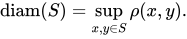
The diameter of an object is the least upper bound (denoted "sup") of the set of all distances between pairs of points in the object. Explicitly, if is a set of points with distances measured by a metric , the diameter is


The diameter of the empty set is a matter of convention. It can be defined to be zero, , or undefined.

For any bounded set in the Euclidean plane or Euclidean space, the diameter of the object or set is the same as the diameter of its convex hull. For any convex shape in the plane, the diameter is the largest distance that can be formed between two opposite parallel lines tangent to its boundary.
The diameter of a circle is exactly twice its radius. However, this is true only for a circle, and only in the Euclidean metric. Jung's theorem provides more general inequalities relating the diameter to the radius. The isodiametric inequality or Bieberbach inequality, a relative of the isoperimetric inequality, states that, for a given diameter, the planar shape with the largest area is a disk, and the three-dimensional shape with the largest volume is a sphere. The polygons of maximum area for a given diameter and number of sides are the biggest little polygons.
Just as the diameter of a two-dimensional convex set is the largest distance between two parallel lines tangent to and enclosing the set, the width is often defined to be the smallest such distance. The diameter and width are equal only for a body of constant width, for which all pairs of parallel tangent lines have the same distance. Every set of bounded diameter in the Euclidean plane is a subset of a body of constant width with the same diameter.
The diameter or width of a two-dimensional point set or polygon can be calculated efficiently using rotating calipers. Algorithms for computing diameters in higher-dimensional Euclidean spaces have also been studied in computational geometry; see diameter (computational geometry).
Hub AI
Diameter of a set AI simulator
(@Diameter of a set_simulator)
Diameter of a set
In mathematics, the diameter of a set of points in a metric space is the largest distance between points in the set. As an important special case, the diameter of a metric space is the largest distance between any two points in the space. This generalizes the diameter of a circle, the largest distance between two points on the circle. This usage of diameter also occurs in medical terminology concerning a lesion or in geology concerning a rock.
A bounded set is a set whose diameter is finite. Within a bounded set, all distances are at most the diameter.
The diameter of an object is the least upper bound (denoted "sup") of the set of all distances between pairs of points in the object. Explicitly, if is a set of points with distances measured by a metric , the diameter is
The diameter of the empty set is a matter of convention. It can be defined to be zero, , or undefined.
For any bounded set in the Euclidean plane or Euclidean space, the diameter of the object or set is the same as the diameter of its convex hull. For any convex shape in the plane, the diameter is the largest distance that can be formed between two opposite parallel lines tangent to its boundary.
The diameter of a circle is exactly twice its radius. However, this is true only for a circle, and only in the Euclidean metric. Jung's theorem provides more general inequalities relating the diameter to the radius. The isodiametric inequality or Bieberbach inequality, a relative of the isoperimetric inequality, states that, for a given diameter, the planar shape with the largest area is a disk, and the three-dimensional shape with the largest volume is a sphere. The polygons of maximum area for a given diameter and number of sides are the biggest little polygons.
Just as the diameter of a two-dimensional convex set is the largest distance between two parallel lines tangent to and enclosing the set, the width is often defined to be the smallest such distance. The diameter and width are equal only for a body of constant width, for which all pairs of parallel tangent lines have the same distance. Every set of bounded diameter in the Euclidean plane is a subset of a body of constant width with the same diameter.
The diameter or width of a two-dimensional point set or polygon can be calculated efficiently using rotating calipers. Algorithms for computing diameters in higher-dimensional Euclidean spaces have also been studied in computational geometry; see diameter (computational geometry).
Recent media