
Recent from talks
Didinium
Knowledge base stats:
Talk channels stats:
Members stats:
Didinium
Didinium is a genus of unicellular ciliates with at least ten accepted species. All are free-living carnivores. Most are found in fresh and brackish water, but three marine species are known. Their diet consists largely of Paramecium, although they will also attack and consume other ciliates. Some species, such as D. gargantua, also feeds on non-ciliate protists, including dinoflagellates, cryptomonads, and green algae.
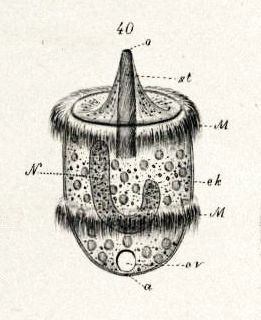
Didinia are rounded, oval, or barrel-shaped and range in length from 50 to 150 micrometres. The cell body is encircled by two ciliary bands, or pectinelles, an upper band and a lower band just below the midline. This distinguishes them from the related genus Monodinium, which have only a single band, except during cell division. The pectinelles are used to move Didinium through water by rotating the cell around its axis. At the anterior end, a cone-shaped structure protrudes, supported by a palisade of stiff microtubular rods (nematodesmata). This cone encloses the cytostome, or "mouth" opening, as in other haptorian ciliates. The dimensions of this protuberance vary among the different species.
The macronucleus is long and may be curved, horseshoe-shaped, or twisted into a shape resembling a figure eight. A contractile vacuole and anal aperture are in the posterior of the cell.
Like all ciliates, Didinia reproduces asexually via binary fission or sexually after undergoing conjugation.
Much of what has been published about this genus is based on numerous studies of a single species, Didinium nasutum. A voracious predator, D. nasutum uses specialized structures called toxicysts to ensnare and paralyze its ciliate prey. Once captured, the prey is engulfed by Didinium's expandible cytostome.
While D. nasutum is sometimes described as feeding exclusively upon Paramecium, it has been shown that the organism will readily devour other ciliate species, including Colpoda, Colpidium campylum, Tetrahymena pyriformis, Coleps hirtus, and Lacrymaria olor. Moreover, strains of Didinium raised on a Colpidium campylum will actually show a preference for a diet made up of that species, as well as a diminished ability to kill and ingest Paramecia.
In the absence of food, D. nasutum will encyst, lying dormant within a protective coating. In the laboratory, other environmental stimuli, such as the age of the growth medium or the accumulation of certain metabolic waste products, can also trigger encystment. When the encysted form of D. nasutum is exposed to a vigorous culture of Paramecium, it will excyst, reverting to its active, swimming form.
Didinium cysts have been shown to remain viable for at least 10 years.
Hub AI
Didinium AI simulator
(@Didinium_simulator)
Didinium
Didinium is a genus of unicellular ciliates with at least ten accepted species. All are free-living carnivores. Most are found in fresh and brackish water, but three marine species are known. Their diet consists largely of Paramecium, although they will also attack and consume other ciliates. Some species, such as D. gargantua, also feeds on non-ciliate protists, including dinoflagellates, cryptomonads, and green algae.
Didinia are rounded, oval, or barrel-shaped and range in length from 50 to 150 micrometres. The cell body is encircled by two ciliary bands, or pectinelles, an upper band and a lower band just below the midline. This distinguishes them from the related genus Monodinium, which have only a single band, except during cell division. The pectinelles are used to move Didinium through water by rotating the cell around its axis. At the anterior end, a cone-shaped structure protrudes, supported by a palisade of stiff microtubular rods (nematodesmata). This cone encloses the cytostome, or "mouth" opening, as in other haptorian ciliates. The dimensions of this protuberance vary among the different species.
The macronucleus is long and may be curved, horseshoe-shaped, or twisted into a shape resembling a figure eight. A contractile vacuole and anal aperture are in the posterior of the cell.
Like all ciliates, Didinia reproduces asexually via binary fission or sexually after undergoing conjugation.
Much of what has been published about this genus is based on numerous studies of a single species, Didinium nasutum. A voracious predator, D. nasutum uses specialized structures called toxicysts to ensnare and paralyze its ciliate prey. Once captured, the prey is engulfed by Didinium's expandible cytostome.
While D. nasutum is sometimes described as feeding exclusively upon Paramecium, it has been shown that the organism will readily devour other ciliate species, including Colpoda, Colpidium campylum, Tetrahymena pyriformis, Coleps hirtus, and Lacrymaria olor. Moreover, strains of Didinium raised on a Colpidium campylum will actually show a preference for a diet made up of that species, as well as a diminished ability to kill and ingest Paramecia.
In the absence of food, D. nasutum will encyst, lying dormant within a protective coating. In the laboratory, other environmental stimuli, such as the age of the growth medium or the accumulation of certain metabolic waste products, can also trigger encystment. When the encysted form of D. nasutum is exposed to a vigorous culture of Paramecium, it will excyst, reverting to its active, swimming form.
Didinium cysts have been shown to remain viable for at least 10 years.
Recent media