Recent from talks
Nothing was collected or created yet.
Cryptomonad
View on Wikipedia
| Cryptomonads | |
|---|---|
| Rhodomonas salina | |
| Scientific classification | |
| Domain: | Eukaryota |
| Clade: | Pancryptista |
| Phylum: | Cryptista |
| Subphylum: | Rollomonadia |
| Superclass: | Cryptomonada Cavalier-Smith, 2004 stat. nov. 2015[1] |
| Classes & orders[1] | |
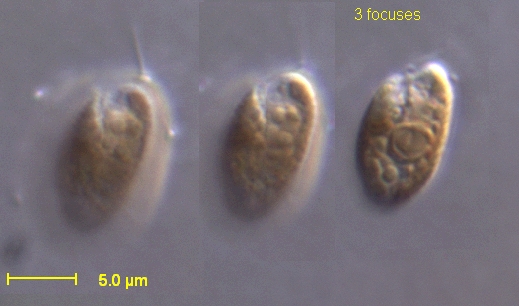
The cryptomonads (sometimes called cryptophytes)[2] are a superclass of algae,[3] most of which have plastids. They are traditionally considered a division of algae among phycologists, under the name of Cryptophyta.[4] They are common in freshwater, and also occur in marine and brackish habitats. Each cell is around 10–50 μm in size and flattened in shape, with an anterior groove or pocket. At the edge of the pocket there are typically two slightly unequal flagella. Some may exhibit mixotrophy.[5] They are classified as superclass Cryptomonada, which is divided into two classes: heterotrophic Goniomonadea and phototrophic Cryptophyceae. The two groups are united under three shared morphological characteristics: presence of a periplast, ejectisomes with secondary scroll, and mitochondrial cristae with flat tubules.[6] Genetic studies as early as 1994 also supported the hypothesis that Goniomonas was sister to Cryptophyceae.[7] A study in 2018 found strong evidence that the common ancestor of Cryptomonada was an autotrophic protist.[8]
Characteristics
[edit]Cryptomonads are distinguished by the presence of characteristic extrusomes called ejectosomes, which consist of two connected spiral ribbons held under tension.[9] If the cells are irritated either by mechanical, chemical or light stress, they discharge, propelling the cell in a zig-zag course away from the disturbance. Large ejectosomes, visible under the light microscope, are associated with the pocket; smaller ones occur underneath the periplast, the cryptophyte-specific cell surrounding.[10][11]
Except for the class Goniomonadea, which lacks plastids entirely,[12] and Cryptomonas paramecium (previously called Chilomonas paramecium), which has leucoplasts, cryptomonads have one or two chloroplasts. These contain chlorophylls a and c, together with phycobiliproteins and other pigments, and vary in color (brown, red to blueish-green). Each is surrounded by four membranes, and there is a reduced cell nucleus called a nucleomorph between the middle two. This indicates that the plastid was derived from a eukaryotic symbiont, shown by genetic studies to have been a red alga.[13] However, the plastids are very different from red algal plastids: phycobiliproteins are present but only in the thylakoid lumen and are present only as phycoerythrin or phycocyanin. In the case of Rhodomonas, the crystal structure has been determined to 1.63 Å;[14] and it has been shown that the alpha subunit bears no relation to any other known phycobiliprotein.
A few cryptomonads, such as Cryptomonas, can form palmelloid stages, but readily escape the surrounding mucus to become free-living flagellates again. Some Cryptomonas species may also form immotile microbial cysts—resting stages with rigid cell walls to survive unfavorable conditions. Cryptomonad flagella are inserted parallel to one another, and are covered by bipartite hairs called mastigonemes, formed within the endoplasmic reticulum and transported to the cell surface. Small scales may also be present on the flagella and cell body. The mitochondria have flat cristae, and mitosis is open; sexual reproduction has also been reported.

- Anterior flagellum (mastigonemes on both faces)
- Posterior flagellum (mastigonemes on one face)
- Contractile vacuole, regulates the quantity of water inside a cell
- Vestibulum
- Basal bodies
- Gullet (furrow or crypt)
- Mitochondrion, creates ATP (energy) for the cell
- Maupa's bodies
- Ejectisomes
- Starch granule
- Golgi apparatus, packages proteins
- Nucleomorph, a small, vestigial eukaryotic nucleus
- Pyrenoid, center of carbon fixation
- Periplastidial compartment
- Thylakoid, site of the light-dependent reactions of photosynthesis
- Plastid membranes (4, secondary)
- Nucleus
- Nucleolus
- Lipid globules
Classification
[edit]

The first mention of cryptomonads appears to have been made by Christian Gottfried Ehrenberg in 1831,[15] while studying Infusoria. Later, botanists treated them as a separate algae group, class Cryptophyceae or division Cryptophyta, while zoologists treated them as the flagellate protozoa order Cryptomonadina. In some classifications, the cryptomonads were considered close relatives of the dinoflagellates because of their (seemingly) similar pigmentation, being grouped as the Pyrrhophyta. Cryptomonad chloroplasts are closely related to those of the heterokonts and haptophytes, and the three groups were united by Cavalier-Smith as the Chromista. However, the case that the organisms themselves are closely related was counter-indicated by the major differences in cell organization (ultrastructural identity), suggesting that the three major lineages assigned to the chromists had acquired plastids independently, and that chromists are polyphyletic. The perspective that cryptomonads are primitively heterotrophic and secondarily acquired chloroplasts, is supported by molecular evidence.[16] Parfrey et al. and Burki et al. placed Cryptophyceae as a sister clade to the Green Algae,[17] or green algae plus glaucophytes.[18] The sister group to the cryptomonads is likely the kathablepharids (also referred to as katablepharids), a group of flagellates that also have ejectisomes.[19]
One suggested grouping is as follows: (1) Cryptomonas, (2) Chroomonas/Komma and Hemiselmis, (3) Rhodomonas/Rhinomonas/Storeatula, (4) Guillardia/Hanusia, (5) Geminigera/Plagioselmis/Teleaulax, (6) Proteomonas sulcata, (7) Falcomonas daucoides.[20]
References
[edit]- ^ a b Cavalier-Smith, Thomas (2018). "Kingdom Chromista and its eight phyla: A new synthesis emphasising periplastid protein targeting, cytoskeletal and periplastid evolution, and ancient divergences". Protoplasma. 255: 297–357. doi:10.1007/S00709-017-1147-3. PMC 5756292. PMID 28875267.
- ^ Barnes, Richard Stephen Kent (2001). The Invertebrates: A Synthesis. Wiley-Blackwell. p. 41. ISBN 978-0-632-04761-1.
- ^ Khan H, Archibald JM (May 2008). "Lateral transfer of introns in the cryptophyte plastid genome". Nucleic Acids Res. 36 (9): 3043–53. doi:10.1093/nar/gkn095. PMC 2396441. PMID 18397952.
- ^ Okamoto, N.; Inouye, I. (2005). "The Katablepharids are a Distant Sister Group of the Cryptophyta: A Proposal for Katablepharidophyta Divisio Nova/Kathablepharida Phylum Novum Based on SSU rDNA and Beta-Tubulin Phylogeny". Protist. 156 (2): 163–179. doi:10.1016/j.protis.2004.12.003. PMID 16171184.
- ^ "Cryptophyta - the cryptomonads". Archived from the original on 2011-06-10. Retrieved 2009-06-02.
- ^ Cavalier-Smith, Thomas (2004). Organelles, Genomes, and Eukaryote Phylogeny. pp. 87–88.
- ^ McFadden, Gilson, & Hill (1994), "Goniomonas: rRNA sequences indicate that this phagotrophic flagellate is a close relative of the host component of cryptomonads", European Journal of Phycology, 29 (1): 29–32, doi:10.1080/09670269400650451
{{citation}}: CS1 maint: multiple names: authors list (link) - ^ Cenci (2018), "Nuclear genome sequence of the plastid-lacking cryptomonad Goniomonas avonlea provides insights into the evolution of secondary plastids", BMC Biology, 16 (1): 137, doi:10.1186/s12915-018-0593-5, PMC 6260743, PMID 30482201
- ^ Graham, L. E.; Graham, J. M.; Wilcox, L. W. (2009). Algae (2nd ed.). San Francisco, CA: Benjamin Cummings (Pearson). ISBN 978-0-321-55965-4.
- ^ Morrall, S.; Greenwood, A. D. (1980). "A comparison of the periodic sub-structures of the trichocysts of the Cryptophyceae and Prasinophyceae". BioSystems. 12 (1–2): 71–83. doi:10.1016/0303-2647(80)90039-8. PMID 6155157.
- ^ Grim, J. N.; Staehelin, L. A. (1984). "The ejectisomes of the flagellate Chilomonas paramecium - Visualization by freeze-fracture and isolation techniques". Journal of Protozoology. 31 (2): 259–267. doi:10.1111/j.1550-7408.1984.tb02957.x. PMID 6470985.
- ^ Nuclear genome sequence of the plastid-lacking cryptomonad Goniomonas avonlea provides insights into the evolution of secondary plastids
- ^ Douglas, S.; et al. (2002). "The highly reduced genome of an enslaved algal nucleus". Nature. 410 (6832): 1091–1096. Bibcode:2001Natur.410.1091D. doi:10.1038/35074092. PMID 11323671.
- ^ Wilk, K.; et al. (1999). "Evolution of a light-harvesting protein by addition of new subunits and rearrangement of conserved elements: Crystal structure of a cryptophyte phycoerythrin at 1.63Å resolution". PNAS. 96 (16): 8901–8906. doi:10.1073/pnas.96.16.8901. PMC 17705. PMID 10430868.
- ^ Novarino, G. (2012). "Cryptomonad taxonomy in the 21st century: The first 200 years". Phycological Reports: Current Advances in Algal Taxonomy and Its Applications: Phylogenetic, Ecological and Applied Perspective: 19–52. Retrieved 2018-10-16.
- ^ Cenci, U.; Sibbald, S. J.; Curtis, B. A.; Kamikawa, R.; Eme, L.; Moog, D.; Henrissat, B.; Maréchal, E.; Chabi, M.; Djemiel, C.; Roger, A. J.; Kim, E.; Archibald, J. M. (2018). "Nuclear genome sequence of the plastid-lacking cryptomonad Goniomonas avonlea provides insights into the evolution of secondary plastids". BMC Biology. 16 (1): 137. doi:10.1186/s12915-018-0593-5. PMC 6260743. PMID 30482201.
- ^ Parfrey, Laura Wegener; Lahr, Daniel J. G.; Knoll, Andrew H.; Katz, Laura A. (August 16, 2011). "Estimating the timing of early eukaryotic diversification with multigene molecular clocks". Proceedings of the National Academy of Sciences of the United States of America. 108 (33): 13624–13629. Bibcode:2011PNAS..10813624P. doi:10.1073/pnas.1110633108. PMC 3158185. PMID 21810989.
- ^ Burki, Fabien; Kaplan, Maia; Tikhonenkov, Denis V.; Zlatogursky, Vasily; Minh, Bui Quang; Radaykina, Liudmila V.; Smirnov, Alexey; Mylnikov, Alexander P.; Keeling, Patrick J. (2016-01-27). "Untangling the early diversification of eukaryotes: a phylogenomic study of the evolutionary origins of Centrohelida, Haptophyta and Cryptista". Proc. R. Soc. B. 283 (1823) 20152802. doi:10.1098/rspb.2015.2802. ISSN 0962-8452. PMC 4795036. PMID 26817772.
- ^ Nishimura, Yuki; Kume, Keitaro; Sonehara, Keito; Tanifuji, Goro; Shiratori, Takashi; Ishida, Ken-Ichiro; Hashimoto, Tetsuo; Inagaki, Yuji; Ohkuma, Moriya (2020). "Mitochondrial Genomes of Hemiarma marina and Leucocryptos marina Revised the Evolution of Cytochrome c Maturation in Cryptista". Frontiers in Ecology and Evolution. 8. doi:10.3389/fevo.2020.00140.
- ^ "Cryptomonads". Retrieved 2009-06-24.
External links
[edit]Cryptomonad
View on GrokipediaMorphology and Cell Structure
Periplast and Ejectisomes
The periplast of cryptomonads is a distinctive protein-rich cell covering that envelops the plasma membrane, consisting of an outer surface periplast component (SPC) and an inner periplast component (IPC) that sandwich the membrane itself. This layered structure provides structural rigidity and protection to the cell, with the IPC typically formed from discrete proteinaceous plates—often rectangular or hexagonal—arranged in longitudinal rows across the cell surface. These plates are anchored to the inner leaflet of the plasma membrane by transmembrane particles, ensuring close apposition and contributing to the flattened, dorsoventral asymmetry characteristic of cryptomonad morphology.[5][1][2] The composition and arrangement of periplast components vary significantly among species, reflecting taxonomic diversity within the group. In genera like Cryptomonas, the IPC plates are generally smooth and unornamented, forming a uniform covering, whereas other species such as Chroomonas exhibit more elaborate rectangular plates or even sheet-like IPCs without discrete plates. The SPC, in contrast, may comprise self-assembling crystalline plates, rosette scales, or a fibrous coat derived from high-molecular-weight glycoproteins synthesized in the endomembrane system; these outer elements develop through anamorphic growth zones during the cell cycle and can be visualized distinctly via electron microscopy. Such variations not only aid in species identification but also adapt the periplast to environmental stresses, enhancing overall cell integrity without a true cell wall.[5][2] Ejectisomes, also termed extrusomes or trichocysts, are hallmark defensive organelles unique to cryptomonads, housed in vesicles beneath the periplast and concentrated along the cell's furrow or sulcus. These structures consist of two unequally sized, tightly coiled ribbon-like tapes—approximately 100–200 nm wide when coiled—enclosed within a membrane, with larger ejectisomes measuring 500–700 nm in diameter and smaller ones 250 nm. Formed in the Golgi apparatus, they discharge rapidly in response to stimuli such as mechanical disturbance, pH shifts, osmolarity changes, or light fluctuations, everting into elongated threads (up to 7 μm for large ones) that release mucilage or propel the cell backward in a jerky motion. This extrusion mechanism serves primarily for predator deterrence or temporary attachment, with ejectisomes numbering in the dozens to hundreds per cell and exhibiting genus-specific variations in size, coiling, and arrangement.[6][1][2]Chloroplasts and Nucleomorph
Cryptomonad chloroplasts are typically single or paired organelles per cell, often exhibiting an H-shaped configuration with lobes extending along the cell's length. These plastids are bounded by four membranes, the outermost of which is continuous with the endoplasmic reticulum, reflecting their secondary endosymbiotic origin. Internally, the thylakoids are organized into unstacked pairs or lamellae, lacking grana formations, and contain chlorophylls a and c₂ as primary photosynthetic pigments, alongside the carotenoid alloxanthin. Unique to cryptomonads among algae, the chloroplasts house phycobiliproteins such as phycoerythrin or phycocyanin, which are sequestered within the intrathylakoid lumen rather than forming phycobilisomes. These biliproteins, including Cr-PC (a phycocyanin-like complex) or Cr-PE (phycoerythrin), absorb green wavelengths of light (approximately 490–570 nm), complementing chlorophyll absorption and facilitating efficient energy transfer to photosystem II in shaded aquatic environments. The pigment composition imparts varied cell colors, from blue-green to red or brown, depending on the dominant biliprotein. The nucleomorph, a vestigial nucleus of the engulfed red algal endosymbiont, resides in the periplastidial space between the second and third chloroplast membranes. This double-membraned organelle, with pores resembling nuclear pores, contains a compact genome across three chromosomes totaling 0.49–0.84 megabases, encoding approximately 466–518 protein-coding genes primarily for transcription, translation, and plastid functions, including its own rRNA operons and ribosomes. The nucleomorph's position varies by species, often embedded in a pyrenoid invagination or appressed to the inner chloroplast envelope.[7][7] While most cryptomonads are photosynthetic, some species, such as Chilomonas paramecium, are colorless and heterotrophic, having lost functional chloroplasts through gene degradation in the nucleomorph and plastid genomes but retaining a reduced nucleomorph with ~17–19 plastid-targeted genes. These non-photosynthetic forms highlight the evolutionary persistence of the endosymbiotic remnant despite the absence of phototrophy.[7][7]Flagella and Motility
Cryptomonads possess two heterokont flagella of unequal length, inserted subapically into a ventral furrow or gullet structure known as the vestibulum.[1] The anterior flagellum, typically longer and directed forward, serves primarily for propulsion, while the posterior flagellum, shorter and trailing backward, facilitates steering and stability.[6] Both flagella measure approximately 15–20 μm in length and are adorned with fine hairs called mastigonemes, which are rigid, bipartite structures consisting of tubular shafts with terminal filaments and associated scales measuring 140–170 nm across.[8][6] The longer flagellum usually bears two unilateral rows of these mastigonemes, spaced about 240–825 nm apart, whereas the shorter flagellum has one row, enhancing hydrodynamic drag and propulsion efficiency.[8] Motility in cryptomonads is achieved through coordinated flagellar beating that generates a rotary or helical swimming trajectory, with the anterior flagellum pulling the cell forward in a breaststroke-like motion while the posterior flagellum modulates direction.[1][8] This pattern allows for smooth forward progression and rapid reorientation via two-dimensional beating, enabling the cell to reverse direction by altering flagellar orientation without thrust reversal.[8] The mastigonemes contribute to these dynamics by increasing drag on the recovery stroke and thrust on the power stroke, resulting in swimming speeds on the order of 100–200 μm/s in active cells.[8] Under stress, such as predator encounter, ejectisomes can discharge to produce jerky backward propulsion, supplementing flagellar movement.[6] The flagella also enable sensory functions, particularly in detecting environmental cues for directed motility.[9] Phototaxis is mediated by a dual-rhodopsin system in the flagella, where light absorption at wavelengths around 450–500 nm triggers photoelectric currents that modulate beating frequency and direction, allowing positive orientation toward light sources.[9] Similarly, the flagella facilitate chemotaxis by sensing nutrient gradients, adjusting swimming paths to optimize foraging in nutrient-rich areas. Across species, variations in flagellar structure include different appendage arrangements, such as single rows of mastigonemes on both flagella or curved spikes on the shorter one, which may fine-tune motility for specific ecological niches.[10]Reproduction and Life Cycle
Asexual Reproduction
Asexual reproduction in cryptomonads primarily occurs through binary fission, a process of longitudinal cell division that begins at the posterior end of the cell and proceeds anteriorly, resulting in two genetically identical daughter cells.[11] This mode of reproduction is the dominant mechanism for population expansion in both culture and natural environments, enabling rapid clonal propagation without genetic recombination.[12] Division typically takes place in either haploid or diploid states, varying by species; for instance, diploid forms predominate in nutrient-abundant conditions, while haploid phases may occur during certain life stages.[13] The cell cycle in cryptomonads involves distinct phases coordinated across the nucleus, nucleomorph, and organelles. During the G1 phase, cells undergo growth with a single cup-shaped chloroplast; this is followed by the S phase, where DNA replication occurs in both the nucleus and nucleomorph.[11] Mitosis is open, with the nuclear envelope breaking down during prometaphase, and features an initially extranuclear spindle formed from microtubules originating at the replicated flagellar bases, which migrate anteriorly and enter the nucleus.[14] Flagella duplicate early in prophase, leading to a transient quadriflagellate stage that facilitates motility in daughter cells.[11] The chloroplast divides in preprophase via constriction at the dorsal bridge, while the nucleomorph undergoes division through sequential invagination of its envelope membranes without microtubule involvement, ensuring equitable segregation to each daughter cell.[11] Cytokinesis completes the process by furrowing, separating the cells.[14] Binary fission is favored under nutrient-rich conditions, such as elevated inorganic nitrogen levels following environmental inputs like rainfall, which promote rapid population growth and can lead to blooms in aquatic habitats.[15] For example, in the species Cryptomonas, division occurs every 12-24 hours under optimal laboratory conditions of moderate light (approximately 50-100 μmol photons m⁻² s⁻¹) and temperatures around 15-20°C, allowing doubling times that support dense cultures.[16] This efficiency underscores the role of asexual reproduction in enabling cryptomonads to quickly exploit favorable ecological niches.[17]Sexual Reproduction
Sexual reproduction in cryptomonads is rare, with observations limited to a few genera including Cryptomonas and Chroomonas, where it contrasts with the predominant asexual mode of binary fission.[18] In documented cases, vegetative cells function as isogametes, fusing in an isogamous manner without significant morphological differentiation between mating types.[19] Plasmogamy initiates at the posterior end of one gamete and the mid-ventral region of the other, often involving a pointed protuberance, leading to a transient quadriflagellate cell that becomes spherical and settles.[19] Karyogamy follows, with nuclear membranes breaking down and the haploid nuclei fusing directly to form a diploid zygotic nucleus, while the two nucleomorphs and chloroplasts remain distinct but enclosed together in a shared periplastidial compartment.[19] The zygote develops a multi-layered wall and enters a resistant resting stage, resembling a palmelloid form, prior to meiosis.[20] Cryptomonads follow a haplontic life cycle, characterized by a prolonged haploid vegetative phase; the diploid state is transient within the zygote, where meiosis restores haploidy and generates genetic variation through recombination.[19][21] This process enhances heterozygosity and adaptability in environmentally variable habitats, though direct evidence remains sparse.[13] In some species like Proteomonas sulcata, dimorphic forms alternate between haploid and diploid stages, suggesting potential variations in cycle expression.[21]Classification and Taxonomy
Historical Development
The first descriptions of cryptomonads date to 1831, when Christian Gottfried Ehrenberg observed biflagellate unicellular organisms in freshwater samples and established the genus Cryptomonas as part of his studies on Infusoria, noting their distinctive flattened shape and pigmentation.[22] These early observations, based on light microscopy, highlighted features such as the cells' anterior gullet and flagellar arrangement, though Ehrenberg initially grouped them with other microscopic animals.[23] Throughout the 19th and early 20th centuries, botanists increasingly treated cryptomonads as algae, with Alfred Pascher's 1914 classification in Die Süsswasser-Flora Deutschlands, Österreichs und der Schweiz dividing them into motile and non-motile subgroups based on thallus organization and habitat preferences.[23] By the mid-20th century, improved light microscopy techniques, as detailed in Georg Huber-Pestalozzi's 1950 compendium Das Phytoplankton des Süsswassers, revealed finer details of their flagella, pigments like alloxanthin, and nutritional modes, solidifying their placement among photosynthetic protists while resolving earlier debates over animal-like versus plant-like traits.[4] A pivotal advance came in the 1960s with the application of electron microscopy, which first confirmed the periplast—a complex surface layer of plates and scales—as a defining ultrastructural feature, as reported in studies on species like Cryptomonas ovata.[24] This period marked the transition to recognizing cryptomonads as a distinct protist group, culminating in Pierre Bourrelly's 1970 classification in Les Algues d'Eau Douce, which integrated these findings into a cohesive taxonomic framework emphasizing their biflagellate nature and ecological roles.[23] These developments provided the morphological foundation for subsequent molecular refinements in taxonomy.Modern Taxonomic Framework
The modern taxonomic framework of cryptomonads places them within the phylum Cryptophyta, which is divided into two classes: Cryptophyceae, encompassing photosynthetic forms with plastids, and Goniomonadea, comprising non-photosynthetic, heterotrophic lineages.[25] The class Cryptophyceae includes orders such as Cryptomonadales and Pyrenomonadales, characterized by the presence of chloroplasts and associated pigments, while the class Goniomonadea contains the order Goniomonadales, distinguished by the absence of plastids and reliance on phagotrophy.[26] This hierarchical structure integrates ultrastructural features, such as periplast composition and flagellar apparatus, with biochemical traits like pigment profiles. Non-photosynthetic forms, including goniomonads, are firmly included within Cryptophyta, while katablepharids are recognized as a distant sister group within the broader infrakingdom Cryptista but excluded from the core cryptophyte assemblage.[27] The core group of Cryptophyta encompasses approximately 230 species across more than 20 genera, reflecting a compact but diverse radiation primarily in aquatic environments.[28][29] Molecular markers, particularly small subunit ribosomal RNA (SSU rRNA) genes from both nuclear and nucleomorph genomes, alongside plastid-encoded genes such as psbA, have been pivotal in defining clades and supporting taxonomic emendations.[30] These analyses have facilitated the separation of photosynthetic and heterotrophic lineages, refining generic boundaries and revealing cryptic diversity, such as within Cryptomonas, where emendations distinguish species based on sequence divergences.[31] The foundational revision by Clay et al. (1999) established key aspects of this framework using integrated ultrastructural, biochemical, and early molecular data.[32] Subsequent updates in the 2010s, incorporating internal transcribed spacer 2 (ITS2) rDNA sequencing aligned to secondary structures, have further resolved species-level taxonomy, confirming monophyly of key genera and identifying novel lineages without altering the overarching class and order structure.[33]Diversity of Genera and Species
The Cryptophyta, commonly known as cryptomonads, exhibit a moderate level of described taxonomic diversity, with approximately 230 species recognized across more than 20 genera, though molecular studies suggest substantial undescribed variation within this phylum.[28][29] This diversity is characterized by variations in pigmentation, nutritional modes, and habitat preferences, with genera often differentiated by the presence or absence of plastids and the composition of periplast plates. The genus Cryptomonas represents one of the most species-rich groups, primarily inhabiting freshwater environments and featuring brownish pigmentation due to phycobiliproteins; it includes approximately 100 described species, with higher diversity observed in temperate and tropical inland waters.[22] For instance, a comprehensive survey in Vietnam identified 24 Cryptomonas species from 122 strains, underscoring elevated freshwater diversity in certain regions.[30] Recent taxonomic work has added to this, describing six new species—C. matvienkoae, C. furtiva, C. paludosa, C. ursina, C. vietnamica, and C. vietnamensis—from Vietnamese freshwater habitats in 2022, based on combined morphological and molecular analyses.[30] In contrast, marine forms show distinct adaptations, such as the red-pigmented genus Rhodomonas, which is predominantly oceanic and includes several species valued for their role in aquaculture feeds due to high lipid content.[34] Other notable marine genera include Teleaulax, comprising a few small, biflagellate species that contribute to nanoplankton communities.[35] Colorless heterotrophs like Chilomonas, which lack functional plastids and rely on bacterivory, are mostly freshwater dwellers with limited species diversity, exemplified by C. paramecium.[36] Rare or specialized genera highlight further morphological variation; Goniomonas, the sole member of the aplastidic order Goniomonadales, is heterotrophic and lacks chloroplasts entirely, occurring in both freshwater and marine settings. A 2025 revision described seven new species and emended descriptions of existing ones, expanding known diversity in this genus.[37][38] Similarly, Plagioselmis features nanoplanktonic species such as P. prolonga, which exhibit dimorphic life stages and are widespread in coastal waters, reflecting adaptive plasticity in size and form.[39] Overall, while freshwater genera dominate in species richness, marine and heterotrophic forms underscore the phylum's ecological breadth.[31]Evolutionary History
Endosymbiotic Origins
Cryptomonads possess complex plastids that originated via secondary endosymbiosis, in which a heterotrophic eukaryotic host engulfed a photosynthetic red alga approximately 1.26 billion years ago. This event integrated the red algal plastid into the host cell, resulting in a four-membrane-bound organelle where the outermost membranes derive from the host's endomembrane system and the inner two from the original red algal chloroplast envelope. The engulfed red alga's nucleus was not fully eliminated but reduced to a vestigial structure known as the nucleomorph, while the majority of its genes were transferred to the host's nucleus through endosymbiotic gene transfer, enabling coordinated control of the plastid by the host.[40][41] Strong evidence for this red algal origin comes from the structure and genetics of the cryptomonad plastid and nucleomorph. The four-membrane configuration is a hallmark of secondary plastids in chromists, and phylogenetic analyses of plastid genes such as rbcL and psaA confirm their affinity to red algae. The nucleomorph genome, exemplified by that of Guillardia theta, spans 551 kilobase pairs across three chromosomes and encodes 486 proteins, many of which show clear red algal ancestry, including housekeeping genes and components for plastid protein import. This genome's compact, gene-dense nature (one gene per 977 base pairs) reflects extensive gene loss and relocation to the host nucleus.[40][42] A distinctive feature of cryptomonad plastids is the retention of the nucleomorph, which sets them apart from other chromists like haptophytes and stramenopiles that lost this structure after the shared endosymbiotic event. Additionally, cryptomonads inherited phycobiliproteins—pigments such as phycoerythrin—from their red algal ancestor, which are attached to thylakoid membranes rather than organized into phycobilisomes as in free-living red algae, aiding in light harvesting in low-light environments. Recent studies debate whether this secondary endosymbiosis represents a single event in a common chromist ancestor or independent acquisitions; while a 2024 analysis supports a single origin approximately 1.26 billion years ago predating the divergence of cryptophytes from haptophytes and stramenopiles (estimated at around 1.14 billion years ago), an alternative 2024 model proposes separate endosymbioses for cryptophytes (~1.53 billion years ago) and other chromalveolates.[40][43][44]Phylogenetic Relationships
Cryptomonads, also known as cryptophytes, occupy a distinct position within the Diaphoretickes supergroup of the eukaryotic tree of life, where the Cryptista clade—encompassing cryptomonads and their sister group, the katablepharids—forms a close relationship with haptophytes.[45] This arrangement aligns with broader formulations of Hacrobia, which groups cryptomonads alongside haptophytes and certain other lineages, although the monophyly of Hacrobia remains contentious due to inconsistent support across datasets.[46] Some earlier phylogenomic reconstructions placed cryptomonads in sister relation to haptophytes and stramenopiles within an expanded Chromalveolata, but contemporary multi-gene analyses favor their integration into Diaphoretickes as a deeply branching algal lineage.[47] Phylogenetic support derives primarily from nuclear-encoded small subunit ribosomal RNA (SSU rRNA) sequences, which reveal a deep divergence of cryptomonads from other eukaryotic groups while affirming their monophyly.[48] Complementary plastid phylogenies, based on multi-gene datasets, unequivocally trace the origin of their complex plastids to a secondary endosymbiosis involving a red alga from the stem lineage of Rhodophytina.[49] These molecular markers highlight the ancient integration of the red algal symbiont, distinguishing cryptomonads from primary plastid-bearing algae like those in Archaeplastida. Ongoing debates center on the precise inclusion of katablepharids within Cryptista and evidence for independent losses of photosynthesis across non-photosynthetic lineages, which complicate interpretations of ancestral character states.[46] A 2023 phylogenomic study employing ultraconserved elements from nuclear, nucleomorph, and plastid genomes across 91 cryptomonad strains robustly upholds their status as a distinct phylum, while molecular clock estimates from related analyses indicate divergence from other chromist groups approximately 1.14 billion years ago.[50][40][49]Ecology and Distribution
Habitats and Global Distribution
Cryptomonads inhabit a diverse array of aquatic environments, primarily freshwater systems such as lakes and rivers, as well as marine settings including coastal zones and the open ocean.[51] They are also common in brackish waters, reflecting their adaptability to varying ionic compositions.[52] These protists particularly favor low-light conditions, thriving in shaded microenvironments like those beneath ice covers in polar regions or under vegetative canopies in temperate lakes, where reduced irradiance supports their phycobiliprotein-mediated photosynthesis.[51] The global distribution of cryptomonads is cosmopolitan, spanning from polar latitudes, such as Arctic lakes and seas, to tropical oceans and inland waters.[51] They occur worldwide in nearly all types of water bodies, from saline oceans to freshwater puddles, with notable abundance in temperate eutrophic lakes where nutrient enrichment promotes their growth.[12] This broad occurrence underscores their ecological versatility across climatic zones.[53] Cryptomonads demonstrate tolerance to a wide environmental gradient, flourishing in temperatures ranging from near 0°C in cold polar waters to 25°C in warmer temperate and subtropical systems.[54] They accommodate salinities from 0 ppt in freshwater to 35 ppt in fully marine habitats, enabling persistence across estuarine gradients.[55] For pH, they prefer slightly alkaline conditions (above 7.5) but tolerate values between 6 and 9, often dominating in buffered, productive waters.[56] Within these environments, cryptomonads predominantly occupy planktonic niches as free-floating cells in the water column, contributing to phytoplankton assemblages.[12] Some species, however, are benthic, adhering to sediments or substrates in shallow aquatic zones.[57] Additionally, certain cryptomonads engage in symbiotic associations with freshwater sponges, where they provide nutritional benefits within host tissues.[58]Ecological Roles
Cryptomonads serve as key primary producers in aquatic ecosystems, particularly in freshwater and coastal marine environments where they contribute substantially to carbon fixation. Their ability to thrive in dim light conditions is facilitated by phycobilins, accessory pigments that enhance light harvesting in the green spectrum, allowing efficient photosynthesis under low irradiance levels often found in deeper or shaded waters.[1] In lakes, cryptomonads can form a significant portion of phytoplankton biomass.[59] This productivity supports overall ecosystem carbon dynamics, with documented increases in primary production rates in fertilized lake systems dominated by cryptomonads.[60] In trophic interactions, cryptomonads occupy multiple levels within food webs, functioning both as prey and predators. They are highly nutritious and digestible for herbivorous zooplankton, including species like Daphnia pulicaria and D. thorata, which exhibit strong growth when feeding on cryptomonads such as Cryptomonas erosa.[60] Heterotrophic and mixotrophic forms, such as Goniomonas species, actively consume bacteria, positioning cryptomonads as bacterivores that link microbial loops to higher trophic levels.[61] This dual role enhances energy transfer efficiency, as mixotrophic cryptomonads combine photosynthesis with phagotrophy to exploit diverse resources.[62] Recent studies as of 2025 have further elucidated cryptophyte community assembly in river-estuary-coast continua, revealing deterministic processes like environmental filtering that shape diversity and ecological roles in connected ecosystems.[61] Cryptomonads play a vital part in nutrient cycling by releasing dissolved organic matter through grazing and excretion, which facilitates the remineralization of nitrogen and phosphorus in aquatic systems.[60] Their mixotrophic capabilities allow them to acquire nutrients via both dissolved uptake and bacterial predation, thereby recycling bioavailable forms of these elements and supporting phytoplankton succession.[62] Zooplankton grazing on cryptomonads further promotes nutrient regeneration, creating feedback loops that sustain productivity in nutrient-limited environments.[60] Occasional blooms of cryptomonads occur in stratified lakes, where they can dominate phytoplankton assemblages and influence ecosystem processes. These events elevate local oxygen production during peak growth but may lead to depletion upon senescence, affecting water quality and the base of fish food chains by providing abundant prey resources.[63] Such blooms underscore their role in maintaining biodiversity and trophic stability in temperate freshwater systems.[61]Interactions and Seasonality
Cryptomonads engage in various biotic interactions that influence their survival and distribution in aquatic ecosystems. They are frequently preyed upon by small planktonic ciliates, such as those in the genus Balanion, which exhibit species-specific feeding preferences and can exert significant predation pressure on cryptomonad populations, particularly in metalimnetic layers where Cryptomonas species aggregate.[64][65] Rotifers, including species like Keratella and Synchaeta, also graze heavily on small cryptophytes (<1,000 μm³), contributing to top-down control in both freshwater and marine environments, with grazing rates often leading to rapid declines in cryptomonad abundance during periods of high rotifer activity.[66][67] In response to such predation, cryptomonads deploy defensive ejectisomes, extrusome-like structures that discharge to deter herbivores upon disturbance.[68] Competition with diatoms is another key interaction, where shifts in dominance occur based on environmental conditions; for instance, in Antarctic coastal waters, cryptomonads prevail under shallower mixed layers and lower salinities, while diatoms outcompete them during deeper mixing and warmer periods.[69] A notable symbiotic relationship involves viruses within cryptomonad cells, as demonstrated in a 2023 study of Cryptomonas gyropyrenoidosa, where a single cell hosts two bacterial endosymbionts (Megaira polyxenophila and another) along with a bacteriophage that infects one endosymbiont, forming a complex intracellular community that highlights viral mediation in endosymbiotic dynamics.[70] Seasonal patterns of cryptomonad abundance vary by latitude and are closely tied to physical mixing and nutrient availability. In temperate lakes, populations often peak during spring and autumn turnover events, when destratification mixes nutrient-rich hypolimnetic waters with the epilimnion, favoring cryptomonad growth; for example, in mesotrophic systems, abundances surge as temperatures moderate between 10–20°C.[71][51] In tropical regions, cryptomonads maintain more consistent year-round presence, with fluctuations driven by pulsed nutrient inputs from rainfall or upwelling rather than thermal stratification, allowing persistent low-level blooms under stable warm conditions (25–30°C).[72] Responses to temperature and nutrient pulses are pronounced; elevated temperatures up to an optimum (around 20–25°C for many species) enhance growth rates, while sudden nutrient enrichments, such as nitrate spikes, trigger rapid proliferation, though excesses can shift community structure toward competitors.[66][73] Population dynamics of cryptomonads are characterized by episodic blooms and grazing-induced declines, modulated by trophic conditions. In eutrophic basins, such as those in Lake Taihu, China, cryptomonads form notable blooms during transitional seasons, with a 2015 study revealing higher densities and prolonged peaks in mesotrophic to eutrophic zones compared to oligotrophic areas, where nutrient gradients dictate biomass variations up to 10-fold.[74] Grazing by zooplankton, particularly ciliates and rotifers, frequently causes sharp declines, with rates removing 5–25% of standing cryptomonad biomass daily in stratified lakes, leading to synchronous crashes during peak predator abundances.[65][75] Cryptomonads hold relevance for human activities, serving as bioindicators of water quality due to their sensitivity to nutrient enrichment; elevated abundances often signal mesoeutrophic conditions and inorganic nitrogen pulses, as observed in riverine systems where blooms correlate with deteriorating physicochemical parameters.[76][62] Their high lipid content, reaching 22% dry weight in species like Cryptomonas sp., positions them as promising feed additives in aquaculture, providing essential polyunsaturated fatty acids (e.g., 20:5ω3) that enhance larval nutrition and replace fish oils sustainably.[77][78]References
- https://species.wikimedia.org/wiki/Cryptophyta
