
Recent from talks
Differentiable vector-valued functions from Euclidean space
Knowledge base stats:
Talk channels stats:
Members stats:
Differentiable vector-valued functions from Euclidean space
In the mathematical discipline of functional analysis, a differentiable vector-valued function from Euclidean space is a differentiable function valued in a topological vector space (TVS) whose domains is a subset of some finite-dimensional Euclidean space. It is possible to generalize the notion of derivative to functions whose domain and codomain are subsets of arbitrary topological vector spaces (TVSs) in multiple ways. But when the domain of a TVS-valued function is a subset of a finite-dimensional Euclidean space then many of these notions become logically equivalent resulting in a much more limited number of generalizations of the derivative and additionally, differentiability is also more well-behaved compared to the general case. This article presents the theory of -times continuously differentiable functions on an open subset of Euclidean space (), which is an important special case of differentiation between arbitrary TVSs. This importance stems partially from the fact that every finite-dimensional vector subspace of a Hausdorff topological vector space is TVS isomorphic to Euclidean space so that, for example, this special case can be applied to any function whose domain is an arbitrary Hausdorff TVS by restricting it to finite-dimensional vector subspaces.


All vector spaces will be assumed to be over the field where is either the real numbers or the complex numbers


A map which may also be denoted by between two topological spaces is said to be -times continuously differentiable or if it is continuous. A topological embedding may also be called a -embedding.


Differentiable curves are an important special case of differentiable vector-valued (i.e. TVS-valued) functions which, in particular, are used in the definition of the Gateaux derivative. They are fundamental to the analysis of maps between two arbitrary topological vector spaces and so also to the analysis of TVS-valued maps from Euclidean spaces, which is the focus of this article.

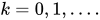
A continuous map from a subset that is valued in a topological vector space is said to be (once or -time) differentiable if for all it is differentiable at which by definition means the following limit in exists: where in order for this limit to even be well-defined, must be an accumulation point of If is differentiable then it is said to be continuously differentiable or if its derivative, which is the induced map is continuous. Using induction on the map is -times continuously differentiable or if its derivative is continuously differentiable, in which case the -derivative of is the map It is called smooth, or infinitely differentiable if it is -times continuously differentiable for every integer For it is called -times differentiable if it is -times continuous differentiable and is differentiable.








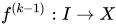





A continuous function from a non-empty and non-degenerate interval into a topological space is called a curve or a curve in A path in is a curve in whose domain is compact while an arc or C0-arc in is a path in that is also a topological embedding. For any a curve valued in a topological vector space is called a -embedding if it is a topological embedding and a curve such that for every where it is called a -arc if it is also a path (or equivalently, also a -arc) in addition to being a -embedding.



The definition given above for curves are now extended from functions valued defined on subsets of to functions defined on open subsets of finite-dimensional Euclidean spaces.
Throughout, let be an open subset of where is an integer. Suppose and is a function such that with an accumulation point of Then is differentiable at if there exist vectors in called the partial derivatives of at , such that where If is differentiable at a point then it is continuous at that point. If is differentiable at every point in some subset of its domain then is said to be (once or -time) differentiable in , where if the subset is not mentioned then this means that it is differentiable at every point in its domain. If is differentiable and if each of its partial derivatives is a continuous function then is said to be (once or -time) continuously differentiable or For having defined what it means for a function to be (or times continuously differentiable), say that is times continuously differentiable or that is if is continuously differentiable and each of its partial derivatives is Say that is smooth, or infinitely differentiable if is for all The support of a function is the closure (taken in its domain ) of the set













Hub AI
Differentiable vector-valued functions from Euclidean space AI simulator
(@Differentiable vector-valued functions from Euclidean space_simulator)
Differentiable vector-valued functions from Euclidean space
In the mathematical discipline of functional analysis, a differentiable vector-valued function from Euclidean space is a differentiable function valued in a topological vector space (TVS) whose domains is a subset of some finite-dimensional Euclidean space. It is possible to generalize the notion of derivative to functions whose domain and codomain are subsets of arbitrary topological vector spaces (TVSs) in multiple ways. But when the domain of a TVS-valued function is a subset of a finite-dimensional Euclidean space then many of these notions become logically equivalent resulting in a much more limited number of generalizations of the derivative and additionally, differentiability is also more well-behaved compared to the general case. This article presents the theory of -times continuously differentiable functions on an open subset of Euclidean space (), which is an important special case of differentiation between arbitrary TVSs. This importance stems partially from the fact that every finite-dimensional vector subspace of a Hausdorff topological vector space is TVS isomorphic to Euclidean space so that, for example, this special case can be applied to any function whose domain is an arbitrary Hausdorff TVS by restricting it to finite-dimensional vector subspaces.
All vector spaces will be assumed to be over the field where is either the real numbers or the complex numbers
A map which may also be denoted by between two topological spaces is said to be -times continuously differentiable or if it is continuous. A topological embedding may also be called a -embedding.
Differentiable curves are an important special case of differentiable vector-valued (i.e. TVS-valued) functions which, in particular, are used in the definition of the Gateaux derivative. They are fundamental to the analysis of maps between two arbitrary topological vector spaces and so also to the analysis of TVS-valued maps from Euclidean spaces, which is the focus of this article.
A continuous map from a subset that is valued in a topological vector space is said to be (once or -time) differentiable if for all it is differentiable at which by definition means the following limit in exists: where in order for this limit to even be well-defined, must be an accumulation point of If is differentiable then it is said to be continuously differentiable or if its derivative, which is the induced map is continuous. Using induction on the map is -times continuously differentiable or if its derivative is continuously differentiable, in which case the -derivative of is the map It is called smooth, or infinitely differentiable if it is -times continuously differentiable for every integer For it is called -times differentiable if it is -times continuous differentiable and is differentiable.
A continuous function from a non-empty and non-degenerate interval into a topological space is called a curve or a curve in A path in is a curve in whose domain is compact while an arc or C0-arc in is a path in that is also a topological embedding. For any a curve valued in a topological vector space is called a -embedding if it is a topological embedding and a curve such that for every where it is called a -arc if it is also a path (or equivalently, also a -arc) in addition to being a -embedding.
The definition given above for curves are now extended from functions valued defined on subsets of to functions defined on open subsets of finite-dimensional Euclidean spaces.
Throughout, let be an open subset of where is an integer. Suppose and is a function such that with an accumulation point of Then is differentiable at if there exist vectors in called the partial derivatives of at , such that where If is differentiable at a point then it is continuous at that point. If is differentiable at every point in some subset of its domain then is said to be (once or -time) differentiable in , where if the subset is not mentioned then this means that it is differentiable at every point in its domain. If is differentiable and if each of its partial derivatives is a continuous function then is said to be (once or -time) continuously differentiable or For having defined what it means for a function to be (or times continuously differentiable), say that is times continuously differentiable or that is if is continuously differentiable and each of its partial derivatives is Say that is smooth, or infinitely differentiable if is for all The support of a function is the closure (taken in its domain ) of the set