


Community hub
Recent from talks
Contribute something
Nothing was collected or created yet.
Differentiable function
View on Wikipedia
In mathematics, a differentiable function of one real variable is a function whose derivative exists at each point in its domain. In other words, the graph of a differentiable function has a non-vertical tangent line at each interior point in its domain. A differentiable function is smooth (the function is locally well approximated as a linear function at each interior point) and does not contain any break, angle, or cusp.
If x0 is an interior point in the domain of a function f, then f is said to be differentiable at x0 if the derivative exists. In other words, the graph of f has a non-vertical tangent line at the point (x0, f(x0)). f is said to be differentiable on U if it is differentiable at every point of U. f is said to be continuously differentiable if its derivative is also a continuous function over the domain of the function . Generally speaking, f is said to be of class if its first derivatives exist and are continuous over the domain of the function .



For a multivariable function, as shown here, the differentiability of it is something more complex than the existence of the partial derivatives of it.
Differentiability of real functions of one variable
[edit]A function , defined on an open set , is said to be differentiable at if the derivative



exists. This implies that the function is continuous at a.
This function f is said to be differentiable on U if it is differentiable at every point of U. In this case, the derivative of f is thus a function from U into

A continuous function is not necessarily differentiable, but a differentiable function is necessarily continuous (at every point where it is differentiable) as is shown below (in the section Differentiability and continuity). A function is said to be continuously differentiable if its derivative is also a continuous function; there exist functions that are differentiable but not continuously differentiable (an example is given in the section Differentiability classes).
Semi-differentiability
[edit]The above definition can be extended to define the derivative at boundary points. The derivative of a function defined on a closed subset of the real numbers, evaluated at a boundary point , can be defined as the following one-sided limit, where the argument approaches such that it is always within :


For to remain within , which is a subset of the reals, it follows that this limit will be defined as either

Differentiability and continuity
[edit]
.svg)
If f is differentiable at a point x0, then f must also be continuous at x0. In particular, any differentiable function must be continuous at every point in its domain. The converse does not hold: a continuous function need not be differentiable. For example, a function with a bend, cusp, or vertical tangent may be continuous, but fails to be differentiable at the location of the anomaly.
Most functions that occur in practice have derivatives at all points or at almost every point. However, a result of Stefan Banach states that the set of functions that have a derivative at some point is a meagre set in the space of all continuous functions.[1] Informally, this means that differentiable functions are very atypical among continuous functions. The first known example of a function that is continuous everywhere but differentiable nowhere is the Weierstrass function.
Differentiability classes
[edit]
.svg)




A function is said to be continuously differentiable if the derivative exists and is itself a continuous function. Although the derivative of a differentiable function never has a jump discontinuity, it is possible for the derivative to have an essential discontinuity. For example, the function is differentiable at 0, since exists. However, for differentiation rules imply which has no limit as Thus, this example shows the existence of a function that is differentiable but not continuously differentiable (i.e., the derivative is not a continuous function). Nevertheless, Darboux's theorem implies that the derivative of any function satisfies the conclusion of the intermediate value theorem.






Similarly to how continuous functions are said to be of class continuously differentiable functions are sometimes said to be of class . A function is of class if the first and second derivative of the function both exist and are continuous. More generally, a function is said to be of class if the first derivatives all exist and are continuous. If derivatives exist for all positive integers the function is smooth or equivalently, of class


Differentiability in higher dimensions
[edit]A function of several real variables f: Rm → Rn is said to be differentiable at a point x0 if there exists a linear map J: Rm → Rn such that

If a function is differentiable at x0, then all of the partial derivatives exist at x0, and the linear map J is given by the Jacobian matrix, an n × m matrix in this case. A similar formulation of the higher-dimensional derivative is provided by the fundamental increment lemma found in single-variable calculus.
If all the partial derivatives of a function exist in a neighborhood of a point x0 and are continuous at the point x0, then the function is differentiable at that point x0.
However, the existence of the partial derivatives (or even of all the directional derivatives) does not guarantee that a function is differentiable at a point. For example, the function f: R2 → R defined by
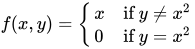
is not differentiable at (0, 0), but all of the partial derivatives and directional derivatives exist at this point. For a continuous example, the function

is not differentiable at (0, 0), but again all of the partial derivatives and directional derivatives exist.
Differentiability in complex analysis
[edit]In complex analysis, complex-differentiability is defined using the same definition as single-variable real functions. This is allowed by the possibility of dividing complex numbers. So, a function is said to be differentiable at when


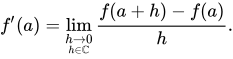
Although this definition looks similar to the differentiability of single-variable real functions, it is however a more restrictive condition. A function , that is complex-differentiable at a point is automatically differentiable at that point, when viewed as a function . This is because the complex-differentiability implies that

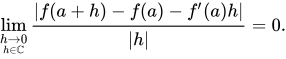
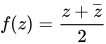
However, a function can be differentiable as a multi-variable function, while not being complex-differentiable. For example, is differentiable at every point, viewed as the 2-variable real function , but it is not complex-differentiable at any point because the limit gives different values for different approaches to 0.


Any function that is complex-differentiable in a neighborhood of a point is called holomorphic at that point. Such a function is necessarily infinitely differentiable, and in fact analytic.
Differentiable functions on manifolds
[edit]If M is a differentiable manifold, a real or complex-valued function f on M is said to be differentiable at a point p if it is differentiable with respect to some (or any) coordinate chart defined around p. If M and N are differentiable manifolds, a function f: M → N is said to be differentiable at a point p if it is differentiable with respect to some (or any) coordinate charts defined around p and f(p).
See also
[edit]References
[edit]- ^ Banach, S. (1931). "Über die Baire'sche Kategorie gewisser Funktionenmengen". Studia Math. 3 (1): 174–179. doi:10.4064/sm-3-1-174-179.. Cited by Hewitt, E; Stromberg, K (1963). Real and abstract analysis. Springer-Verlag. Theorem 17.8.
Differentiable computing | |
|---|---|
| General | |
| Hardware | |
| Software libraries | |
| |
