


Dihedral angle
View on Wikipedia
| Types of angles |
|---|
| 2D angles |
| Spherical |
| 2D angle pairs |
|
Adjacent |
| 3D angles |
| Solid |
A dihedral angle is the angle between two intersecting planes or half-planes. It is a plane angle formed on a third plane, perpendicular to the line of intersection between the two planes or the common edge between the two half-planes. In higher dimensions, a dihedral angle represents the angle between two hyperplanes. In chemistry, it is the clockwise angle between half-planes through two sets of three atoms, having two atoms in common.
Mathematical background
[edit]When the two intersecting planes are described in terms of Cartesian coordinates by the two equations


the dihedral angle, between them is given by:

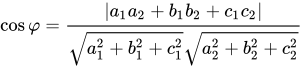
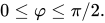
and satisfies It can easily be observed that the angle is independent of and .


Alternatively, if nA and nB are normal vector to the planes, one has
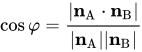
where nA · nB is the dot product of the vectors and |nA| |nB| is the product of their lengths.[1]
The absolute value is required in above formulas, as the planes are not changed when changing all coefficient signs in one equation, or replacing one normal vector by its opposite.
However the absolute values can be and should be avoided when considering the dihedral angle of two half planes whose boundaries are the same line. In this case, the half planes can be described by a point P of their intersection, and three vectors b0, b1 and b2 such that P + b0, P + b1 and P + b2 belong respectively to the intersection line, the first half plane, and the second half plane. The dihedral angle of these two half planes is defined by
- ,
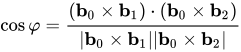
and satisfies In this case, switching the two half-planes gives the same result, and so does replacing with In chemistry (see below), we define a dihedral angle such that replacing with changes the sign of the angle, which can be between −π and π.


In polymer physics
[edit]In some scientific areas such as polymer physics, one may consider a chain of points and links between consecutive points. If the points are sequentially numbered and located at positions r1, r2, r3, etc. then bond vectors are defined by u1=r2−r1, u2=r3−r2, and ui=ri+1−ri, more generally.[2] This is the case for kinematic chains or amino acids in a protein structure. In these cases, one is often interested in the half-planes defined by three consecutive points, and the dihedral angle between two consecutive such half-planes. If u1, u2 and u3 are three consecutive bond vectors, the intersection of the half-planes is oriented, which allows defining a dihedral angle that belongs to the interval (−π, π]. This dihedral angle is defined by[3]
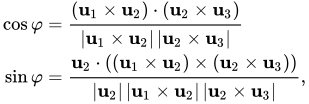
or, using the function atan2,

This dihedral angle does not depend on the orientation of the chain (order in which the point are considered) — reversing this ordering consists of replacing each vector by its opposite vector, and exchanging the indices 1 and 3. Both operations do not change the cosine, but change the sign of the sine. Thus, together, they do not change the angle.
A simpler formula for the same dihedral angle is the following (the proof is given below)
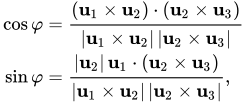
or equivalently,

This can be deduced from previous formulas by using the vector quadruple product formula, and the fact that a scalar triple product is zero if it contains twice the same vector:
![{\displaystyle (\mathbf {u} _{1}\times \mathbf {u} _{2})\times (\mathbf {u} _{2}\times \mathbf {u} _{3})=[(\mathbf {u} _{2}\times \mathbf {u} _{3})\cdot \mathbf {u} _{1}]\mathbf {u} _{2}-[(\mathbf {u} _{2}\times \mathbf {u} _{3})\cdot \mathbf {u} _{2}]\mathbf {u} _{1}=[(\mathbf {u} _{2}\times \mathbf {u} _{3})\cdot \mathbf {u} _{1}]\mathbf {u} _{2}}](https://wikimedia.org/api/rest_v1/media/math/render/svg/78dfd079ef2f25bdd1f87bcbd9d208c2af4ca75b)
Given the definition of the cross product, this means that is the angle in the clockwise direction of the fourth atom compared to the first atom, while looking down the axis from the second atom to the third. Special cases (one may say the usual cases) are , and , which are called the trans, gauche+, and gauche− conformations.


In stereochemistry
[edit]
|

|

|
| Configuration names according to dihedral angle |
syn n-Butane in the gauche− conformation (−60°) Newman projection |
syn n-Butane sawhorse projection |

A torsion angle, found in stereochemistry, is a particular example of a dihedral angle describing the geometric relation of two parts of a molecule joined by a chemical bond.[4][5] Every set of three non-colinear atoms of a molecule defines a half-plane. As explained above, when two such half-planes intersect (i.e., a set of four consecutively-bonded atoms), the angle between them is a dihedral angle. Dihedral angles are used to specify the molecular conformation.[6] Stereochemical arrangements corresponding to angles between 0° and ±90° are called syn (s), those corresponding to angles between ±90° and 180° anti (a). Similarly, arrangements corresponding to angles between 30° and 150° or between −30° and −150° are called clinal (c) and those between 0° and ±30° or ±150° and 180° are called periplanar (p).
The two types of terms can be combined so as to define four ranges of angle; 0° to ±30° synperiplanar (sp); 30° to 90° and −30° to −90° synclinal (sc); 90° to 150° and −90° to −150° anticlinal (ac); ±150° to 180° antiperiplanar (ap). The synperiplanar conformation is also known as the syn- or cis-conformation; antiperiplanar as anti or trans; and synclinal as gauche or skew.
For example, with n-butane two planes can be specified in terms of the two central carbon atoms and either of the methyl carbon atoms. The syn-conformation shown above, with a dihedral angle of 60° is less stable than the anti-conformation with a dihedral angle of 180°.
For macromolecular usage the symbols T, C, G+, G−, A+ and A− are recommended (ap, sp, +sc, −sc, +ac and −ac respectively).
Proteins
[edit]

A Ramachandran plot (also known as a Ramachandran diagram or a [φ,ψ] plot), originally developed in 1963 by G. N. Ramachandran, C. Ramakrishnan, and V. Sasisekharan,[7] is a way to visualize energetically allowed regions for backbone dihedral angles ψ against φ of amino acid residues in protein structure.
In a protein chain three dihedral angles are defined:
- ω (omega) is the angle in the chain Cα − C' − N − Cα,
- φ (phi) is the angle in the chain C' − N − Cα − C'
- ψ (psi) is the angle in the chain N − Cα − C' − N (called φ′ by Ramachandran)
The figure at right illustrates the location of each of these angles (but it does not show correctly the way they are defined).[8]
The planarity of the peptide bond usually restricts ω to be 180° (the typical trans case) or 0° (the rare cis case). The distance between the Cα atoms in the trans and cis isomers is approximately 3.8 and 2.9 Å, respectively. The vast majority of the peptide bonds in proteins are trans, though the peptide bond to the nitrogen of proline has an increased prevalence of cis compared to other amino-acid pairs.[9]
The side chain dihedral angles are designated with χn (chi-n).[10] They tend to cluster near 180°, 60°, and −60°, which are called the trans, gauche−, and gauche+ conformations. The stability of certain sidechain dihedral angles is affected by the values φ and ψ.[11] For instance, there are direct steric interactions between the Cγ of the side chain in the gauche+ rotamer and the backbone nitrogen of the next residue when ψ is near −60°.[12] This is evident from statistical distributions in backbone-dependent rotamer libraries.
Dihedral angles have also been defined by the IUPAC for other molecules, such as the nucleic acids (DNA and RNA) and for polysaccharides.
Geometry
[edit]Every polyhedron has a dihedral angle at every edge describing the relationship of the two faces that share that edge. This dihedral angle, also called the face angle, is measured as the internal angle with respect to the polyhedron. An angle of 0° means the face normal vectors are antiparallel and the faces overlap each other, which implies that it is part of a degenerate polyhedron. An angle of 180° means the faces are parallel, as in a tiling. An angle greater than 180° exists on concave portions of a polyhedron.
Every dihedral angle in a polyhedron that is isotoxal and/or isohedral has the same value. This includes the 5 Platonic solids, the 13 Catalan solids, the 4 Kepler–Poinsot polyhedra, the 2 convex quasiregular polyhedra, and the 2 infinite families of bipyramids and trapezohedra.
Law of cosines for dihedral angle
[edit]Given 3 faces of a polyhedron which meet at a common vertex P and have edges AP, BP and CP, the cosine of the dihedral angle between the faces containing APC and BPC is:[13]

This can be deduced from the spherical law of cosines, but can also be found by other means.[14]
Higher dimensions
[edit]In m-dimensional Euclidean space, the dihedral angle between the two hyperplanes defined by the equations for vectors nA, nB, x ∈ Rm and constants cA and cB, is given by


See also
[edit]References
[edit]- ^ "Angle Between Two Planes". TutorVista.com. Archived from the original on 2020-10-28. Retrieved 2018-07-06.
- ^ Kröger, Martin (2005). Models for polymeric and anisotropic liquids. Springer. ISBN 3540262105.
- ^ Blondel, Arnaud; Karplus, Martin (7 Dec 1998). "New formulation for derivatives of torsion angles and improper torsion angles in molecular mechanics: Elimination of singularities". Journal of Computational Chemistry. 17 (9): 1132–1141. doi:10.1002/(SICI)1096-987X(19960715)17:9<1132::AID-JCC5>3.0.CO;2-T.
- ^ IUPAC, Compendium of Chemical Terminology, 5th ed. (the "Gold Book") (2025). Online version: (2006–) "Torsion angle". doi:10.1351/goldbook.T06406
- ^ IUPAC, Compendium of Chemical Terminology, 5th ed. (the "Gold Book") (2025). Online version: (2006–) "Dihedral angle". doi:10.1351/goldbook.D01730
- ^ Anslyn, Eric; Dennis Dougherty (2006). Modern Physical Organic Chemistry. University Science. p. 95. ISBN 978-1891389313.
- ^ Ramachandran, G. N.; Ramakrishnan, C.; Sasisekharan, V. (1963). "Stereochemistry of polypeptide chain configurations". Journal of Molecular Biology. 7: 95–9. doi:10.1016/S0022-2836(63)80023-6. PMID 13990617.
- ^ Richardson, J. S. (1981). "The Anatomy and Taxonomy of Protein Structure". Anatomy and Taxonomy of Protein Structures. Advances in Protein Chemistry. Vol. 34. pp. 167–339. doi:10.1016/S0065-3233(08)60520-3. ISBN 9780120342341. PMID 7020376.
- ^ Singh J, Hanson J, Heffernan R, Paliwal K, Yang Y, Zhou Y (August 2018). "Detecting Proline and Non-Proline Cis Isomers in Protein Structures from Sequences Using Deep Residual Ensemble Learning". Journal of Chemical Information and Modeling. 58 (9): 2033–2042. doi:10.1021/acs.jcim.8b00442. PMID 30118602. S2CID 52031431.
- ^ "Side Chain Conformation".
- ^ Dunbrack, RL Jr.; Karplus, M (20 March 1993). "Backbone-dependent rotamer library for proteins. Application to side-chain prediction". Journal of Molecular Biology. 230 (2): 543–74. doi:10.1006/jmbi.1993.1170. PMID 8464064.
- ^ Dunbrack, RL Jr; Karplus, M (May 1994). "Conformational analysis of the backbone-dependent rotamer preferences of protein sidechains". Nature Structural Biology. 1 (5): 334–40. doi:10.1038/nsb0594-334. PMID 7664040. S2CID 9157373.
- ^ "dihedral angle calculator polyhedron". www.had2know.com. Archived from the original on 25 November 2015. Retrieved 25 October 2015.
- ^ "Formula Derivations from Polyhedra". Retrieved 4 December 2024.
External links
[edit]- The Dihedral Angle in Woodworking at Tips.FM
- Analysis of the 5 Regular Polyhedra gives a step-by-step derivation of these exact values.

Dihedral angle
View on GrokipediaFundamentals
Definition
A dihedral angle is the angle formed between two intersecting planes, or more precisely, between two half-planes sharing a common boundary line known as the edge of intersection. This angle is specifically measured within a plane that is perpendicular to the line of intersection, capturing the deviation between the two planes in three-dimensional space.[7][8] The unsigned dihedral angle typically ranges from to radians (or to ), the smaller angle between the planes without regard to orientation. In contexts where direction matters, such as oriented surfaces or concave figures, a signed dihedral angle may be used, extending the range from to radians to indicate the relative orientation (positive or negative) across the intersection line. Commonly denoted by the symbol , the dihedral angle in convex figures is often considered the interior angle (inside the figure, less than or equal to ), while the angle on the exterior side is minus the interior angle; in concave figures, interior angles can exceed .[9] Basic examples illustrate this concept intuitively: the angle between two adjacent walls of a room forms a right dihedral angle of radians, while the angle between the pages of an open book creates a variable dihedral angle depending on how widely it is opened.[10] The systematic study of dihedral angles originated in the 18th century through Leonhard Euler's work on polyhedral geometry, where he employed spherical trigonometry to compute them for platonic solids.[11] The term "dihedral angle" itself was coined in 19th-century geometry texts, with its first recorded use dating to 1820–1830.[12] In chemistry, dihedral angles serve as torsion angles, a special case defining the rotation around bonds in molecular structures.[13]Geometric Interpretation
To visualize a dihedral angle, one effective technique involves projecting the two intersecting planes onto a third plane that is perpendicular to their line of intersection, known as the edge. This projection creates two lines on the third plane, and the angle between these lines directly represents the dihedral angle, providing an intuitive two-dimensional view of the three-dimensional tilt between the original planes.[14] Another visualization method uses a sphere centered at a point along the edge of intersection. The planes intersect the sphere along great circles, and the dihedral angle corresponds to the angle between these great circles at their intersection points on the sphere's surface, offering a curved, global perspective that highlights how the planes divide the space around the edge.[15] Dihedral angles can be measured as unsigned (between 0° and 90°, focusing on magnitude) or signed (ranging from -180° to 180°), with the sign indicating orientation relative to a chosen direction. The signed measure employs the right-hand rule: pointing the thumb along the edge in a specified direction, the fingers curl to determine whether the angle is positive (counterclockwise rotation from one plane to the other) or negative (clockwise).[16] A basic construction for observing the dihedral angle begins by drawing the two planes meeting at the edge, then sketching a normal plane perpendicular to that edge at any point. The intersections of the original planes with this normal plane form two lines, and the angle between those lines is the dihedral angle itself, measurable with standard tools like a protractor in the plane.[14] A common misconception is that the dihedral angle is simply the direct angle between the normals to the two planes, without considering the specific plane of measurement; in reality, it is the angle in the plane perpendicular to the edge, which aligns with the supplement or complement of the normals' angle depending on the chosen side.[1] This distinction ensures accurate geometric intuition, as seen in applications like the edge angles of polyhedra.[1]Mathematical Methods
Normal Vector Approach
The normal vector approach provides a straightforward method for computing the dihedral angle between two intersecting planes in three-dimensional space by leveraging the relationship between the planes and their perpendicular normal vectors. This technique is particularly useful when the equations of the planes are known or can be derived from points lying on them. Consider two planes given by the general equations and . The normal vector to the first plane is , and to the second is . To find the dihedral angle , first normalize these vectors to unit length: and , where . The cosine of the unsigned dihedral angle (the acute angle between 0 and ) is then given byLaw of Cosines Derivation
The dihedral angle φ between two adjacent faces of a polyhedron can be derived using spherical trigonometry by considering the unit sphere centered at a vertex where three faces meet. Let the two faces in question be face 1 (containing edges OA and OB) and face 2 (containing edges OB and OC), with the third face 3 containing edges OC and OA. The plane angle (interior angle of the face polygon) at the vertex O in face 1 is α, in face 2 is β, and in face 3 is γ. The intersection of the three face planes with the unit sphere forms a spherical triangle with sides of lengths α, β, and γ (measured in radians), where the side of length γ lies opposite the spherical vertex corresponding to the dihedral angle φ between faces 1 and 2.[19] Applying the spherical law of cosines to this triangle, the formula for the cosine of the opposite side γ isVector-Based Methods for Chains
In vector-based methods for chains, such as those encountered in polymer or molecular structures, the dihedral angle φ is computed using sequential bond vectors b₁, b₂, and b₃, where b₁ points from atom i to j, b₂ from j to k, and b₃ from k to l along the chain. The two planes defining the dihedral are the plane spanned by b₁ and b₂, and the plane spanned by b₂ and b₃. The normal vectors to these planes are obtained via cross products: n₁ = b₁ × b₂ and n₂ = b₂ × b₃. The cosine of the dihedral angle is then given byGeometric Applications
In Polyhedra
In polyhedra, dihedral angles define the internal structure by specifying the orientation between adjacent faces, influencing the overall geometry, volume, and symmetry of the solid. These angles are fundamental to the classification and construction of polyhedra, as they must satisfy closure conditions around edges and vertices to form a closed surface without gaps or overlaps.[1] For the five Platonic solids, which are regular convex polyhedra with identical faces and vertex figures, all dihedral angles are uniform and can be derived from the symmetry and edge lengths. The tetrahedron has a dihedral angle of , the cube , the octahedron , the dodecahedron , and the icosahedron .[23] These values highlight how increasing the number of faces per vertex correlates with larger dihedral angles, approaching but not reaching to maintain convexity. Archimedean solids extend this uniformity to vertex transitivity while incorporating multiple regular face types, resulting in distinct dihedral angles for different adjacent face pairs. Calculations for these often involve trigonometric relations between face angles and edge lengths, yielding multiple values per solid. For instance, the truncated tetrahedron features a dihedral angle of between two hexagonal faces and between a hexagonal and a triangular face.[24] Convex polyhedra exhibit all dihedral angles less than , ensuring the solid lies entirely on one side of each face plane. In contrast, concave polyhedra, including star polyhedra like the small stellated dodecahedron, incorporate dihedral angles greater than at reflex edges, where the interior geometry folds inward and creates indentations or interpenetrations.[25] Dihedral angles relate directly to face angles at vertices and edge lengths, enabling their determination through geometric constraints that ensure edge consistency across the polyhedron. Isogonal polyhedra, characterized by vertex transitivity, feature equal dihedral angles at symmetrically equivalent edges, enhancing their aesthetic and structural uniformity beyond Platonic solids. In irregular polyhedra, dihedral angles vary non-uniformly, leading to dihedral defects—deviations from ideal angles that impact stability and curvature approximation. These defects are critical in modern geometric modeling, such as finite element analysis and 3D mesh generation, where optimizing dihedral angles minimizes artifacts in simulations of deformable structures or material stress.[26]In Aviation and Engineering
In aviation, the dihedral angle refers to the positive upward tilt of an aircraft's wings relative to the horizontal plane, which enhances lateral stability by producing a restoring roll moment during sideslip. This configuration is common in most fixed-wing aircraft to counteract unwanted rolling tendencies. Typical dihedral angles range from 3 to 7 degrees, with high-wing designs often incorporating 5 to 7 degrees to achieve desired roll stability without excessive drag penalties.[27][28][29] The primary effect of wing dihedral is the generation of a dihedral effect, where sideslip induces asymmetric lift distribution, creating a rolling moment that rights the aircraft. This stability contribution is quantified by the roll moment coefficient derivative with respect to sideslip angle, $ C_{l_\beta} $, which is approximately proportional to the dihedral angle $ \Lambda $ (in radians): $ C_{l_\beta} \approx -K \Lambda $, where $ K $ is an aerodynamic factor influenced by wing aspect ratio and sweep. The resulting roll moment is then $ L = \frac{1}{2} \rho V^2 S b C_{l_\beta} \beta $, with $ \rho $ as air density, $ V $ as airspeed, $ S $ as wing area, $ b $ as wing span, and $ \beta $ as sideslip angle.[30][31][32] Beyond aviation, dihedral angles appear in mechanical engineering applications involving deployable or folded structures, such as origami-inspired mechanisms used in aerospace and robotics for compact storage and controlled expansion. In these designs, the dihedral angle between adjacent facets governs folding kinematics, stiffness, and load distribution; for instance, in Miura-ori patterns, variations in dihedral angles enable tunable metamaterial properties like negative Poisson's ratio. Recent advancements include algorithmic methods to optimize dihedral angles in multi-vertex folds for enhanced mobility in tessellated mechanisms.[33][34][35] Post-2020 computational studies have advanced the understanding of dihedral in aerospace engineering through computational fluid dynamics (CFD) simulations, revealing how variations in dihedral angle affect aerodynamic performance across flight envelopes. For example, a 2023 investigation into adjustable dihedral mechanisms on flying-wing configurations showed that dynamic adjustments improve lateral-directional stability and reduce control surface demands in variable-speed operations.[36] Similarly, analyses of dihedral effects on hypersonic vehicles demonstrated shifts in lift and drag coefficients, with negative dihedral enhancing directional stability at high Mach numbers.[37] These CFD approaches, leveraging high-fidelity solvers, have informed designs for next-generation unmanned aerial vehicles. In materials engineering, dihedral angles at grain boundaries are critical during liquid-phase sintering of metals, dictating wetting behavior, densification, and final microstructure. In tungsten heavy alloys, such as those composed of tungsten with nickel-iron binders, the dihedral angle at solid-liquid junctions is typically low (around 20-30 degrees), promoting liquid penetration along grain boundaries for improved ductility and strength. This equilibrium angle arises from the balance of interfacial energies per Young's equation, $ \gamma_{GB} = 2 \gamma_{SL} \cos(\phi/2) $, where $ \gamma_{GB} $ is grain boundary energy, $ \gamma_{SL} $ is solid-liquid interfacial energy, and $ \phi $ is the dihedral angle; low values indicate favorable wetting in these alloys. Automated image processing techniques have recently quantified these angles to correlate microstructure with mechanical properties in sintered components.[38][39][40]Chemical and Physical Applications
In Stereochemistry
In stereochemistry, dihedral angles, commonly termed torsion angles, quantify the spatial arrangement of atoms connected by single bonds in molecules, particularly in defining conformational isomers. For a sequence of four atoms A-B-C-D, the torsion angle is the dihedral angle between the two planes formed by atoms A-B-C and B-C-D, measuring the rotation around the central B-C bond. This angle is signed, ranging from -180° to +180°, with the convention that a positive value corresponds to a clockwise rotation of the A-B bond relative to the C-D bond when viewed along the B-C axis to achieve superposition.[41][42] Conformational descriptors classify these torsion angles using the Klyne-Prelog system, which divides the range into categories based on approximate values and ranges to describe substituent orientations. The syn conformation occurs at 0°, where substituents are on the same side; anti at 180°, where they are opposite; and gauche at ±60°, indicating a skewed arrangement. More precise terms include synperiplanar (0° ± 30°), synclinal or gauche (±30° to ±90°), anticlinal (±90° to ±150°), and antiperiplanar (180° ± 30°), aiding in the systematic notation of molecular geometries in organic compounds like butane (C-C-C-C sequence).[42][43] Rotational energy profiles around single bonds reveal barriers arising from torsional strain in eclipsed conformations and steric hindrance in staggered ones, influencing molecular stability and reactivity. In butane, the anti conformation (180°) represents the global energy minimum, while the gauche (±60°) is destabilized by approximately 0.9 kcal/mol due to non-bonded interactions between the methyl groups, as determined by experimental and computational methods. Newman projections facilitate visualization of these profiles by projecting the molecule along the rotating bond, displaying the dihedral angle between front and back substituents as a circular arrangement, with staggered forms (dihedral angles of 60°, 180°, 300°) generally lower in energy than eclipsed (0°, 120°, 240°).[44] Recent quantum chemistry calculations on flexible organic molecules, such as 1,3-difluorinated alkanes, have provided deeper insights into dihedral angle preferences beyond classical steric models, incorporating hyperconjugation and electrostatic effects to predict population distributions of conformers with high accuracy. These ab initio approaches, often using density functional theory, reveal that fluorine substitution can invert typical gauche penalties, favoring synclinal arrangements in certain systems due to favorable orbital interactions, enhancing understanding of conformational dynamics in drug-like molecules.[45]In Polymers and Proteins
In polymer physics, dihedral angles along the backbone chains govern the conformational flexibility and overall shape of linear polymers such as polyethylene. These angles exhibit energy minima primarily at the staggered trans conformation (approximately 180°) and the gauche conformations (approximately ±60°), where the trans state is favored due to minimized steric repulsion between substituents, with the energy difference between trans and gauche states typically around 0.5–1 kcal/mol depending on the polymer.[46] The cis conformation (0°) represents an eclipsed, high-energy state that is rarely observed under thermal conditions, though it can appear transiently in certain constrained polymer systems like those with bulky side chains.[47] In proteins, the backbone dihedral angles (defined by the N-C bond) and (defined by the C-C bond) are fundamental to secondary structure formation, as their combinations dictate whether segments adopt -helices, -sheets, or turns. The Ramachandran plot, introduced in 1963 by G. N. Ramachandran, C. Ramakrishnan, and V. Sasisekharan, maps the sterically allowed regions for and based on van der Waals exclusions, revealing core allowed areas (e.g., , for helices) and generally disallowed zones due to atomic clashes.80023-6) The angle across the peptide bond is predominantly fixed at 180° (trans) owing to resonance stabilization, which imparts partial double-bond character; the cis state at 0° is uncommon overall (~0.03% of non-proline bonds) but occurs in roughly 5–6% of Xaa-Pro bonds, often influencing folding kinetics or functional switches like in cyclophilin substrates.[48][49] Potential energy surfaces (PES) for these dihedral angles, computed via quantum mechanical methods or empirical force fields, provide maps of conformational stability, with minima corresponding to low-energy basins separated by rotational barriers of 3–20 kcal/mol. For instance, optimized dihedral potentials derived from matching to ab initio calculations of dipeptides enhance accuracy in simulating backbone flexibility across amino acid types.[50] Recent molecular dynamics (MD) simulations in the 2020s have advanced dynamic modeling of dihedral transitions by integrating enhanced sampling techniques like replica-exchange MD, enabling better capture of rare events such as flips in intrinsically disordered proteins over microsecond timescales.[51] Computational tools for protein folding prediction have evolved rapidly in 2024–2025 to leverage dihedral angles directly, bypassing full atomic coordinates for efficiency. Diffusion-based generative models, such as FrameDiff, sample backbone dihedrals sequentially to mimic folding pathways, achieving high fidelity in reconstructing native structures from sequences alone.[52] Similarly, lightweight neural networks like DCMA use dilated convolutions and multi-head attention to predict , , and angles with reduced computational cost, supporting large-scale folding simulations and variant analysis.[53] These methods build on biophysical models to explore energy landscapes, prioritizing sterically viable dihedral ensembles for applications in drug design and protein engineering.In Crystallography and Materials Science
In crystallography, dihedral angles describe the orientations between intersecting lattice planes, which are defined by their Miller indices and normals in the crystal lattice. These angles are calculated from the dot product of the plane normals, providing a measure of the geometric relationships inherent to the crystal structure. For instance, in single-phase materials like aluminum, dihedral angles between pairs of planes can discriminate specific lattice types by analyzing X-ray diffraction data.[54] Crystal symmetry groups impose constraints on these dihedral angles, as the 32 crystallographic point groups and 230 space groups dictate the allowable rotations, reflections, and inversions that maintain lattice periodicity. Dihedral mirror planes, for example, bisect angles between principal rotation axes in groups like D_n, ensuring that plane intersections align with the overall symmetry. In X-ray diffraction patterns, the dihedral angles between lattice planes determine the angular positions of diffracted beams, as governed by Bragg's law, where the reciprocal lattice geometry reflects these interplanar angles to produce characteristic spot arrays.[55][56][57] In materials science, dihedral angles at grain boundaries in polycrystals are pivotal for microstructural evolution, particularly at triple junctions where three grains meet. For metals with isotropic grain boundary energies, the equilibrium dihedral angle is approximately 120°, arising from the balance of surface tensions as described by Herring's relation, which equates the vector sum of boundary tensions to zero. Deviations from this angle signal anisotropy, influencing sintering and recrystallization processes. In graphene multilayers, dihedral angles between stacked layers affect interlayer binding; a 2018 registry-dependent potential incorporates dihedral corrections to the Kolmogorov-Crespi model, capturing bending rigidity and improving simulations of twisted or buckled structures.[58][59][60] These angles enable predictions of mechanical properties in polycrystals, such as fracture toughness and creep resistance, by correlating boundary configurations with stress distribution and energy dissipation. Automated quantification has advanced this analysis; for sintered tungsten heavy alloys, image processing of scanning electron micrographs segments phases and computes dihedral angles at triple junctions via vector methods, achieving errors under 2° compared to manual measurements and aiding optimization of liquid-phase sintering for enhanced ductility. Recent developments in additive manufacturing leverage dihedral angles in lattice designs, where varying strut intersection angles controls relative density and compressive strength—for example, dihedral tiling metamaterials exhibit tunable stiffness through angle adjustments during printing. Vector-based methods facilitate these computations by deriving angles from plane normals in microstructural data.[61][62]Extensions
Higher Dimensions
In -dimensional Euclidean space , the dihedral angle generalizes to the angle between two hyperplanes, each an -dimensional affine subspace, provided they intersect transversely along an -dimensional flat (the intersection of codimension 2). The angle is defined and measured within the 2-dimensional orthogonal complement to this intersection flat, equivalent to the angle between the hyperplanes' normal vectors in .[63][64] The cosine of the dihedral angle is computed asComputational Determination
Computational determination of dihedral angles relies on numerical algorithms that compute surface normals from point clouds, enabling angle estimation without explicit surface reconstruction. These methods identify feature lines as intersections of approximating planes fitted to local point sets, particularly useful for irregular or sparse data in geometric modeling. For noisy datasets, least-squares plane fitting projects points onto best-fit planes and refines dihedral estimates by minimizing residuals, improving robustness against measurement errors common in scanned or simulated structures.[69][70][71] Specialized software facilitates efficient computation across domains. In molecular visualization, VMD employs themeasure dihed command to calculate dihedral angles from atomic coordinates, supporting trajectory analysis for proteins and other biomolecules. For general geometric tasks, MATLAB provides vector-based functions to derive dihedrals from Cartesian points, often integrated into scripts for batch processing of structural data. In aviation engineering, computational fluid dynamics (CFD) tools incorporate dihedral angle variations to simulate aerodynamic effects, as demonstrated in 2023 studies optimizing wing configurations for stability and lift.[72][73][74][75]
Machine learning approaches, particularly neural networks, have advanced prediction of dihedral angles from protein sequences, accelerating materials discovery between 2021 and 2025. Deep neural networks trained on protein datasets predict backbone dihedrals with mean absolute errors around 15 degrees, outperforming traditional methods by incorporating sequence and evolutionary profiles. Graph neural networks extend this to three-dimensional structures, embedding dihedral constraints for property prediction in complex systems like alloys and polymers. These models reduce computational cost in high-throughput screening, with applications in secondary structure forecasting.[53][76][77]
Challenges in computational determination include managing large datasets from crystal structures, where high dimensionality and periodic boundaries complicate angle extraction across millions of points. Error analysis in simulations reveals sensitivities to noise and parameterization, with dihedral deviations up to several degrees arising from force field approximations or incomplete sampling. Mitigation strategies involve robust fitting and validation against experimental data to ensure reliability in downstream analyses.[78][79][80][81]
Recent developments from 2024 to 2025 emphasize automated quantification, particularly for alloys, where image processing pipelines measure dihedral angles in sintered microstructures to correlate with mechanical properties in tungsten heavy alloys. Quantum chemistry packages like ORCA enable precise torsion energy scans along dihedral coordinates, supporting force field parameterization with hybrid DFT methods for accurate conformational analysis. These advances, scalable to higher dimensions via tensor extensions, enhance automated workflows in materials and quantum simulations.[82][61][83][84]