


Community hub
Recent from talks
Contribute something
Nothing was collected or created yet.
Direct impingement
View on Wikipedia
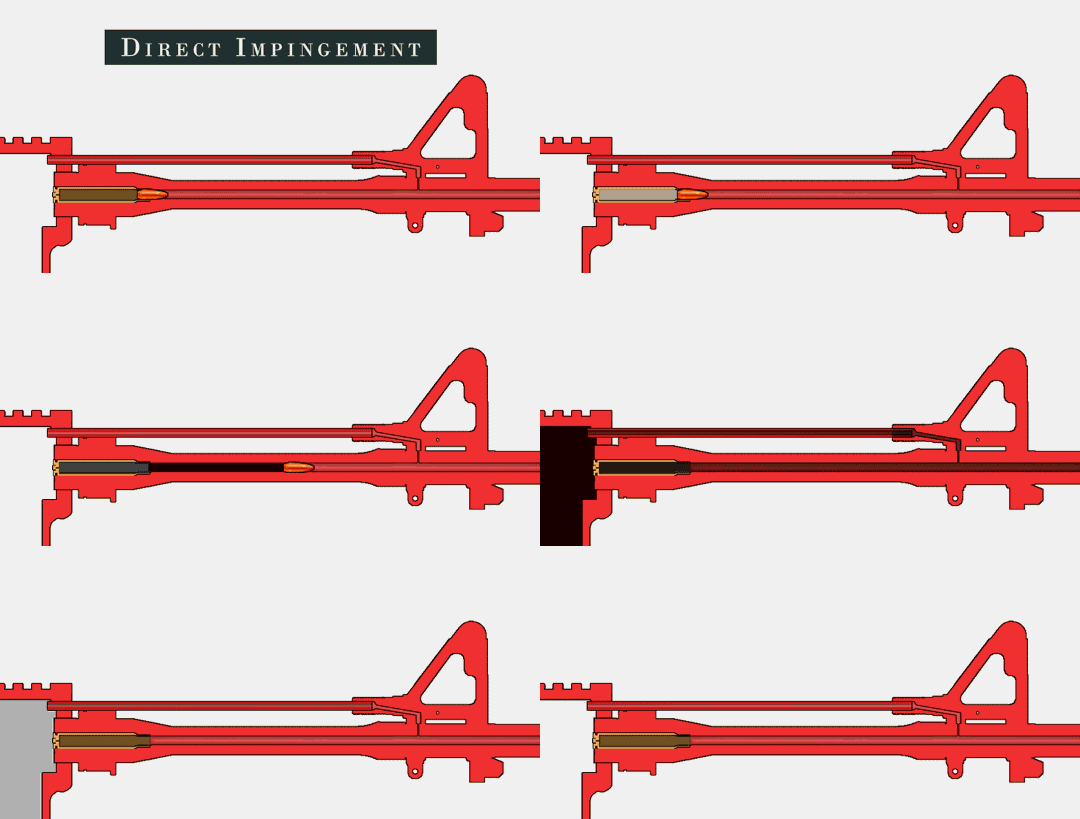
Direct impingement is a type of gas operation for a firearm that utilizes gas from a fired cartridge to impart force on the bolt carrier or slide assembly to cycle the action. Firearms using direct impingement are theoretically lighter, more accurate, and less expensive than firearms using cleaner and cooler gas piston systems.
Advantages
[edit]Firearms with a direct impingement design can, in principle, be constructed lighter than piston-operated designs. Because high-pressure gas acts directly upon the bolt and carrier in a direct impingement system, it does not need a separate gas cylinder, piston, and operating rod assembly of a conventional piston-operated system, only requiring a gas tube to channel gas from the barrel back towards the action. This saves weight, lowers manufacturing costs, and reduces the mass of the operating parts, and thereby the wear on mechanical parts due to movement. By removing the gas piston, the potential amount of moving mass is also lowered, decreasing the potential for firearm movement and barrel distortion before the bullet leaves the barrel.[1]
The gas directed at the bolt carrier group may improve reliability in some conditions. The jet of gas can blow debris away from the ejection port which, in other designs, could enter the mechanism and foul the gun.
Disadvantages
[edit]The main disadvantage of direct impingement is that the breech of the firing mechanism becomes fouled more quickly compared to long or short stroke piston systems. This is caused by the operating mechanism's direct exposure to gases from burned cartridge propellant when the firearm cycles. The gases contain vaporized metals, carbon, and impurities in a gaseous state until they condense on the relatively cooler operating parts. These deposits increase friction on the bolt's camming system, leading to malfunctions. Frequent and thorough cleaning is required to ensure reliability. The amount of fouling depends upon the rifle's design as well as the type of propellant powder used.[2]
Another disadvantage of direct impingement is that combustion gases heat the bolt and bolt carrier as the firearm operates. This heating causes lubricant to be "burned off". Lack of proper lubrication is the most common cause of weapon malfunctions. These combined factors reduce service life of these parts, reliability, and mean time between failures.[3]
Variables
[edit]The operation of the system is highly dependent on both the length of the barrel and the gas tube which transports gas from the barrel to the bolt. Using too short a gas tube can result in increased pressure inside the bolt assembly and an increased rate of automatic fire, both of which can negatively affect the weapon and accuracy of shots. The use of a suppressor also increases gas pressure, further aggravating the situation. The problem can be reduced by using a longer gas tube, moving the gas port on the barrel further forward, and/or by installing an adjustable gas block to provide the right amount of gas pressure depending on the desired operating mode.[1][4][5]
History
[edit]The first experimental rifle using a direct impingement system was the French Rossignol ENT B1 automatic rifle followed by Rossignol's B2, B4 and B5. The first successful production weapon was the French MAS 40 rifle adopted in March 1940. The Swedish Automatgevär m/42 is another example. Both the French and Swedish rifles use a simple system whereby the gas tube acts as a piston with a cylinder recess in the bolt carrier.
Stoner bolt and carrier piston system
[edit]
The original AR-10 action designed by Eugene Stoner (later developed into the ArmaLite AR-15, M16 rifle, and M4 carbine) is commonly called a direct impingement system, but it does not actually utilize this mechanism. In U.S. patent 2,951,424, the designer states: "This invention is a true expanding gas system instead of the conventional impinging gas system."[6] Gas is routed from a port in the barrel through a gas tube, directly to a chamber inside the bolt carrier. The bolt within the bolt carrier is fitted with piston rings to contain the gas. In effect, the bolt and carrier act as a gas piston and cylinder. The subtleties involved in ArmaLite's patent on the gas system[7] significantly diverge from classical direct impingement; upon firing, the pressurized propellant gasses exit the barrel via the gas port and travel the length of the gas tube, but instead of simply applying the inertia necessary to cycle the weapon directly to the bolt carrier, the gas is funneled inside the bolt carrier, wherein the increase in pressure results in the bolt itself acting as a piston, forcing the bolt carrier away from the barrel face.[8]
See also
[edit]References
[edit]- ^ a b Sweeney, Patrick. "AR-15: Direct Impingement Vs Gas Piston". Gun Digest. Retrieved 9 August 2021.
- ^ Maddox, Brandon. "Direct Impingement vs. Gas Piston: Settling the Debate". Silencer Central. Retrieved 9 August 2021.
- ^ Major Thomas P. Ehrhart Increasing Small Arms Lethality in Afghanistan: Taking Back the Infantry Half-Kilometer. US Army. 2009
- ^ https://www.thefirearmblog.com/blog/griffin-armaments-new-adjustable-ar-15-gas-block-44822956
- ^ https://patents.google.com/patent/US8596185B1/en
- ^ "Patent US2951424 - GAS OPERATED BOLT AND CARRIER SYSTEM". Retrieved 2013-04-11.
- ^ Eugene Stoner, 1956, Gas operated bolt and carrier system, US2951424A, https://patents.google.com/patent/US2951424A/en
- ^ "ARMALITE TECHNICAL NOTE 54: DIRECT IMPINGEMENT VERSUS PISTON DRIVE" (PDF). Armalite. 3 July 2010. Archived from the original (PDF) on 5 September 2012.
Sources
[edit]- Centre des archives de l'armement, Châtellerault. National Armament Archives Center.
- Huon, Jean. Proud Promise—French Semiautomatic Rifles: 1898-1979, Collector Grade Publications,1995,ISBN 0-88935-186-4
- United States Patent Office, Patent No. 2951424 - Gas Operated Bolt and Carrier System, Sep 6 1960.
External links
[edit]
- How Does It Work: Direct Gas Impingement Forgotten Weapons
Direct impingement
View on GrokipediaOverview
Definition
Direct impingement is a type of gas-operated reloading mechanism used in firearms, in which high-pressure propellant gases are tapped from a port in the barrel and directed through a tube to act directly upon the bolt carrier group, thereby driving it rearward to cycle the action.[4][5] This system harnesses the energy from the expanding gases generated by the burning propellant to perform essential functions such as unlocking the bolt, extracting the spent cartridge, ejecting it, and chambering a new round, all without employing an intermediary piston between the gas and the bolt carrier.[2][6] In contrast to manual actions or recoil-operated systems, direct impingement relies solely on the controlled diversion of barrel gases to automate the cycling process.[7] The primary components of a direct impingement system include the gas port drilled into the barrel, the gas block that captures and redirects the gases, the gas tube that channels them rearward, the bolt carrier key that receives the gas flow, and the bolt carrier itself, which moves under the impingement to initiate cycling.[8][1] These elements work in concert to ensure reliable operation by timing the gas release to coincide with the bullet's passage beyond the port, minimizing pressure loss in the barrel.[9]Applications
Direct impingement is predominantly employed in assault rifles and carbines, most notably the AR-15, M16, and M4 series, across military, law enforcement, and civilian sectors.[10][11] This operating system was notably implemented and popularized in Eugene Stoner's ArmaLite AR-10 and AR-15 designs in the late 1950s, which established the foundational platform for subsequent rifles.[12] Civilian adaptations, including the Colt AR-15 and various modern modular platforms, have widely adopted the system for sporting, self-defense, and recreational purposes. Other examples include certain variants of the Ruger Mini-14 and modern sporting rifles from manufacturers like Remington and DPMS, extending its use beyond the AR platform.[13][14] The design proves particularly suitable for intermediate cartridges, such as the 5.56×45mm NATO, in both semi-automatic and select-fire setups, enabling reliable operation in diverse tactical environments.[15] However, it sees limited application in heavy machine guns, where accumulated fouling from sustained fire poses significant reliability challenges.[16] In suppressed firearms, direct impingement systems are employed with modifications like adjustable gas blocks to manage excess backpressure and carbon buildup, although such setups demand careful tuning for optimal performance.[17][18]Operating mechanism
Gas diversion
In the direct impingement system, upon ignition of the propellant, expanding gases from the burning powder propel the bullet down the barrel while a small portion of these high-pressure gases is diverted through a port drilled into the barrel wall, typically located several inches from the muzzle.[3] This port captures the gases at a point where pressure has dropped significantly from the chamber but remains substantial, with typical values ranging from 10,000 to 20,000 psi depending on ammunition and barrel length.[19][20] The diverted gases then travel rearward through a thin-walled stainless steel gas tube, which connects the barrel port to an entry port in the upper receiver.[3] The size and placement of the gas port are critical design variables that influence the timing and magnitude of the gas impulse delivered to cycle the action. For instance, rifle-length systems (with ports about 13 inches from the chamber in a 20-inch barrel) allow more time for pressure decay, resulting in lower port pressures around 10,000 psi with original IMR powders, while carbine-length systems (ports about 7 inches from the chamber in a 14.5-inch barrel) capture gases closer to peak pressure, often exceeding 20,000 psi and increasing the impulse volume.[19][20] Mid-length configurations, with ports around 9 inches from the chamber, provide a balance to mitigate excessive pressure in shorter barrels. These parameters ensure the gas volume and pressure provide sufficient energy for reliable operation without overwhelming downstream components.[3] A gas block, clamped or pinned to the barrel at the port location, secures the forward end of the gas tube and aligns it precisely to channel the hot gases (often exceeding 2,000°F) directly into the system.[19] Unlike mechanisms employing intermediaries, this setup involves no piston, enabling unfiltered transfer of the high-temperature, carbon-laden gases through the tube to the receiver. The diverted gases ultimately enter a chamber within the bolt carrier group to initiate cycling.[3] In shorter-barreled configurations, such as those under 14.5 inches, the proximity of the gas port to the muzzle results in higher port pressures and greater gas volume, often leading to over-gassing that produces excessive bolt carrier velocity and accelerated wear on components.[20][21]Bolt carrier interaction
In the direct impingement system, high-pressure propellant gases diverted from the barrel enter the upper receiver through the gas tube and into the bolt carrier key, a component affixed to the top of the bolt carrier group (BCG). These gases then flow through the key into an internal annular chamber within the bolt carrier, where they rapidly expand and exert force against the carrier's forward-facing wall. This expansion drives the bolt carrier rearward relative to the stationary bolt initially locked in the barrel extension.[3] As the bolt carrier moves rearward, a cam pin protruding from the bolt engages a helical slot in the carrier, causing the bolt to rotate counterclockwise. This rotation unlocks the bolt's locking lugs from the barrel extension's abutments, allowing the bolt and carrier to continue rearward together. During this phase, the bolt extracts the spent cartridge case from the chamber using its extractor claw, and the ejector expels it from the receiver. The rearward inertia of the BCG compresses the recoil spring and cocks the hammer, preparing the firearm for the next shot. Upon reaching the end of its travel, the recoil spring expands, propelling the carrier and bolt forward; the bolt strips a new cartridge from the magazine and chambers it, after which the cam pin rotates the bolt clockwise to lock it securely.[3] Key dynamics in this interaction include dwell time—the distance and duration the bullet travels from the gas port to the muzzle—which allows sufficient pressure buildup in the barrel for effective gas diversion to the carrier without excessive velocity. Carrier mass and buffer systems further tune the recoil impulse; heavier carriers or buffers slow the BCG's cycling speed, reducing felt recoil and wear, while lighter setups enable faster follow-up shots but demand precise gas regulation. The gas tube's routing from the gas block to the carrier key ensures unobstructed flow but exposes internal components to hot gases.[22][23] Direct exposure of the bolt carrier and chamber to propellant gases and residue leads to carbon fouling buildup over time, necessitating regular cleaning to maintain reliable function; unaddressed accumulation can impede BCG movement and increase friction.[24]Comparison to other systems
Versus short-stroke piston
Direct impingement and short-stroke gas piston systems differ fundamentally in how they utilize propellant gases to cycle the action. In a short-stroke piston design, high-pressure gas from the barrel is diverted to a piston head located near the gas port, causing the piston to travel only a short distance—typically less than an inch—before striking the bolt carrier group and imparting kinetic energy to unlock and retract the bolt.[6] This single, discrete impulse occurs without continuous gas flow into the receiver, as the piston separates the high-pressure gas system from the action.[25] In contrast, direct impingement routes the gas uninterrupted through a small-diameter tube directly to the bolt carrier key, where it expands to drive the carrier rearward, performing the unlocking and extraction functions without an intermediary piston.[11] These mechanical differences lead to distinct operational trade-offs. The short-stroke system isolates the bolt carrier and receiver from hot gases and combustion byproducts, resulting in reduced heat transfer and carbon fouling within the action, which contributes to cleaner operation and extended maintenance intervals.[6] However, the addition of the piston, operating rod, and related components introduces extra mass to the system, increasing the overall mechanical complexity compared to direct impingement's streamlined design with fewer moving parts.[11] Direct impingement, while simpler and more compact, allows gases to vent directly into the receiver, accelerating fouling buildup and heat accumulation in the bolt carrier area, which can degrade reliability over prolonged firing.[5] Representative examples illustrate these dynamics in practice. The HK416 rifle employs a short-stroke piston for enhanced performance in demanding environments, as adopted by units like U.S. Navy SEAL Team 6 for its ability to maintain function during sustained fire with less internal contamination.[11] Similarly, the FN SCAR-L uses a short-stroke system to support operations in adverse conditions, such as dusty or muddy terrains, where fouling resistance proves advantageous.[25] The M16 rifle, relying on direct impingement, offers a lighter and more straightforward alternative but requires more frequent cleaning to mitigate gas-induced fouling during extended use.[6] In terms of performance, short-stroke pistons provide greater consistency in bolt carrier velocity by delivering a fixed mechanical impulse from the piston's strike, which is less sensitive to variations in gas volume due to factors like ammunition type or barrel fouling.[5] This reduces bolt speed variability compared to direct impingement, where direct gas pressure can fluctuate, potentially affecting cycling reliability under inconsistent conditions.[25]Versus long-stroke piston
Direct impingement systems differ fundamentally from long-stroke gas piston mechanisms in how they harness propellant gases to cycle the action. In direct impingement, high-pressure gases are diverted from a port in the barrel through a stationary gas tube directly into the bolt carrier key, imparting force to the bolt carrier group without intermediate mechanical components.[6] In contrast, long-stroke piston systems employ a piston attached directly to the bolt carrier, where gases act on the piston head to drive the entire assembly rearward over the full stroke distance, separating the high-heat, high-pressure gas operation from the action itself.[26] These design differences lead to distinct operational trade-offs. Long-stroke pistons offer enhanced robustness and inherent self-cleaning properties, as the piston's extended travel sweeps away debris and carbon buildup within the gas cylinder, reducing fouling in the action and promoting reliability in adverse conditions.[27] However, this integration results in a heavier reciprocating mass and additional moving parts, increasing overall rifle weight and potentially complicating full disassembly. Direct impingement, by relying solely on gas pressure through a fixed tube, achieves a lighter and more compact design with fewer components, but it is more susceptible to gas tube failures under prolonged high-heat conditions, such as sustained automatic fire, where the tube can warp or rupture.[28] Illustrative examples highlight these characteristics. The AR-15 platform exemplifies direct impingement, utilizing its gas tube to deliver precise, lightweight operation suited to semi-automatic use.[6] Conversely, the AK-47 and M1 Garand employ long-stroke pistons, with the AK-47's design particularly noted for excelling in full-automatic reliability due to its tolerant machining and piston-driven cycling.[25]Advantages and disadvantages
Advantages
Direct impingement systems in firearms, such as those employed in the AR-15 platform, offer notable advantages stemming from their streamlined design, which eliminates the need for a separate piston and operating rod found in gas piston alternatives. This simplicity results in fewer components overall, typically reducing the part count by several elements like the piston head, rod, and associated hardware, thereby lowering manufacturing costs and easing production scalability. For instance, standard direct impingement AR-15 rifles are generally more affordable, with entry-level models starting around $500–$700 as of 2025, compared to piston-driven variants that often exceed $1,000 due to the added complexity.[6][29] The reduced number of parts also contributes to a lighter overall weight, enhancing portability and handling, particularly for extended use in civilian or tactical scenarios. A conventional direct impingement AR-15 weighs approximately 6.5 pounds unloaded, whereas comparable piston-driven models, such as the Lewis Machine & Tool MARS-L, tip the scales at about 7.4 pounds, with the extra mass concentrated in the forward section from the piston assembly. This weight savings—often around 0.5 to 1 pound—improves maneuverability without compromising structural integrity.[6][11] In terms of accuracy potential, direct impingement benefits from lower reciprocating mass in the bolt carrier group, which minimizes disruptions to barrel harmonics and allows for a more consistent free-floating barrel configuration. This setup is particularly valued in precision-oriented builds, where the absence of a heavy piston reduces vibrations during cycling, enabling sub-minute-of-angle groupings in match-grade AR-15 configurations under controlled conditions.[11][5] When maintained in clean conditions, direct impingement systems demonstrate high reliability through a direct and consistent gas impulse that ensures smooth semi-automatic cycling without the potential misalignment issues of piston components. Field stripping is straightforward, requiring minimal tools and time, which facilitates quick maintenance and inspection compared to disassembling piston assemblies.[30] The inherent modularity of direct impingement platforms, exemplified by the AR-15, allows for seamless caliber conversions and accessory integrations without necessitating reconfiguration of a piston system, supporting rapid adaptations for roles ranging from varmint hunting to competitive shooting. This flexibility arises from the standardized gas tube and bolt carrier interface, promoting widespread parts compatibility across manufacturers.[6]Disadvantages
Direct impingement systems expose the bolt carrier group and chamber directly to hot propellant gases and carbon residues, leading to rapid fouling and accelerated wear on internal components. This contamination creates hard, baked-on carbon deposits on the bolt face and chamber, which can impair function and necessitate frequent cleaning to maintain reliability. For instance, the M16 rifle's direct impingement design contributed to jamming issues during Vietnam War operations, particularly in muddy environments where debris mixed with carbon fouling caused stoppages in mud immersion tests.[31][32] The use of suppressors exacerbates these problems by increasing backpressure, which over-gasses the system and results in excessive recoil, premature component wear, and failures to eject spent casings. This heightened gas volume amplifies fouling in the action and can lead to operational failures without adjustments to mitigate the added pressure; modern refinements like adjustable gas blocks help address this.[18] Direct impingement rifles exhibit greater sensitivity to adverse environmental conditions compared to piston-driven alternatives, performing poorly in extreme dirt, sand, or cold where fouling accumulates faster or gas flow is disrupted. In dusty environments, stoppage rates can reach one per 68 rounds due to contamination of working parts, while in cold weather, propellant gases may condense in the gas tube, further hindering reliable cycling. Piston systems generally tolerate such conditions better by isolating the action from fouling.[31] Maintenance requirements are notably higher, as the gas tube is susceptible to bending from impacts or clogging with carbon buildup, and the system induces greater bore wear from the direct impingement of hot gases and particles at the gas port. Cleaning sessions often exceed 15 minutes and must occur every 1,000–5,000 rounds to remove residues, contrasting with simpler upkeep for other designs. Barrel life is typically 15,000–20,000 rounds for 5.56mm AR-15 barrels, with erosion primarily from throat wear; piston systems offer similar durations.[31][33]Design variables
Gas system parameters
In direct impingement systems, the gas system parameters are critical engineering variables that determine the amount of propellant gas diverted to cycle the action, balancing reliability, recoil, and wear. These parameters include the gas port's size and location, dwell time, gas tube dimensions, and provisions for tuning under varying conditions such as suppressor use. Optimization involves fluid dynamics principles to ensure sufficient impulse without excessive gas volume, which can lead to over-gassing or fouling.[34] The gas port, drilled into the barrel, taps high-pressure propellant gases, with its diameter and position from the chamber directly controlling the pressure and volume entering the system. For 5.56mm NATO chambers, typical port diameters range from 0.062 to 0.093 inches, depending on barrel length and gas system type; for example, a 14.5-inch carbine-length barrel often uses a 0.063-inch port, while a 20-inch rifle-length barrel may employ a 0.093-inch port to account for pressure drop over distance.[35] Positions vary by configuration: carbine systems locate the port approximately 7 inches from the chamber, mid-length at 9 inches, and rifle-length at 13 inches, allowing earlier gas diversion in shorter barrels to compensate for reduced total pressure.[22] Larger diameters increase gas flow for reliable cycling in suppressed or adverse conditions, but risk over-gassing, while positioning closer to the chamber captures higher initial pressures (up to 50,000 psi) for quicker impulse delivery.[36] The impulse delivered to the bolt carrier can be approximated by the relation , where is average gas pressure, is the effective area (influenced by port size), is the duration of gas exposure, is bolt carrier mass, and is resulting velocity; this derives from the equation of motion for the carrier, integrating force over time to achieve necessary momentum for unlocking and extraction.[37] Dwell time, defined as the duration the bullet travels from the gas port to the muzzle after passing the port, governs gas expansion and pressure decay in the barrel ahead of the port. In carbine configurations with shorter barrels (e.g., 14.5 inches), dwell time is approximately 0.0002 seconds (0.2 ms), necessitating larger port diameters to capture adequate gas volume before significant pressure loss, whereas rifle-length systems with slightly longer dwell times (around 0.0002 seconds) use smaller ports for balanced operation.[38] This parameter ensures the gas impulse peaks appropriately for bolt carrier velocity without excessive rearward force. Gas tubes, which convey diverted gases to the bolt carrier key, typically feature an inner diameter of 0.120 inches to minimize flow resistance while fitting standard barrel journals.[39] Their lengths correspond to system type—approximately 9.75 inches for carbine, 11.75 inches for mid-length, and 15 inches for rifle—ranging overall from 7 to 15 inches in common AR-15 variants, influencing frictional losses and gas arrival timing at the carrier.[40] For suppressed operation, where muzzle devices increase back pressure and gas return by 20-50%, adjustable gas blocks are essential to vent excess flow, preventing over-gassing symptoms like increased recoil and facial gas exposure. These blocks, often with 5-20 settings, allow tuning by restricting or bleeding port output, restoring balance without permanent barrel modifications.[41]| Gas System Type | Port Distance from Chamber (inches) | Typical Port Diameter (inches, 5.56mm) | Gas Tube Length (inches) |
|---|---|---|---|
| Carbine | 7 | 0.062-0.076 | 9.75 |
| Mid-length | 9 | 0.070-0.081 | 11.75 |
| Rifle | 13 | 0.078-0.093 | 15 |