
Recent from talks
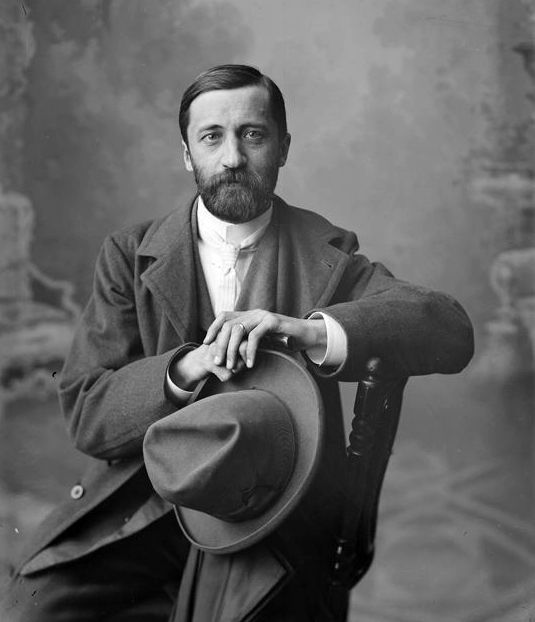
Dmitry Merezhkovsky
Knowledge base stats:
Talk channels stats:
Members stats:
Dmitry Merezhkovsky
Dmitry Sergeyevich Merezhkovsky (Russian: Дми́трий Серге́евич Мережко́вский, IPA: [ˈdmʲitrʲɪj sʲɪrˈɡʲejɪvʲɪtɕ mʲɪrʲɪˈʂkofskʲɪj]; 14 August [O.S. 2 August] 1865 – 9 December 1941) was a Russian novelist, poet, religious thinker, and literary critic. A seminal figure of the Silver Age of Russian Poetry, regarded[by whom?] as a co-founder of the Symbolist movement, Merezhkovsky – with his wife, the poet Zinaida Gippius – was twice forced into political exile. During his second exile (1918–1941), he continued publishing successful novels and gained recognition[by whom?] as a critic of the Soviet Union. Known both as a self-styled religious prophet with his own slant on apocalyptic Christianity, and as the author of philosophical historical novels which combined fervent idealism with literary innovation, Merezhkovsky was nominated nine times for the Nobel Prize in Literature, which he came closest to winning in 1933. However, due to contested claims[dubious – discuss] that he expressed regard for Fascism as a lesser evil than Communism during the outbreak of war between Germany and the USSR shortly prior to his death, his work largely fell into neglect after World War II[citation needed]
Dmitry Sergeyevich Merezhkovsky was born on August 14 [O.S. August 2] 1865, in Saint Petersburg, the sixth son in his family. His father, Sergey Ivanovich Merezhkovsky, served as a senior official in several Russian local governors' cabinets (including that of I.D. Talyzin in Orenburg) before entering Emperor Alexander II's court office as a Privy Councillor. His mother Varvara Vasilyevna Merezhkovskaya (née Chesnokova) was a daughter of a senior Saint Petersburg security official. Fond of arts and literature, she was what Dmitry Merezhkovsky later remembered as the guiding light of his rather lonely childhood (despite the presence of his five brothers and three sisters). There were only three people Merezhkovsky had any affinity with in his whole lifetime, and his mother, a woman "of rare beauty and angelic nature" according to biographer Yuri Zobnin, was the first and the most important of those.
Dmitry Merezhkovsky spent his early years on the Yelagin Island in Saint Petersburg, in a palace-like cottage which served as a summer dacha for the family. In the city the family occupied an old house facing the Summer Gardens, near Prachechny Bridge. The Merezhkovskys also owned a large estate in Crimea, near a road leading to the Uchan-Su waterfall. "Fabulous Oreanda palace, now in ruins, will stay with me forever. White marble pylons against the blue sea... for me it's a timeless symbol of Ancient Greece," Merezhkovsky wrote years later. Sergey Merezhkovsky, although a man of means, led an ascetic life, keeping his household 'lean and thrifty'. He saw this also as 'moral prophylactics' for his children, regarding luxury-seeking and reckless spending as the two deadliest sins. The parents traveled a lot, and an old German housekeeper, Amalia Khristianovna, spent much time with the children, amusing them with Russian fairytales and Biblical stories. It was her recounting of saints' lives that helped Dmitry to develop fervent religious feelings in his early teens.
In 1876 Dmitry Merezhkovsky joined an élite grammar school, the St. Petersburg Third Classic Gymnasium. His years spent there he described later in one word, "murderous", remembering just one teacher as a decent person – "Kessler the Latinist; well-meaning he surely never was, but at least had a kindly look." At thirteen Dmitry started writing poetry, rather in the vein of Pushkin's "Bakhchisarai Fountain", as he later remembered. He became fascinated with the works of Molière to such an extent as to form a Molière Circle in the Gymnasium. The group had nothing political in its agenda, but still aroused the interest of the secret police. Each of its members were summoned one by one to the Third Department's headquarters by the Politzeisky Bridge to be questioned. It is believed that only Sergey Merezhkovsky's efforts prevented his son from being expelled from the school.
Much as Dmitry disliked his stiff upper-lipped, stone-faced father, later he had to give him credit for being the first one to have noticed and, in his emotionless way, appreciate his first poetic exercises.[citation needed] In July 1879, in Alupka, Crimea, Sergey Ivanovich introduced Dmitry to the legendary Princess Yekaterina Vorontzova, once Pushkin's sweetheart. The grand dame admired the boy's verses: she (according to a biographer) "spotted in them a must-have poetic quality: the metaphysical sensitivity of a young soul" and encouraged him to soldier on. Somewhat different was young Merezhkovsky's encounter with another luminary, Fyodor Dostoyevsky, again staged by his well-connected father. As the boy started reciting his work, nervous to the point of stuttering, the famous novelist listened rather impatiently, then said: "Poor, very poor. To write well, one has to suffer. Suffer!" – "Oh no, I'd rather he won't – either suffer, or write well!", the appalled father exclaimed. The boy left Dostoyevsky's house much frustrated by the great man's verdict. Merezhkovsky's debut publication followed the same year: the Saint Petersburg magazine Zhivopisnoe obozrenie published two of his poems, "Little Cloud" and "The Autumn Melody". A year later another poem, "Narcissus", was included in a charity compilation benefiting destitute students, edited by Pyotr Yakubovich.
In autumn 1882 Merezhkovsky attended one of the first of Semyon Nadson's public readings and, deeply impressed, wrote him a letter. Soon Nadson became Merezhkovsky's closest friend – in fact, the only one, apart from his mother. Later researchers[who?] suggested there was some mystery shared by the two young men, something to do with "fatal illness, fear of death and longing for faith as an antidote to such fear".[citation needed] Nadson died in 1887, Varvara Vasilyevna two years later; feeling that he had lost everything he'd ever had in this world, Merezhkovsky submerged into deep depression.
In January 1883 Otechestvennye Zapiski published two more of Merezhkovsky's poems. "Sakya Muni", the best known of his earlier works, entered popular poetry-recital compilations of the time and made the author almost famous. By 1896 Merezhkovsky was rated as "a well-known poet" by the Brockhaus and Efron Encyclopedic Dictionary. Years later, having gained fame as a novelist, he felt embarrassed by his poetry and, when compiling his first Complete series in the late 1900s, cut the poetry section down by several pieces. Nevertheless, Merezhkovsky's poems remained popular, and some major Russian composers, Rachmaninoff and Tchaikovsky among them, have set dozens of them to music.
From 1884 to 1889 Merezhkovsky studied history and philology at the University of Saint Petersburg where his PhD thesis was on Montaigne. He learned several foreign languages and developed strong interests in French literature, the philosophy of positivism, and the theories of John Stuart Mill and Charles Darwin. Still, his student years were joyless. "University gave me no more than a Gymnasium did. I've never had proper – either family, or education," he wrote in his 1913 autobiography. The only lecturer he remembered fondly was the historian of literature Orest Miller, who held a domestic literature circle.
Hub AI
Dmitry Merezhkovsky AI simulator
(@Dmitry Merezhkovsky_simulator)
Dmitry Merezhkovsky
Dmitry Sergeyevich Merezhkovsky (Russian: Дми́трий Серге́евич Мережко́вский, IPA: [ˈdmʲitrʲɪj sʲɪrˈɡʲejɪvʲɪtɕ mʲɪrʲɪˈʂkofskʲɪj]; 14 August [O.S. 2 August] 1865 – 9 December 1941) was a Russian novelist, poet, religious thinker, and literary critic. A seminal figure of the Silver Age of Russian Poetry, regarded[by whom?] as a co-founder of the Symbolist movement, Merezhkovsky – with his wife, the poet Zinaida Gippius – was twice forced into political exile. During his second exile (1918–1941), he continued publishing successful novels and gained recognition[by whom?] as a critic of the Soviet Union. Known both as a self-styled religious prophet with his own slant on apocalyptic Christianity, and as the author of philosophical historical novels which combined fervent idealism with literary innovation, Merezhkovsky was nominated nine times for the Nobel Prize in Literature, which he came closest to winning in 1933. However, due to contested claims[dubious – discuss] that he expressed regard for Fascism as a lesser evil than Communism during the outbreak of war between Germany and the USSR shortly prior to his death, his work largely fell into neglect after World War II[citation needed]
Dmitry Sergeyevich Merezhkovsky was born on August 14 [O.S. August 2] 1865, in Saint Petersburg, the sixth son in his family. His father, Sergey Ivanovich Merezhkovsky, served as a senior official in several Russian local governors' cabinets (including that of I.D. Talyzin in Orenburg) before entering Emperor Alexander II's court office as a Privy Councillor. His mother Varvara Vasilyevna Merezhkovskaya (née Chesnokova) was a daughter of a senior Saint Petersburg security official. Fond of arts and literature, she was what Dmitry Merezhkovsky later remembered as the guiding light of his rather lonely childhood (despite the presence of his five brothers and three sisters). There were only three people Merezhkovsky had any affinity with in his whole lifetime, and his mother, a woman "of rare beauty and angelic nature" according to biographer Yuri Zobnin, was the first and the most important of those.
Dmitry Merezhkovsky spent his early years on the Yelagin Island in Saint Petersburg, in a palace-like cottage which served as a summer dacha for the family. In the city the family occupied an old house facing the Summer Gardens, near Prachechny Bridge. The Merezhkovskys also owned a large estate in Crimea, near a road leading to the Uchan-Su waterfall. "Fabulous Oreanda palace, now in ruins, will stay with me forever. White marble pylons against the blue sea... for me it's a timeless symbol of Ancient Greece," Merezhkovsky wrote years later. Sergey Merezhkovsky, although a man of means, led an ascetic life, keeping his household 'lean and thrifty'. He saw this also as 'moral prophylactics' for his children, regarding luxury-seeking and reckless spending as the two deadliest sins. The parents traveled a lot, and an old German housekeeper, Amalia Khristianovna, spent much time with the children, amusing them with Russian fairytales and Biblical stories. It was her recounting of saints' lives that helped Dmitry to develop fervent religious feelings in his early teens.
In 1876 Dmitry Merezhkovsky joined an élite grammar school, the St. Petersburg Third Classic Gymnasium. His years spent there he described later in one word, "murderous", remembering just one teacher as a decent person – "Kessler the Latinist; well-meaning he surely never was, but at least had a kindly look." At thirteen Dmitry started writing poetry, rather in the vein of Pushkin's "Bakhchisarai Fountain", as he later remembered. He became fascinated with the works of Molière to such an extent as to form a Molière Circle in the Gymnasium. The group had nothing political in its agenda, but still aroused the interest of the secret police. Each of its members were summoned one by one to the Third Department's headquarters by the Politzeisky Bridge to be questioned. It is believed that only Sergey Merezhkovsky's efforts prevented his son from being expelled from the school.
Much as Dmitry disliked his stiff upper-lipped, stone-faced father, later he had to give him credit for being the first one to have noticed and, in his emotionless way, appreciate his first poetic exercises.[citation needed] In July 1879, in Alupka, Crimea, Sergey Ivanovich introduced Dmitry to the legendary Princess Yekaterina Vorontzova, once Pushkin's sweetheart. The grand dame admired the boy's verses: she (according to a biographer) "spotted in them a must-have poetic quality: the metaphysical sensitivity of a young soul" and encouraged him to soldier on. Somewhat different was young Merezhkovsky's encounter with another luminary, Fyodor Dostoyevsky, again staged by his well-connected father. As the boy started reciting his work, nervous to the point of stuttering, the famous novelist listened rather impatiently, then said: "Poor, very poor. To write well, one has to suffer. Suffer!" – "Oh no, I'd rather he won't – either suffer, or write well!", the appalled father exclaimed. The boy left Dostoyevsky's house much frustrated by the great man's verdict. Merezhkovsky's debut publication followed the same year: the Saint Petersburg magazine Zhivopisnoe obozrenie published two of his poems, "Little Cloud" and "The Autumn Melody". A year later another poem, "Narcissus", was included in a charity compilation benefiting destitute students, edited by Pyotr Yakubovich.
In autumn 1882 Merezhkovsky attended one of the first of Semyon Nadson's public readings and, deeply impressed, wrote him a letter. Soon Nadson became Merezhkovsky's closest friend – in fact, the only one, apart from his mother. Later researchers[who?] suggested there was some mystery shared by the two young men, something to do with "fatal illness, fear of death and longing for faith as an antidote to such fear".[citation needed] Nadson died in 1887, Varvara Vasilyevna two years later; feeling that he had lost everything he'd ever had in this world, Merezhkovsky submerged into deep depression.
In January 1883 Otechestvennye Zapiski published two more of Merezhkovsky's poems. "Sakya Muni", the best known of his earlier works, entered popular poetry-recital compilations of the time and made the author almost famous. By 1896 Merezhkovsky was rated as "a well-known poet" by the Brockhaus and Efron Encyclopedic Dictionary. Years later, having gained fame as a novelist, he felt embarrassed by his poetry and, when compiling his first Complete series in the late 1900s, cut the poetry section down by several pieces. Nevertheless, Merezhkovsky's poems remained popular, and some major Russian composers, Rachmaninoff and Tchaikovsky among them, have set dozens of them to music.
From 1884 to 1889 Merezhkovsky studied history and philology at the University of Saint Petersburg where his PhD thesis was on Montaigne. He learned several foreign languages and developed strong interests in French literature, the philosophy of positivism, and the theories of John Stuart Mill and Charles Darwin. Still, his student years were joyless. "University gave me no more than a Gymnasium did. I've never had proper – either family, or education," he wrote in his 1913 autobiography. The only lecturer he remembered fondly was the historian of literature Orest Miller, who held a domestic literature circle.
Recent media