Hubbry Logo
ChapbookChapbookMain
Open search
Chapbook
Community hub
Chapbook
logo
8 pages, 0 posts
0 subscribers
Be the first to start a discussion here.
Chapbook
Chapbook
from Wikipedia
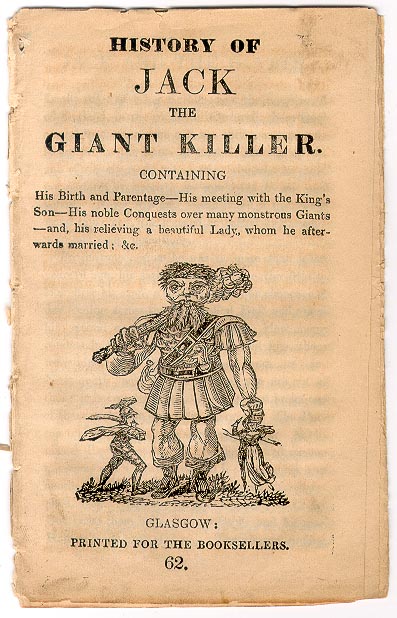
Chapbook (c. 1800) of Jack the Giant Killer

A chapbook is a type of small printed booklet that was a popular medium for street literature throughout early modern Europe. Chapbooks were usually produced cheaply, illustrated with crude woodcuts and printed on a single sheet folded into 8, 12, 16, or 24 pages, sometimes bound with a saddle stitch. Printers provided chapbooks on credit to chapmen, who sold them both from door to door and at markets and fairs, then paying for the stock they sold. The tradition of chapbooks emerged during the 16th century as printed books were becoming affordable, with the medium ultimately reaching its height of popularity during the 17th and 18th centuries. Various ephemera and popular or folk literature were published as chapbooks, such as almanacs, children's literature, folklore, ballads, nursery rhymes, pamphlets, poetry, and political and religious tracts. The term chapbook remains in use by publishers to refer to short, inexpensive booklets.

Terminology

[edit]

Chapbook is first attested in English in 1824, and seemingly derives from chapman, the word for the itinerant salesmen who would sell such books.[1][2] The first element of chapman comes in turn from Old English cēap 'barter', 'business', 'dealing',[3] from which the modern adjective cheap was ultimately derived.

Chapbooks correspond to Portuguese Cordel literature, and to French bibliothèque bleue 'blue library' literature, because they were often wrapped in cheap blue paper that was usually reserved as a wrapping for sugar.[4] Chapbooks are called Volksbuch 'people's book' in German, and as pliegos sueltos 'loose sheets' in Spanish, with the latter name referring to their method of assembly.[4] Lubok books are the Russian equivalent.[5]

History

[edit]
Woodcut of a fairy-circle from a 17th-century chapbook

Broadside ballads were popular songs, sold for a penny or halfpenny in the streets of towns and villages around Britain between the 16th and the early 20th centuries. They preceded chapbooks but had similar content, marketing, and distribution systems. There are records from Cambridgeshire as early as in 1553 of a man offering a scurrilous ballad "maistres mass" at an alehouse, and a pedlar selling "lytle books" to people,[6] including a patcher of old clothes in 1578. These sales are probably characteristic of the market for chapbooks.

The form factor originated in Britain, but was also used in North America. Chapbooks gradually disappeared from the mid-19th century in the face of competition from cheap newspapers and, especially in Scotland, from tract societies that regarded them as ungodly.

Chapbooks were generally aimed at buyers who did not maintain libraries, and due to their flimsy construction they rarely survive as individual items. In an era when paper was expensive, chapbooks were sometimes used for wrapping, baking, or as toilet paper.[7] Many of the surviving chapbooks come from the collections of Samuel Pepys between 1661 and 1688 which are now held at Magdalene College, Cambridge. The antiquary Anthony Wood also collected 65 chapbooks, including 20 from before 1660, which are now in the Bodleian Library. There are also significant Scottish collections, such as those held by the University of Glasgow[8] and the National Library of Scotland.[9]

Modern collectors such as Peter Opie, have chiefly a scholarly interest in the form.[10][11] Modern small literary presses, such as Louffa Press, Black Lawrence Press and Ugly Duckling Presse, continue to issue several small editions of chapbooks a year, updated in technique and materials, often to high fabrication standards, such as letterpress.

Production and distribution

[edit]

Chapbooks were cheap, anonymous publications that were the usual reading material for lower-class people who could not afford books. Members of the upper classes occasionally owned chapbooks, and sometimes bound them in leather. Printers typically tailored their texts for the popular market. Chapbooks were usually between four and twenty-four pages long, and produced on rough paper with crude, frequently recycled, woodcut illustrations. Millions of chapbooks were sold each year. After 1696, English chapbook peddlers had to be licensed, and 2,500 of them were then authorized, 500 in London alone. In France, there were 3,500 licensed colporteurs by 1848, and they sold 40 million books annually.[12]

The centre of the chapbook and ballad production was London, and until the Great Fire of London in 1666 the printers were based around London Bridge. However, a feature of chapbooks is the proliferation of provincial printers, especially in Scotland and Newcastle upon Tyne.[13] The first Scottish publication was the tale of Tom Thumb, in 1682.[14]

Content

[edit]
The frontispiece of a late 18th-century chapbook edition of Voltaire's The Extraordinary Tragical Fate of Calas, depicting Jean Calas being broken on the wheel

Chapbooks were an important medium for the dissemination of popular culture to the common people, especially in rural areas. They were a medium of entertainment and information. Though the content of chapbooks has been criticized as unsophisticated narratives which were heavily loaded with repetition and emphasized adventure through mostly anecdotal structures,[15] they are valued as a record of popular culture, preserving cultural artefacts that may not survive in any other form.

Chapbooks were priced for sales to workers, although their market was not limited to the working classes. Broadside ballads were sold for a halfpenny, or a few pence. Prices of chapbooks were from 2d. to 6d., when agricultural labourers' wages were 12d. per day. The literacy rate in England in the 1640s was around 30 percent for males and rose to 60 percent in the mid-18th century. Many working people were readers, if not writers, and pre-industrial working patterns provided periods during which they could read.

Chapbooks were used for reading to family groups or groups in alehouses. They contributed to the development of literacy, and there is evidence of their use by autodidacts. In the 1660s, as many as 400,000 almanacs were printed annually, enough for one family in three in England. One 17th-century publisher of chapbooks in London stocked one book for every 15 families in the country.[clarification needed] In the 1520s the Oxford bookseller John Dorne noted in his day-book selling up to 190 ballads a day at a halfpenny each. The probate inventory of the stock of Charles Tias, of The sign of the Three Bibles on London Bridge, in 1664 included books and printed sheets to make approximately 90,000 chapbooks (including 400 reams of paper) and 37,500 ballad sheets. This was not regarded as an outstanding figure in the trade. The inventory of Josiah Blare, of The Sign of the Looking Glass on London Bridge, in 1707 listed 31,000 books, plus 257 reams of printed sheets. A conservative estimate of sales in Scotland alone in the second half of the 18th century was over 200,000 per year.

Printers provided chapbooks on credit to chapmen, who sold them both from door to door and at markets and fairs, then paying for the stock they sold. This facilitated wide distribution and large sales with minimum outlay, and also provided the printers with feedback about what titles were most popular. Popular works were reprinted, pirated, edited, and produced in different editions.

Publishers also issued catalogues, and chapbooks are found in the libraries of provincial yeomen and gentry. John Whiting, a Quaker yeoman imprisoned at Ilchester, Somerset, in the 1680s had books sent by carrier from London, and left for him at an inn.

Samuel Pepys had a collection of ballads bound into volumes, under the following classifications, into which could fit the subject matter of most chapbooks:

  1. Devotion and Morality
  2. History – true and fabulous
  3. Tragedy: viz. Murders, executions, and judgments of God
  4. State and Times
  5. Love – pleasant
  6. Ditto – unpleasant
  7. Marriage, Cuckoldry, &c.
  8. Sea – love, gallantry & actions
  9. Drinking and good fellowship
  10. Humour, frollicks and mixt.

Stories in many chapbooks have much earlier origins. Bevis of Hampton was an Anglo-Norman romance of the 13th century, which probably drew on earlier themes. The structure of The Seven Sages of Rome was of Eastern origin, and was used by Geoffrey Chaucer. Many jests about ignorant and greedy clergy in chapbooks were taken from The Friar and the Boy printed about 1500 by Wynkyn de Worde, and The Sackfull of News (1557).

Historical stories set in a mythical and fantastical past were popular, while many significant historical figures and events appear rarely or not at all: in the Pepys collection, Charles I, and Oliver Cromwell do not appear as historical figures, The Wars of the Roses and the English Civil War do not appear at all, Elizabeth I appears only once, and Henry VIII and Henry II appear in disguise, standing up for the right[clarification needed] with cobblers and millers and then inviting them to court and rewarding them. There was a pattern of high born heroes overcoming reduced circumstances by valour, such as Saint George, Guy of Warwick, Robin Hood, and heroes of low birth who achieve status through force of arms, such as Clim of Clough, and William of Cloudesley. Clergy often appear as figures of fun, and foolish countrymen were also popular (e.g., The Wise Men of Gotham). Other works were aimed at regional and rural audience (e.g., The Country Mouse and the Town Mouse).

From 1597, works were published that were aimed at specific trades, such as cloth merchants, weavers and shoemakers. The latter were commonly literate.[clarification needed] Thomas Deloney, a weaver, wrote Thomas of Reading, about six clothiers from Reading, Gloucester, Worcester, Exeter, Salisbury and Southampton, traveling together and meeting at Basingstoke their fellows from Kendal, Manchester and Halifax. In his Jack of Newbury, set during Henry VIII's reign, an apprentice to a broadcloth weaver takes over his business and marries his widow on his death. On achieving success, he is liberal to the poor and refuses a knighthood for his substantial services to the king.

Other examples from the Pepys collection include The Countryman's Counsellor, or Everyman his own Lawyer, and Sports and Pastimes, written for schoolboys, including magic tricks, like how to "fetch a shilling out of a handkerchief",[16] write invisibly, make roses out of paper, snare wild duck, and make a maid-servant fart uncontrollably.

The provinces and Scotland had their own local heroes. Robert Burns commented that one of the first two books he read in private was "the history of Sir William Wallace ... poured a Scottish prejudice in my veins which will boil along there till the flood-gates of life shut in eternal rest".[17]

Influence

[edit]

Chapbooks had a wide and continuing influence. Eighty percent of English folk songs collected by early-20th-century collectors have been linked to printed broadsides, including over 90 of which could only be derived from those printed before 1700. It has been suggested the majority of surviving ballads can be traced to 1550–1600 by internal evidence.

One of the most popular and influential chapbooks was Richard Johnson's Seven Champions of Christendom (1596), believed to be the source for the introduction of Saint George into English folk plays.

Robert Greene's 1588 novel Dorastus and Fawnia, the basis of Shakespeare's The Winter's Tale, was still being published in cheap editions in the 1680s. Some stories were still being published in the 19th century, (e.g., Jack of Newbury, Friar Bacon, Dr Faustus and The Seven Champions of Christendom).

Later production

[edit]
A modern chapbook

Chapbook is also a term currently used to denote publications of up to about 40 pages, usually poetry bound with some form of saddle stitch, though many are perfect bound, folded, or wrapped. These publications range from low-cost productions to finely produced, hand-made editions that may sell to collectors for hundreds of dollars. More recently,[when?] the popularity of fiction and non-fiction chapbooks has also increased. In the UK they are more often referred to as pamphlets.

The genre has been revitalized in the past 40 years by the widespread availability of first mimeograph technology, then low-cost copy centres and digital printing, and by the cultural revolutions spurred by both zines and poetry slams, the latter generating hundreds upon hundreds of self-published chapbooks that are used to fund tours. The Center for the Humanities at the City University of New York Graduate Center has held the NYC/CUNY Chapbook Festival, focused on "the chapbook as a work of art, and as a medium for alternative and emerging writers and publishers".[18]

Collections

[edit]
  • The National Library of Scotland[19] holds a large collection of Scottish chapbooks; approximately 4,000 of an estimated total of 15,000 published – including several in Lowland Scots and Gaelic.[14] Records for most Scottish chapbooks have been catalogued online. Approximately 3,000 of these have been digitized and can be accessed from the Library's Digital Gallery. A project is underway to add every chapbook in the collection to Wikisource called WikiProject NLS.
  • The Glasgow University Library[20] has over 1,000 examples throughout the collections, searchable online via the Scottish Chapbooks Catalogue of c. 4,000 works, which covers the Lauriston Castle collection, Edinburgh City libraries and Stirling University. The University of South Carolina's G. Ross Roy Collection is collaborating in research for the Scottish Chapbook Project.
  • The Bodleian Library of the University of Oxford[21] has over 30,000 ballads in several major collections. The original printed materials range from the 16th to the 20th century. The Broadside Ballads project makes the digitized copies of the sheets and ballads available.
  • Sir Frederick Madden's Collection of Broadside Ballads, at Cambridge University Library,[22] is possibly the largest collection from London and provincial presses between 1775 and 1850, with earlier 18th-century garlands and Irish volumes.
  • The Lilly Library, Indiana University[23] has 1,900 chapbooks from England, Scotland, Ireland, France, and the United States, which were part of the Elisabeth W. Ball collection. Online search facility
  • Rutgers University, Special Collections and University Archives[24] houses the Harry Bischoff Weiss collection of 18th- and 19th-century chapbooks, illustrated with catchpenny prints.
  • The John Rylands University Library at University of Manchester[25] contains 600 items in The Sharpe Collection of chapbooks, formed by Charles Kirkpatrick Sharpe. These are 19th-century items printed in Scotland and Newcastle upon Tyne.
  • Literatura de Cordel Brazilian Chapbook Collection Library of Congress, American Folklife Center[26] has a collection of over 7200 works of cordel literature. Descended from the medieval troubadour and chapbook tradition of cordel literature has been published in Brazil for over a century.
  • The Archival and Special Collections at the University of Guelph Library[27] has a collection of more than 550 chapbooks in its extensive Scottish holdings.
  • The National Art Library, Victoria & Albert Museum in London[28] has a collection of approximately 800 chapbooks, all catalogued.
  • The McGill University Library[29] has over 900 British and American chapbooks published in the 18th and 19th centuries. The chapbooks have been digitized and can be read online.
  • The Grupo de investigación sobre relaciones de sucesos (siglos XVI–XVIII) en la Península Ibérica, Universidade da Coruña[30] Catalog and Digital Library of "Relaciones de sucesos" (16th–18th centuries). Bibliographical database of more than 5,000 chap-books, pamphlets, Early modern press news, etc. Facsimilar reproduction of many of the copies: Catálogo y Biblioteca Digital de Relaciones de Sucesos (siglos XVI–XVIII)
  • The Ball State University Digital Media Repository Chapbooks collection[31] provides online access to 173 chapbooks from the 19th and 20th centuries.
  • The Elizabeth Nesbitt Room, University of Pittsburgh[32]
  • Cambridge Digital Library[33] hosts a growing number of digital facsimiles of Spanish chapbooks from the collections of Cambridge University Library and the British Library.
  • The Biblioteca Nacional de España has a digitized collection of chapbooks.[34]
  • The project Untangling the cordel offers a collection of almost 1000 pliegos de cordel, the Spanish equivalent of English chapbooks, kept at the University Library of the University of Geneva.[35]
  • Mapping Pliegos is a portal dedicated to 19th-century Spanish chapbook literature. It brings together the digitized collections of over a dozen partner libraries.

See also

[edit]

References

[edit]
[edit]
Revisions and contributorsEdit on WikipediaRead on Wikipedia
from Grokipedia
A chapbook is a small, inexpensive, paper-covered booklet or , typically unbound or simply stitched, that was sold by itinerant peddlers known as chapmen throughout and . The term derives from "chapman," with "chap" stemming from the ceap, meaning trade or barter, reflecting the commercial peddling of these affordable publications. Emerging in the alongside the spread of printing technology, chapbooks democratized access to by offering short, accessible content such as ballads, folk tales, religious tracts, abridged novels, and moralistic stories to a largely illiterate or semi-literate working-class audience. They were produced cheaply on low-quality paper, often with crude illustrations, and distributed via markets, fairs, and sales rather than formal bookstores. Notable examples include adaptations of classic tales like and abridged versions of Jonathan Swift's , which popularized and adventure narratives among the masses. In the 17th to 19th centuries, chapbooks played a key role in preserving oral traditions and disseminating , though their content frequently blended entertainment with didactic elements, such as cautionary morals or Protestant , amid limited regulation of printing. Their decline coincided with rising , industrialization, and the advent of newspapers and serialized novels, yet chapbooks influenced broader literary forms and persist in modern small-press poetry editions as a format for emerging authors.

Terminology and Definition

Etymology and Terminology

The term chapbook originated in the 18th century, with documented use as early as 1747, though it gained wider currency in the early 19th century around 1812–1824. It derives from chapman, an term for itinerant peddlers or tradesmen, combining ceap ("trade" or "bargain") with man. These sellers distributed small, affordable booklets door-to-door or at markets, distinguishing chapbooks from larger, bound volumes sold in stationary shops. While some early speculation linked chapbook to "cheap book" due to the low cost and related etymological roots in , scholarly consensus attributes it directly to the chapmen's in dissemination rather than price alone. The format predates the term, emerging in 16th-century with the spread of printing, but chapbook specifically denotes these stitched, paper-covered pamphlets of 8–32 pages, often illustrated with crude woodcuts. In historical terminology, chapbooks differ from pamphlets, which were unbound or loosely stitched sheets focused on polemical, religious, or political topics of the moment, such as debates or electioneering. Chapbooks, by contrast, emphasized enduring popular genres like ballads, folk tales, and moral allegories aimed at semi-literate audiences. They also contrast with broadsides—single-sided, large-sheet prints used for proclamations, news, or songs—which served as precursors but lacked the multi-page binding of chapbooks. Regional variants existed, such as French colportage literature or German Volksbücher, but the English chapbook term reflects its association with peripatetic vending.

Defining Characteristics

A chapbook is a small, inexpensive typically consisting of 8 to 24 pages, produced from one or two sheets of low-quality folded and sometimes stitched together, often without a rigid cover or binding. These booklets measured approximately 3½ by 6 inches, making them portable and affordable, usually priced at a or less to appeal to working-class readers. Distinguishing them from larger books or broadsides, chapbooks featured crude illustrations on the or interspersed within the text, printed via letterpress on rough paper intended for ephemeral use rather than durability. Content focused on accessible, popular genres such as ballads, abridged romances, adventure tales, religious tracts, or moral stories, often anonymous and derived from oral traditions or simplified versions of longer narratives. Their primary mode of distribution by itinerant chapmen—peddlers carrying them in packs to rural areas, markets, and —further defined chapbooks as a democratized form of print, bridging literacy gaps among the lower classes where fixed booksellers were scarce. This hawked, hand-printed format emphasized mass accessibility over literary refinement, positioning chapbooks as precursors to modern mass-market paperbacks.

Historical Development

Origins in 16th-Century Europe

The proliferation of printing presses across in the , building on Johannes Gutenberg's movable-type innovation circa 1440, enabled the production of inexpensive printed materials that democratized access to beyond the elite. By , presses operated in approximately European cities, facilitating the creation of small booklets aimed at emerging literate or semi-literate audiences among the working classes. These precursors to formalized chapbooks typically comprised 8 to 12 unbound pages printed on low-grade paper, often sold for a or less, with content drawn from oral , ballads, and simple narratives illustrated by recycled engravings. In , printers such as , who inherited Caxton's operations after 1491 and established a press in , produced early popular narratives and jest collections that influenced chapbook formats, emphasizing accessible and verse for mass appeal. These works, often folded from a single sheet into 8 to 24 pages and distributed unbound, catered to rural and urban peddlers known as chapmen—hence the term's association with "cheap" literature—who traversed fairs and villages to reach non-elite buyers. Parallel developments in saw the rise of Volksbücher, affordable adaptations of medieval epics and folk tales, with early printed editions like the chapbook appearing around 1510–1512 in , marking a shift from exclusivity to printed of cultural motifs. This format's economic model—relying on high-volume, low-cost output—reflected causal drivers like rising and urban-rural trade networks, though survival rates of these fragile items remain low, limiting precise enumeration of 16th-century outputs.

Expansion and Peak in the 17th-19th Centuries

Chapbooks expanded significantly in the as printing presses proliferated across , particularly in Britain, enabling of affordable for the lower classes. By the 1660s, annual print runs for related ephemera like almanacs reached 400,000 copies in , indicating substantial output capacity for chapbooks as well. These small booklets, typically 8 to 24 pages long and priced at one , were distributed by itinerant chapmen at markets, fairs, and , filling a demand for simple and information among semi-literate audiences. Early examples included Scottish editions like the 1682 printing of , marking the medium's growing foothold in regional markets. The represented the peak of chapbook popularity, with a marked surge in publication volumes driven by expanded urban presses and rising demand for popular print. In alone, the number of active printing presses increased by at least 400 percent during this period, facilitating widespread dissemination of chapbooks containing ballads, heroic tales, execution accounts, and news of disasters or notable figures like Rob Roy and . This era saw chapbooks overtake broadside ballads as the dominant form of cheap print, serving as communal reading material often recited aloud in pubs and homes to engage both literate and illiterate individuals. Their content emphasized , moral lessons, and , with illustrations enhancing appeal despite crude quality. Into the , chapbooks maintained relevance early on but began declining from the mid-century onward due to competition from cheaper newspapers, periodicals, and serialized , which offered fresher content and higher production values. Mass-produced books and improved further eroded their market, rendering chapbooks obsolete by the 1860s as alternative formats absorbed their audience. Despite this, they persisted in niche areas like religious tracts and toy books until the early .

Production and Economics

Printing Techniques and Materials

Chapbooks were printed using letterpress techniques, which involved composing text from movable metal type, inking the forme, and pressing it against paper to transfer the image in relief. This method, widespread since the late 15th century, enabled rapid production of small runs on rudimentary presses operated by individual printers or small shops. Illustrations, a key feature to attract buyers, were predominantly produced via woodcuts: designs carved in relief on wooden blocks, inked, and printed alongside the type in a single pass, yielding crude but durable images suited to the format's audience. Materials emphasized economy over durability, with production relying on low-quality rag paper—often unevenly sized, watermarked, and coarse—to minimize costs for penny-priced sales. Such paper, derived from recycled textiles but of the cheapest grades available, yellowed and disintegrated quickly, reflecting the ephemeral intent of street literature. Inks consisted of standard oil-based pigments mixed with and driers, applied sparingly to avoid smudging on absorbent stock. Bindings were minimal: single sheets folded into signatures of 8 to 24 pages, sometimes secured with coarse thread stitching or left unbound, enclosed in plain paper wrappers rather than boards or .

Distribution by Chapmen and Markets

Chapmen, itinerant peddlers deriving their name from the term for merchants dealing in bargains, served as the principal distributors of chapbooks across from the 16th to the mid-19th centuries. These sellers obtained chapbooks on from printers, typically in urban centers, and resold them after covering costs from sales, enabling printers to extend reach without fixed retail infrastructure. This credit-based model minimized financial risk for chapmen while ensuring steady supply chains for popular titles, with chapmen often traveling established routes on foot or horseback to cover rural territories inaccessible to stationary booksellers. Door-to-door sales formed a core method, allowing chapmen to target households in remote villages and countryside regions, where literacy materials were scarce. Complementing this, periodic markets and fairs—such as those held annually in English counties or Scottish burghs—provided high-volume outlets, where chapmen hawked chapbooks alongside needles, ribbons, and ballads to assembled crowds of farmers, laborers, and families. These venues facilitated bulk transactions, with chapbooks priced affordably at around 1 for 24-page editions to appeal to working-class buyers, fostering widespread dissemination of , almanacs, and moral tales. Beyond mere vending, chapmen influenced content evolution by relaying sales data back to printers, highlighting "best sellers" like tales of or highwaymen adventures, which informed reprint decisions and adaptations. This feedback loop, documented in printer records from centers like and , underscored chapmen's role not only in but in shaping market-driven production, sustaining chapbooks as a democratizing force in until railroads and fixed retail eroded their itinerant dominance by the 1840s.

Content and Themes

Genres and Formats

Chapbooks featured a diverse range of genres tailored to the interests and levels of working-class readers, primarily consisting of ballads, romances, and tales. Common content included romantic tales of , such as abridged versions of medieval stories like , which emphasized heroic adventures and . Religious tracts and instruction dominated early productions, offering biblical summaries, sermons, and ethical guides to promote piety and virtue among the masses. Bawdy jests, legends, and reports of crimes or executions provided sensational , often blending humor with cautionary elements. Almanacs, songbooks (or "garlands"), nursery rhymes, and rudimentary children's stories rounded out the offerings, serving practical purposes like seasonal advice or family amusement. In terms of formats, chapbooks were designed for affordability and portability, typically printed on low-grade in small sizes ranging from 5.5 by 4.25 inches. They were produced as folded single sheets or small gatherings, yielding 8, 12, 16, or 24 pages—multiples of four to accommodate techniques—often stitched loosely without rigid covers. formats (8 pages) prevailed in the for rural distribution, featuring crude illustrations on the cover and interior to attract buyers visually. By the early , duodecimo formats (24 pages) emerged with finer engravings and slightly better , targeting urban markets while maintaining prices at 2-3 pence. These unbound or thread-sewn pamphlets prioritized over durability, reflecting their role as ephemeral reading matter.

Recurring Motifs and Examples

Recurring motifs in chapbooks often drew from folklore traditions, featuring diminutive heroes overcoming giants or supernatural adversaries, as seen in tales like Tom Thumb, first printed in a Scottish chapbook in 1682. These narratives emphasized themes of ingenuity, courage, and social mobility, reflecting aspirations among lower-class readers for advancement despite humble origins. Adventure and rescue patterns appeared frequently, such as in The Factor’s Garland, where a protagonist saves a damsel from peril, survives shipwrecks, and marries into royalty, embodying rags-to-riches progressions. Ballads and songs formed another staple, with garlands compiling popular tunes in vernacular languages, often highlighting outlaw heroes like Rob Roy or , who defied authority through cunning and valor. Cautionary motifs of crime and retribution dominated execution broadsides repurposed into chapbooks, detailing criminals' last words and divine punishment to deter vice. Religious and moral didacticism intertwined with these, urging piety amid jests or farces, though elements like prophecies and foretellings introduced causality. Knightly romances adapted medieval epics, such as Guy of Warwick or Bevis of Southampton, recurrently portrayed chivalric quests against monstrous foes, blending heroism with grotesque violence. Fairy tales and paraphrased classics, including abridged Robinson Crusoe, reinforced motifs of survival and moral fortitude through woodcut-illustrated perils. Historical accounts of figures like Admiral Nelson or disasters served sensational motifs, prioritizing dramatic causality over factual precision. These elements collectively transmitted cultural lore while catering to plebeian tastes for escapism and ethical instruction.

Societal Role and Influence

Promotion of Literacy Among the Masses

Chapbooks, priced typically between one penny and sixpence, provided affordable printed material to working-class and rural populations in Europe from the 16th to 19th centuries, enabling broader access to texts beyond elite libraries. This low cost distinguished them from bound books, which remained expensive until industrialization, allowing even laborers and farmers to purchase reading matter for personal or family use. In Scotland, where literacy rates were comparatively high—reaching around 70% for men by the late 18th century despite the scarcity of formal schooling—chapbooks supplemented limited educational resources and catered to a public eager for inexpensive literature. Historians note that chapbooks served as introductory reading material, often featuring simple narratives, ballads, and illustrations that appealed to semi-literate individuals learning to decode print. They were commonly read aloud in groups, alehouses, or communal settings, fostering oral-literate transitions and reinforcing reading skills through repetition and discussion. Evidence from ownership inscriptions and in surviving chapbooks indicates use by ordinary readers, including children, supporting the view that these pamphlets functioned as de facto primers in households lacking formal textbooks. The proliferation of chapbooks coincided with rising in , where male literacy rates increased from approximately 20-30% in the early to over 50% by 1800 in and similar gains elsewhere, driven partly by expanded print availability post-1650. While charity schools and religious instruction contributed significantly, chapbooks filled a market gap by offering secular, entertaining content that sustained reading habits among the masses, distinct from didactic school materials. In Ireland, 18th-century literacy growth similarly spurred demand for such humble prints, affordable to humble purchasers and integral to . Critics of overemphasizing chapbooks' role point to inferential evidence, as direct literacy instruction via chapbooks is "generally assumed" rather than exhaustively documented, with some collections showing across generations rather than widespread . Nonetheless, their role as the "staple reading diet" of lower classes underscores a democratizing effect on , bridging elite literature with folk traditions and encouraging self-taught in regions underserved by institutions.

Transmission of Folklore and Superstition

Chapbooks played a crucial role in preserving and disseminating and superstitions from the 16th to the 19th centuries, transforming oral traditions into affordable printed materials accessible to the lower classes. These small pamphlets, often sold by itinerant chapmen, captured legends, stories, and popular beliefs that might otherwise have faded, providing a printed record of cultural narratives rooted in pre-modern rural life. Specific examples include tales of supernatural encounters, such as "Miss Bailey’s ," a chilling account of a spectral apparition, and "Nancy of Yarmouth and Jemmy the ," where a drags a lover to a watery amid wartime Britain. Other chapbooks featured and trickery, like "Brave Nell, or the Lawyer Outwitted," in which a disguises herself as a to compel , blending folk with social satire. Collections compiled by John Ashton in the late , such as those reproducing 18th-century chapbooks, document recurring motifs of medieval legends, , and prevalent superstitions, illustrating their endurance in popular literature. In and , chapbooks incorporated regional dialects and local , helping to sustain traditions amid and aiding scholars like , whose 1830 work Letters on and drew from such sources to explore versus . By merging elements with contemporary events, these publications influenced public perceptions of the , perpetuating beliefs in omens, fairies, and heroic like among illiterate or semi-literate audiences through recitation and shared reading. Their distribution ensured broad reach, with woodcut illustrations enhancing vivid depictions of fairies dancing in rings or ghostly figures, reinforcing visual and narrative transmission of superstitions across generations and regions.

Vehicles for Propaganda and Moral Didacticism

Chapbooks, owing to their low cost and broad circulation by itinerant sellers, frequently functioned as accessible mediums for disseminating political propaganda, particularly during periods of ideological upheaval. In the late 18th century, Thomas Paine's The Rights of Man (1791–1792), an abridged edition priced at sixpence, circulated as a chapbook and achieved sales exceeding 2 million copies, advocating republicanism and critiquing hereditary monarchy as a tool to rally support for radical reform amid the French Revolution's influence on British politics. Such works exploited chapbooks' portability to challenge established authority, prompting authorities to view them as politically destabilizing, akin to contemporary concerns over unregulated information spread. Beyond politics, chapbooks served didactic purposes by embedding moral and religious instruction within narratives, aiming to instill ethical behavior and piety among largely illiterate or semi-literate audiences. Religious tracts and catechisms, such as those produced by the from the late 17th century onward, were formatted as chapbooks to propagate Protestant doctrine and counter Catholic influences, often simplifying complex into memorable verses or stories for use. tales within chapbooks, common from the 17th to 19th centuries, depicted consequences of —such as , , or —through cautionary examples like criminal biographies or allegorical fables, reinforcing societal norms of diligence and temperance. These formats prioritized explicit behavioral guidance over entertainment alone, with publishers categorizing content under "religious and moral" themes to target children and the working classes, as evidenced by collections preserving prayers, hymns, and ethical primers designed for daily recitation. In the , Enlightenment-influenced chapbooks extended this role by promoting rational virtues, though they retained a core emphasis on deterring and through vivid, consequence-driven stories. This dual utility as and teaching tool amplified chapbooks' influence, enabling elites and reformers to shape public morality without reliance on formal systems.

Decline and Transition

Impact of Industrialization on Traditional Forms

The advent of steam-powered printing presses in the early , exemplified by Friedrich Koenig's adopted by in 1814, dramatically increased production speeds to over 1,100 sheets per hour—more than four times that of hand presses—enabling the mass manufacture of printed materials at reduced costs. Concurrent innovations, such as the Fourdrinier continuous paper-making patented in 1807 and refined in the 1820s, lowered paper prices by facilitating large-scale production from wood pulp and rags. These technological shifts shifted the printing industry toward high-volume output, favoring serialized novels, weekly magazines, and newspapers over the short, rudimentary chapbooks that had dominated popular reading since the . This proliferation of affordable alternatives eroded the chapbook market, as consumers increasingly opted for expansive narratives in formats like and illustrated periodicals, which offered serialized adventures and current events at comparable prices but with greater variety and perceived sophistication. By the mid-19th century, chapbook sales dwindled as publishers pivoted to these emerging media; for instance, British output of traditional chapbooks, once peaking at millions annually in the , contracted sharply amid from steam-printed dailies and monthlies that reached urban audiences through fixed vendors rather than itinerant chapmen. Urbanization and regulatory measures further marginalized chapmen, with British laws such as the 1824 Vagrancy Act and subsequent restrictions on street hawking and ballad-singing effectively curtailing their trade by classifying it as , driving remnants underground or into obsolescence. Cultural and educational changes amplified these pressures: compulsory schooling acts, like Britain's 1870 Education Act, boosted literacy rates from around 60% in 1840 to over 90% by 1900 among males, fostering demand for "respectable" among an expanding that viewed chapbooks' folklore-heavy, sensational content as outdated and vulgar. Publishers responded by producing refined editions of and moralistic tracts, further displacing chapbooks' role in disseminating ballads, almanacs, and cautionary tales, though some traditional forms persisted in rural pockets until the late .

Emergence of Modern Publishing Alternatives

The decline of traditional chapbooks in the mid-19th century coincided with the rise of industrialized printing technologies, such as steam-powered presses introduced in the and , which lowered costs and enabled higher-volume production of alternatives like newspapers and serialized . In Britain, penny dreadfuls emerged as a direct successor, with publishers like Edward Lloyd issuing weekly one-penny installments starting around 1836, featuring lurid tales of highwaymen, detectives, and gothic horrors serialized across 8-16 pages per issue. These publications, printed on low-grade paper and sold via newsstands rather than chapmen, reached circulations exceeding 30,000 copies per title by the 1840s, outcompeting chapbooks by offering ongoing narratives that hooked readers with cliffhangers and moralistic resolutions. In the United States, dime novels filled a parallel role, debuting in 1860 with Irwin P. Beadle and Robert Adams's Malaeska; the Indian Wife of the White Hunter, a 100-page adventure story priced at 10 cents due to efficient from wood pulp innovations in the . By 1862, 's series alone produced over 200 titles, emphasizing Western frontiers, Civil War exploits, and pluck-and-luck heroes, with sales reaching millions annually through mail-order and railway distribution networks that bypassed rural peddlers. Unlike chapbooks' eclectic compilations, dime novels standardized in formulaic series, such as the detective line from 1886, which adapted to rising rates—U.S. adult literacy climbed from 20% in 1800 to 80% by 1870—while critics like decried their purported corruption of youth in 1873 congressional testimony. These formats transitioned popular literature from artisanal, hawker-distributed pamphlets to mechanized, market-driven serials, with influencing British boys' weeklies like (launched 1879) and dime novels evolving into by the 1890s. The shift marginalized standalone chapbooks, whose production dropped sharply after 1850 as periodicals captured 70% of working-class reading by 1870, per contemporary surveys, though both faced suppression under obscenity laws like Britain's 1857 Obscene Publications Act. This era's alternatives democratized access further but prioritized profit-driven sensationalism over chapbooks' oral-tradition roots, setting precedents for 20th-century mass paperbacks.

Contemporary Revival

Modern Poetry Chapbooks Since the 20th Century

The chapbook format experienced a resurgence in the early among movements, particularly Dadaism and leftist groups, which adapted it for experimental poetry and dissemination amid the instability following . This revival marked a departure from historical uses, emphasizing radical content over mass-market entertainment, as traditional printing centers waned. Surrealists and the expanded this trend in the mid-century, with small-scale productions enabling rapid distribution of innovative verse. A prominent example is Lawrence Ferlinghetti's Pocket Poets Series, initiated in 1955, which issued compact volumes like Allen Ginsberg's (1956), reaching audiences through affordable, portable editions that challenged mainstream literary norms. These efforts aligned with the Beats' countercultural ethos, using chapbooks to foreground spontaneous, unfiltered expression outside commercial constraints. The Mimeo Revolution, spanning the early 1960s to the mid-1980s, represented the format's peak proliferation in , driven by technology that allowed poets to produce limited runs independently. Associated with the New American Poetry movement, it facilitated works by figures like (Trip Out & Fall Back, 1978) and others addressing marginalized perspectives on class, race, and gender, as underscored in Edward Dorn's 1965 Berkeley Poetry Conference address on the "stranger's" role in poetry. Small Press Distribution, founded in 1968, supported over 400 independent publishers by the late , amplifying chapbooks' reach for emerging and experimental voices. Technological shifts, including photocopying and from the onward, further democratized production, making chapbooks a staple for poets across levels of recognition, often focusing on thematic clusters like elegies or mythic reinterpretations in 15-40 page collections. Institutions like Poets House preserve over 11,000 such items, including digitized Mimeo examples, highlighting their enduring utility for testing ideas and building readership before full-length publications.

Indie and Self-Publishing Applications

In independent and , chapbooks function as low-barrier vehicles for authors to produce and distribute compact literary works, often or themed short , bypassing traditional gatekeepers and enabling rapid experimentation. These booklets, typically 15 to 40 pages in length and produced in print runs of 100 to 500 copies, incur minimal costs—frequently under $500 for initial setups via print-on-demand services—making them ideal for emerging writers testing audience reception. platforms like Direct Publishing (KDP) and Lulu facilitate this by offering on-demand , digital proofs, and global distribution without requirements, allowing authors to retain 60-70% royalties per sale after printing fees. This model empowers indie creators to maintain full editorial and design control, from selecting unified themes like personal loss or to crafting handmade aesthetics via home printers or local binderies. For poets, chapbooks serve as portfolio builders, with data from services indicating that 20-30% of full-length contracts stem from prior chapbook success in niche markets. Authors often market them directly through literary festivals, online stores, or , achieving sales of 200-1,000 units for targeted releases, as reported by analytics tools. Indie presses, such as those specializing in imprints, complement by handling small-batch production and curation, though authors increasingly opt for hybrid approaches combining DIY formatting with professional services for assignment and e-book conversions. This revival aligns with broader trends in decentralized publishing, where chapbooks' brevity and affordability—averaging $5-15 retail price—foster direct reader engagement over mass-market scalability.

Preservation Efforts

Major Historical Collections

One of the most extensive collections is the Opie Collection at the , , acquired in 1988 from collectors , comprising approximately 20,000 historic children's books printed from the late 16th to late 20th centuries, including over 1,000 chapbooks alongside 4,000 magazines, , and bound volumes. This assemblage preserves chapbooks as key artifacts of popular juvenile literature, emphasizing their role in early print dissemination of and moral tales, with items sourced primarily from British imprints. The Hockliffe Collection, housed at the University of Bedfordshire's Polhill Library, contains over 1,000 British children's books predominantly from the 18th, 19th, and early 20th centuries, assembled by Frederick Hockliffe (1833–1914) and featuring numerous chapbooks such as abbreviated fairy tales and primers. Its significance lies in documenting the from chapbook formats to more structured juvenile publications, with digitized subsets enabling scholarly analysis of printing techniques and content adaptations. At Library's Rare Books and Special Collections, the Chapbook Collection holds over 900 English-language chapbooks published in the 18th and 19th centuries across , , , and the , digitized for public access to highlight regional variations in hawker-sold . The collection underscores chapbooks' affordability and portability, with examples including ballads and cautionary narratives printed on inexpensive paper. Cambridge University Library's Chapbooks and Juvenile Collection (CCA-CCE 7) encompasses around 3,900 volumes of popular literature, of which approximately 2,350 are traditional chapbooks distributed by itinerant sellers, spanning the 18th and 19th centuries and focusing on British productions. This repository aids into chapbooks as vehicles for unrefined , distinct from elite literature, through preserved hawker imprints and illustrations. The in maintains a specialized holding of about 1,100 chapbooks, the majority printed locally in the 18th and 19th centuries, reflecting Scotland's vibrant chapbook trade in urban centers. These items capture dialect-specific content and elements, preserved as evidence of regional printing economies before mass literacy shifts.

and Scholarly Access

Efforts to digitize historical chapbooks have accelerated since the early , enabling broader scholarly access to these fragile, often deteriorating artifacts through online repositories and searchable databases. Major institutions have led projects focusing on 18th- and 19th-century collections, prioritizing high-resolution scans, metadata tagging, and open-access platforms to facilitate into popular literature, transmission, and printing history. McGill 's Chapbook Digitization Project, completed around 2014, made available over 900 English-language chapbooks from Britain and the , spanning the 17th to 19th centuries, via their . This initiative included thematic cataloging by subject matter, such as instructional texts and , allowing scholars to analyze authorship patterns and cultural dissemination without physical handling. Similarly, the of Guelph's 2015 of its Scottish chapbook collection—one of North America's largest, with thousands of 18th- and 19th-century items—provides full-text searchability and contextual essays, supporting studies in regional balladry and moral . Specialized archives further enhance access: the University of South Carolina's Chapbooks collection offers digital facsimiles of all pre-1830 chapbooks containing Burns's works from the G. Ross Roy collection, aiding literary attribution research. The American Antiquarian Society's ongoing digitization, highlighted in 2022, encompasses over 700 19th-century chapbooks and pamphlets, revealing underrepresented indigenous and abolitionist narratives through enhanced metadata. For non-English traditions, Cambridge University's Spanish Chapbooks collection digitizes 18th- and 19th-century pliegos sueltos, enabling comparative analyses of European street literature. These projects mitigate physical preservation risks while democratizing access, though challenges persist, including incomplete OCR accuracy for gothic fonts and varying institutional policies on reproductions. Scholarly platforms like host niche sets, such as 91 York-printed chapbooks, underscoring the value of aggregated tools for cross-referencing ephemeral prints. Overall, digitization has transformed chapbooks from rare curiosities into analyzable corpora, fostering empirical studies of pre-industrial .

References

Add your contribution
Related Hubs
User Avatar
No comments yet.