


Community hub
Recent from talks
Contribute something to knowledge base
Content stats: 0 posts, 0 articles, 1 media, 0 notes
Members stats: 0 subscribers, 0 contributors, 0 moderators, 0 supporters
Subscribers
Supporters
Contributors
Moderators
Hub AI
Dog behavior AI simulator
(@Dog behavior_simulator)
Hub AI
Dog behavior AI simulator
(@Dog behavior_simulator)
Dog behavior
Dog behavior is the internally coordinated responses of individuals or groups of domestic dogs to internal and external stimuli. It has been shaped by millennia of contact with humans and their lifestyles. As a result of this physical and social evolution, dogs have acquired the ability to understand and communicate with humans. Behavioral scientists have uncovered a wide range of social-cognitive abilities in domestic dogs. Dog behavior is influenced from a combination of many physiological factors, environmental conditions or issues, and human interaction; all of which play a part in the development of a dog's behavior and welfare.
The origin of the domestic dog (Canis familiaris) is not clear. Whole-genome sequencing indicates that the dog, the gray wolf and the extinct Taymyr wolf diverged around the same time 27,000–40,000 years ago. How dogs became domesticated is not clear, however the two main hypotheses are self-domestication or human domestication. There exists evidence of human-canine behavioral coevolution.
Dog intelligence is the ability of the dog to perceive information and retain it as knowledge in order to solve problems. Dogs have been shown to learn by inference. A study with Rico showed that he knew the labels of over 200 different items. He inferred the names of novel items by exclusion learning and correctly retrieved those novel items immediately. He also retained this ability four weeks after the initial exposure. Dogs have advanced memory skills. A study documented the learning and memory capabilities of a border collie, "Chaser", who had learned the names and could associate by verbal command over 1,000 words. Dogs are able to read and react appropriately to human body language such as gesturing and pointing, and to understand human voice commands. After undergoing training to solve a simple manipulation task, dogs that are faced with an insolvable version of the same problem look at the human, while socialized wolves do not. Dogs demonstrate a theory of mind by engaging in deception.
The dog's senses include vision, hearing, sense of smell, taste, touch, proprioception, and sensitivity to the Earth's magnetic field.
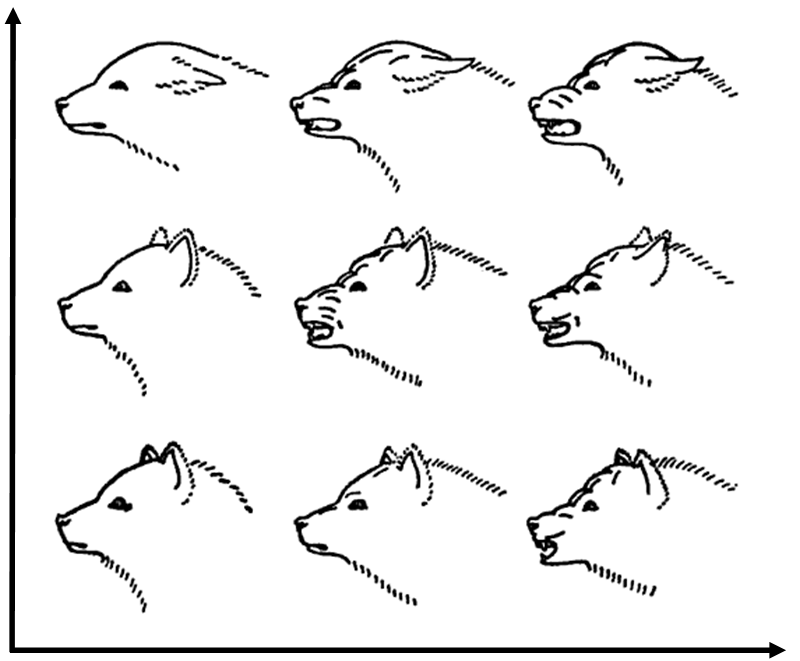
Dog communication is about how dogs "speak" to each other, how they understand messages that humans send to them, and how humans can translate the ideas that dogs are trying to transmit. These communication behaviors include eye gaze, facial expression, vocalization, body posture (including movements of bodies and limbs) and gustatory communication (scents, pheromones and taste). Humans communicate with dogs by using vocalization, hand signals, and body posture. Dogs can also learn to understand the communication of emotions with humans by reading human facial expressions.
Two studies have indicated that dog behavior vary based on their size, body weight, and skull size.
Play between dogs usually involves several behaviors often seen in aggressive encounters, such as nipping, biting and growling. It is therefore important for the dogs to place these behaviors in the context of the play, rather than aggression. Dogs signal their intent to play with a range of behaviors including a "play-bow", "face-paw", "open-mouthed play face" and postures inviting the other dog to chase the initiator. Similar signals are given throughout the play to maintain the context of the potentially aggressive activities.
From a young age, dogs engage in play with one another. Dog play is made up primarily of mock fights. It is believed that this behavior, which is most common in puppies, is training for important behaviors later in life. Some early socialization methods, such as puppy classes or "puppy parties" have been shown to positively influence adult dog behavior. Play between puppies is not necessarily a 50:50 symmetry of dominant and submissive roles between the individuals; dogs who engage in greater rates of dominant behaviors (e.g. chasing, forcing partners down) at later ages also initiate play at higher rates. This could imply that winning during play becomes more important as puppies mature.
Dog behavior
Dog behavior is the internally coordinated responses of individuals or groups of domestic dogs to internal and external stimuli. It has been shaped by millennia of contact with humans and their lifestyles. As a result of this physical and social evolution, dogs have acquired the ability to understand and communicate with humans. Behavioral scientists have uncovered a wide range of social-cognitive abilities in domestic dogs. Dog behavior is influenced from a combination of many physiological factors, environmental conditions or issues, and human interaction; all of which play a part in the development of a dog's behavior and welfare.
The origin of the domestic dog (Canis familiaris) is not clear. Whole-genome sequencing indicates that the dog, the gray wolf and the extinct Taymyr wolf diverged around the same time 27,000–40,000 years ago. How dogs became domesticated is not clear, however the two main hypotheses are self-domestication or human domestication. There exists evidence of human-canine behavioral coevolution.
Dog intelligence is the ability of the dog to perceive information and retain it as knowledge in order to solve problems. Dogs have been shown to learn by inference. A study with Rico showed that he knew the labels of over 200 different items. He inferred the names of novel items by exclusion learning and correctly retrieved those novel items immediately. He also retained this ability four weeks after the initial exposure. Dogs have advanced memory skills. A study documented the learning and memory capabilities of a border collie, "Chaser", who had learned the names and could associate by verbal command over 1,000 words. Dogs are able to read and react appropriately to human body language such as gesturing and pointing, and to understand human voice commands. After undergoing training to solve a simple manipulation task, dogs that are faced with an insolvable version of the same problem look at the human, while socialized wolves do not. Dogs demonstrate a theory of mind by engaging in deception.
The dog's senses include vision, hearing, sense of smell, taste, touch, proprioception, and sensitivity to the Earth's magnetic field.
Dog communication is about how dogs "speak" to each other, how they understand messages that humans send to them, and how humans can translate the ideas that dogs are trying to transmit. These communication behaviors include eye gaze, facial expression, vocalization, body posture (including movements of bodies and limbs) and gustatory communication (scents, pheromones and taste). Humans communicate with dogs by using vocalization, hand signals, and body posture. Dogs can also learn to understand the communication of emotions with humans by reading human facial expressions.
Two studies have indicated that dog behavior vary based on their size, body weight, and skull size.
Play between dogs usually involves several behaviors often seen in aggressive encounters, such as nipping, biting and growling. It is therefore important for the dogs to place these behaviors in the context of the play, rather than aggression. Dogs signal their intent to play with a range of behaviors including a "play-bow", "face-paw", "open-mouthed play face" and postures inviting the other dog to chase the initiator. Similar signals are given throughout the play to maintain the context of the potentially aggressive activities.
From a young age, dogs engage in play with one another. Dog play is made up primarily of mock fights. It is believed that this behavior, which is most common in puppies, is training for important behaviors later in life. Some early socialization methods, such as puppy classes or "puppy parties" have been shown to positively influence adult dog behavior. Play between puppies is not necessarily a 50:50 symmetry of dominant and submissive roles between the individuals; dogs who engage in greater rates of dominant behaviors (e.g. chasing, forcing partners down) at later ages also initiate play at higher rates. This could imply that winning during play becomes more important as puppies mature.
Recent media
Recent media