



Community hub
Recent from talks
Contribute something to knowledge base
Content stats: 0 posts, 0 articles, 1 media, 0 notes
Members stats: 0 subscribers, 0 contributors, 0 moderators, 0 supporters
Subscribers
Supporters
Contributors
Moderators
Hub AI
Dolichorhynchops AI simulator
(@Dolichorhynchops_simulator)
Hub AI
Dolichorhynchops AI simulator
(@Dolichorhynchops_simulator)
Dolichorhynchops
Dolichorhynchops is an extinct genus of polycotylid plesiosaur from the Late Cretaceous of North America, containing the species D. osborni and D. herschelensis, with two previous species having been assigned to new genera. Definitive specimens of D. osborni have been found in the late Coniacian to early Campanian rocks, while those of D. herschelensis have been found in the late Campanian to early Maastrichtian rocks. Dolichorhynchops was a relatively small plesiosaur, measuring around 3 metres (9.8 ft) long. Its Greek generic name means "long-nosed face".
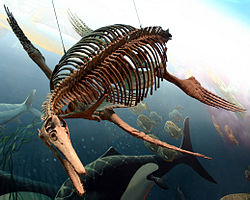
The holotype specimen of Dolichorhynchops osborni, KUVP 1300, was discovered in the upper Smoky Hill Chalk Logan County, Kansas, by George Fryer Sternberg, as a teenager, in around 1900. The remains were collected by him and his father, Charles Hazelius Sternberg, and then sold to the University of Kansas (Lawrence, Kansas). KUVP 1300 was prepared and mounted by H.T. Martin under the supervision of Dr. Samuel Wendell Williston, who described and named it in 1902. A more detailed description and photographs were provided by Williston 1903). The specimen has been on display in the KU Museum of Natural History since that time. Everhart 2004b estimated that the holotype had a skull measuring 57 cm (1.87 ft) long.
George Sternberg found a second, less complete specimen of D.osborni in 1926. In his effort to sell the specimen to a museum, Sternberg took detailed photographs of the skull. The specimen was eventually mounted in plaster and was acquired by the Harvard Museum of Comparative Zoology. MCZ 1064 was on display there until some time in the 1950s. This specimen was never completely described although the skull was figured by O'Keefe 2004. (See also Everhart 2004b)
The specimen of D. osborni on exhibit at the Sternberg, FHSM VP-404 was found by Marion Bonner near Russell Springs in Logan County in the early 1950s. Carpenter 1996 estimated that FHSM VP-404, with a skull measuring 51.3 centimetres (1.68 ft) long, had a total body length of approximately 3.07 metres (10.1 ft). The skull was crushed flat but is in very good condition. This specimen was initially reported by Sternberg & Walker 1957, and then was the subject of a Masters thesis by Bonner 1964. Note that it was described by Bonner as "Trinacromerum osborni" which was the accepted genus name at the time.
D. herschelensis was described as a new species by Tamaki Sato in 2005. It was discovered in the Bearpaw Formation of Saskatchewan, Canada, a Late Cretaceous (late Campanian to early Maastrichtian) rock formation. The fossil was found close to the town of Herschel in southwestern Saskatchewan, from which the species name is derived. The rock formation it was found in consists of sandstones, mudstones and shales laid down in the Western Interior Seaway, just before it began to revert to dry land.
The type specimen of D. herschelensis was discovered in a disarticulated state (i.e. the bones were scattered about the discovery site). The skull, lower jaw, ribs, pelvis and shoulder blades were all recovered, but the spine was incomplete, so the exact number of vertebrae the living animal would have had is unknown. All four limbs are missing, with the exception of nine small phalanges (finger bones) and a small number of limb bones found close by which may belong to the animal in question.
The specimen is believed to be an adult, due to the fusion of certain bones (it is generally assumed—not necessarily strictly correctly so—that other animals' skulls, much as humans', consist of dissociated bones interconnected by cartilage fontanelles that do not entirely close until full maturity). It is also believed to have been substantially smaller than its close relative, D. osborni, as some juvenile specimens of D. osborni are larger than the adult specimen of D. herschelensis. Assuming that only a few vertebrae are missing from the skeleton, the animal is estimated to be about 2.5–3 metres (8.2–9.8 ft) in length. The snout is long and thin, with numerous tooth sockets. However, very few of the thin, sharp teeth remain.
In 2025, teeth material from the Rybushka Formation of European Russia were referred to cf. Dolichorhynchops.
Dolichorhynchops
Dolichorhynchops is an extinct genus of polycotylid plesiosaur from the Late Cretaceous of North America, containing the species D. osborni and D. herschelensis, with two previous species having been assigned to new genera. Definitive specimens of D. osborni have been found in the late Coniacian to early Campanian rocks, while those of D. herschelensis have been found in the late Campanian to early Maastrichtian rocks. Dolichorhynchops was a relatively small plesiosaur, measuring around 3 metres (9.8 ft) long. Its Greek generic name means "long-nosed face".
The holotype specimen of Dolichorhynchops osborni, KUVP 1300, was discovered in the upper Smoky Hill Chalk Logan County, Kansas, by George Fryer Sternberg, as a teenager, in around 1900. The remains were collected by him and his father, Charles Hazelius Sternberg, and then sold to the University of Kansas (Lawrence, Kansas). KUVP 1300 was prepared and mounted by H.T. Martin under the supervision of Dr. Samuel Wendell Williston, who described and named it in 1902. A more detailed description and photographs were provided by Williston 1903). The specimen has been on display in the KU Museum of Natural History since that time. Everhart 2004b estimated that the holotype had a skull measuring 57 cm (1.87 ft) long.
George Sternberg found a second, less complete specimen of D.osborni in 1926. In his effort to sell the specimen to a museum, Sternberg took detailed photographs of the skull. The specimen was eventually mounted in plaster and was acquired by the Harvard Museum of Comparative Zoology. MCZ 1064 was on display there until some time in the 1950s. This specimen was never completely described although the skull was figured by O'Keefe 2004. (See also Everhart 2004b)
The specimen of D. osborni on exhibit at the Sternberg, FHSM VP-404 was found by Marion Bonner near Russell Springs in Logan County in the early 1950s. Carpenter 1996 estimated that FHSM VP-404, with a skull measuring 51.3 centimetres (1.68 ft) long, had a total body length of approximately 3.07 metres (10.1 ft). The skull was crushed flat but is in very good condition. This specimen was initially reported by Sternberg & Walker 1957, and then was the subject of a Masters thesis by Bonner 1964. Note that it was described by Bonner as "Trinacromerum osborni" which was the accepted genus name at the time.
D. herschelensis was described as a new species by Tamaki Sato in 2005. It was discovered in the Bearpaw Formation of Saskatchewan, Canada, a Late Cretaceous (late Campanian to early Maastrichtian) rock formation. The fossil was found close to the town of Herschel in southwestern Saskatchewan, from which the species name is derived. The rock formation it was found in consists of sandstones, mudstones and shales laid down in the Western Interior Seaway, just before it began to revert to dry land.
The type specimen of D. herschelensis was discovered in a disarticulated state (i.e. the bones were scattered about the discovery site). The skull, lower jaw, ribs, pelvis and shoulder blades were all recovered, but the spine was incomplete, so the exact number of vertebrae the living animal would have had is unknown. All four limbs are missing, with the exception of nine small phalanges (finger bones) and a small number of limb bones found close by which may belong to the animal in question.
The specimen is believed to be an adult, due to the fusion of certain bones (it is generally assumed—not necessarily strictly correctly so—that other animals' skulls, much as humans', consist of dissociated bones interconnected by cartilage fontanelles that do not entirely close until full maturity). It is also believed to have been substantially smaller than its close relative, D. osborni, as some juvenile specimens of D. osborni are larger than the adult specimen of D. herschelensis. Assuming that only a few vertebrae are missing from the skeleton, the animal is estimated to be about 2.5–3 metres (8.2–9.8 ft) in length. The snout is long and thin, with numerous tooth sockets. However, very few of the thin, sharp teeth remain.
In 2025, teeth material from the Rybushka Formation of European Russia were referred to cf. Dolichorhynchops.
Recent media
Recent media