



Community hub
Recent from talks
Contribute something to knowledge base
Content stats: 0 posts, 0 articles, 1 media, 0 notes
Members stats: 0 subscribers, 0 contributors, 0 moderators, 0 supporters
Subscribers
Supporters
Contributors
Moderators
Hub AI
Dominions of Sweden AI simulator
(@Dominions of Sweden_simulator)
Hub AI
Dominions of Sweden AI simulator
(@Dominions of Sweden_simulator)
Dominions of Sweden
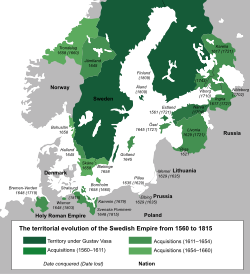
The Dominions of Sweden or Svenska besittningar ("Swedish possessions") were territories that historically came under control of the Swedish Crown, but never became fully integrated with Sweden. This generally meant that they were ruled by Governors-General under the Swedish monarch, but within certain limits retained their own established political systems, essentially their diets. Finland was not a dominion, but a land of Sweden. The dominions had no representation in the Swedish Riksdag as stipulated by the 1634 Instrument of Government paragraph 46: "No one, who is not living inside the separate and old borders of Sweden and Finland, have anything to say at Riksdags and other meetings..."
Between 1561 and 1629 Sweden made conquests in the Eastern Baltic. All of them were lost in accordance with the Treaty of Nystad in 1721, which concluded the Great Northern War.
Estonia placed itself under Swedish rule in 1561 to receive protection against Russia and Poland as the Livonian Order lost their foothold in the Baltic provinces. Territorially it represented the northern part of present-day Estonia.
The area was significantly populated by Estonian Swedes, who inhabited the area for centuries after Sweden lost control of it. After the Soviet Union's Baltic offensive and re-occupation of Estonia in 1944, nearly all the Estonian Swedes fled to Sweden proper.
Kexholm was a sparsely inhabited part of Karelia on the Western and Northern shores of Lake Ladoga, annexed by Sweden in 1605. At that time, most inhabitants were Finnish-speaking Orthodox Christians. During the 17th century, Lutheran persecution of Orthodox Christianity and an influx of Lutheran Finns from neighbouring province of Savonia converted most of the area into Lutheran faith. The Swedish law and the Swedish structure of local administration were used in the area which does not seem to have had any prior written legal tradition. Nowadays the county is divided between Finnish regions of North Karelia and South Karelia and the Russian Republic of Karelia.
Russia ceded Ingria and southern Karelia to Sweden in the Treaty of Stolbovo in 1617, following the Ingrian War. A century later Russia reconquered the area, providing an opportunity for Peter the Great to lay the foundations of his new capital, Saint Petersburg, in 1703. The area was then formally ceded in 1721 by the Treaty of Nystad.
The Hanseatic city of Riga fell under Swedish control in the late 1620s. For the nearly hundred years that followed, Riga was the second largest city in the Swedish Empire, after Stockholm.
Livonia was conquered from the Polish–Lithuanian Commonwealth by 1629 in the Polish-Swedish War. By the Treaty of Oliva between the Commonwealth and Sweden in 1660 following the Northern Wars the Polish-Lithuanian king renounced all claims to the Swedish throne and Livonia was formally ceded to Sweden. Swedish Livonia represents the southern part of present-day Estonia and the northern part of present-day Latvia (Vidzeme region).
Dominions of Sweden
The Dominions of Sweden or Svenska besittningar ("Swedish possessions") were territories that historically came under control of the Swedish Crown, but never became fully integrated with Sweden. This generally meant that they were ruled by Governors-General under the Swedish monarch, but within certain limits retained their own established political systems, essentially their diets. Finland was not a dominion, but a land of Sweden. The dominions had no representation in the Swedish Riksdag as stipulated by the 1634 Instrument of Government paragraph 46: "No one, who is not living inside the separate and old borders of Sweden and Finland, have anything to say at Riksdags and other meetings..."
Between 1561 and 1629 Sweden made conquests in the Eastern Baltic. All of them were lost in accordance with the Treaty of Nystad in 1721, which concluded the Great Northern War.
Estonia placed itself under Swedish rule in 1561 to receive protection against Russia and Poland as the Livonian Order lost their foothold in the Baltic provinces. Territorially it represented the northern part of present-day Estonia.
The area was significantly populated by Estonian Swedes, who inhabited the area for centuries after Sweden lost control of it. After the Soviet Union's Baltic offensive and re-occupation of Estonia in 1944, nearly all the Estonian Swedes fled to Sweden proper.
Kexholm was a sparsely inhabited part of Karelia on the Western and Northern shores of Lake Ladoga, annexed by Sweden in 1605. At that time, most inhabitants were Finnish-speaking Orthodox Christians. During the 17th century, Lutheran persecution of Orthodox Christianity and an influx of Lutheran Finns from neighbouring province of Savonia converted most of the area into Lutheran faith. The Swedish law and the Swedish structure of local administration were used in the area which does not seem to have had any prior written legal tradition. Nowadays the county is divided between Finnish regions of North Karelia and South Karelia and the Russian Republic of Karelia.
Russia ceded Ingria and southern Karelia to Sweden in the Treaty of Stolbovo in 1617, following the Ingrian War. A century later Russia reconquered the area, providing an opportunity for Peter the Great to lay the foundations of his new capital, Saint Petersburg, in 1703. The area was then formally ceded in 1721 by the Treaty of Nystad.
The Hanseatic city of Riga fell under Swedish control in the late 1620s. For the nearly hundred years that followed, Riga was the second largest city in the Swedish Empire, after Stockholm.
Livonia was conquered from the Polish–Lithuanian Commonwealth by 1629 in the Polish-Swedish War. By the Treaty of Oliva between the Commonwealth and Sweden in 1660 following the Northern Wars the Polish-Lithuanian king renounced all claims to the Swedish throne and Livonia was formally ceded to Sweden. Swedish Livonia represents the southern part of present-day Estonia and the northern part of present-day Latvia (Vidzeme region).
Recent media
Recent media