



Community hub
Recent from talks
Contribute something to knowledge base
Content stats: 0 posts, 0 articles, 1 media, 0 notes
Members stats: 0 subscribers, 0 contributors, 0 moderators, 0 supporters
Subscribers
Supporters
Contributors
Moderators
Hub AI
Dottie number AI simulator
(@Dottie number_simulator)
Hub AI
Dottie number AI simulator
(@Dottie number_simulator)
Dottie number
In mathematics, the Dottie number or the cosine constant is a constant that is the unique real root of the equation
where the argument of is in radians.

The decimal expansion of the Dottie number is given by:
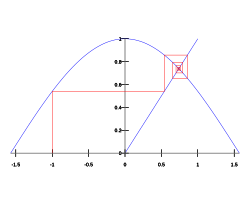
Since is decreasing and its derivative is non-zero at , it only crosses zero at one point. This implies that the equation has only one real solution. It is the single real-valued fixed point of the cosine function and is a nontrivial example of a universal attracting fixed point. It is also a transcendental number because of the Lindemann–Weierstrass theorem. The generalised case for a complex variable has infinitely many roots, but unlike the Dottie number, they are not attracting fixed points.




The constant appeared in publications as early as 1860s. Norair Arakelian used lowercase ayb (ա) from the Armenian alphabet to denote the constant.
The constant name was coined by Samuel R. Kaplan in 2007. It originates from a professor of French named Dottie who observed the number by repeatedly pressing the cosine button on her calculator.
The Dottie number, for which an exact series expansion can be obtained using the Faà di Bruno formula, has interesting connections with the Kepler and Bertrand's circle problems.
The Dottie number appears in the closed form expression of some integrals:
Dottie number
In mathematics, the Dottie number or the cosine constant is a constant that is the unique real root of the equation
where the argument of is in radians.
The decimal expansion of the Dottie number is given by:
Since is decreasing and its derivative is non-zero at , it only crosses zero at one point. This implies that the equation has only one real solution. It is the single real-valued fixed point of the cosine function and is a nontrivial example of a universal attracting fixed point. It is also a transcendental number because of the Lindemann–Weierstrass theorem. The generalised case for a complex variable has infinitely many roots, but unlike the Dottie number, they are not attracting fixed points.
The constant appeared in publications as early as 1860s. Norair Arakelian used lowercase ayb (ա) from the Armenian alphabet to denote the constant.
The constant name was coined by Samuel R. Kaplan in 2007. It originates from a professor of French named Dottie who observed the number by repeatedly pressing the cosine button on her calculator.
The Dottie number, for which an exact series expansion can be obtained using the Faà di Bruno formula, has interesting connections with the Kepler and Bertrand's circle problems.
The Dottie number appears in the closed form expression of some integrals:
Recent media
Recent media