


Community hub
Recent from talks
Contribute something
Nothing was collected or created yet.
Doyle Lawson
View on Wikipedia
Key Information


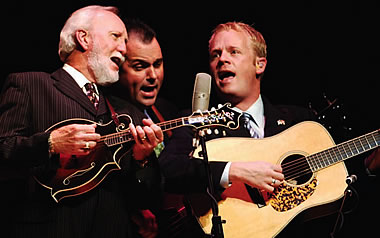
Doyle Wayne Lawson[1] (born April 20, 1944) is an American traditional bluegrass and Southern gospel musician.[2] He is best known as a mandolin player, vocalist, producer, and leader of the 6-man group Doyle Lawson & Quicksilver.[3] Lawson was inducted into the International Bluegrass Music Hall of Fame in 2012.
Early life
[edit]Doyle Lawson was born in Fordtown, Sullivan County, Tennessee,[4] the son of Leonard and Minnie Lawson. The Lawson family moved to Sneedville in 1954.[5] Lawson grew up listening to the Grand Ole Opry on Saturday nights. This is where he heard mandolinist Bill Monroe, the "founding father" of bluegrass, and his band the Blue Grass Boys.
Lawson became interested in playing the mandolin around the age of eleven so his father borrowed a mandolin from Willis Byrd, a family friend and fellow musician. Doyle taught himself how to play the mandolin by listening to the radio and records, and watching an occasional TV show.[2] Later Lawson learned to play the guitar and banjo as well.[4]
Career
[edit]Early career
[edit]In 1963, aged 18 or 19, Lawson went to Nashville to play the banjo with Jimmy Martin and the Sunny Mountain Boys.[6]
In 1966, he started playing with J.D. Crowe and the Kentucky Mountain Boys (later called the New South) in Lexington, Kentucky. He returned to play the mandolin and sing tenor with Martin in 1969 for six months, and then played again with Crowe until August 1971.[5][7]
In September 1971, Lawson started playing with The Country Gentlemen and remained part of the band for almost eight years. During that time, in 1977, he backed up U.S. Senator Robert Byrd on his Mountain Fiddler album. In March 1979, Lawson left the Country Gentlemen with the intention of forming a band and creating his own sound.[5][4]
Doyle Lawson & Quicksilver
[edit]Within a month Lawson had formed Doyle Lawson and Foxfire, with Jimmy Haley on guitar, Lou Reid on bass, and Terry Baucom on banjo.[4] The band name was soon changed to Doyle Lawson and Quicksilver.[8][9] In 1981, through Sugar Hill Records, Lawson with this lineup released the critically acclaimed Rock My Soul, an album that would become a landmark bluegrass gospel project.[6][10][11] With a new bassist, Randy Graham, the band recorded a second gospel album, Heavenly Treasures, also on Sugar Hill.[4][8]
Shortly thereafter, Graham, Baucom and Haley left to form their own band. Lawson hired guitarist Russell Moore, banjoist Scott Vestal and bassist Curtis Vestal, and continued to perform. After a time Ray Deaton took over on bass.[4]
In 1989 the band won song of the year at the International Bluegrass Music Awards for "Little Mountain Church House". In 1997, There's a Light Guiding Me was a 39th Annual Grammy Award nominee for Best Southern Gospel, Country Gospel or Bluegrass Gospel Album.[12] Through the years, Quicksilver toured regularly, performing at festivals concerts and other musical events.[13]
In 1998, Lawson and Quicksilver became the first bluegrass band to perform at the National Quartet Convention. Lawson and Quicksilver performed in Ontario, Canada at the Tottenham Bluegrass Festival in June 2001[14] and again in June 2015. Lawson and Quicksilver provided the background vocals to the song "Dazzling Blue" on Paul Simon's 2011 album So Beautiful or So What. In 2015, In Session was nominated for Best Bluegrass Album at the 58th Annual Grammy Awards.[15]

Lawson composed a number of the band's songs and tunes. His instrumental piece "Rosine", is a tribute to Monroe's birthplace and features, among other things, strains from the singer's 1967 instrumental "Kentucky Mandolin".[16] Lawson hosts the annual Doyle Lawson and Quicksilver Festival in Denton, North Carolina. In 2021, Lawson announced his retirement as a bandleader. Doyle Lawson and Quicksilver played their last show in the winter of 2021.
Personal life
[edit]Doyle has been married to Suzanne Lawson since 1978. He has one son, two daughters, and a grandchild. Doyle rededicated his life to Christianity in May 1985 and is a practicing member of Cold Spring Presbyterian Church.[citation needed]
Band members
[edit]Final lineup
- Doyle Lawson — mandolin, mandola, guitar, dojo, lead, baritone and low tenor vocals (1979–2021)
- Eli Johnston — banjo, guitar, bass (2013–2018), lead, baritone and low tenor vocals (2013–2018, 2020–2021)
- Stephen Burwell — fiddle, percussion (2014–2020, 2021)
- Jerry Cole — bass, guitar, percussion, lead, tenor and baritone vocals (2018–2021)
- Ben James — guitar, lead and tenor vocals (2020–2021)
- Matt Flake – fiddle, bass, bass vocals (2020–2021)
Discography
[edit]Studio albums
[edit]| Year | Album | US Bluegrass | Label |
|---|---|---|---|
| 1977 | Tennessee Dream | County | |
| 1979 | Doyle Lawson & Quicksilver | Sugar Hill | |
| 1981 | Heavenly Treasures | ||
| Quicksilver Rides Again | |||
| Rock My Soul | |||
| 1985 | Once and for Always | ||
| 1986 | Beyond the Shadows | ||
| 1987 | The News Is Out | ||
| 1988 | Heaven's Joy Awaits | ||
| Hymn Time in the Country | |||
| I'll Wander Back Someday | |||
| 1989 | I Heard the Angels Singing | ||
| 1990 | My Heart Is Yours[7] | ||
| 1991 | Merry Christmas from Our House to Your House | ||
| 1992 | Pressing on Regardless | Brentwood | |
| Treasures Money Can't Buy | |||
| 1995 | Doyle Lawson with Bobby Hicks & Jerry Douglas | Koch | |
| Never Walk Away | Sugar Hill | ||
| 1996 | There's a Light Guiding Me | ||
| 1997 | Kept & Protected | ||
| 1998 | Gospel Radio Gems | ||
| 1999 | Original Band | ||
| Winding Through Life | |||
| 2000 | Just Over in Heaven | ||
| 2001 | Gospel Parade | ||
| 2002 | The Hard Game of Love | ||
| 1994 | Hallelujah in My Heart | Music Mill | |
| Thank God | Crossroads | ||
| 2005 | You Gotta Dig a Little Deeper[17] | 4 | Rounder |
| 2006 | He Lives in Me | 4 | Crossroads |
| 2007 | More Behind the Picture Than the Wall | 2 | Rounder |
| 2008 | Help Is On the Way | 4 | Horizon |
| 2009 | Lonely Street | Rounder | |
| 2010 | Light On My Feet, Ready to Fly | 11 | Horizon |
| 2011 | Drive Time | 15 | Crossroads |
| 2012 | Sing Me a Song About Jesus | 9 | |
| 2013 | Roads Well Traveled | 14 | Mountain Home |
| 2014 | Open Carefully, Message Inside[18] | 10 | |
| 2015 | In Session[19] | 8 | |
| 2016 | Burden Bearer | 4 | |
| 2017 | Life is a Story | Mountain Home | |
| 2019 | Live in Prague, Czech Republic | Billy Blue Records | |
| 2022 | Roundtable |
Compilation albums
[edit]| Year | Album | US Bluegrass | Label |
|---|---|---|---|
| 1990 | The Gospel Collection 1 | Sugar Hill | |
| 1999 | A School of Bluegrass | 9 | Crossroads |
| Once and for Always/The News Is Out | Sugar Hill | ||
| 2007 | Best of the Sugar Hill Years |
Awards
[edit]Lawson is a recipient of a 2006 National Heritage Fellowship awarded by the National Endowment for the Arts, which is the United States government's highest honor in the folk and traditional arts.[20]
International Bluegrass Music Association
[edit]- 1990 Song of the Year: Doyle Lawson and Quicksilver for "Little Mountain Church"[7]
- 1996 Gospel Recorded Performance of the Year: Doyle Lawson and Quicksilver for "There's a Light Guiding Me"[7]
- 2000 Gospel Recorded Performance of the Year: Doyle Lawson and Quicksilver for "Winding Through Life"
- 2001 Vocal Group of the Year: Doyle Lawson and Quicksilver
- 2002 Vocal Group of the Year: Doyle Lawson and Quicksilver
- 2003 Vocal Group of the Year: Doyle Lawson and Quicksilver
- 2003 Song of the Year: Doyle Lawson and Quicksilver for "Blue Train"
- 2003 Gospel Recorded Performance of the Year: Doyle Lawson and Quicksilver for "Hand Made Cross"
- 2004 Vocal Group of the Year: Doyle Lawson and Quicksilver
- 2005 Vocal Group of the Year: Doyle Lawson and Quicksilver
- 2005 Gospel Recorded Performance of the Year: Doyle Lawson and Quicksilver for "Praise His Name"
- 2006 Vocal Group of the Year: Doyle Lawson and Quicksilver
- 2006 Album of the Year: Celebration of Life: Musicians Against Childhood Cancer, featuring various bluegrass bands and musicians
- 2006 Gospel Recorded Performance of the Year: Doyle Lawson and Quicksilver for "He Lives in Me"
- 2007 Vocal Group of the Year: Doyle Lawson and Quicksilver
- 2007 Gospel Recorded Performance of the Year: Doyle Lawson and Quicksilver for "He Lives in Me"
- 2011 Recorded Event of the Year: Doyle Lawson, J. D. Crowe, Paul Williams for "Prayer Bells of Heaven"
- 2011 Gospel Recorded Performance of the Year: Doyle Lawson, J. D. Crowe, Paul Williams for "Prayer Bells of Heaven"
- 2012 Hall of Fame: Doyle Lawson[19][21]
References
[edit]- ^ "Brother Have You Heard". ASCAP. American Society of Composers, Authors and Publishers. Retrieved April 26, 2023.
- ^ a b Appalachian Journal. 1980. pp. 331–332.
- ^ Loyal Jones (October 8, 2008). Country Music Humorists and Comedians. University of Illinois Press. pp. 238–. ISBN 978-0-252-03369-8.
- ^ a b c d e f W. K. McNeil (October 18, 2013). Encyclopedia of American Gospel Music. Routledge. pp. 226–. ISBN 978-1-135-37700-7.
- ^ a b c Stephanie P. Ledgin (2004). Homegrown Music: Discovering Bluegrass. Greenwood Publishing Group. pp. 47–. ISBN 978-0-275-98115-0.
- ^ a b Kurt Wolff; Orla Duane (2000). Country Music: The Rough Guide. Rough Guides. pp. 228–. ISBN 978-1-85828-534-4.
- ^ a b c d Contemporary Musicians. Gale Research, Incorporated. 2006. pp. 101–102. ISBN 978-0-7876-8068-8.
- ^ a b Thomas Goldsmith (2004). The Bluegrass Reader. University of Illinois Press. pp. 248–. ISBN 978-0-252-02914-1.
- ^ "No one since the late great Bill Monroe melds bluegrass with gospel music quite like the former Country Gentlemen member Doyle Lawson…" Memphis Commercial Appeal (what date?).
- ^ Neil V. Rosenberg (2005). Bluegrass: A History. University of Illinois Press. pp. 376–. ISBN 978-0-252-07245-1.
- ^ Option. Sonic Options Network. 1987. p. 64.
- ^ "The Complete List of Nominees". Los Angeles Times. January 8, 1997. ISSN 0458-3035. Retrieved January 27, 2017.
- ^ No Depression. No Depression. 2004. pp. 22, issues 49–54.
- ^ Strings, newsletter of the Pineridge Bluegrass Folklore Society, May/June 2001
- ^ "58th Annual Grammy Awards". Grammy Awards. Retrieved June 14, 2024.
- ^ Profile Archived December 3, 2012, at the Wayback Machine, ibmaawards.org; accessed October 30, 2015.
- ^ "Billboard Picks". Billboard. Nielsen Business Media, Inc. April 16, 2005. pp. 44–. ISSN 0006-2510.
- ^ "Open Carefully. Message Inside. from Doyle Lawson & Quicksilver" Archived September 8, 2015, at the Wayback Machine. Cybergrass Bluegrass Music News Network, 07/09/2014
- ^ a b "Doyle Lawson & Quicksilver In Session". Pop Matters, Jonathan Frahm 20 February 2015.
- ^ "NEA National Heritage Fellowships 2006". www.arts.gov. National Endowment for the Arts. Archived from the original on May 21, 2020. Retrieved January 6, 2021.
- ^ Profile Archived January 3, 2018, at the Wayback Machine, ibma.org; accessed August 16, 2016.
External links
[edit]
Doyle Lawson
View on GrokipediaBiography
Early life
Doyle Lawson was born on April 20, 1944, in Ford Town, Sullivan County, Tennessee, to parents Leonard and Minnie Lawson.[2] He grew up in a family that included two brothers, James and Les, and a sister, Colleen.[2] In 1954, the Lawson family relocated to Sneedville, Tennessee, where Doyle spent much of his formative years in the rural Appalachian setting.[3] From an early age, Lawson was immersed in music through family traditions and local culture. His family frequently participated in gospel singing at church gatherings and local events, with his parents and relatives forming trios and quartets that performed a cappella harmonies.[2] This environment fostered his initial appreciation for vocal music, while broader exposure to regional bluegrass came via community jams and informal music sessions in East Tennessee.[13] Lawson's passion for bluegrass ignited through radio broadcasts of the Grand Ole Opry, which he listened to regularly as a child.[14] He was particularly inspired by Bill Monroe and his Blue Grass Boys, drawn to the mandolin's "high lonesome" sound that defined the genre.[2] At age 11, Lawson began teaching himself to play the mandolin on a borrowed instrument, practicing by ear from Opry recordings and live radio performances.[8]Personal life
Doyle Lawson married Suzanne Lawson on June 24, 1978.[2] The couple has three children: one son, Robbie, and two daughters, Suzi and Kristi.[2] As of recent updates, they also have one grandchild, grandson Spencer, with whom they spend much of their spare time.[2] In May 1985, Lawson rededicated his life to Christianity, an event that profoundly shaped his personal values and decisions thereafter.[15] He and his family are active members of Cold Spring Presbyterian Church in Bristol, Tennessee, where he worships regularly when not traveling.[2] Following his retirement from touring in 2022, Lawson resides in Bristol, Tennessee, with his wife, embracing a quieter lifestyle centered on family and personal interests.[16] He enjoys collecting Western memorabilia, particularly items related to Roy Rogers, as a favored hobby outside of music.[2] His involvement in the local church community continues to provide a foundation for his post-retirement days.[2]Musical Career
Early career
Doyle Lawson's professional career in bluegrass music began in 1963 when, at the age of 18, he moved to Nashville and joined Jimmy Martin and the Sunny Mountain Boys as their banjo player. This marked his first significant gig on the bluegrass circuit, where he performed alongside Martin's high-energy style and contributed to the band's live shows and recordings during his initial tenure.[3][2] In 1966, Lawson relocated to Lexington, Kentucky, to join J.D. Crowe and the Kentucky Mountain Boys, initially playing guitar before transitioning to mandolin. He remained with the band through 1969, briefly returning to Jimmy Martin's group for six months that year before rejoining Crowe until August 1971. During this period, Lawson made his recording debut on the 1968 album Bluegrass Holiday, featuring collaborations with Red Allen on guitar and vocals, showcasing his emerging skills on mandolin and tenor vocals.[3][17][2] Lawson then spent nearly eight years with The Country Gentlemen, starting on September 1, 1971, and departing in March 1979. In this role, he solidified his position as the band's mandolinist and high tenor singer, contributing to numerous albums and extensive tours, including a notable 1972 trip to Japan. His work with the group honed his vocal harmonies and instrumental precision, drawing from influences like Bill Monroe's style encountered in his youth. During this time, in 1977, Lawson backed U.S. Senator Robert Byrd on the album Mountain Fiddler, providing guitar accompaniment alongside banjoist James Bailey and bassist Spider Gilliam.[2][18][19] By the late 1970s, Lawson's focus had shifted primarily to mandolin and lead/baritone vocals, establishing him as a versatile front-line musician in bluegrass ensembles. This evolution from banjo through multi-instrumental roles prepared him for greater leadership opportunities in the genre.[3][20]Doyle Lawson & Quicksilver
Doyle Lawson formed his band in April 1979, initially naming it Doyle Lawson & Foxfire, before renaming it Doyle Lawson & Quicksilver shortly thereafter to reflect a desire for a name evoking speed and precision in their bluegrass style.[2] The group debuted with an eponymous album in 1980 on Sugar Hill Records, featuring original members including banjoist Terry Baucom, guitarist Jimmy Haley, and bassist Lou Reid, alongside Lawson's lead mandolin and tenor vocals.[18] This formation marked Lawson's transition to band leadership, drawing on his prior experience to emphasize intricate instrumental interplay and vocal harmonies rooted in traditional bluegrass. The band's early sound evolved with their 1981 release Rock My Soul, a landmark album that established their signature blend of bluegrass and gospel through a cappella quartet harmonies and spiritual themes, revitalizing the genre's gospel tradition.[18] Following a personal faith rededication in 1985, Lawson shifted the group's focus more deeply toward gospel-influenced bluegrass, incorporating themes of redemption and divine guidance while highlighting his precise mandolin technique—often featuring chop rhythms and melodic leads inspired by Bill Monroe—and the band's renowned tight harmonies, typically structured as three-part with a floating high tenor.[18] This evolution was evident in key releases like Hymn of Glory (1985), which deepened their spiritual repertoire, and later albums such as There's a Light Guiding Me (1997, nominated for a Grammy Award for Best Southern, Country, or Bluegrass Gospel Album), You Gotta Dig a Little Deeper (2005), and In Session (2015, nominated for a Grammy Award for Best Bluegrass Album).[2][21][22] Quicksilver's live performances underscored their growing prominence, including their historic appearance as the first bluegrass act at the National Quartet Convention in 1998, where they bridged gospel and bluegrass audiences with high-energy sets.[23] They also performed internationally at events like the Tottenham Bluegrass Festival in Ontario, Canada, in 2001 and 2015, contributing to their reputation for dynamic stage presence.[23] Over their four-decade run through 2021, the band released more than 40 albums, toured extensively across the United States, Europe, the Near East, and North Africa—where their acoustic gospel resonated with local traditions—and maintained a consistent sound that balanced virtuosic musicianship with heartfelt lyrical content.[18][24]Retirement and legacy
In April 2021, Doyle Lawson announced his intention to retire as the bandleader of Doyle Lawson & Quicksilver after more than four decades, with the group's final tour scheduled to conclude in December 2022.[16] This decision allowed Lawson to step away from the demanding road schedule while reflecting on a career marked by consistent innovation within traditional bluegrass. The band's final studio album, Roundtable, released in June 2021 on Billy Blue Records, featured a mix of original and classic material, serving as a capstone to their secular recordings and showcasing Lawson's signature mandolin precision alongside tight vocal harmonies.[25] Although a concluding gospel project was initially planned for 2022, no such release materialized with the band.[26] Following his retirement from full-time touring, Lawson has remained selectively active in the bluegrass community through guest appearances and production roles. In 2024, he joined Paul Williams for performances at Crowefest, delivering classic hits like "Hit Parade of Love" and "Prayer Bells in Heaven" to enthusiastic audiences.[27] As of 2025, Lawson continues to engage with the genre, serving as a presenter at the International Bluegrass Music Association (IBMA) Bluegrass Music Awards, where he contributes to recognizing emerging talent.[28] These limited engagements underscore his ongoing commitment to music without the rigors of constant travel. Lawson's legacy endures through his profound influence on mandolin playing, where his dynamic, precise style—rooted in Bill Monroe's foundational techniques—has inspired generations of pickers to blend technical virtuosity with emotional depth.[29] He played a pivotal role in popularizing gospel elements within bluegrass, incorporating quartet-style harmonies and sacred themes that elevated the genre's spiritual dimension and broadened its appeal.[30] As a mentor, Lawson shaped numerous musicians through his band, many of whom, including members of the post-retirement group Authentic Unlimited, credit his leadership for their professional growth. His educational impact extends to informal workshops and his "School of Bluegrass" column, where he shares insights on technique and career navigation for aspiring artists.[31] Inducted into the International Bluegrass Music Hall of Fame in 2012 and the Blue Ridge Music Hall of Fame in 2023, Lawson's contributions to preserving traditional bluegrass while fostering its evolution cement his status as a cornerstone figure in the music's history.[3][32]Band and Collaborations
Band members
Doyle Lawson & Quicksilver maintained a core focus on multi-instrumentalists who excelled in vocal harmonies, enabling the band's signature blend of driving bluegrass instrumentation and gospel quartet-style singing. Each member typically handled lead, tenor, baritone, or bass vocals alongside their primary instruments, contributing to the group's tight, layered sound that emphasized emotional delivery in both sacred and secular material. This approach shaped Quicksilver's distinctive style, distinguishing it from more instrumentally dominant bluegrass ensembles by prioritizing vocal precision and blend.[2][33] The final lineup, active from approximately 2018 to the band's retirement in December 2021, consisted of Doyle Lawson on mandolin and lead vocals, Eli Johnston on banjo and vocals, Stephen Burwell on fiddle, Jerry Cole on guitar and vocals, Ben James on bass and vocals, and Matt Flake on dobro and steel guitar. Members often switched instruments during performances, with Johnston and Burwell providing rhythmic drive through banjo and fiddle interplay, while Cole, James, and Flake supported the low end and added harmonic depth on guitar, bass, and resophonic elements. This configuration enhanced the band's energetic live sound, particularly in fast-paced breakdowns and a cappella gospel numbers, as showcased in their farewell performances. Following the band's retirement, former members Eli Johnston, Stephen Burwell, and Jerry Cole formed the bluegrass group Authentic Unlimited in 2021.[25][34][35] Among notable past members, banjoist Terry Baucom served in the 1980s, helping establish the band's foundational progressive bluegrass tone with his three-finger picking style that complemented Lawson's mandolin leads. Guitarist and vocalist Jamie Dailey joined in the early 2000s through 2007, bringing dynamic lead vocals and flatpicking that infused Quicksilver's material with a more contemporary edge during albums like Rocky Road (2005). Bassist and vocalist Russell Moore performed in the early 2000s, contributing powerful baritone harmonies and upright bass lines that bolstered the group's rhythmic stability and vocal richness on recordings such as Just Over in the Gloryland (2001). These individuals not only filled key instrumental roles but also advanced the band's reputation for vocal excellence, with many going on to lead their own acclaimed acts.[2][36][37] The band experienced significant lineup turnover throughout its 42-year history, largely attributed to its rigorous touring demands as one of bluegrass's hardest-working acts, often performing over 150 shows annually. This pattern favored recruiting vocal harmony specialists capable of sustaining high-energy performances on the road, ensuring continuity in Quicksilver's polished, quartet-driven aesthetic despite frequent changes.[38][39]Notable collaborations
One of Doyle Lawson's early notable collaborations occurred in 1978 when he provided guitar accompaniment for U.S. Senator Robert Byrd on the album Mountain Fiddler, recorded in Byrd's Senate office and featuring traditional bluegrass tunes like "Cumberland Gap" and "Will the Circle Be Unbroken."[19] Lawson, then a member of the Country Gentlemen, joined Byrd alongside banjoist James Bailey and bassist Spider Gilliam for the session, which captured an informal, living-room-style performance emphasizing Appalachian musical heritage.[40] Throughout his career, Lawson made significant guest appearances on recordings with prominent bluegrass figures. In the early 1980s, he joined J.D. Crowe, Tony Rice, Bobby Hicks, and others as part of the Bluegrass Album Band, contributing mandolin and tenor vocals to five influential albums released between 1981 and 1996 on Rounder Records, including The Bluegrass Album (1981) and Blue Ridge Cabin Home (1996), which blended progressive and traditional bluegrass styles.[41] These projects showcased Lawson's harmonic expertise and helped bridge generations in the genre. Later, he appeared alongside Ricky Skaggs in all-star festival performances, such as the 2018 IBMA Wide Open Bluegrass event, where they joined forces for collaborative sets honoring bluegrass pioneers.[42] Lawson also took on production roles for select bluegrass projects in the 1990s and 2000s, guiding recordings that highlighted emerging talent while maintaining traditional sounds; for instance, he served as arranger on compilation tracks for albums like Bluegrass Essentials (1998), featuring contributions from multiple artists.[43] In special projects, Lawson contributed to tribute efforts celebrating bluegrass legends, including his band's performance of "Our Last Goodbye" on the 1997 compilation Legacy: A Tribute to the First Generation of Bluegrass, which honored Bill Monroe, Flatt & Scruggs, and the Stanley Brothers through reinterpretations by contemporary acts.[44] Additionally, he participated in multi-band festivals dedicated to Monroe, such as the 50th annual Bill Monroe Bluegrass Festival at Bean Blossom in 2016, where Doyle Lawson & Quicksilver performed alongside other groups to commemorate the event's history and Monroe's enduring influence.[45]Discography
Studio albums
Doyle Lawson's studio recordings, mainly under the banner of Doyle Lawson & Quicksilver, encompass a diverse body of work that evolved from roots in traditional bluegrass instrumentation and secular themes to a pronounced emphasis on Southern gospel harmonies and spiritual narratives. Early efforts highlighted his mandolin prowess and tight vocal arrangements, blending high-energy instrumentals with occasional sacred material, while later albums increasingly centered on faith-based songwriting, reflecting Lawson's personal conversion to Christianity in the mid-1980s. This shift is evident in the thematic depth of releases, where bluegrass drive supports messages of redemption and divine guidance, solidifying his reputation as a bridge between the genres.[46][47] Throughout his career, Lawson has worked with several prominent labels, beginning with Sugar Hill Records for his initial Quicksilver output in the early 1980s, followed by a period with Rounder Records in the 2000s, with select releases and reissues on Rebel Records, and transitioning to Mountain Home Music Company starting around 2010. This label progression paralleled the band's growing focus on gospel, with Sugar Hill facilitating experimental mixes of styles and later imprints enabling more dedicated sacred projects. Notable tracks across these albums include covers like "My Little Georgia Rose," a Bill Monroe standard reinterpreted with Quicksilver's signature vocal layering, and original gospel compositions such as "Help Is on the Way," which exemplifies the uplifting quartet harmonies that became a hallmark of his sound.[48][49][50] Key studio albums illustrate this trajectory:| Album Title | Release Year | Label | Thematic Significance |
|---|---|---|---|
| Rock My Soul | 1981 | Sugar Hill Records | Blends bluegrass instrumentals with gospel tracks like the title song, marking Lawson's early fusion of styles.[51] |
| Once and for Always | 1985 | Sugar Hill Records | Features a balance of secular bluegrass and emerging gospel elements, showcasing vocal precision on songs of longing and faith.[52] |
| There's a Light Guiding Me | 1996 | Sugar Hill Records | A pivotal gospel album emphasizing spiritual guidance, with the title track highlighting harmonious pleas for divine direction.[46] |
| You Gotta Dig a Little Deeper | 2005 | Rounder Records | Returns to traditional bluegrass roots with introspective themes, including covers that nod to classic influences.[53] |
| Burden Bearer | 2016 | Mountain Home Music Company | Fully gospel-oriented, exploring burdens of life through songs like the title track, earning a Grammy nomination for Best Bluegrass Album.[54] |
| Roundtable | 2021 | Billy Blue Records | Collaborative songwriting among band members yields a mix of bluegrass and gospel, serving as a reflective capstone before Lawson's touring retirement.[55] |
Compilation and live albums
Doyle Lawson's compilation albums primarily serve as retrospectives of his early work with Quicksilver, aggregating gospel and bluegrass tracks from previous studio releases to highlight his contributions to the genre. These collections, released post-1990, often feature remastered audio for improved sound quality and thematic focus on spiritual themes, appealing to fans seeking accessible overviews of his catalog. One notable compilation is The Gospel Collection Volume 1, released in 1990 by Sugar Hill Records, which gathers 15 gospel songs recorded between 1980 and 1989, including tracks like "My Lord Delivered Me" and "Calm the Storm," drawn from albums such as Rock My Soul and Heavenly Treasures.[56] Another key release, Best of the Sugar Hill Years (2007, Sugar Hill Records), compiles 18 remastered tracks spanning 1980 to 1992, serving as a career retrospective with hits like "Quicksilver Ride" and "Long Time Gone," emphasizing his mandolin-driven bluegrass style.[57] Additional compilations include The Original Band (1999, Sugar Hill Records), a remastered HDCD featuring early Quicksilver material from 1980 to 1981, such as selections from the debut album, to celebrate the band's formative sound.[58] Similarly, Once and for Always / The News Is Out (1999, Sugar Hill Records) combines two full 1980s albums on one disc, offering a bundled retrospective of mid-career gospel and bluegrass recordings without new material.[59]| Title | Year | Label | Notes |
|---|---|---|---|
| The Gospel Collection Volume 1 | 1990 | Sugar Hill Records | Themed gospel compilation from prior albums; 15 tracks.[56] |
| The Original Band | 1999 | Sugar Hill Records | Remastered early recordings; focuses on debut era.[58] |
| Once and for Always / The News Is Out | 1999 | Sugar Hill Records | Two-in-one reissue of 1980s albums.[59] |
| Best of the Sugar Hill Years | 2007 | Sugar Hill Records | Greatest hits retrospective; 18 remastered tracks.[57] |
| Title | Year | Label | Notes |
|---|---|---|---|
| Live in Prague, Czech Republic | 2019 | Billy Blue Records | International tour recording; 14 tracks with gospel and bluegrass selections.[60] |