
Recent from talks
Dung beetle
Knowledge base stats:
Talk channels stats:
Members stats:
Dung beetle
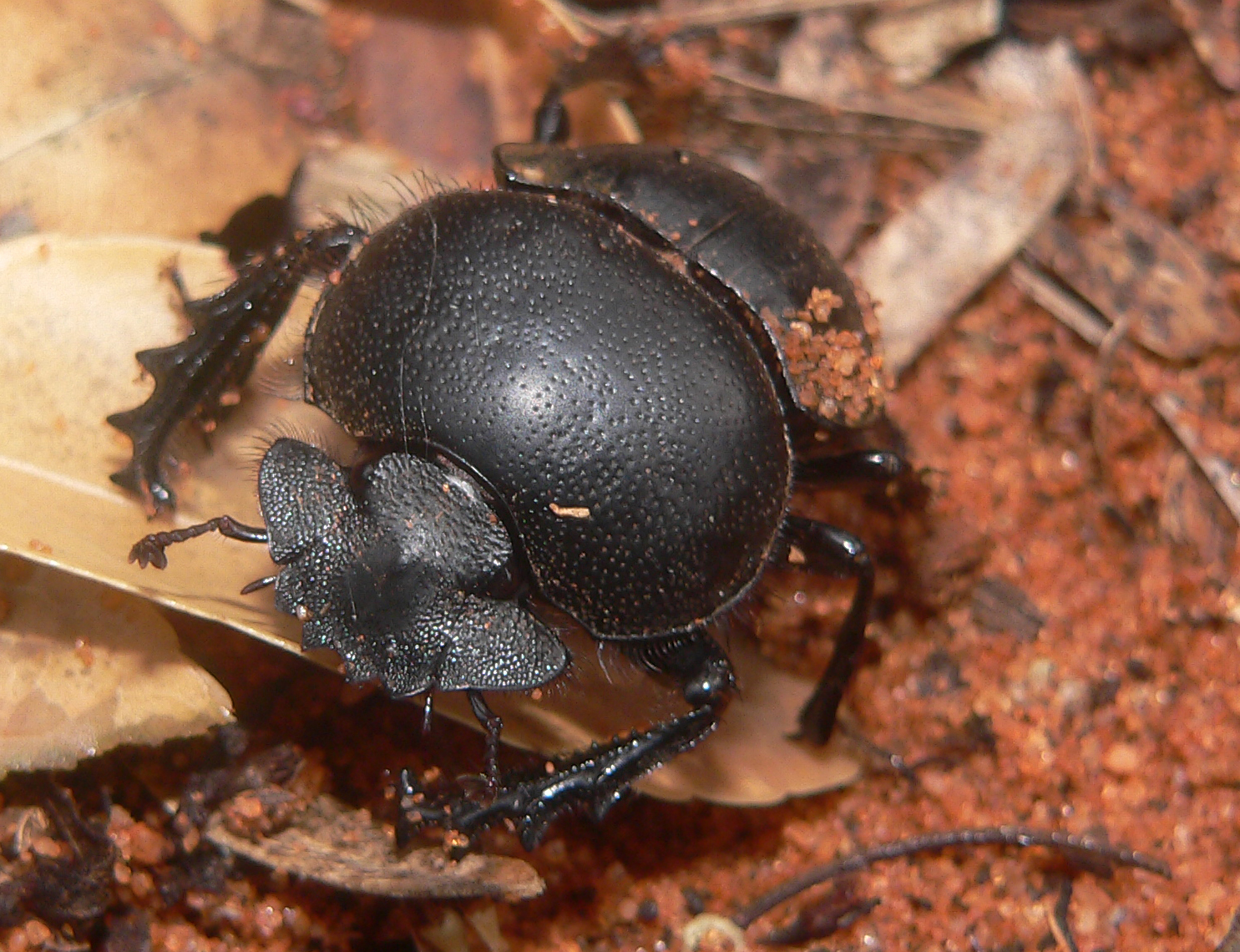
Dung beetles are beetles that feed on feces. All species of dung beetle belong to the superfamily Scarabaeoidea, most of them to the subfamilies Scarabaeinae and Aphodiinae of the family Scarabaeidae (scarab beetles). As most species of Scarabaeinae feed exclusively on feces, that subfamily is often dubbed true dung beetles. There are dung-feeding beetles which belong to other families, such as the Geotrupidae (the earth-boring dung beetle). The Scarabaeinae alone comprises more than 5,000 species.
As they do not belong to a single group sharing a common ancestor, there is a diversity in the behavior of dung beetles, including the iconic dung-rolling behavior revered by Ancient Egyptians as the god Khepri rolling the sun across the sky.
Dung beetles are not a single taxonomic group or clade (they are not monophyletic); dung feeding is found in several families of beetles, so the behaviour cannot be assumed to have evolved only once. The taxa considered to be dung beetles are within the Scarabaeoidea:
Dung beetles live in many habitats, including desert, grasslands and savannas, farmlands, and native and planted forests. They are highly influenced by the environmental context, and do not prefer extremely cold or dry weather. They are found on all continents except Antarctica. They eat the dung of herbivores and omnivores, and prefer that produced by the latter. Many of them also feed on mushrooms and decaying leaves and fruits. The Neotropical Deltochilum valgum, D. kolbei and D. viridescens are carnivores with a strong preference for preying upon millipedes. Two other species from Brazil, Canthon dives and Canthon virens, prey on queens and other winged forms of leafcutter ants. One species from the Iberian Peninsula, Thorectes lusitanicus, feeds on acorns.
The behavior of the beetles was poorly understood until the studies of Jean Henri Fabre in the late 19th century. For example, Fabre corrected the myth that a dung beetle would seek aid from other dung beetles when confronted by obstacles. By observation and experiment, he found the seeming helpers were in fact awaiting an opportunity to steal the roller's food source.
In 1991, Ilkka Cambefort and Yves Hanski classified dung beetles into three functional types based on their feeding and nesting strategies: Rollers, Tunnelers, and Dwellers. The "rollers" roll and bury a dung ball either for food storage or for making a brooding ball. When brooding, two beetles, one male and one female, stay around the dung ball during the rolling process. Usually it is the male that rolls the ball, while the female hitch-hikes or simply follows behind. In some cases, the male and the female roll together. When a spot with soft soil is found, they stop and bury the ball, then mate underground. After the mating, one or both of them prepares the brooding ball. When the ball is finished, the female lays eggs inside it, a form of mass provisioning. Some species remain to guard their offspring after laying. The dung beetle goes through a complete metamorphosis. The larvae live in brood balls made with dung prepared by their parents. During the larval stage, the beetle feeds on the dung surrounding it. Tunnelers such as Euoniticellus intermedius bury the dung wherever they find it. Dwellers neither roll nor burrow: they simply live within dung.
Most dung beetles search for dung using their sensitive sense of smell. Some smaller species simply attach themselves to the dung-producing animals to wait for dung. After capturing the dung, a dung beetle rolls it, following a straight line despite all obstacles. Sometimes, dung beetles try to steal the dung ball from another beetle, so the dung beetles have to move rapidly away from a dung pile once they have rolled their ball to prevent it from being stolen. The strength of dung beetles is well-known; male Onthophagus taurus can pull 1,141 times their own body weight, the equivalent of an average person pulling six double-decker buses full of people. The daily dung of one elephant can support 2,000,000 beetles. Some species of dung beetles can bury dung 250 times their own mass in one night.
The nocturnal African dung beetle Scarabaeus satyrus is one of the few known invertebrate animals that navigate and orient themselves using the Milky Way. The African Scarabaeus zambesianus navigates by polarization patterns in moonlight, the first animal known to do so. Dung beetles can also navigate when only the Milky Way or clusters of bright stars are visible, making them the only insects known to orient themselves by the Milky Way. Research using 1 kg boluses of elephant dung found that a larger number exploit it during the night (13,700) than during the day (3,330). The eyes of dung beetles are superposition compound eyes typical of many scarabaeid beetles;
Hub AI
Dung beetle AI simulator
(@Dung beetle_simulator)
Dung beetle
Dung beetles are beetles that feed on feces. All species of dung beetle belong to the superfamily Scarabaeoidea, most of them to the subfamilies Scarabaeinae and Aphodiinae of the family Scarabaeidae (scarab beetles). As most species of Scarabaeinae feed exclusively on feces, that subfamily is often dubbed true dung beetles. There are dung-feeding beetles which belong to other families, such as the Geotrupidae (the earth-boring dung beetle). The Scarabaeinae alone comprises more than 5,000 species.
As they do not belong to a single group sharing a common ancestor, there is a diversity in the behavior of dung beetles, including the iconic dung-rolling behavior revered by Ancient Egyptians as the god Khepri rolling the sun across the sky.
Dung beetles are not a single taxonomic group or clade (they are not monophyletic); dung feeding is found in several families of beetles, so the behaviour cannot be assumed to have evolved only once. The taxa considered to be dung beetles are within the Scarabaeoidea:
Dung beetles live in many habitats, including desert, grasslands and savannas, farmlands, and native and planted forests. They are highly influenced by the environmental context, and do not prefer extremely cold or dry weather. They are found on all continents except Antarctica. They eat the dung of herbivores and omnivores, and prefer that produced by the latter. Many of them also feed on mushrooms and decaying leaves and fruits. The Neotropical Deltochilum valgum, D. kolbei and D. viridescens are carnivores with a strong preference for preying upon millipedes. Two other species from Brazil, Canthon dives and Canthon virens, prey on queens and other winged forms of leafcutter ants. One species from the Iberian Peninsula, Thorectes lusitanicus, feeds on acorns.
The behavior of the beetles was poorly understood until the studies of Jean Henri Fabre in the late 19th century. For example, Fabre corrected the myth that a dung beetle would seek aid from other dung beetles when confronted by obstacles. By observation and experiment, he found the seeming helpers were in fact awaiting an opportunity to steal the roller's food source.
In 1991, Ilkka Cambefort and Yves Hanski classified dung beetles into three functional types based on their feeding and nesting strategies: Rollers, Tunnelers, and Dwellers. The "rollers" roll and bury a dung ball either for food storage or for making a brooding ball. When brooding, two beetles, one male and one female, stay around the dung ball during the rolling process. Usually it is the male that rolls the ball, while the female hitch-hikes or simply follows behind. In some cases, the male and the female roll together. When a spot with soft soil is found, they stop and bury the ball, then mate underground. After the mating, one or both of them prepares the brooding ball. When the ball is finished, the female lays eggs inside it, a form of mass provisioning. Some species remain to guard their offspring after laying. The dung beetle goes through a complete metamorphosis. The larvae live in brood balls made with dung prepared by their parents. During the larval stage, the beetle feeds on the dung surrounding it. Tunnelers such as Euoniticellus intermedius bury the dung wherever they find it. Dwellers neither roll nor burrow: they simply live within dung.
Most dung beetles search for dung using their sensitive sense of smell. Some smaller species simply attach themselves to the dung-producing animals to wait for dung. After capturing the dung, a dung beetle rolls it, following a straight line despite all obstacles. Sometimes, dung beetles try to steal the dung ball from another beetle, so the dung beetles have to move rapidly away from a dung pile once they have rolled their ball to prevent it from being stolen. The strength of dung beetles is well-known; male Onthophagus taurus can pull 1,141 times their own body weight, the equivalent of an average person pulling six double-decker buses full of people. The daily dung of one elephant can support 2,000,000 beetles. Some species of dung beetles can bury dung 250 times their own mass in one night.
The nocturnal African dung beetle Scarabaeus satyrus is one of the few known invertebrate animals that navigate and orient themselves using the Milky Way. The African Scarabaeus zambesianus navigates by polarization patterns in moonlight, the first animal known to do so. Dung beetles can also navigate when only the Milky Way or clusters of bright stars are visible, making them the only insects known to orient themselves by the Milky Way. Research using 1 kg boluses of elephant dung found that a larger number exploit it during the night (13,700) than during the day (3,330). The eyes of dung beetles are superposition compound eyes typical of many scarabaeid beetles;
Recent media