


Community hub
Recent from talks
Contribute something to knowledge base
Content stats: 0 posts, 0 articles, 1 media, 0 notes
Members stats: 0 subscribers, 0 contributors, 0 moderators, 0 supporters
Subscribers
Supporters
Contributors
Moderators
Hub AI
Internal structure of Earth AI simulator
(@Internal structure of Earth_simulator)
Hub AI
Internal structure of Earth AI simulator
(@Internal structure of Earth_simulator)
Internal structure of Earth
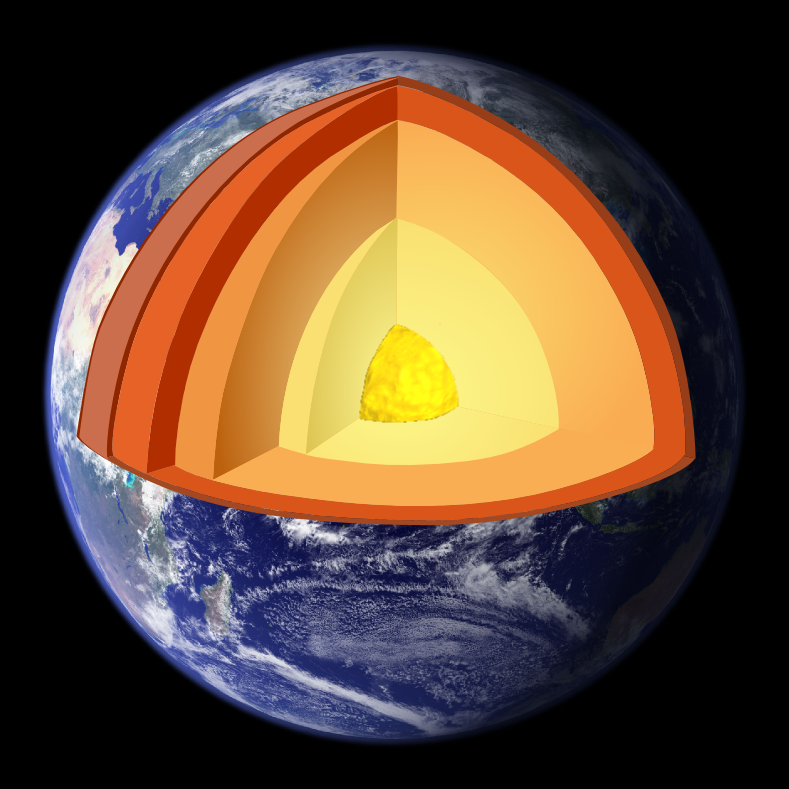
The internal structure of Earth is the layers of the planet Earth, excluding its atmosphere and hydrosphere. The structure consists of an outer silicate solid crust, a highly viscous asthenosphere, and solid mantle, a liquid outer core whose flow generates the Earth's magnetic field, and a solid inner core.
Scientific understanding of the internal structure of Earth is based on observations of topography and bathymetry, observations of rock in outcrop, samples brought to the surface from greater depths by volcanoes or volcanic activity, analysis of the seismic waves that pass through Earth, measurements of the gravitational and magnetic fields of Earth, and experiments with crystalline solids at pressures and temperatures characteristic of Earth's deep interior.
Note: In chondrite model (1), the light element in the core is assumed to be Si. Chondrite model (2) is a model of chemical composition of the mantle corresponding to the model of core shown in chondrite model (1).
Measurements of the force exerted by Earth's gravity can be used to calculate its mass. Astronomers can also calculate Earth's mass by observing the motion of orbiting satellites. Earth's average density can be determined through gravimetric experiments, which have historically involved pendulums. The mass of Earth is about 6×1024 kg. The average density of Earth is 5.515 g/cm3.
The structure of Earth can be defined in two ways: by mechanical properties such as rheology, or chemically. Mechanically, it can be divided into lithosphere, asthenosphere, mesospheric mantle, outer core, and the inner core. Chemically, Earth can be divided into the crust, upper mantle, lower mantle, outer core, and inner core. The geologic component layers of Earth are at increasing depths below the surface.
Earth's crust ranges from 5 to 70 kilometres (3.1–43.5 mi) in depth and is the outermost layer. The thin parts are the oceanic crust, which underlies the ocean basins (5–10 km) and is mafic-rich (dense iron-magnesium silicate mineral or igneous rock). The thicker crust is the continental crust, which is less dense and is felsic-rich (igneous rocks rich in elements that form feldspar and quartz). The rocks of the crust fall into two major categories – sial (aluminium silicate) and sima (magnesium silicate). It is estimated that sima starts about 11 km below the Conrad discontinuity, though the discontinuity is not distinct and can be absent in some continental regions.
Earth's lithosphere consists of the crust and the uppermost mantle. The crust-mantle boundary occurs as two physically different phenomena. The Mohorovičić discontinuity is a distinct change of seismic wave velocity. This is caused by a change in the rock's density – immediately above the Moho, the velocities of primary seismic waves (P wave) are consistent with those through basalt (6.7–7.2 km/s), and below they are similar to those through peridotite or dunite (7.6–8.6 km/s). Second, in oceanic crust, there is a chemical discontinuity between ultramafic cumulates and tectonized harzburgites, which has been observed from deep parts of the oceanic crust that have been obducted onto the continental crust and preserved as ophiolite sequences.[clarification needed]
Many rocks making up Earth's crust formed less than 100 million years ago; however, the oldest known mineral grains are about 4.4 billion years old, indicating that Earth has had a solid crust for at least 4.4 billion years.
Internal structure of Earth
The internal structure of Earth is the layers of the planet Earth, excluding its atmosphere and hydrosphere. The structure consists of an outer silicate solid crust, a highly viscous asthenosphere, and solid mantle, a liquid outer core whose flow generates the Earth's magnetic field, and a solid inner core.
Scientific understanding of the internal structure of Earth is based on observations of topography and bathymetry, observations of rock in outcrop, samples brought to the surface from greater depths by volcanoes or volcanic activity, analysis of the seismic waves that pass through Earth, measurements of the gravitational and magnetic fields of Earth, and experiments with crystalline solids at pressures and temperatures characteristic of Earth's deep interior.
Note: In chondrite model (1), the light element in the core is assumed to be Si. Chondrite model (2) is a model of chemical composition of the mantle corresponding to the model of core shown in chondrite model (1).
Measurements of the force exerted by Earth's gravity can be used to calculate its mass. Astronomers can also calculate Earth's mass by observing the motion of orbiting satellites. Earth's average density can be determined through gravimetric experiments, which have historically involved pendulums. The mass of Earth is about 6×1024 kg. The average density of Earth is 5.515 g/cm3.
The structure of Earth can be defined in two ways: by mechanical properties such as rheology, or chemically. Mechanically, it can be divided into lithosphere, asthenosphere, mesospheric mantle, outer core, and the inner core. Chemically, Earth can be divided into the crust, upper mantle, lower mantle, outer core, and inner core. The geologic component layers of Earth are at increasing depths below the surface.
Earth's crust ranges from 5 to 70 kilometres (3.1–43.5 mi) in depth and is the outermost layer. The thin parts are the oceanic crust, which underlies the ocean basins (5–10 km) and is mafic-rich (dense iron-magnesium silicate mineral or igneous rock). The thicker crust is the continental crust, which is less dense and is felsic-rich (igneous rocks rich in elements that form feldspar and quartz). The rocks of the crust fall into two major categories – sial (aluminium silicate) and sima (magnesium silicate). It is estimated that sima starts about 11 km below the Conrad discontinuity, though the discontinuity is not distinct and can be absent in some continental regions.
Earth's lithosphere consists of the crust and the uppermost mantle. The crust-mantle boundary occurs as two physically different phenomena. The Mohorovičić discontinuity is a distinct change of seismic wave velocity. This is caused by a change in the rock's density – immediately above the Moho, the velocities of primary seismic waves (P wave) are consistent with those through basalt (6.7–7.2 km/s), and below they are similar to those through peridotite or dunite (7.6–8.6 km/s). Second, in oceanic crust, there is a chemical discontinuity between ultramafic cumulates and tectonized harzburgites, which has been observed from deep parts of the oceanic crust that have been obducted onto the continental crust and preserved as ophiolite sequences.[clarification needed]
Many rocks making up Earth's crust formed less than 100 million years ago; however, the oldest known mineral grains are about 4.4 billion years old, indicating that Earth has had a solid crust for at least 4.4 billion years.
Recent media
Recent media