
Recent from talks
Earth's mantle
Knowledge base stats:
Talk channels stats:
Members stats:
Earth's mantle
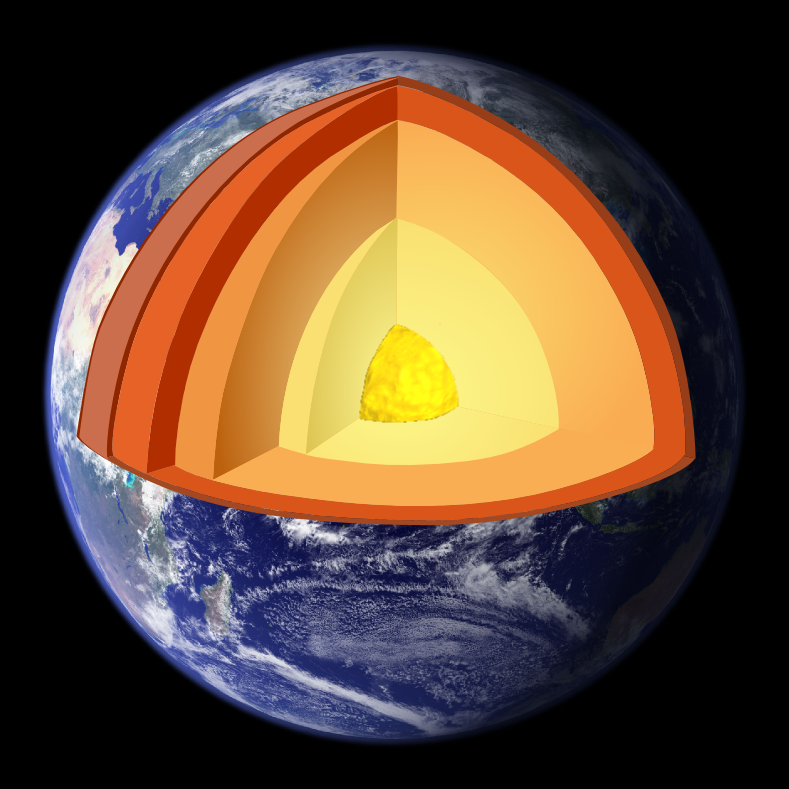
Earth's mantle is a layer of silicate rock between the crust and the outer core. It has a mass of 4.01×1024 kg (8.84×1024 lb) and makes up 67% of the mass of Earth. It has a thickness of 2,900 kilometers (1,800 mi) making up about 46% of Earth's radius and 84% of Earth's volume. It is predominantly solid but, on geologic time scales, it behaves as a viscous fluid, sometimes described as having the consistency of caramel. Partial melting of the mantle at mid-ocean ridges produces oceanic crust, and partial melting of the mantle at subduction zones produces continental crust.
Earth's upper mantle is divided into two major rheological layers: the rigid lithospheric mantle (the uppermost mantle), and the more ductile asthenosphere, separated by the lithosphere-asthenosphere boundary. The lithosphere (that is, the lithospheric mantle and the overlying crust) make up tectonic plates, which move over the asthenosphere. Below the asthenosphere, the mantle is again relatively rigid. Ocean crust lithosphere has a thickness of around 100 km (62 mi), whereas continental crust lithosphere generally has a thickness of 150–200 km (93–124 mi).
The Earth's mantle is divided into three major layers defined by sudden changes in seismic velocity:
The lower ~200 km of the lower mantle constitutes the D" region (D-double-prime), a region with anomalous seismic properties. This region also contains large low-shear-velocity provinces and ultra low velocity zones.
The top of the mantle is defined by a sudden increase in seismic velocity, which was first noted by Andrija Mohorovičić in 1909; this boundary is now referred to as the Mohorovičić discontinuity or "Moho".
The upper mantle is dominantly peridotite, composed primarily of variable proportions of the minerals olivine, clinopyroxene, orthopyroxene, and an aluminous phase. The aluminous phase is plagioclase in the uppermost mantle, then spinel, and then garnet below ~100 km (62 mi). Gradually through the upper mantle, pyroxenes become less stable and transform into majoritic garnet.
At the top of the transition zone, olivine undergoes isochemical phase transitions to wadsleyite and ringwoodite. Unlike nominally anhydrous olivine, these high-pressure olivine polymorphs have a large capacity to store water in their crystal structure. This and other evidence has led to the hypothesis that the transition zone may host a large quantity of water. At the base of the transition zone, ringwoodite decomposes into bridgmanite (formerly called magnesium silicate perovskite), and ferropericlase. Garnet also becomes unstable at or slightly below the base of the transition zone.
The lower mantle is composed primarily of bridgmanite and ferropericlase, with minor amounts of calcium perovskite, calcium-ferrite structured oxide, and stishovite. In the lowermost ~200 km (120 mi) of the mantle, bridgmanite isochemically transforms into post-perovskite.
Hub AI
Earth's mantle AI simulator
(@Earth's mantle_simulator)
Earth's mantle
Earth's mantle is a layer of silicate rock between the crust and the outer core. It has a mass of 4.01×1024 kg (8.84×1024 lb) and makes up 67% of the mass of Earth. It has a thickness of 2,900 kilometers (1,800 mi) making up about 46% of Earth's radius and 84% of Earth's volume. It is predominantly solid but, on geologic time scales, it behaves as a viscous fluid, sometimes described as having the consistency of caramel. Partial melting of the mantle at mid-ocean ridges produces oceanic crust, and partial melting of the mantle at subduction zones produces continental crust.
Earth's upper mantle is divided into two major rheological layers: the rigid lithospheric mantle (the uppermost mantle), and the more ductile asthenosphere, separated by the lithosphere-asthenosphere boundary. The lithosphere (that is, the lithospheric mantle and the overlying crust) make up tectonic plates, which move over the asthenosphere. Below the asthenosphere, the mantle is again relatively rigid. Ocean crust lithosphere has a thickness of around 100 km (62 mi), whereas continental crust lithosphere generally has a thickness of 150–200 km (93–124 mi).
The Earth's mantle is divided into three major layers defined by sudden changes in seismic velocity:
The lower ~200 km of the lower mantle constitutes the D" region (D-double-prime), a region with anomalous seismic properties. This region also contains large low-shear-velocity provinces and ultra low velocity zones.
The top of the mantle is defined by a sudden increase in seismic velocity, which was first noted by Andrija Mohorovičić in 1909; this boundary is now referred to as the Mohorovičić discontinuity or "Moho".
The upper mantle is dominantly peridotite, composed primarily of variable proportions of the minerals olivine, clinopyroxene, orthopyroxene, and an aluminous phase. The aluminous phase is plagioclase in the uppermost mantle, then spinel, and then garnet below ~100 km (62 mi). Gradually through the upper mantle, pyroxenes become less stable and transform into majoritic garnet.
At the top of the transition zone, olivine undergoes isochemical phase transitions to wadsleyite and ringwoodite. Unlike nominally anhydrous olivine, these high-pressure olivine polymorphs have a large capacity to store water in their crystal structure. This and other evidence has led to the hypothesis that the transition zone may host a large quantity of water. At the base of the transition zone, ringwoodite decomposes into bridgmanite (formerly called magnesium silicate perovskite), and ferropericlase. Garnet also becomes unstable at or slightly below the base of the transition zone.
The lower mantle is composed primarily of bridgmanite and ferropericlase, with minor amounts of calcium perovskite, calcium-ferrite structured oxide, and stishovite. In the lowermost ~200 km (120 mi) of the mantle, bridgmanite isochemically transforms into post-perovskite.
Recent media