
Recent from talks
Contribute something
Nothing was collected or created yet.
P wave
View on Wikipedia| Part of a series on |
| Earthquakes |
|---|


A P wave (primary wave or pressure wave) is one of the two main types of elastic body waves, called seismic waves in seismology. P waves travel faster than other seismic waves and hence are the first signal from an earthquake to arrive at any affected location or at a seismograph. P waves may be transmitted through gases, liquids, or solids.
Nomenclature
[edit]The name P wave can stand for either pressure wave (as it is formed from alternating compressions and rarefactions) or primary wave (as it has high velocity and is therefore the first wave to be recorded by a seismograph).[1] The name S wave represents another seismic wave propagation mode, standing for secondary or shear wave, a usually more destructive wave than the primary wave.
Seismic waves in the Earth
[edit]
Primary and secondary waves are body waves that travel within the Earth. The motion and behavior of both P and S waves in the Earth are monitored to probe the interior structure of the Earth. Discontinuities in velocity as a function of depth are indicative of changes in phase or composition. Differences in arrival times of waves originating in a seismic event like an earthquake as a result of waves taking different paths allow mapping of the Earth's inner structure.[3][4]
P wave shadow zone
[edit]
Almost all the information available on the structure of the Earth's deep interior is derived from observations of the travel times, reflections, refractions and phase transitions of seismic body waves, or normal modes. P waves travel through the fluid layers of the Earth's interior, and yet they are refracted slightly when they pass through the transition between the semisolid mantle and the liquid outer core. As a result, there is a P wave "shadow zone" between 103° and 142°[5] from the earthquake's focus, where the initial P waves are not registered on seismometers. In contrast, S waves do not travel through liquids.
As an earthquake warning
[edit]Advance earthquake warning is possible by detecting the nondestructive primary waves that travel more quickly through the Earth's crust than do the destructive secondary and Rayleigh waves.
The amount of warning depends on the delay between the arrival of the P wave and other destructive waves, generally on the order of seconds up to about 60 to 90 seconds for deep, distant, large quakes such as the 2011 Tohoku earthquake. The effectiveness of a warning depends on accurate detection of the P waves and rejection of ground vibrations caused by local activity (such as trucks or construction). Earthquake early warning systems can be automated to allow for immediate safety actions, such as issuing alerts, stopping elevators at the nearest floors, and switching off utilities.
Propagation
[edit]Velocity
[edit]In isotropic and homogeneous solids, a P wave travels in a straight line longitudinally; thus, the particles in the solid vibrate along the axis of propagation (the direction of motion) of the wave energy. The velocity of P waves in that kind of medium is given by where K is the bulk modulus (the modulus of incompressibility), μ is the shear modulus (modulus of rigidity, sometimes denoted as G and also called the second Lamé parameter), ρ is the density of the material through which the wave propagates, and λ is the first Lamé parameter.
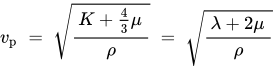
In typical situations in the interior of the Earth, the density ρ usually varies much less than K or μ, so the velocity is mostly "controlled" by these two parameters.
The elastic moduli P wave modulus, , is defined so that and thereby
Typical values for P wave velocity in earthquakes are in the range 5 to 8 km/s. The precise speed varies according to the region of the Earth's interior, from less than 6 km/s in the Earth's crust to 13.5 km/s in the lower mantle, and 11 km/s through the inner core.[6]
| Rock Type | Velocity [m/s] | Velocity [ft/s] |
|---|---|---|
| Unconsolidated sandstone | 4,600–5,200 | 15,000–17,000 |
| Consolidated sandstone | 5,800 | 19,000 |
| Shale | 1,800–4,900 | 6,000–16,000 |
| Limestone | 5,800–6,400 | 19,000–21,000 |
| Dolomite | 6,400–7,300 | 21,000–24,000 |
| Anhydrite | 6,100 | 20,000 |
| Granite | 5,800–6,100 | 19,000–20,000 |
| Gabbro | 7,200 | 23,600 |
Geologist Francis Birch discovered a relationship between the velocity of P waves and the density of the material the waves are traveling in: which later became known as Birch's law. (The symbol a() is an empirically tabulated function, and b is a constant.)
See also
[edit]References
[edit]- ^ Milsom, J. (2003). Field Geophysics. The geological field guide series. Vol. 25. John Wiley and Sons. p. 232. ISBN 978-0-470-84347-5. Retrieved 2010-02-25.
- ^ GR Helffrich & BJ Wood (2002). "The Earth's Mantle" (PDF). Nature. 412 (2 August): 501–7. doi:10.1038/35087500. PMID 11484043. S2CID 4304379.
- ^
Rubinstein, Justin L.; Shelly, D. R.; Ellsworth, W. L. (2009). "Non-volcanic tremor: A window into the roots of fault zones". In Cloetingh, S.; Negendank, Jorg (eds.). New Frontiers in Integrated Solid Earth Sciences. Springer. p. 287 ff. ISBN 978-90-481-2736-8.
The analysis of seismic waves provides a direct high-resolution means for studying the internal structure of the Earth...
- ^
Fowler, C. M. R. (2005). "§4.1 Waves through the Earth". The solid earth: an introduction to global geophysics (2nd ed.). Cambridge University Press. p. 100. ISBN 978-0-521-58409-8.
Seismology is the study of the passage of elastic waves through the Earth. It is arguably the most powerful method available for studying the structure of the interior of the Earth, especially the crust and mantle.
- ^ Lowrie, William. The Fundamentals of Geophysics. Cambridge University Press, 1997, p. 149.
- ^ Dziewonski, Adam M.; Anderson, Don L. (1981). "Preliminary reference Earth model". Physics of the Earth and Planetary Interiors. 25 (4): 297–356. Bibcode:1981PEPI...25..297D. doi:10.1016/0031-9201(81)90046-7.
- ^ "Acoustic Logging". Geophysics. U.S. Environmental Protection Agency. 2011-12-12. Archived from the original on October 22, 2011. Retrieved 2015-02-03.
- "Photo Glossary of Earthquakes". United States Geological Survey". Archived from the original on February 27, 2009. Retrieved March 8, 2009.
External links
[edit]- Animation of a P wave
- P-wave velocity calculator
- Purdue's catalog of animated illustrations of seismic waves
- Animations illustrating simple wave propagation concepts by Jeffrey S. Barker Archived 2017-05-10 at the Wayback Machine
- Bayesian Networks for Earthquake Magnitude Classification in a (sic) Early Warning System
P wave
View on GrokipediaFundamentals
Definition and Mechanism
P waves, also known as primary waves, are a type of seismic body wave that propagate through the Earth as longitudinal or compressional waves, in which the direction of particle displacement is parallel to the direction of wave propagation.[7] This motion results in alternating regions of compression and dilation within the medium, similar to the propagation of sound waves in air.[7] In elastic wave theory, P waves arise from the deformation of materials under stress, where the medium's elasticity allows for the reversible storage and release of strain energy during wave passage.[8] The mechanism of P wave propagation relies on the compressional nature of the wave, where particles in the solid or fluid medium oscillate back and forth along the propagation axis, transmitting the disturbance through successive compressions and rarefactions.[9] This process is governed by the principles of continuum mechanics in elastic media, assuming small deformations where Hooke's law relates stress and strain linearly.[8] P waves can travel through both solids and fluids because they do not require shear strength, only bulk modulus for compression.[7] P waves are generated by the sudden release of stored elastic strain energy in the Earth's crust, typically during earthquakes, volcanic eruptions, or man-made explosions, originating from the hypocenter—the point of initial rupture.[7] This release creates a pressure disturbance that radiates outward as an elastic wave, with the hypocenter serving as the source point for spherical wavefront expansion in homogeneous media.[9] Mathematically, in an isotropic elastic medium, the displacement field for P waves satisfies the wave equation derived from the Navier equations under the irrotational condition : where and are the Lamé parameters representing the medium's compressional and shear responses, respectively, and is the density.[8] This equation describes the decoupled propagation of the dilatational (P-wave) component, assuming constant material properties and neglecting body forces.[9]Nomenclature and Terminology
The term "P wave" derives from "primary wave," reflecting its status as the fastest seismic wave and thus the first to arrive at recording stations during an earthquake. This nomenclature was established in the late 19th and early 20th centuries through pioneering seismographic observations. British seismologist John Milne, who developed one of the first practical horizontal seismographs in the 1880s, enabled the recording of distant earthquakes, laying the groundwork for identifying distinct wave arrivals. However, the explicit distinction and naming of P waves as primary, alongside secondary (S) waves and surface waves, is credited to Richard Dixon Oldham in his 1900 analysis of seismograms from the 1897 Assam earthquake, where he characterized the initial compressional phase based on its precedence in arrival times.[10][11] In geophysical literature, P waves are also known by alternative terms that emphasize their physical characteristics, such as compressional waves (due to their longitudinal motion), dilatational waves (highlighting volume changes in the medium), and irrotational waves (indicating no rotational component in particle displacement). These synonyms appear in technical contexts to describe the wave's push-pull mechanism, where particles oscillate parallel to the propagation direction. The term "push wave" occasionally appears informally to convey the compressive nature, though "primary" remains the standard in seismology.[6] P waves are distinguished from other seismic phases primarily by their role as the initial arrival on seismograms, denoted as the "P-phase," which precedes S waves and surface waves in time. This temporal priority allows seismologists to use P-phase onsets for rapid event detection and location. Historically, the understanding of P waves evolved significantly with Oldham's 1906 observations of a "shadow zone" in P-wave arrivals at distances beyond 100–120 degrees from epicenters, which he attributed to refraction at the Earth's core-mantle boundary and the absence of S waves, providing early evidence for a liquid outer core.[12][13] In contemporary seismology, the nomenclature for P waves and related phases is standardized by organizations like the International Seismological Centre (ISC), which catalogs millions of arrival times in its bulletins using a consistent phase list that includes primary P arrivals and variants like pP (depth phases). This system, refined since the ISC's founding in 1965, ensures interoperability across global networks and supports precise earthquake hypocenter determination.[14]Physical Properties
Velocity in Different Media
The velocity of P waves in a homogeneous isotropic elastic medium is given by the formula , where is the first Lamé parameter representing the incompressibility of the medium, is the shear modulus reflecting resistance to shear deformation, and is the material density.[15] This expression derives from the linearized equations of motion in linear elasticity theory, highlighting how P wave speed depends on the material's elastic stiffness relative to its density.[16] In the Earth's interior, P wave velocities vary significantly with depth and composition, as modeled by the Preliminary Reference Earth Model (PREM). Typical velocities range from 5 to 8 km/s in the crust, reflecting the heterogeneous mix of crustal rocks under moderate pressure. In the upper mantle, speeds increase to about 8 km/s due to higher pressures and more uniform peridotite composition, while in the lower mantle, they reach up to 13 km/s owing to greater compression and phase transitions in mineral structures. In the outer core, treated as a fluid where shear modulus , P waves propagate at approximately 8 km/s as compressional waves through the molten iron-nickel alloy, with velocities rising slightly to around 10 km/s near the inner core boundary. Laboratory measurements on terrestrial materials show lower velocities under ambient conditions: 3 to 6 km/s in common rocks like granite or sandstone, and about 1.5 km/s in water, illustrating the role of porosity and fluid content in reducing stiffness. Several factors influence P wave velocity beyond the basic elastic parameters. Increasing pressure, as encountered with depth in the Earth, enhances velocity by compacting the medium and raising elastic moduli, often by 10-20% per gigapascal in mantle rocks.[17] Conversely, elevated temperatures soften materials, decreasing velocity by expanding the lattice and lowering moduli, with effects amplified in the upper mantle where thermal gradients are steep.[18] Density variations, tied to composition and phase, inversely affect speed through the denominator in the velocity formula, though stiffness increases often dominate in deeper layers.[19] Anisotropy introduces directional dependence, with velocities faster along crystal alignments in minerals like olivine due to preferred orientations from deformation; for instance, in the upper mantle, horizontal P wave speeds can exceed vertical ones by 2-4%.[20] In anisotropic media, such as transversely isotropic rocks with a vertical symmetry axis, the isotropic formula serves as a baseline, but weak anisotropy is quantified using Thomsen parameters: measures fractional deviation of horizontal from vertical P wave speed, controls near-vertical velocity variation, and affects shear waves but indirectly influences quasi-P waves.[21] These parameters, defined for weak anisotropy where deviations are less than 10%, simplify wave propagation calculations without full stiffness matrix inversion, enabling models of mantle flow where lattice-preferred orientations align with shear.[21]Attenuation and Energy Loss
Attenuation of P waves occurs through multiple mechanisms that dissipate or redistribute seismic energy during propagation. Intrinsic absorption, arising from anelasticity in rocks, converts elastic wave energy into heat via internal friction within the mineral lattice and grain boundaries.[22] Scattering by heterogeneities, such as impedance contrasts in the Earth's crust and mantle, redirects energy from the coherent P wave into diffuse coda waves.[23] Viscoelastic damping contributes through the time-dependent, non-elastic response of rock materials to applied stress, leading to hysteresis in strain recovery.[24] The quality factor , specific to P waves, serves as a dimensionless measure of this attenuation, representing the number of wave cycles required for the energy to decay by a factor of . It governs the exponential decay of wave amplitude according to the formula where is the amplitude after travel time , is the initial amplitude, and is the wave frequency; lower values indicate stronger attenuation.[25] Typical values in the Earth's crust range from 100 to 500, increasing in the mantle to 200–1000, reflecting varying material properties.[23] Attenuation exhibits strong frequency dependence, with higher-frequency components decaying more rapidly due to the linear proportionality of the exponent to . This preferential loss acts as a natural low-pass filter, reducing the bandwidth of P waves over long distances and smoothing their spectra.[25] In the upper mantle, for instance, often increases with frequency following a power-law relation where , amplifying the effect for short-period signals.[26] This frequency-dependent attenuation manifests observationally in the broader, less impulsive waveforms of teleseismic P waves compared to near-field recordings, where high-frequency content persists due to shorter propagation paths. Teleseismic events, traveling thousands of kilometers, show spectral peaks shifted to lower frequencies (typically 0.5–2 Hz), evidencing cumulative energy loss.[27]Behavior in the Earth
Travel Paths and Ray Theory
Ray theory provides a high-frequency approximation for modeling the propagation of seismic waves through the Earth, treating wavefronts as locally plane and rays as perpendicular paths governed by the medium's velocity structure. In this framework, P waves, as compressional body waves, follow curved trajectories determined by refraction at velocity discontinuities and continuous bending due to gradients, with ray directions satisfying Snell's law at interfaces: the ray parameter remains constant, where is the incidence angle and is the P-wave velocity.[28][29] Reflections occur when rays bounce off boundaries, such as the Mohorovičić discontinuity, while refractions alter paths across layers with differing velocities. This geometric approach is particularly effective for wavelengths much shorter than structural scales, enabling predictions of arrival times and amplitudes in spherically symmetric models.[28] Common P-wave ray paths include the direct P phase, which travels entirely through the mantle without reflection or core entry, serving as the primary arrival for epicentral distances up to about 100°. The PmP phase represents a P wave that reflects off the Mohorovičić discontinuity (Moho) at the crust-mantle boundary, typically observed shortly after the direct Pg or Pn crustal phases due to the sharp velocity increase there. For greater distances, core-penetrating paths dominate, such as PKP, which refracts into the outer core (denoted by "K" for kiss, indicating grazing or turning) and back into the mantle; a variant, PKIKP, further penetrates the solid inner core (I), with rays nearly vertical at the inner core boundary due to the velocity contrast. These paths are computed using ray tracing algorithms that integrate the ray parameter through layered velocity profiles, ensuring conservation of angular momentum in the spherical Earth.[30][31] Refraction arises from lateral and depth variations in P-wave velocity, causing rays to curve: in regions of increasing velocity with depth, such as much of the mantle, rays bend upward toward the surface, reaching a turning point where the ray becomes horizontal (grazing incidence). In low-velocity zones, such as those observed for S waves in the upper mantle asthenosphere, rays would steepen and bend downward if present for P waves; however, in PREM, P-wave velocities increase with depth in much of the upper mantle, causing upward bending. The PREM, a standard radially symmetric model, incorporates smooth velocity gradients derived from global seismic data, with P-wave speeds decreasing from about 13 km/s in the lower mantle to around 8 km/s at the top of the outer core, dictating these turning depths—shallower for steeper rays (higher ) and deeper for near-grazing paths (lower ). Such gradients ensure that direct mantle paths turn before reaching the core for epicentral distances under 100°, while core phases require rays that penetrate deeper.[30][32] Computationally, ray theory facilitates the generation of travel-time curves by parameterizing rays with , yielding epicentral distance and time via integrals over slowness , where distance increases with decreasing as rays sample deeper structure. In PREM, these curves show monotonic increases for direct P up to triplications from gradient discontinuities, allowing inversion for velocity models without specifying numerical values; for instance, PKP arrivals emerge prominently beyond 100° epicentral distance, reflecting core refraction. This dependence on distance enables seismologists to map interior structure by fitting observed arrivals to synthetic paths.[30][28]Shadow Zone and Core Effects
The P-wave shadow zone refers to an angular region on Earth's surface, spanning approximately 103° to 142° from the earthquake epicenter, where direct P waves do not arrive at seismic stations due to refraction at the core-mantle boundary (CMB).[33] This phenomenon arises because P-wave velocity decreases sharply upon entering the liquid outer core from the solid mantle, causing ray paths to bend away from the radial direction and preventing direct transmission to the far side of the planet.[34] The absence of these waves in this zone provides key evidence for the layered structure of Earth's interior, particularly the distinction between the mantle and core. At the edges of the shadow zone, P waves undergo diffraction along the CMB, producing diffracted phases known as Pdiff, which arrive with low amplitudes and exhibit strong attenuation due to the grazing incidence and the fluid nature of the outer core.[35] The liquid outer core supports compressional P waves but lacks rigidity to propagate shear waves, resulting in slower P-wave speeds compared to the mantle (approximately 8 km/s versus 13-14 km/s in the lower mantle) and enabling this diffractive behavior without shear support.[36] These core effects not only delineate the shadow zone but also allow seismologists to probe the CMB's properties, such as its topography and low-velocity regions like ultra-low velocity zones. The existence of the P-wave shadow zone was first recognized by Richard Dixon Oldham in 1906, who analyzed seismograms from multiple earthquakes, such as the 1897 Assam earthquake, and identified the absence of P waves beyond about 100° angular distance, inferring a central core with distinct seismic properties.[37] Oldham's observations confirmed the core's liquid outer layer, as the refraction pattern was inconsistent with a fully solid Earth. In modern seismology, detailed studies of arrivals near the shadow zone edges reveal triplicated P-wave patterns, where multiple closely spaced arrivals result from interactions with upper mantle discontinuities at approximately 410 km and 660 km depths.[38] These triplications arise from velocity increases across the phase boundaries (olivine to wadsleyite at 410 km and ringwoodite to perovskite/majorite at 660 km), creating short-period multiples that enhance resolution of transition zone structure.[39]Detection and Applications
Seismic Recording and Analysis
P waves are primarily detected using broadband seismometers, which capture a wide frequency range from long-period (up to 360 seconds) to short-period signals, enabling the recording of the initial onset of compressional motion. The Streckeisen STS-1 is a widely used broadband seismometer in global networks, featuring a feedback system that provides high dynamic range and linearity for resolving low-amplitude P wave arrivals against background noise.[40] These instruments typically consist of three orthogonal components (vertical, north-south, and east-west) to measure particle displacement, allowing for the determination of P wave polarization, which aligns with the direction of propagation for compressional waves.[41] Accelerometers, such as MEMS-based strong-motion sensors, complement broadband seismometers by recording higher-frequency content and acceleration during intense shaking, facilitating precise identification of P wave onsets in near-field events where velocities may exceed the linear range of velocity sensors.[42] The arrival time of P waves, known as "picking," is a critical step in seismic analysis, performed through both automatic and manual methods to establish event timelines. Automatic picking often employs the short-term average to long-term average (STA/LTA) ratio, where the STA captures signal energy over a brief window (e.g., 1 second) and the LTA estimates background noise over a longer window (e.g., 30 seconds); a threshold ratio (typically 3-5) triggers detection of the P onset.[43] This method, originally proposed by Allen in 1978, excels in real-time applications but can produce false positives in noisy environments, necessitating post-processing.[43] Manual picking involves visual inspection of waveforms by analysts, who refine automatic picks to account for subtle onsets, achieving higher accuracy for teleseismic P waves with typical uncertainties of 0.1 to 1 second depending on signal-to-noise ratio and distance.[44] These uncertainties arise from factors like wave scattering and instrument response, and are quantified using statistical models such as the Akaike Information Criterion to estimate pick reliability.[44] Advanced analysis techniques enhance the isolation and interpretation of P waves from multi-component and array data. Beamforming, applied to seismic arrays, delays and stacks signals across sensors to maximize coherence in a specified direction, improving signal-to-noise ratio for P wave detection and estimating apparent velocity and backazimuth; for instance, conventional beamforming on regional arrays resolves P wave arrivals from microseismic events with angular uncertainties below 5 degrees.[45] Polarization filters exploit the linear, radial motion of P waves by analyzing the covariance matrix of three-component data, suppressing transverse components to isolate compressional energy; this method effectively separates overlapping P and SV waves in vertical seismic profiling records.[46] Waveform modeling inverts observed P wave seismograms against synthetic traces generated via ray theory or finite-difference methods to constrain source parameters, such as moment magnitude and focal mechanism, with broadband data enabling resolution of source spectra from 0.01 to 1 Hz.[47] Global seismic data for P wave analysis are sourced from networks like the Incorporated Research Institutions for Seismology (IRIS) Data Management Center and the GEOSCOPE program, which together provide access to over 150 broadband stations worldwide.[48] IRIS archives continuous waveforms in real-time via SeedLink protocol, supporting automated processing for rapid event detection and location using P arrival times from multiple stations.[49] GEOSCOPE, operated by the Institut de Physique du Globe de Paris, contributes high-fidelity broadband records from 30+ stations, emphasizing real-time telemetry for global monitoring and integration with IRIS for hypocenter determination via least-squares inversion of P travel times.[50]Role in Earthquake Early Warning
P waves play a crucial role in earthquake early warning systems (EEWS) due to their higher velocity compared to secondary (S) waves, arriving approximately 10 to 60 seconds earlier at a given location, which provides critical lead time for protective actions such as slowing trains or evacuating buildings.[51] This speed advantage—P waves propagating at typical crustal speeds of 5–8 km/s versus about 3–4.5 km/s for S waves—enables systems like the U.S. ShakeAlert to detect initial ground motion and issue alerts before damaging shaking begins.[52] As of 2025, ShakeAlert operates across the West Coast with ongoing expansions, including Phase 1 implementation in Alaska, and Version 3 enhancements for improved magnitude estimation and alert dissemination.[53][54] In practice, seismic sensors identify the P-wave onset in real time, triggering automated processing to estimate earthquake location, magnitude, and expected ground motion.[55] Implementation of P-wave-based warnings involves rapid algorithms for P-onset picking, followed by magnitude estimation using parameters like peak displacement or characteristic periods from the initial waveform, often refined with finite-fault models for larger events to forecast rupture extent and shaking intensity.[56] For instance, ShakeAlert integrates data from regional seismic networks to generate alerts within seconds of detection, disseminating them via apps, sirens, and automated controls to predict peak ground acceleration and issue region-specific warnings.[57] These systems prioritize low-latency data transmission to minimize delays, ensuring alerts reach users before S-wave arrival.[58] Despite these advances, limitations persist, including a blind zone within roughly 10 km of the epicenter where strong shaking arrives before alerts can be processed and delivered, rendering warnings ineffective close to the rupture.[59] False alarms can occur from non-seismic noise or small events misidentified as larger ones, though machine learning filters help mitigate this; overall accuracy and reliability improve with denser seismic networks that reduce detection thresholds and enhance parameter estimation.[60][61] Case studies illustrate varying performance: During the 2011 Tohoku earthquake (Mw 9.0), Japan's JMA EEWS detected P waves and issued initial alerts with lead times of 10 to 30 seconds in affected areas, but severely underestimated the magnitude at 7.2 due to saturation of point-source algorithms, limiting its effectiveness for the full rupture extent.[62][63] In contrast, ShakeAlert performed successfully for the 2019 Ridgecrest sequence, detecting the Mw 7.1 mainshock within 6.9 seconds of origin time and providing lead times up to 50 seconds for distant users, enabling timely evacuations and automated responses without major underestimations.[57][64] More recently, in 2025 earthquake swarms in Southern California, ShakeAlert demonstrated reliable detection and alerting, contributing to ongoing system validation.[65]References
- https://wiki.seg.org/wiki/Dictionary:P-wave
