Hubbry Logo
SpinelSpinelMain
Open search
Spinel
Community hub
Spinel
logo
8 pages, 0 posts
0 subscribers
Be the first to start a discussion here.
Contribute something
Spinel
Spinel
from Wikipedia
Spinel
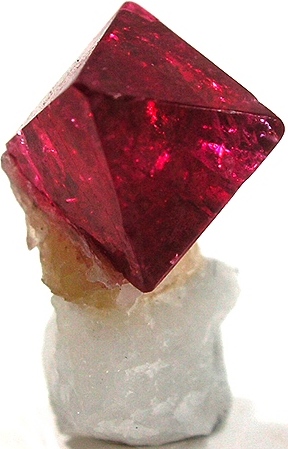
Small spinel crystal on top of a white calcite from Mogok, Myanmar, measuring 1.5 × 1.1 × 1 cm in size
General
Category
FormulaMgAl
2
O
4
IMA symbolSpl[1]
Strunz classification4.BB.05
Crystal systemCubic
Crystal classHextetrahedral (43m)
H–M symbol: (43m)[2][3][4]
Space groupF 4 3 m (No. 216)
Unit cella = 8.0898(9) Å; Z = 8
Identification
ColorVarious; red, pink, blue, lavender/violet, dark green, brown, black, colourless
Crystal habitOctahedral or flat triangular plates caused by twinning
Twinningcommon
CleavageNone
FractureConchoidal
Mohs scale hardness7.5–8.0
LusterVitreous
StreakWhite
DiaphaneityTransparent to opaque
Specific gravity(Depending on the composition) The rare Zn-rich spinel can be as high as 4.40, otherwise it averages from 3.58 to 3.61.
Optical propertiesIsotropic
Refractive index1.719
PleochroismAbsent
SolubilityNone
Other characteristicsWeak to medium magnetic, sometimes fluorescent (red synthetic yes, natural red sometimes)
References[5][6]
Polyhedral representation of spinel MgAl2O4

Spinel (/spɪˈnɛl, ˈspɪnəl/[7]) is the magnesium/aluminium member of the larger spinel group of minerals. It has the formula MgAl
2
O
4
in the cubic crystal system. Its name comes from the Latin word spinella, a diminutive form of spine, in reference to its pointed crystals.[5]

Properties

[edit]
Cut spinel

Spinel crystallizes in the isometric system; common crystal forms are octahedra, usually twinned. It has no true cleavage, but shows an octahedral parting and a conchoidal fracture.[8] Its hardness is 8, its specific gravity is 3.5–4.1, and it is transparent to opaque with a vitreous to dull luster. It may be colorless, but is usually various shades of red, lavender, blue, green, brown, black, or yellow.[9] Chromium(III) causes the red color in spinel from Burma.[10] Some spinels are among the most famous gemstones; among them are the Black Prince's Ruby and the "Timur ruby" in the British Crown Jewels,[11] and the "Côte de Bretagne", formerly from the French Crown jewels.[12] The Samarian Spinel is the largest known spinel in the world, weighing 500 carats (100 g).[13]

The transparent red spinels were called spinel-rubies[14] or balas rubies.[15] In the past, before the arrival of modern science, spinels and rubies were equally known as rubies. After the 18th century, the word ruby was only used for the red gem variety of the mineral corundum, and the word spinel came to be used.[16] "Balas" is derived from Balascia, the ancient name for Badakhshan, a region in central Asia situated in the upper valley of the Panj River, one of the principal tributaries of the Oxus River. However, "Balascia" itself may be derived from Sanskrit bālasūryaka, which translates as "crimson-coloured morning sun".[17] Mines in the Gorno Badakhshan region of Tajikistan constituted for centuries the main source for red and pink spinels.[16]

Occurrence

[edit]

Geologic occurrence

[edit]

Spinel is found as a metamorphic mineral in metamorphosed limestones and silica-poor mudstones.[9] It also occurs as a primary mineral in rare mafic igneous rocks; in these igneous rocks, the magmas are relatively deficient in alkalis relative to aluminium, and aluminium oxide may form as the mineral corundum or may combine with magnesia to form spinel. This is why spinel and ruby are often found together. The spinel petrogenesis in mafic magmatic rocks is strongly debated, but certainly results from mafic magma interaction with more evolved magma [18] or rock (e.g. gabbro, troctolite).[19][20]

Spinel, (Mg,Fe)(Al,Cr)2O4, is common in peridotite in the uppermost Earth's mantle, between approximately 20 km to approximately 120 km, possibly to lower depths depending on the chromium content.[21] At significantly shallower depths, above the Moho, calcic plagioclase is the more stable aluminous mineral in peridotite while garnet is the stable phase deeper in the mantle below the spinel stability region.[22]

Spinel, (Mg,Fe)Al2O4, is a common mineral in the Ca-Al-rich inclusions (CAIs) in some chondritic meteorites.[23]

Geographical occurrence

[edit]

Spinel has long been found in the gemstone-bearing gravel of Sri Lanka and in limestones of the Badakshan Province in modern-day Afghanistan and Tajikistan; and of Mogok in Myanmar. Over the last decades gem quality spinels are found in the marbles of Lục Yên District (Vietnam), Mahenge and Matombo (Tanzania), Tsavo (Kenya) and in the gravels of Tunduru (Tanzania) and Ilakaka (Madagascar).[16][24]

Since 2000, in several locations around the world, spinels have been discovered with unusual vivid pink or blue colors. Such "glowing" spinels are known from Mogok (Myanmar),[25] Mahenge plateau (Tanzania), Lục Yên District (Vietnam)[26] and some more localities. In 2018 bright blue spinels have been reported also in the southern part of Baffin Island (Canada).[27] The pure blue coloration of spinel is caused by small additions of cobalt.[28]

Synthetic spinel

[edit]

Synthetic spinel can be produced by similar means to synthetic corundum, including the Verneuil method and the flux method pioneered by Edmond Frémy. It is widely used as an inexpensive cut gem in birthstone jewelry for the month of August. Light blue synthetic spinel is a good imitation of aquamarine beryl, and green synthetic spinel is used as an emerald or tourmaline simulant.[29] By 2015, transparent spinel was being made in sheets and other shapes through sintering.[30] Synthetic spinel, which looks like glass but has notably higher strength against pressure, can also have applications in military and commercial use.[31]

See also

[edit]

References

[edit]

Bibliography

[edit]
[edit]
Revisions and contributorsEdit on WikipediaRead on Wikipedia
from Grokipedia
Spinel is a durable with the MgAl₂O₄, belonging to the and renowned as a for its wide range of vibrant colors, including red, pink, blue, violet, and orange, achieved through trace impurities like and , and one of the official modern birthstones for . It exhibits a vitreous luster, a Mohs of 7.5 to 8, and a specific gravity of 3.5 to 4.1, making it suitable for everyday jewelry wear due to its good toughness and lack of cleavage. As part of the , which encompasses over 20 related minerals sharing a similar structure, spinel forms primarily through metamorphic processes in impure limestones or as an accessory in and ultramafic igneous rocks, often occurring alongside . Notable gem-quality sources include alluvial deposits in (Burma), , , , and , where vivid red and cobalt-blue varieties are prized for their intensity. Historically, spinel was frequently misidentified as ruby until its distinction as a separate mineral in 1783, leading to famous examples like the "" in the British and the "," both actually spinels from ancient Central Asian mines in the Badakhshan region of present-day and that adorned the treasures of kings and emperors. These stones, known as Balas rubies from deposits near modern-day , highlight spinel's longstanding cultural significance in jewelry and across and . Today, spinel remains undervalued compared to more famous gems but is gaining appreciation for its untreated beauty and availability in large sizes, with no common enhancements required, though care should be taken to avoid exposure to harsh chemicals or ultrasonics. Its singly refractive nature and further distinguish it in , contributing to its appeal in both faceted gems and collector specimens.

History and Etymology

Origin of the Name

The name "spinel" derives from the Latin word spina, meaning "thorn," specifically through the diminutive form spinella in Italian, alluding to the sharp, pointed octahedral crystals of the mineral that resemble thorns. This etymological connection reflects early observations of the mineral's distinctive , which was noted in European mineralogical descriptions as early as the 16th century. Earlier references to spinel appear in ancient Persian and Arabic texts, where red varieties were misidentified as "balas ruby," a term originating from the Badakhshan region in present-day Afghanistan and Tajikistan, known for producing large spinel crystals from ancient mines. These stones were prized in trade routes across Asia and the Middle East long before the modern name was established, often conflated with true rubies due to their similar color. The first documented European use of "spinel" dates to 1528, marking its entry into Western nomenclature amid growing interest in mineral classification during the Renaissance. A pivotal advancement in the terminology occurred in 1783, when French mineralogist Louis Romé de l'Isle distinguished spinel as a separate mineral from (the basis of and ), resolving centuries of confusion in and . Even earlier, vague mentions in Pliny the Elder's Natural History (1st century AD) likely refer to spinel among descriptions of red gemstones, though without specific identification. This evolution from ancient misnomers to precise scientific naming underscores spinel's long-standing role in the history of mineral identification.

Historical Significance and Use

Spinel has played a prominent role in as a , often mistaken for due to its similar red hues and hardness. In ancient and medieval times, large spinels from mines in were traded along the and incorporated into royal jewelry, symbolizing power and wealth. Notable examples include the , a 361-carat red spinel acquired by the conqueror (Tamerlane) during his invasion of in 1398, which passed through Mughal emperors before entering the British in 1849. Similarly, the , a 170-carat octahedral spinel likely mined in (modern ) in the , was acquired by Edward, Prince of Wales (the Black Prince) in 1367 and later set in the British , where it remains today. During the medieval period, spinel was highly valued in trade routes connecting , the , and . Referred to as "balas rubies" after the region, these gems were imported to from sources in and via the , adorning the crowns and regalia of European monarchs who could not distinguish them from true rubies. In Mughal India, spinels were prized possessions of emperors like , who incorporated them into Mughal treasures, amassing collections that highlighted their status as symbols of imperial grandeur. The 18th and 19th centuries marked a turning point in spinel's recognition as a distinct . In 1783, French mineralogist Jean-Baptiste Louis Romé de l'Isle used to differentiate spinel from , confirming that many historic "rubies" were actually spinels based on their cubic . Further advancements in the late , including chemical analyses, solidified this separation, leading to a decline in spinel's popularity as genuine rubies gained exclusivity. The invention of synthetic rubies via the flame-fusion process by Auguste Verneuil in 1902 further diminished demand for natural spinels, as affordable imitations flooded the market. Culturally, spinel held symbolic importance in and religious artifacts. In classical Persian poetry, such as works by , spinel (known as la'l) was invoked as a for radiant beauty, passion, and , often contrasting its fiery red with other gems to evoke themes of and power. The 20th century saw a revival in spinel's appreciation, alongside growing recognition of spinel's unique vivid colors from deposits, which helped restore its status among collectors and jewelers in the late 20th and early 21st centuries.

Mineralogy

Chemical Composition

Spinel has the ideal \ceMgAl2O4\ce{MgAl2O4}, consisting of magnesium aluminum oxide in a cubic . This end-member composition represents the normal spinel where divalent magnesium ions (\ceMg2+\ce{Mg^{2+}}) occupy tetrahedral sites and trivalent aluminum ions (\ceAl3+\ce{Al^{3+}}) fill octahedral sites, maintaining charge balance within the oxygen framework. Natural spinel forms a series with other members of the , including hercynite (\ceFeAl2O4\ce{FeAl2O4}), gahnite (\ceZnAl2O4\ce{ZnAl2O4}), and (\ceFe3O4\ce{Fe3O4}). These end-members allow for intermediate compositions through substitutions, such as iron replacing magnesium in the spinel-hercynite series or substituting in the spinel-gahnite series, resulting in a range of natural variabilities. , an inverse spinel, features a disordered cation distribution where half of the trivalent iron occupies tetrahedral sites and the other half, along with divalent iron, occupies octahedral sites, contrasting with the ordered normal structure of pure spinel. Trace impurities significantly influence spinel's properties, particularly color. Chromium substitutions produce red to pink hues, while iron can yield black or blue tones, and cobalt imparts intense blue coloration. These elements typically occur in minor amounts, altering the base composition without disrupting the overall spinel framework. The chemical composition of spinel is commonly analyzed using X-ray fluorescence (XRF) spectrometry, which provides quantitative elemental data. Typical ranges include 0-20% iron substitution for magnesium in natural samples, reflecting the extent of solid solution formation.

Crystal Structure

Spinel exhibits a cubic belonging to the space group Fd\overline{3}m (No. 227), which is face-centered cubic. The unit cell contains 8 formula units (Z=8) and has a lattice parameter a ≈ 8.08 Å for stoichiometric MgAl₂O₄. This arrangement consists of a close-packed oxygen framework with cations occupying interstitial sites, forming a three-dimensional network that defines the spinel-type structure common to the mineral group. Within the unit cell, there are 8 tetrahedral (A) sites and 16 octahedral (B) sites available for cations. In natural MgAl₂O₄ spinel, the cation distribution is partially inverse, with Mg²⁺ predominantly occupying tetrahedral sites but some Al³⁺ inverting to those sites, and the remainder of Al³⁺ filling octahedral sites alongside Mg²⁺; the degree of inversion typically ranges from 0.02 to 0.12. This inversion parameter, denoted as x in the formula (Mg_{1-x}Al_x)[Al_{2-x}Mg_x]O₄ where parentheses indicate tetrahedral and brackets octahedral coordination, influences the structural stability and physical properties. Polymorphic forms of spinel arise under varying pressure conditions, particularly in related compositions. For instance, transforms from to the spinel-structured phase at high pressures (approximately 18-22 GPa), representing a dense polymorph stable in the transition zone. In Fe-bearing spinels, high-spin to low-spin transitions of octahedral Fe²⁺ or Fe³⁺ can occur under extreme pressures (above ~30 GPa), altering the electronic configuration and spin multiplicity without changing the overall cubic symmetry. Spinel commonly forms octahedral crystals bounded by {111} faces, often appearing as equant dodecahedrons or modified octahedrons. Penetration twinning is frequent, following the spinel law on {111} planes, resulting in flattened aggregates or six-pointed star-like twins. The mineral shows no true cleavage but exhibits imperfect parting on {111}, with conchoidal to uneven . X-ray diffraction is a key method for identifying spinel, with characteristic peaks including the strongest at d = 2.44 Å corresponding to the (311) plane, followed by prominent reflections at d ≈ 2.03 Å (220) and d ≈ 1.68 Å (400). These patterns confirm the cubic symmetry and can distinguish spinel from similar minerals like magnetite.

Physical and Optical Properties

Mechanical and Thermal Properties

Spinel possesses a Mohs of 7.5–8, rendering it highly resistant to and suitable for use in durable applications such as jewelry. The mineral exhibits no perfect cleavage, though it displays indistinct parting on the {111} plane, which arises from its octahedral . is typically conchoidal, resulting in smooth, curved breaks without pronounced irregularities. The specific gravity of spinel varies between 3.5 and 4.1, depending on compositional differences such as iron or substitution. Thermally, spinel has a high of about 2135°C, enabling stability in extreme heat environments. The thermal expansion coefficient is approximately 8 × 10^{-6} /, indicating low dimensional change with temperature variations. This combination of properties confers good thermal shock resistance, allowing the to withstand rapid temperature fluctuations without fracturing. Electrically, spinel behaves as an insulator with a constant of approximately 9, useful in applications requiring electrical isolation.

Color and Optical Characteristics

Spinel exhibits a range of vibrant colors, including , , orange, , , and , with the most valued varieties featuring , vivid or orange, and intense hues. These colors arise primarily from trace impurities substituting for magnesium or aluminum in the , such as (Cr³⁺) for and tones, iron (Fe²⁺ and Fe³⁺) for and green shades, (Co²⁺) for vivid , and combinations of these elements for . (V³⁺) can also contribute to and alexandrite-like color shifts in some spinels. Optically, spinel is isotropic and singly refractive due to its , displaying no or , which distinguishes it from doubly refractive gems like . The standard is 1.718, though slight variations occur (e.g., 1.711–1.718 in blue Vietnamese spinel) depending on composition and impurities; natural specimens may exhibit uniaxial behavior due to internal strain. It possesses moderate dispersion of 0.020, producing noticeable or spectral colors in faceted stones, comparable to that of or but less than . In , red spinels show characteristic chromium-related absorption bands around 460 nm and 690 nm, similar to , contributing to their warm tones. spinels, particularly cobalt-bearing ones, exhibit broad absorption in the red and yellow regions (peaking near 550–600 nm), resulting in their saturated blue appearance, while pink varieties from display combined Cr³⁺ and Fe³⁺ absorptions leading to subtle thermal color variations under heating. These optical traits make spinel suitable for jewelry, as its transparency and color stability enhance light return without directional dependencies.

Natural Occurrence

Geological Formation Processes

Natural spinel primarily forms through metamorphic processes in carbonate-rich rocks, particularly in marbles and skarns, where it arises from reactions involving dolomite and alumina sources such as clay minerals or aluminosilicates during contact or regional . These reactions typically occur at temperatures of 600–800°C and pressures of 2–5 kbar, often in the presence of H₂O-CO₂ fluids that facilitate . Associated minerals in these assemblages include , , , and , with spinel frequently appearing in spinel-corundum intergrowths exhibiting vermicular textures due to subsolidus exsolution or reaction rims at corundum-carbonate contacts. In igneous environments, spinel crystallizes as a minor phase in ultramafic rocks, notably within xenoliths entrained in or magmas, and as a key component of spinel in the . These occurrences reflect stability in mantle-derived peridotites at depths corresponding to the spinel , typically below the stability field but above the transition. Secondary spinel deposits develop through the erosion and transport of primary metamorphic or igneous sources, concentrating as alluvial or placer accumulations in river systems and sedimentary basins. Additionally, spinel can form or recrystallize via hydrothermal alteration in veins, where metasomatic fluids interact with host rocks under lower-temperature conditions than primary formation. Spinel's stability is favored in reducing conditions with oxygen in the range of log fO₂ ≈ -8 to -10, relative to standard buffers, making it rare in oxidized sedimentary environments.

Principal Mining Localities

The principal mining localities for natural gem-quality spinel are concentrated in , with significant production also emerging from in recent decades. These deposits primarily occur in metamorphic terrains such as marble-hosted skarns and alluvial gravels, yielding spinel in a range of colors prized for jewelry. Major sources include , , , , and , where mining operations vary from traditional artisanal methods to small-scale mechanized pits. Myanmar's Mogok Valley remains the premier source for the world's finest and spinel, particularly the vivid neon varieties known as " spinel" due to their bright, fluorescent-like hue. here dates back centuries but intensified in the mid-20th century with alluvial extraction from gravels and primary deposits in lenses; operations are largely artisanal, involving hand-dug pits up to 30 meters deep. Production fluctuates due to regulatory restrictions and seasonal flooding. The Namya area in northern also contributes high-quality and spinel from similar -hosted deposits since the early . In , spinel is predominantly recovered from secondary gem s in riverbeds and ancient alluvial deposits, with the Elahera and regions being key areas. The island has historically supplied "balas" spinel—pale pink to orange varieties, including the sought-after padparaga type with its pink-orange coloration—since ancient times, often as a byproduct of . Artisanal pit mining, involving manual washing of gravel layers up to 20 meters thick, continues to produce clean, transparent stones, though output is modest and integrated into the broader colored gem trade. Tanzania's Mahenge district in the has emerged as a major producer of intense pink and blue spinel since the early 2000s, with targeting and formations. The area's cobalt-bearing blue spinel, discovered around 2021 near Lukande village, offers vivid saturation rivaling synthetic material, while pinks from sites like Ipanko are noted for their tones. is small-scale and labor-intensive, with thousands of artisanal workers extracting rough from shallow pits, leading to rapid expansion but also environmental concerns. Placer deposits along the and its tributaries in and yield black and dark spinel, often recovered from river gravels alongside other gems like . in these conflict zones, including sites near Jegdalek in Afghanistan's Sorubi District, has been intermittent and artisanal since the , hampered by political instability and limited access. Production focuses on larger, opaque crystals suitable for cabochons, with trade routes passing through in . Other notable localities include Vietnam's Luc Yen District, where vivid blue spinel is mined from cliffs via open pits and tunnels since the , producing chrome- and cobalt-influenced varieties up to several carats. In , the Andranondambo region yields blue spinel as a byproduct of mining in deposits, with small-scale operations active since the . Tajikistan's Kuh-i-Lal mines in the have been a significant source of high-quality and spinel since ancient times, with production from marble-hosted deposits continuing intermittently despite regulatory challenges. These vivid varieties, often associated with historical "Balas rubies," are extracted through artisanal methods in remote, high-altitude terrains. Ethical concerns have intensified since 2010, particularly in and , where armed conflict and unregulated mining raise issues of abuses and , prompting calls for traceability certification in the gem .

Synthetic Spinel

Production Techniques

The flame fusion process, pioneered by Auguste Verneuil in 1902 and detailed in his 1904 publication, was adapted for synthetic spinel production shortly thereafter, with the first accidental synthesis occurring around 1908 during experiments and commercial availability by the 1920s. In this method, a fine powder mixture of alumina (Al₂O₃) and magnesia (MgO) is fed through an flame reaching approximately 2000°C, where it melts into droplets that solidify layer by layer onto a , forming a cylindrical boule suitable for cutting into blue or red gem masses. This rapid, cost-effective technique yields crystals with characteristic curved striae but limited size compared to natural counterparts. Flux growth emerged in the mid-20th century, with significant advancements in the enabling the production of larger, higher-purity spinel crystals through dissolution of oxide precursors in a molten solvent, such as lead (PbF₂) or borates, at temperatures around 1200–1400°C. The solution is slowly cooled over days or weeks in a , promoting via ; this slower process minimizes defects and allows incorporation of dopants for color variation, though residual inclusions like lead traces aid identification. Commercial flux-grown spinel, often in red and varieties, became viable in the , offering superior clarity for gem applications over flame fusion products. Hydrothermal synthesis, developed in the 1960s for oxide materials, involves reacting metal salts in aqueous solutions under elevated temperatures of 400–600°C and pressures of 100–500 bar within sealed autoclaves, facilitating the growth of doped spinel variants like chromium-bearing types for enhanced optical properties. This method mimics natural formation but in controlled lab conditions, yielding high-purity crystals with uniform doping, though it requires longer reaction times (days to weeks) and is less common for bulk production due to equipment costs. Post-2000 advancements in have enabled the fabrication of polycrystalline spinel ceramics from powders via or at 1500–1800°C, achieving near-full (>99%) for transparent applications without single-crystal limitations. Complementing this, (CVD) post-2000 has been refined for depositing thin spinel films (e.g., CoFe₂O₄ or NiFe₂O₄) on substrates by vaporizing metal-organic precursors at 400–600°C, producing uniform layers 100–500 nm thick for electronic and catalytic uses. Recent innovations in the include sol- methods for nanocrystalline spinel, where metal alkoxides or nitrates form a network via and , followed by at 600–1000°C to yield particles 10–50 nm in size with high surface area and phase purity. These techniques also support isotopic enrichment, such as using flux-grown or sol- precursors with specific ⁵⁷Fe or ¹⁸O isotopes, enabling precise studies of fractionation and equilibrium in spinel structures for geochemical research.

Applications and Advancements

Undoped magnesium aluminate spinel is utilized in high-energy systems for its low absorption losses of 6 ppm/cm at 1.06 μm, serving as a durable exit window material with minimal thermal distortion. Optically, synthetic spinel is employed in infrared-transparent components for defense systems, such as windows on missiles and sensor domes, where it maintains high transmittance from the up to 5 μm, providing robust protection against environmental hazards while allowing detection. In electronics, alumina-rich spinel substrates facilitate the epitaxial growth of (GaN) layers for light-emitting diodes (LEDs), offering improved lattice matching compared to traditional substrates and reducing defects in the resulting devices. A significant advancement in is the development of transparent spinel ceramics for ballistic armor, pioneered by the U.S. Army Research Laboratory in the early . These MgAl₂O₄ plates exhibit high exceeding 14 GPa and superior multi-hit resistance, making them suitable for , see-through protective gear in military vehicles and personnel equipment. Recent innovations in the have expanded spinel's role into biomedical applications, leveraging its for esthetic orthodontic brackets and potential implant coatings, where it demonstrates excellent cell viability and mechanical stability without eliciting adverse tissue reactions. In , radiation-resistant spinel coatings protect radioisotope thermoelectric generators in space missions, maintaining thermo-optical performance under extreme gamma and high temperatures up to 1000°C. The global market for synthetic spinel emphasizes its industrial scale, with production volumes far exceeding natural gemstone yields and enabling cost-effective pricing for bulk industrial grades.

References

Add your contribution
Related Hubs
Contribute something
User Avatar
No comments yet.