
Recent from talks
East New York
Knowledge base stats:
Talk channels stats:
Members stats:
East New York
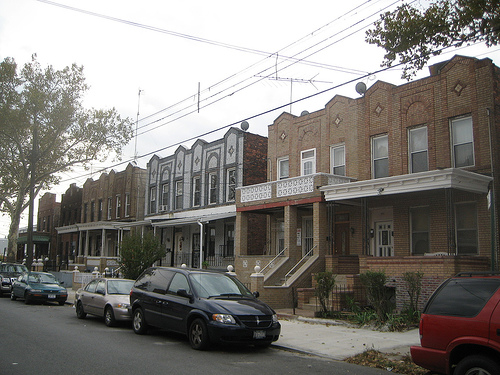
East New York is a residential neighborhood in the eastern section of the New York City borough of Brooklyn. Its boundaries, starting from the north and moving clockwise, are roughly the Cemetery Belt and the Queens borough line to the north; the Queens borough line to the east; Jamaica Bay to the south; the New York City Subway's BMT Canarsie Line, the Bay Ridge Branch railroad tracks, and Van Sinderen Avenue to the west. Linden Boulevard, Pennsylvania Avenue, and Atlantic Avenue are the primary thoroughfares through East New York.
East New York was founded as the Town of New Lots in the 1650s. It was annexed as the 26th Ward of the rapidly growing City of Brooklyn in 1886, and became part of New York City in 1898. During the latter part of the twentieth century, East New York came to be predominantly inhabited by African Americans and Hispanics.
East New York is part of Brooklyn Community District 5, and its primary ZIP Codes are 11207, 11208, and 11239. It is patrolled by the 75th Precinct of the New York City Police Department. New York City Housing Authority (NYCHA) property in the area is patrolled by P.S.A. 2. Coverage by the Fire Department of New York is provided by Battalions 39 & 44. Politically it is represented by the New York City Council's 37th and 42nd Districts.
At the northern edge of what is now East New York, a chain of hills—also known as a terminal moraine—separates northwestern Long Island from Jamaica and the Hempstead Plains, the main part of Long Island's fertile outwash plain. The southern portions of the neighborhood, meanwhile, consisted of salt marshes and several creeks, which drained into Jamaica Bay. These areas were originally settled by the Jameco Native Americans, and later used by the Canarsee and Rockaway tribes as fishing grounds.
In the 1650s Dutch colonists began settling in what are now the eastern sections of Brooklyn, forming the towns of Flatbush, Bushwick, and New Lots (the predecessor of East New York). The area along with the rest of Brooklyn and modern New York City was ceded to the British Empire in 1664. A few 18th-century roads, including the ferry road or Palmer Turnpike from Brooklyn to Jamaica, passed through the chain of hills; hence the area was called "Jamaica Pass". During the American Revolutionary War, invading British and Hessian (German) soldiers ended an all-night forced march at this pass in August 1776 to surprise and flank General George Washington and the Continental Army, to win the Battle of Long Island (also known as the Battle of Brooklyn or the Battle of Brooklyn Heights).
In 1835, Connecticut merchant John Pitkin (the namesake of Pitkin Avenue) purchased the land of the Town of New Lots north of New Lots Avenue, opening a shoe factory at what is now Williams Street and Pitkin Avenue. Pitkin named the area "East New York" to signify it as the eastern end of New York City. In 1836 the Brooklyn and Jamaica Railroad (soon to become part of the Long Island Rail Road, or LIRR) opened through the area; it did not originally stop in East New York, but a stop there was added by 1844. The LIRR moved its terminus to Queens in 1860, and the line through Brooklyn was shortened to end at East New York.
In 1852, New Lots was officially ceded from the Town of Flatbush. In the middle 19th century, the road between Brooklyn and Jamaica became the Brooklyn and Jamaica Plank Road. The Brooklyn and Rockaway Beach Railroad (1865) was built to connect the LIRR's Atlantic Branch with Canarsie at a point later known as Broadway Junction. As often happened at 19th-century railroad junctions, a railway town arose. Sprawling development into the recently rustic northern part of the Town of New Lots followed the reach of elevated transit lines into the area: the Jamaica Avenue Line in 1885 and the Fulton Street Line in 1889. The road to Brooklyn was renamed Fulton Street, the one to Jamaica, Jamaica Avenue, and the one to Williamsburg, Broadway.
East New York (as the Town of New Lots) was annexed as the 26th Ward of the rapidly growing City of Brooklyn in 1886; in 1898 after a decade-long controversy with debates, campaigns and publicity, the community was merged into New York City as a whole with the consolidation of Brooklyn and the other four boroughs into a single entity as the "City of Greater New York". In the 20th century its name came to be applied to much of the former township.
Hub AI
East New York AI simulator
(@East New York_simulator)
East New York
East New York is a residential neighborhood in the eastern section of the New York City borough of Brooklyn. Its boundaries, starting from the north and moving clockwise, are roughly the Cemetery Belt and the Queens borough line to the north; the Queens borough line to the east; Jamaica Bay to the south; the New York City Subway's BMT Canarsie Line, the Bay Ridge Branch railroad tracks, and Van Sinderen Avenue to the west. Linden Boulevard, Pennsylvania Avenue, and Atlantic Avenue are the primary thoroughfares through East New York.
East New York was founded as the Town of New Lots in the 1650s. It was annexed as the 26th Ward of the rapidly growing City of Brooklyn in 1886, and became part of New York City in 1898. During the latter part of the twentieth century, East New York came to be predominantly inhabited by African Americans and Hispanics.
East New York is part of Brooklyn Community District 5, and its primary ZIP Codes are 11207, 11208, and 11239. It is patrolled by the 75th Precinct of the New York City Police Department. New York City Housing Authority (NYCHA) property in the area is patrolled by P.S.A. 2. Coverage by the Fire Department of New York is provided by Battalions 39 & 44. Politically it is represented by the New York City Council's 37th and 42nd Districts.
At the northern edge of what is now East New York, a chain of hills—also known as a terminal moraine—separates northwestern Long Island from Jamaica and the Hempstead Plains, the main part of Long Island's fertile outwash plain. The southern portions of the neighborhood, meanwhile, consisted of salt marshes and several creeks, which drained into Jamaica Bay. These areas were originally settled by the Jameco Native Americans, and later used by the Canarsee and Rockaway tribes as fishing grounds.
In the 1650s Dutch colonists began settling in what are now the eastern sections of Brooklyn, forming the towns of Flatbush, Bushwick, and New Lots (the predecessor of East New York). The area along with the rest of Brooklyn and modern New York City was ceded to the British Empire in 1664. A few 18th-century roads, including the ferry road or Palmer Turnpike from Brooklyn to Jamaica, passed through the chain of hills; hence the area was called "Jamaica Pass". During the American Revolutionary War, invading British and Hessian (German) soldiers ended an all-night forced march at this pass in August 1776 to surprise and flank General George Washington and the Continental Army, to win the Battle of Long Island (also known as the Battle of Brooklyn or the Battle of Brooklyn Heights).
In 1835, Connecticut merchant John Pitkin (the namesake of Pitkin Avenue) purchased the land of the Town of New Lots north of New Lots Avenue, opening a shoe factory at what is now Williams Street and Pitkin Avenue. Pitkin named the area "East New York" to signify it as the eastern end of New York City. In 1836 the Brooklyn and Jamaica Railroad (soon to become part of the Long Island Rail Road, or LIRR) opened through the area; it did not originally stop in East New York, but a stop there was added by 1844. The LIRR moved its terminus to Queens in 1860, and the line through Brooklyn was shortened to end at East New York.
In 1852, New Lots was officially ceded from the Town of Flatbush. In the middle 19th century, the road between Brooklyn and Jamaica became the Brooklyn and Jamaica Plank Road. The Brooklyn and Rockaway Beach Railroad (1865) was built to connect the LIRR's Atlantic Branch with Canarsie at a point later known as Broadway Junction. As often happened at 19th-century railroad junctions, a railway town arose. Sprawling development into the recently rustic northern part of the Town of New Lots followed the reach of elevated transit lines into the area: the Jamaica Avenue Line in 1885 and the Fulton Street Line in 1889. The road to Brooklyn was renamed Fulton Street, the one to Jamaica, Jamaica Avenue, and the one to Williamsburg, Broadway.
East New York (as the Town of New Lots) was annexed as the 26th Ward of the rapidly growing City of Brooklyn in 1886; in 1898 after a decade-long controversy with debates, campaigns and publicity, the community was merged into New York City as a whole with the consolidation of Brooklyn and the other four boroughs into a single entity as the "City of Greater New York". In the 20th century its name came to be applied to much of the former township.
Recent media