Hubbry Logo
Ed PaschkeEd PaschkeMain
Open search
Ed Paschke
Community hub
Ed Paschke
logo
8 pages, 0 posts
0 subscribers
Be the first to start a discussion here.
Ed Paschke
Ed Paschke
from Wikipedia
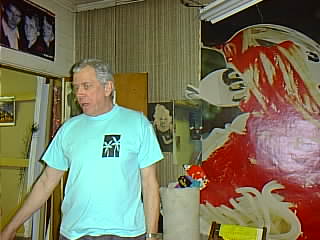
Ed Paschke in his Howard Street Studio, c. 1986

Key Information

Edward Francis Paschke (June 22, 1939 – November 25, 2004) was an American painter. His childhood interest in animation and cartoons, as well as his father's creativity in wood carving and construction, led him toward a career in art. As a student at the School of the Art Institute of Chicago he was influenced by many artists featured in the museum's special exhibitions, in particular the work of Gauguin, Picasso and Seurat.

Life

[edit]

Paschke was born in 1939 in Chicago, where he spent most of his life. He received his bachelor of fine arts degree from the School of the Art Institute of Chicago in 1961, and later his master's degree in art in 1970 from the same school. Drafted into the Army on November 4, 1962, he was sent to Fort Polk, Louisiana, where he worked in the Training Aids Department, working on projects including illustrations for publications, signs, targets and manuals to explain weapons and procedures to incoming troops. He became a regular illustrator for Playboy Magazine, specializing in colorful, sexually suggestive images that reflected his own fine art.

In 1976, he started to teach at Northwestern University.[1] He was a sensitive and supportive professor, often inviting students to his Howard Street studio and forging personal relationships. He sometimes allowed his students to paint on his works-in-progress in his studio, explaining that it would keep him from falling back on his trademark "gestures." He even embarked on a collaboration with Northwestern student Steve Albini of Big Black, though it is not known if any finished product came from the collaboration. On November 22, 1968, Paschke married Nancy Cohn; with whom he had a son Marc, and a daughter Sharon.[2]

Paschke lived and worked in Chicago, where he died in his house on Thanksgiving day, 2004, apparently of heart failure. His wife Nancy Paschke was an artist as well and died seven weeks after him on January 17, 2005, in Chicago.[2]

Work

[edit]

Although Paschke was inclined toward representational imagery, he learned to paint based on the principles of abstraction and expressionism. Like many Chicago artists, he had a fondness for outsider art, as well as tattoo art. There is a picture of him from the late 1970s showing his body covered in elaborate tattoos that he claimed he would often paint on himself for personal gratification.

He avidly collected photographs-related visual media in all its forms, from newspapers, magazines, and posters to film, television, and video, with a preference for imagery that tended toward the risqué and the marginal. Through this he studied the ways in which these media transformed and stylized the experience of reality, which in turn impacted on his consideration of formal and philosophical questions concerning veracity and invention in his own painting. At the same time, he sought living and working situations—from factory hand to psychiatric aide—that would connect him with Chicago's diverse ethnic communities as well as feed his fascination for gritty urban life and human abnormality. Thus he developed a distinctive body of work that oscillated between personal and aesthetic introspection and confronting social and cultural values.[3]

In 1968, his drawing of Bugs Bunny, Porky Pig and Petunia Pig was published as the back cover of Witzend number 5.

In his early paintings Paschke both incorporated and challenged depictions of legendary figures by transforming them into corps exquis, such as Pink Lady (1970) where he set Marilyn Monroe’s famous head atop the suited body of an anonymous male accordion player; or Painted Lady (1971) where he redesigned screen legend Claudette Colbert as a tattooed lady fresh from a freak show. Another direction through which he explored the features and quirks of meaning and logic was in paintings of leather accessories interpreted as anthropomorphized fetish objects, such as Hairy Shoes (1971) and Bag Boots (1972).

In the decades separating Pink Lady and Matinee (1987), Paschke shifted his interest from print to electronic media and a dazzling spectrum of televisual waves and flashes began to fill the paintings. Forms and images disintegrated, broken apart in the fabric of electronic disturbance and its surface. In Matinee, the face of Elvis Presley is fragmented into a field of glowing swathes of color with lips and eyes alone suggesting the human presence beneath the electronic overlay.[4]

Paschke made use of an overhead projector to layer images, which he then rendered using the traditional and time-consuming medium of oil painting. He began with an underpainting in black and white, using a simple can of "Tru-Test" house paint, then addressed it with refined systems of colored glazing or impasto to enliven the optical and physical textures of his painting. He often used synthetic Phthalocynine colors to achieve his neon colored look. With this original and painstaking process he created a formal parallel with the black-and-white-to-color progression in the historical development of printing, film, and television images, at the same time moving the subject matter from the particular to the non-specific to allow a wider range of interpretation. In his later work, once again forms became more solidified, moving back towards certain kinds of psychologized presences and the edgy tension that characterized his earlier work.[4]

Unlike most of his Pop predecessors with their unthreatening embrace of popular culture, Paschke gravitated towards the images that exemplified the underside of American values—fame, violence, sex, and money—a preference that he shared with Andy Warhol, who was one of his foremost inspirations. In the fall of 1984, he was featured on the cover of Art in America magazine, with a great review of his work offered as a powerful alternative to the then popular Neo-Expressionism that was sweeping the New York art scene. Later considered to be an artist of his own time and place, his explorations of the archetypes and clichés of media identity prefigured the appropriative gestures of the "Pictures Generation" and for a new generation of global artists his totemic, eye-popping paintings have come to embody the essence of cosmopolitan art.[4]

In 2000, Paschke was awarded a Guggenheim Fellowship[5] for Fine Arts.

His work is included many museum collections including: the Art Institute of Chicago, the Madison Museum of Contemporary Art, Walker Art Center, Minneapolis, Hirshhorn Museum and Sculpture Garden, Washington D.C., Whitney Museum of American Art, New York, Centre Pompidou, Paris, and Museum of Modern and Contemporary Art, Strasbourg.[6]

Major exhibitions include:[7]

At the time of his death a New York critic lamented that Paschke's "contribution to the art of his time was somewhat obscured by his distance from New York."[1] Since his death there have been several museum and gallery exhibitions of Paschke's work, including in 2010 a museum-quality show at Gagosian Gallery on Madison Avenue in New York City, curated by noted pop artist Jeff Koons.[8] As a student, Koons admired Paschke's work and became his assistant in Chicago in the mid-1970s while attending the School of the Art Institute of Chicago. Paschke would prove to be an important mentor and formative inspiration for the young artist. Paschke's influence in both his subject matter and pioneering use of color continues to influence artists around the world.[4]

On June 22, 2014, a gallery in the Jefferson Park neighborhood of Chicago opened to commemorate the works of Paschke alongside his fellow Chicago artists at the Ed Paschke Art Center.[9]

References

[edit]
[edit]
Revisions and contributorsEdit on WikipediaRead on Wikipedia
from Grokipedia
Edward F. Paschke (June 22, 1939 – November 25, 2004) was an American painter and educator of Polish descent, widely recognized as a leading figure in the Chicago Imagist movement, celebrated for his vibrant, confrontational canvases that distorted mass media imagery through psychedelic colors and expressionist forms. Born and raised on Chicago's North Side, Paschke developed an early interest in art influenced by his father's sketches and Disney animation, which shaped his lifelong engagement with figurative representation and popular culture. He studied painting at the School of the Art Institute of Chicago, earning a BFA in 1961 and an MFA in 1970, where he emerged as part of the late-1960s Chicago Imagists—a group of representational artists drawing from Surrealism, Art Brut, and outsider art to create expressive, anti-establishment works. Throughout his career, Paschke's style evolved from photorealistic depictions of urban grit and media icons in the and 1970s—featuring neon hues, chunky forms, and themes of technology and spectacle—to more abstract, layered explorations of identity, , and global culture in later decades, often using techniques and electric palettes to critique societal obsessions. His works, such as Mid American (1968) and Shoe Sack (1972), exemplify this fusion of influences with hallucinatory distortion, earning him international acclaim through solo exhibitions like his debut at Galerie Darthea Speyer in and inclusions in the (1973, 1981, 1985). As an educator, Paschke taught art theory and practice at institutions including , , and starting in 1978 for over 25 years, where he emphasized experimental and performative aspects of creation, influencing generations of artists through self-produced pedagogical materials. Paschke's legacy endures through collections at major institutions like the , the , and the , as well as the Ed Paschke Art Center, which preserves his archives and promotes his contributions to 20th-century American art. His work continues to receive posthumous recognition, with exhibitions at venues such as the Carl Hammer Gallery and as of 2025.

Early Life and Education

Childhood and Early Influences

Edward Paschke was born on June 22, 1939, at St. Elizabeth's Hospital in , , as the second son of Waldrine and Edward Stanley Paschke, in a Catholic family of Polish immigrant heritage. His father, a bakery truck driver, exhibited artistic leanings through his after-dinner sketches of birds, animals, and characters, as well as , which served as Paschke's initial introduction to creative expression. These family activities, including caricatures his father drew in letters from after , fostered Paschke's early fascination with drawing and cartooning. Growing up in a middle-class neighborhood on Chicago's northwest side near and Diversey Avenue, Paschke was immersed in the vibrant urban environment of the city, though the family briefly relocated to a farm from 1948 to 1950 before returning. This urban setting, combined with exposure to popular media, profoundly shaped his worldview; he attended public schools and developed a keen interest in colorful spectacles like fireworks and the circus. His entry points to art included commercial illustrations and cartoons from Sunday newspapers, particularly comic strips such as and Hogarth's , which captivated him with their dynamic visuals. A pivotal childhood influence was Disney animation, sparked by the 1937 film Snow White and the Seven Dwarfs, for which his father even painted characters Grumpy and Doc on a homemade toy box. This blend of familial creativity and mass-media imagery ignited Paschke's passion for expressive, vibrant visuals, laying the groundwork for his lifelong engagement with art. These formative experiences culminated in his decision to pursue formal training at the .

Academic Training

Paschke enrolled at the School of the Art Institute of Chicago (SAIC) in , pursuing studies in , , and under notable instructors including John Fabian for lineal life , Isabel Steele MacKinnon for volumetric life , and Sonia Sheridan for silkscreening. His early exposure to came in 1958 through an encounter with Georges Seurat's conte-crayon works, while coursework in emphasized vibrant hues and optical effects, establishing the foundation for his signature electric palette. This childhood fascination with further motivated his commitment to formal art studies. He earned his (BFA) degree from SAIC in 1961, with a primary focus on painting techniques that honed his representational skills. Immediately following graduation, Paschke received the Anna Louise Raymond Foreign Traveling Fellowship, enabling a three-month immersion in that profoundly shaped his approach to color and pattern through encounters with the country's exuberant cultural motifs and vivid landscapes. Returning to SAIC, Paschke pursued advanced graduate studies supported by the , completing his (MFA) in 1970 with an emphasis on sophisticated representational methods, including layered applications and tonal to manipulate hue and form. These experiences refined his technical proficiency, bridging traditional principles with innovative visual distortions that would define his later work.

Artistic Career

Early Works and Development

Following his completion of an MFA at the School of the Art Institute of Chicago in 1970, Ed Paschke began experimenting with elements of in his paintings, merging commercial imagery from with traditional techniques to critique consumer culture and urban life. His early professional output in the late and early featured vibrant, distorted representations of everyday objects and figures drawn from , , and print media, reflecting a shift toward provocative, satirical compositions that challenged the boundaries between high and low art. This period marked Paschke's transition from student exercises in abstraction to a more personal style that incorporated bold colors and layered narratives, often evoking the frenetic energy of modern society. Paschke's development was shaped by a range of artistic influences, including , , and , whose approaches to color, form, and informed his handling of light and composition in representational works. He also drew from Andy Warhol's strategies to interrogate media saturation and , adapting silkscreen-like effects to amplify the artificiality of images in his canvases. Additionally, motifs from tattoo art and outsider traditions entered his repertoire, inspired by Chicago's street culture, fairgrounds, and carnival performers, which introduced raw, vernacular symbols of marginality and spectacle into his pieces. These elements allowed Paschke to infuse his paintings with a sense of the grotesque and the exotic, grounding his critique of American excess in local, subcultural realities. In the late 1960s, Paschke gained visibility through group exhibitions in , including the 1968 "Nonplussed Some" show at the Hyde Park Art Center alongside fellow emerging artists, which highlighted his emerging interest in pop-inflected imagery. His first solo exhibition followed in May 1970 at the Deson-Zaks Gallery in , where works like those exploring media distortion solidified his reputation. These presentations positioned Paschke within the , a loose collective of figurative painters active from the mid-1960s who shared his affinity for vibrant hues, surreal distortions, and references to popular and outsider sources, distinguishing their output from East Coast . By the early , this affiliation had established Paschke as a key voice in the group's exploration of urban vernaculars.

Mature Style and Techniques

In the 1970s, Ed Paschke's style evolved significantly, shifting toward vibrant, electric colors such as greens, yellows, reds, and blues, paired with distorted figures that conveyed a of urban alienation and the of fame. This maturation marked a departure from his earlier, more subdued explorations, embracing a bolder aesthetic that amplified the psychological tension in everyday scenes. Central to Paschke's techniques during this period was the use of overhead projectors to layer images directly onto the canvas, allowing him to combine elements from , news clippings, and personal sketches into cohesive paintings. He would project these disparate sources, then meticulously rework them by hand, building depth through precise applications of paint that mimicked the glow and interference of . This method enabled a fluid integration of representational forms with and , resulting in hallucinatory effects that captured the disorienting saturation of visual media in modern life. Paschke's mature works delved into themes of societal margins—such as wrestlers, strippers, and boxers on the fringes of popular entertainment—and the impact of technology on , often portraying celebrities and outsiders as fragmented, electrified icons. These motifs underscored a critique of disjointed communication and perceptual deception in an increasingly mediated urban environment, distinguishing his contributions within the Chicago Imagist movement's emphasis on distorted, surreal figurations drawn from mass culture.

Major Works and Exhibitions

Key Paintings

Ed Paschke's Pink Lady (1970) exemplifies his early exploration of feminine archetypes and media-saturated portraiture, featuring Marilyn Monroe's iconic head superimposed onto the suited body of an anonymous male accordion player in a distorted, vibrant composition that blends pop culture reverence with surreal critique. This work challenges traditional depictions of by transforming familiar figures into hybrid "corps exquis," questioning the boundaries between reality and fabricated imagery in American . In Painted Lady (1971), Paschke continues these themes of gender distortion and marginal spectacle, reimagining actress as a tattooed figure from a , layered with electric colors and projected elements to evoke the risqué underbelly of entertainment history. The painting's innovative fusion of screen legend and grotesquerie highlights Paschke's interest in how media amplifies and alters social identities, using bold pigmentation to confront viewers with the artificiality of fame. By the late , Paschke's style evolved toward influences, as seen in Matinee (1987), where Elvis Presley's face fragments into luminous color bands, with only lips and eyes hinting at human form amid televisual distortions that mimic video interference. This work captures urban and fragmentation, employing an electric palette to explore technology's role in dissolving personal identity into public spectacle. Throughout the and , Paschke produced additional s addressing fame and technological , such as those integrating video stills and digital-like glitches to veil figures in patterns reminiscent of broadcast signals, further innovating his projector-based layering techniques for compositions that blur analog with emerging media .

Notable Exhibitions and Recognition

Paschke gained significant visibility through his inclusion in key group exhibitions alongside fellow during the 1970s and 1980s. In 1972, he participated in "Chicago Imagist Art" at the Museum of Contemporary Art in , which later traveled to New York, showcasing the group's distinctive figurative style and drawing national attention. Further international exposure came with the 1980–1982 touring exhibition "Who Chicago? An Exhibition of Contemporary Imagists," organized by the Camden Arts Centre in and visiting multiple European and U.S. venues; this show highlighted Paschke's vibrant, media-infused works and elevated the Imagists' profile abroad. In 1987, he featured in "The Chicago Imagist Print" at the David and Alfred Smart Gallery at the , further solidifying his role within the movement. A major retrospective, "Ed Paschke: Selected Works," was held at the from October 13, 1990, to January 2, 1991, and traveled to venues in and . In 2000, Paschke received a in Fine Arts for his contributions to , recognizing his innovative approach to contemporary . This prestigious award, granted to artists in including Paschke as a professor at , underscored his impact on the field. Following Paschke's death in 2004, a major posthumous exhibition opened at in New York from March 18 to April 24, 2010, curated by , who had admired Paschke's work as a student. The show presented a selection of his electric, neon-infused s and drawings from the and early 1980s, including pieces like Pink Lady (1970), drawn from private and public collections. A posthumous solo exhibition, "Ed Paschke," was held at Mary Boone Gallery in New York from May 3 to June 24, 2014. The Ed Paschke Art Center in opened on June 22, 2014—what would have been the artist's 75th birthday—established by the Ed Paschke Foundation and the Rabb Family Foundation to house his archive, host exhibitions, and promote his influence through educational programs and artist residencies. The 4,500-square-foot facility in Jefferson Park features dedicated gallery and studio spaces, offering free admission to foster with Paschke's legacy.

Teaching and Legacy

Academic Positions

Ed Paschke began his teaching career at the School of the Art Institute of (SAIC) in the 1970s, where he instructed courses in painting and drawing. His tenure at SAIC, from 1973 to 1976, allowed him to engage with emerging artists in the Chicago Imagist tradition, emphasizing hands-on studio practice and visual experimentation. Among his notable students was , who studied under Paschke during the mid-1970s and later credited him with instilling a professional approach to artistry. Prior to SAIC, Paschke taught at Meramec Community College (1970) and (1971–1973). He also held a position at from 1977 to 1978. In 1976, Paschke joined the faculty of as a professor in the Department of Art Theory and Practice, a position he held until his death in 2004. Over nearly three decades, he developed and taught curriculum focused on contemporary media art, including introductory studio courses that explored visual representation, perceptual philosophies, and the integration of techniques in and . He frequently served as department chair and prioritized engaging non-art majors through rigorous syllabi that stressed attendance, participation, and the cultivation of personal artistic intuition. Paschke's mentorship extended to guiding students in experimental techniques, such as layered color applications and media manipulations drawn from his own Imagist style, which profoundly influenced the next generation of Chicago artists. He often invited students to his studio for critiques, fostering a supportive environment that encouraged risk-taking and cultural awareness in their work. Throughout his academic career, Paschke balanced teaching demands with his studio practice, maintaining freelance illustration work that included contributions to magazine, where he created colorful, suggestive images blending commercial and sensibilities. This dual role provided objective feedback on his paintings while sustaining amid his educational commitments.

Influence on Art and Collections

Ed Paschke played a pivotal role in elevating Imagism to international prominence through his vibrant, media-saturated paintings that critiqued consumer culture and urban alienation. As a core member of the movement, which emerged in the as a counterpoint to New York , Paschke's work helped bridge local aesthetics with global dialogues, influencing the recognition of in major surveys. Posthumously, his contributions gained renewed attention in 21st-century exhibitions, such as the 2019 "How Chicago! Imagists & 70s" at the in the UK, which highlighted his distorted figurative style alongside peers like Jim Nutt and Gladys Nilsson, and more recently, "Ed Paschke & Roger Brown: Imagistic Masters" (November 2024–January 2025) at Carl Hammer Gallery in . Paschke's innovative blending of pop culture icons with fine art critique inspired subsequent generations of artists, notably , who served as his studio assistant in the mid-1970s while studying at the School of the Art Institute of Chicago. Koons has credited Paschke's approach to appropriation and distortion of imagery as formative to his own practice, evident in Koons's early explorations of everyday objects and celebrity. This mentorship underscored Paschke's broader impact on artists navigating the intersection of commercial visuals and . His 2000 Guggenheim Fellowship further marked his early influence within the art world, affirming his techniques as a bridge between analog and emerging digital aesthetics. Paschke's paintings are enshrined in prestigious permanent collections, ensuring his legacy's accessibility to scholars and the public. holds key works such as Mid American (1969), Minnie (1974), and Caliente (1985), reflecting his evolution from gritty urban scenes to luminous abstractions. The Whitney Museum of American Art includes three pieces, including Violencia (1980), which exemplifies his neon-infused commentary on in media. Similarly, the preserves works like Shoe Sack (1972) and Libertad (2001), highlighting his photorealist distortions and cultural motifs. Following Paschke's death in 2004, dedicated archival initiatives have safeguarded his oeuvre, with the Ed Paschke Foundation spearheading efforts to catalog his extensive output. Over 15 years, the foundation compiled detailed records of sales, exhibitions, and painting histories, culminating in the 2014 establishment of the Ed Paschke Art Center as a hub for physical and digital resources. These endeavors include creating a comprehensive virtual archive accessible online, aimed at preserving his projector-based process—where he overlaid photographic slides to build layered compositions—and supporting research by art historians and students.

Personal Life and Death

Paschke was born on June 22, 1939, in to parents Waldrine and Edward Stanley Paschke, as the second son in a Catholic family; his older brother was Richard. He married fellow art student Nancy Cohn on November 22, 1968, whom he met at the School of the Art Institute of . The couple had two children: daughter Sharon, born in April 1971, and son Marc. Nancy was diagnosed with in 1971, and her condition progressively worsened over the years. Paschke died suddenly at his home in on November 25, 2004, at the age of 65, from while sleeping on Day. His services were private. He was survived by his wife Nancy, children Sharon and Marc, mother Waldrine, and brother . Nancy Paschke passed away seven weeks later.

References

Add your contribution
Related Hubs
User Avatar
No comments yet.