Hubbry Logo
PointillismPointillismMain
Open search
Pointillism
Community hub
Pointillism
logo
8 pages, 0 posts
0 subscribers
Be the first to start a discussion here.
Pointillism
Pointillism
from Wikipedia
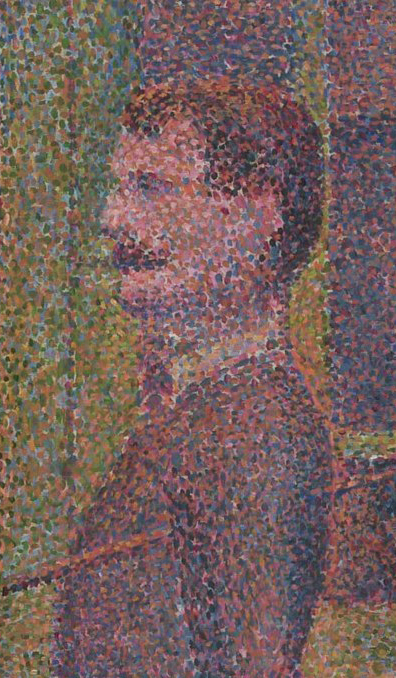
Detail from Seurat's Parade de cirque, 1889, showing the contrasting dots of paint which define Pointillism

Pointillism (/ˈpwæ̃tɪlɪzəm/, also US: /ˈpwɑːn-ˌ ˈpɔɪn-/)[1] is a technique of painting in which small, distinct dots of color are applied in patterns to form an image.

Georges Seurat and Paul Signac developed the technique in 1886, branching from Impressionism. The term "Pointillism" was coined by art critics in the late 1880s to ridicule the works of these artists, but is now used without its earlier pejorative connotation.[2] The movement Seurat began with this technique is known as Neo-impressionism. The Divisionists used a similar technique of patterns to form images, though with larger cube-like brushstrokes.[3]

Technique

[edit]

The technique relies on the ability of the eye and mind of the viewer to blend the color spots into a fuller range of tones. It is related to Divisionism, a more technical variant of the method. Divisionism is concerned with color theory, whereas pointillism is more focused on the specific style of brushwork used to apply the paint.[2] Pointillism is a technique with few serious practitioners today and is notably seen in the works of Seurat, Signac, and Cross.

From 1905 to 1907, Robert Delaunay and Jean Metzinger painted in a Divisionist style with large squares or 'cubes' of color: the size and direction of each gave a sense of rhythm to the painting, yet color varied independently of size and placement.[4] This form of Divisionism was a significant step beyond the preoccupations of Signac and Cross. In 1906, the art critic Louis Chassevent recognized the difference and, as art historian Daniel Robbins pointed out, used the word "cube" which would later be taken up by Louis Vauxcelles to baptize Cubism. Chassevent writes:

M. Metzinger is a mosaicist like M. Signac but he brings more precision to the cutting of his cubes of color which appear to have been made mechanically [...].[5][6][7][8]

Practice

[edit]

The practice of Pointillism is in sharp contrast to the traditional methods of blending pigments on a palette. Pointillism is analogous to the four-color CMYK printing process used by some color printers and large presses that place dots of cyan, magenta, yellow, and key (black). Televisions and computer monitors use a similar technique to represent image colors using red, green and blue (RGB) colors.[9]

If red, blue, and green light (the additive primaries) are mixed, the result is something close to white light (see Prism (optics)). Painting is inherently subtractive, but Pointillist colors often seem brighter than typical mixed subtractive colors. This may be partly because subtractive mixing of the pigments is avoided, and because some of the white canvas may be showing between the applied dots.[9]

The painting technique used for Pointillist color mixing is at the expense of the traditional brushwork used to delineate texture.[9]

The majority of Pointillism is done in oil paint. Anything may be used in its place, but oils are preferred for their thickness and tendency not to run or bleed.[10]

Music

[edit]

Pointillism also refers to a style of 20th-century music composition. Different musical notes are made in seclusion, rather than in a linear sequence, giving a sound texture similar to the painting version of Pointillism. This type of music is also known as punctualism or klangfarbenmelodie.

In the 21st century, Australian composer Georges Lentz’s music, influenced by the subtle dot paintings of Kathleen Petyarre and by the starry night sky in the Australian Outback, has also, in some aspects, been described as pointillistic[11].

Notable artists

[edit]

Notable paintings

[edit]
[edit]

See also

[edit]

References

[edit]
[edit]
Revisions and contributorsEdit on WikipediaRead on Wikipedia
from Grokipedia
Pointillism is a technique developed in the late by French artists and , characterized by the application of small, distinct dots of pure color to a , which blend optically in the viewer's eye to create form, depth, and vibrancy. This method, rooted in scientific principles of , marked a deliberate departure from the looser brushwork of , aiming for greater precision and luminosity through the juxtaposition of . As a cornerstone of the Neo-Impressionist movement, Pointillism emerged from Seurat's innovative experiments beginning around 1884, inspired by optical theories from scientists like Michel Eugène Chevreul and Ogden Rood, which posited that colors intensify when placed side by side rather than mixed on the palette. Seurat, often credited as the technique's inventor, first showcased it publicly with works like Bathers at Asnières (1884) and refined it in his masterpiece A Sunday on La Grande Jatte—1884 (1884–1886), a large-scale scene of Parisians at leisure that exemplifies the method's meticulous application of thousands of dots. Signac, Seurat's close collaborator, played a pivotal role in promoting and evolving the style after Seurat's early death in 1891 at age 31, authoring influential treatises like D'Eugène Delacroix au Néo-Impressionnisme (1899) to defend its theoretical foundations. The term "Pointillism" itself was coined derogatorily by critics in 1886 during the Eighth Impressionist Exhibition, mocking the dot-based approach, though Signac preferred "Divisionism" to emphasize the division of color. Pointillism's influence extended beyond its originators, impacting Post-Impressionists like Vincent van Gogh, who adapted looser dot-like strokes in works such as his 1887 self-portrait, and later modernists including Piet Mondrian and Wassily Kandinsky. Despite its labor-intensive nature—Seurat reportedly spent over two years on La Grande Jatte—the technique revolutionized color perception in art, prioritizing optical mixing over traditional pigment blending to achieve heightened emotional and visual intensity.

Historical Context

Roots in Impressionism

Impressionism, which emerged in the 1870s, emphasized the transient effects of light and color through loose, broken brushwork that captured fleeting atmospheric conditions and optical sensations. This approach, seen in works by artists like and , prioritized the immediate visual impression over detailed rendering, using dabs and strokes of pure color to suggest vibrancy and movement on the canvas. These techniques laid foundational groundwork for Pointillism by introducing the concept of juxtaposing colors to achieve luminous effects, moving away from traditional blending on the palette toward optical mixing perceived by the viewer's eye. Georges Seurat's early painting (1884) exemplifies this transitional phase, bridging Impressionist spontaneity with a more structured application of color. In the work, Seurat employed larger patches of color and contoured forms to depict figures along the , evoking the relaxed leisure scenes common in Impressionist landscapes while introducing a deliberate composition that hinted at greater precision. Submitted to the 1884 Paris Salon but rejected, the painting reflected Seurat's initial immersion in Impressionist themes of modern life and outdoor light, yet its methodical arrangement of tones foreshadowed his refinement toward smaller, dot-like marks in subsequent pieces. Seurat encountered , a leading Impressionist known for mentoring younger artists in the , during this period. While their relationship was collaborative, Seurat's independent experiments with color juxtaposition—building on Impressionist practices of applying pure colors directly to suggest atmospheric depth—influenced Pissarro, who began exploring divided color techniques after meeting Seurat around 1885. Seurat's studies during the mid-1880s tested systematic arrangements of hues to capture , gradually evolving toward the dotted technique that defined Pointillism. By the mid-1880s, some artists, including Seurat, grew dissatisfied with Impressionism's reliance on intuitive spontaneity, seeking a more rigorous, to control optical interactions and ensure reproducible color harmony. This shift toward precision addressed perceived limitations in the movement's ephemeral quality, transforming broken brushwork into a calculated system of pure color application. These developments contributed to the broader framework of , which formalized such innovations around 1886.

Formation of Neo-Impressionism

The was founded in 1884 by a group of artists, including and , as a response to the restrictive jury system of the official Salon, providing an unjuried platform for works that would become central to . This society organized its first exhibition that year, allowing Seurat and Signac to display early experiments in divided color techniques, which laid the groundwork for the movement's institutional presence independent of the Impressionists. In 1886, at the Eighth Impressionist Exhibition, critic Félix Fénéon reviewed the works of Seurat and his contemporaries, coining the term "Pointillism" (from the French peinture au point, or "painting by dots") to describe their methodical application of color dots, while also introducing "Neo-Impressionism" to signify the movement's evolution from Impressionist spontaneity toward scientific precision. Fénéon's articles in publications like L'Art Moderne helped solidify the movement's identity, drawing attention to its optical innovations exhibited alongside traditional Impressionist pieces. However, artists such as Signac rejected "Pointillism" as overly simplistic, preferring "Divisionism" to emphasize the theoretical division of colors rather than just the dotting technique. Following Seurat's death in 1891, Signac emerged as the primary advocate for the movement, promoting its principles through exhibitions at the and theoretical writings that positioned as a logical progression from Delacroix's color theories. In his 1899 treatise D'Eugène Delacroix au Néo-Impressionnisme, Signac formalized the movement's scientific foundations, arguing for as a harmonious synthesis of and , which further entrenched its terminology and legacy among practitioners.

Technique

Principles of Divisionism

, the foundational technique underlying Pointillism, involves the systematic separation of colors into distinct applications of on the , rather than mixing them beforehand, to achieve perceptual effects through the viewer's vision. In Pointillism, this method is refined through the exclusive use of small, precise dots—known as "points"—applied uniformly without blending, distinguishing it from the broader , which allows for strokes, patches, or other divided forms of color application. This dot-based approach ensures that colors remain unadulterated, preserving their maximum intensity and luminosity. The core principle of optical mixing in Pointillism relies on the human eye's ability to merge these adjacent dots from a viewing distance, creating secondary colors and tones that appear more vibrant and luminous than those obtained by traditional palette mixing, which often results in muddier hues due to dulling. By applying pure primary colors—such as , , and —alongside their complements in tiny, distinct dots, artists exploit the retina's integrative process to generate a fuller of perceived colors, enhancing the overall of the composition. This technique avoids the loss of vibrancy inherent in mechanical mixing, as the optical blend occurs purely in the viewer's perception. A key aspect of Divisionism's principles is simultaneous contrast, where the juxtaposition of unblended colors intensifies their mutual effects, making each appear more vivid against its neighbor—for instance, a dot adjacent to a one will seem brighter and more saturated due to their oppositional interaction. This phenomenon amplifies color differences and perceptual depth without altering the pigments themselves, contributing to the technique's goal of heightened visual harmony and dynamism. These principles draw briefly from 19th-century theories on and contrast.

Scientific Basis

The scientific foundations of Pointillism drew extensively from 19th-century optical and color theories, particularly those addressing how the perceives and mixes colors. Michel Eugène Chevreul's seminal work, The Principles of and Contrast of Colors (1839), provided a key theoretical framework by outlining the laws of simultaneous contrast—where adjacent colors mutually intensify or alter each other's appearance—and successive contrast, involving afterimages produced by prolonged viewing of a color. Chevreul, as director of the Gobelins manufactory, developed these principles through empirical observations of dyeing and , emphasizing that color effects arise not in isolation but through interactions on the . This scientific approach to color influenced Pointillist artists by suggesting that juxtaposed pure colors could achieve greater vibrancy than blended pigments, with art critic Charles Blanc's Grammaire des arts du dessin (1867) popularizing these ideas among painters. Building on Chevreul, American physicist Ogden Nicholas Rood's Modern Chromatics: Students' Text-book of Color (1879) further explored color perception through the lens of light wavelengths and physiological . Rood described how the eye blends adjacent colors optically, rather than through physical mixing, and highlighted the role of spectral purity in maintaining luminosity, drawing from experiments on light refraction and response. Translated into French in 1881, Rood's text reinforced the idea that unmixed colors, when placed in proximity, fuse in the viewer's perception to produce harmonious tones with enhanced brightness, as shorter wavelengths (like ) and longer ones (like red) interact at varying distances on the . Pointillists applied these theories by dividing paintings into small dots of pure spectrum colors—primarily red, yellow, and blue, along with their complements—to exploit retinal fusion for . This technique aimed to maximize and intensity, as optical blending in the eye preserved the full vibrancy of each hue, avoiding the desaturation caused by traditional palette mixing. These principles underpinned as a practical method, where dot placement and size were calculated to optimize perceptual effects based on viewing distance. Despite its rigorous basis, the Pointillist approach faced for being overly rigid and mechanistic, subordinating the emotional and intuitive dimensions of color to scientific formulas. Detractors argued that this emphasis on optical precision limited artistic expressiveness, reducing color to a predictable physiological response rather than a subjective of mood or feeling.

Practice and Application

Artistic Process

Pointillist artists began the creative process with extensive preparation, creating detailed preparatory drawings and color studies to map out compositions and tonal relationships before applying dots to the final canvas. For instance, produced approximately 28 drawings using crayon on textured white paper to outline figures, landscapes, and spatial arrangements, alongside 28 small oil panels as color studies to experiment with pigment interactions and lighting effects. These preliminary works, often executed or in the studio, allowed artists to refine forms and ensure optical harmony, guided briefly by scientific color principles such as complementary contrasts for enhanced vibrancy. In executing the paintings, artists employed specialized tools and materials to achieve precise dot placement, typically using fine es or the wooden end of a dipped in paint to form small, distinct dabs without blending on the . They favored paints with stable pigments, such as and , to minimize fading over time, though some colors like yellow proved less reliable and have discolored in surviving works. This meticulous application demanded patience, as dots were placed individually to allow the viewer's eye to optically mix colors from a distance, resulting in luminous effects unattainable through traditional mixing. The process was notoriously time-intensive due to the sheer volume of dots required, with Seurat's A Sunday on La Grande Jatte—1884 taking over two years to complete from initial studies in 1884 to final refinements in 1886. This duration reflected the challenges of maintaining consistency across large surfaces, where even minor adjustments, such as reshaping figures or intensifying contrasts, could extend labor significantly. While strict pointillism emphasized uniform small dots, some practitioners introduced variations for efficiency, employing larger dashes or strokes known as couleur divisée to divide colors more broadly without sacrificing optical blending. , for example, advocated this divisionist approach over rigid dotting, applying short, varied marks to accelerate execution while preserving the technique's theoretical foundations.

Exhibitions and Reception

Pointillism made its public debut at the Eighth and Final Impressionist Exhibition in in 1886, where presented his monumental work A Sunday Afternoon on the Island of La Grande Jatte. This showcase introduced the technique to a broader audience, featuring works by Seurat and that emphasized the systematic application of colored dots, jolting the art world with their radical departure from traditional brushwork. Following this initial exposure, Pointillist artists actively participated in the Salon des Indépendants, established in 1884 as an alternative venue for works free from . Starting from the 1886 edition, Seurat, Signac, and other practitioners like exhibited there regularly, using the salon to promote among progressive circles and solidify as a distinct movement. The reception to these exhibitions was sharply divided, with traditionalist critics mocking the method as overly mechanical or "dotty," derisively dubbing it "Pointillism" to highlight its perceived absurdity and failure to achieve naturalism. In contrast, forward-thinking reviewers like Félix Fénéon praised its scientific rigor, coining the term "" in 1886 to celebrate the deliberate, theory-based innovation that elevated color harmony and optical mixing. By the 1890s, strict adherence to Pointillism began to wane, largely due to the technique's extreme , which demanded painstaking application of countless dots and limited artistic spontaneity. Seurat's untimely in 1891 further accelerated this shift, as the perceived rigidity of the method prompted many artists to explore more fluid, expressive approaches, though its principles continued to influence broader Post-Impressionist developments.

Notable Artists

Georges Seurat

Georges-Pierre Seurat was born on December 2, 1859, in , , into a prosperous family that provided him financial independence throughout his career. As the youngest of three children, he received early artistic encouragement and began formal training at the municipal art school under sculptor Justin Lequien at age 16. In 1878, Seurat enrolled at the École des Beaux-Arts in , studying under Henri Lehmann, a pupil of Ingres, where he focused on academic drawing for about a year before his studies were interrupted by mandatory on the Breton coast from 1879 to 1880. Upon returning to in 1880, Seurat immersed himself in self-directed studies of , drawing from scientific treatises by and Ogden Rood to develop a systematic approach to that would evolve into Pointillism. This period of experimentation, spanning roughly 1882 to 1884, marked his shift from traditional techniques toward a method emphasizing optical mixing of colors through divided brushstrokes. Seurat's innovations positioned him as the central figure in founding , a movement he led not through written manifestos but by demonstrating the technique's principles to fellow artists. Seurat organized key exhibitions to advance the method, notably including his work in the eighth and final Impressionist exhibition of , which helped establish as a distinct style. He influenced peers such as , with whom he collaborated closely from 1884 onward to refine and promote the technique among emerging artists. His leadership fostered a small but dedicated group of adherents, emphasizing rigorous application over casual adoption. Seurat's perfectionist tendencies resulted in a limited body of work, as he labored meticulously over compositions, often taking years to complete major pieces. This deliberate pace, combined with his early death on March 29, 1891, at age 31 from a sudden illness—likely contracted from his infant son—severely curtailed his output and left the movement's theoretical elaboration to others. Despite his brief career, Seurat's foundational contributions ensured Pointillism's enduring influence on .

Paul Signac

Paul Signac (1863–1935) was a French painter born on November 11, 1863, in to a wealthy family involved in the saddlery trade. Largely self-taught, he abandoned architectural studies at age 18 after attending an Impressionist exhibition, committing fully to painting thereafter. An enthusiastic sailor, Signac undertook extensive voyages along the coasts of Europe, from to the Mediterranean, where he applied Pointillist techniques to depict vibrant harbor and landscape scenes. He passed away on August 15, 1935, in . Signac encountered Georges Seurat's work in 1884, which inspired his adoption of the Pointillist method based on optical . As the primary advocate for the technique following Seurat's early death, Signac made significant theoretical contributions, most notably through his 1899 D'Eugène Delacroix au Néo-Impressionnisme (translated as From Delacroix to ), which positioned as a scientific and harmonious progression in from Delacroix's color theories to contemporary practice. In his later career, Signac gradually relaxed the rigorous dotting of early Pointillism, favoring broader, more fluid strokes that emphasized rhythmic color application and light effects. This stylistic evolution bridged with emerging movements, influencing Fauvism's emphasis on pure, unmixed colors. Signac also played a pivotal organizational role as co-founder of the in 1884 and its president from 1908 until his death, actively mentoring younger artists by promoting their experimental works in exhibitions.

Other Practitioners

Beyond the foundational roles of and , several artists adopted Pointillism, adapting its dot-based technique to diverse subjects and contributing to its evolution within . , a Belgian-born painter who settled in , refined Pointillism after adopting it around 1890, particularly in the 1890s and beyond while working in the South of alongside Signac. He specialized in luminous landscapes and seascapes, emphasizing vibrant color harmonies and the optical blending of pure tones to capture Mediterranean light effects. Maximilien Luce, a French influenced by Seurat, applied Pointillism to urban and industrial scenes during the late 1880s and 1890s, often infusing his works with social commentary on labor and everyday life. His compositions highlighted contemporary Parisian life, blending the technique's scientific precision with empathetic portrayals of workers, occasionally incorporating symbolic elements to underscore human dignity amid modernization. Théo van Rysselberghe, another Belgian practitioner, embraced Pointillism from the mid-1880s, using it to depict portraits and female nudes with a focus on elegant forms and subtle tonal gradations. His adoption of the method, inspired by Seurat's demonstrations in 1887, extended to intimate interior scenes and figures, where he explored the interplay of light on skin and fabric. Camille Pissarro, the elder statesman of , experimented with Pointillism in the late 1880s after meeting Seurat and Signac, producing Divisionist landscapes and rural scenes that bridged Impressionist spontaneity with Neo-Impressionist precision before largely returning to looser styles by 1890. The technique also spread internationally, with Australian artist John Peter Russell incorporating Pointillism into his coastal landscapes after encountering Seurat in during the 1880s, thereby introducing Neo-Impressionist principles to circles.

Significant Works

Seurat's Paintings

Georges Seurat's Pointillist paintings exemplify his commitment to a scientific approach to art, transforming everyday scenes into structured compositions through meticulous application of colored dots. His oeuvre, developed during a brief but intense career from the early 1880s until his death in 1891, showcases evolving techniques that bridged and . One of Seurat's earliest major works, (1884), serves as a transitional piece toward full Pointillism, featuring larger areas of color rather than strictly divided dots, while incorporating subtle pointillist touches such as blue dots on shadows. This oil on canvas, measuring 201 × 300 cm, depicts young men and boys relaxing along the banks of the in the industrial suburb of Asnières, north-west of , highlighting the leisure of factory workers amid a backdrop of smokestacks and modern bridges that evoke the encroaching industrialization of urban life. The composition's calm, frieze-like arrangement and use of contour lines to define forms prefigure Seurat's later rigorous style, emphasizing harmony over Impressionist spontaneity. Seurat's masterpiece, A Sunday Afternoon on the Island of La Grande Jatte (1884–1886), fully embodies Pointillism on a monumental scale of approximately 2 × 3 meters (207.5 × 308.1 cm), portraying bourgeois Parisians engaged in leisurely pursuits along the . The painting's theme captures a snapshot of modern social life, with figures frozen in poised, statue-like positions that convey a sense of timeless formality amid contemporary recreation. Seurat innovatively employed dots of pure color to achieve spatial depth and , relying on optical mixing where warm tones in the foreground contrast with cooler in the background, creating through color juxtaposition rather than traditional . This systematic application, informed by , allowed the viewer's eye to blend the dots at a distance, enhancing vibrancy and three-dimensionality. In The Models (Les Poseuses, 1886–1888), Seurat explored studio nudes through Pointillism, depicting three female figures in various poses against a backdrop of his own works, including his masterpiece A Sunday on La Grande Jatte. Measuring 200 × 250 cm, the painting uses thousands of tiny dots to render skin tones with a range of colors—from yellows and pinks to greens and blues—capturing the play of light on forms and emphasizing the models' contemplative expressions and dynamic positioning. The foreground model's pose draws the eye, while the dotted technique diffuses edges, evoking a shimmering, almost ethereal quality that underscores Seurat's interest in light's optical effects on the human figure. Seurat's technical execution across these works involved rigorous grid planning, beginning with extensive preparatory drawings, crayon studies, and oil sketches—over 60 for La Grande Jatte alone—to map compositions and dot placements on a virtual grid, ensuring precise balance and color harmony before applying paint in a methodical, non-spontaneous manner. This process, rooted in scientific and division of labor in color application, distinguished his Pointillism as a deliberate, pursuit rather than an intuitive one.

Works by Signac and Others

Paul Signac's Asnières, the Banks of the (1885) exemplifies an early application of Pointillism in a riverine context, depicting the banks at Asnières with small, roughly square points of pure color applied directly to the canvas. This technique relies on optical mixing, where adjacent dots of complementary hues blend in the viewer's eye to produce vibrant, shimmering effects on the water surface, enhancing the luminosity of the scene through the integration of white ground. The painting captures the dynamic interplay of light and water, marking Signac's transition from Impressionist brushstrokes to a more systematic Divisionist approach. Henri-Edmond Cross advanced Pointillist practice in The Evening Air (1893), portraying women in a serene coastal during twilight with larger, irregular brushstrokes rather than rigid dots. These softer, rectangular touches create an atmospheric diffusion of fading sunlight, evoking a dreamlike harmony between figures and environment through subtle color vibrations. Exhibited at the 1894 Salon des Indépendants, the work demonstrates Cross's evolution toward expressive freedom within , softening the technique for emotional depth. Maximilien Luce's The Seine at Herblay (1889), painted during a stay with Signac near , blends urban and rural elements along the riverbank using dense Pointillist dots to render dynamic water reflections. The composition captures the 's flowing movement through carefully juxtaposed colors that optically merge to simulate rippling light on the surface, bridging industrial outskirts with natural scenery. This collaboration highlights Luce's adaptation of the method for conveying motion in everyday landscapes. Among Signac, , and Luce, Pointillist works commonly featured landscapes and seascapes, with occasional portraits, adapting the dot technique to suggest movement through varying dot sizes and color contrasts that imply depth and flux. These artists often showcased their pieces at independent exhibitions, where the technique's innovative optical effects garnered attention for their luminous quality.

Extensions to Other Disciplines

Pointillism in Music

Pointillism in music, also referred to as punctualism or point music, is a compositional technique characterized by the placement of discrete, unpulsed notes in sparse textures to create emergent musical forms. This approach treats each note as an independent sonic event, avoiding continuous melodic lines or rhythmic pulses, and instead relies on the listener's to synthesize the overall structure. Emerging within the framework of , the style developed from the early 1910s through the 1950s, particularly in atonal and twelve-tone compositions where traditional continuity was rejected in favor of fragmented, point-like elements. The technique draws a direct theoretical parallel to visual pointillism, analogizing musical notes to isolated color dots that blend optically in the viewer's eye; similarly, these sonic points coalesce in the listener's auditory perception to form coherent textures without linear development. Anton Webern pioneered this sparse, pointillistic approach in his atonal works, most notably in the Six Bagatelles for String Quartet, Op. 9 (1913), where brief, isolated gestures—often limited to one to four notes—construct delicate, mosaic-like movements that prioritize timbral and registral contrast over thematic elaboration. Karlheinz Stockhausen further advanced the style in the post-World War II era, incorporating pointillistic episodes in serial compositions such as Gruppen for three orchestras (1955–1957), where spatially distributed points of sound across ensembles create dynamic, multidimensional layers. From its roots in atonal pointillism, the technique evolved into electronic music applications during the , particularly at the studio under Herbert Eimert and Stockhausen, where total extended pointillistic principles to synthesized sounds and tape manipulation, as exemplified in Stockhausen's Gesang der Jünglinge (1956). This shift integrated to heighten the isolation and precision of sonic points, influencing broader experimental practices in spatial and .

Influence on Design and Digital Art

Pointillism's emphasis on optical color mixing through discrete dots has profoundly shaped techniques, particularly the Ben-Day dot system employed in mid-20th-century commercial printing. Developed in the by illustrator Benjamin Day, Ben-Day dots create shading and texture via patterns of small colored or black dots, directly analogous to Pointillist methods for achieving tonal gradations and visual illusions without blending pigments. In the , Pop artist adapted this process in his paintings, enlarging comic book-style Ben-Day dots to mimic Pointillist optical effects, thereby critiquing while evoking Seurat's scientific approach to color perception. Lichtenstein's works, such as Whaam! (1963), used these dots for bold, mechanical shading that reinforced the movement's ironic commentary on consumer culture. The technique's principles extended into digital realms with the advent of in early from the , where individual pixels function as modern dots to form images through viewer-perceived mixing on screens. This parallels Pointillism's reliance on blending, as pixels of pure RGB colors combine optically to simulate continuous tones, much like Seurat's divided color application. Artists and game designers in the and , constrained by low-resolution displays, embraced as a deliberate aesthetic, tracing its conceptual roots to Pointillism's scientific exploration of light and vision. For instance, early video games like those on the employed pixel grids to create illusory depth and color, echoing the optical illusions inherent in Pointillist compositions. In , Pointillism influenced , a photomechanical process that decomposes images into variable-sized dots to reproduce continuous tones in , often producing moiré patterns—interference visuals that enhance or distort illusions akin to Pointillist shimmer. techniques, refined in the late , allowed for efficient color reproduction in newspapers and posters, building on the same dot-based optical mixing that Seurat theorized through . Designers exploited moiré effects for dynamic visual interest in and , where overlapping dot screens create wavy interference patterns that mimic the vibrating boundaries in Pointillist paintings. In the , software tools have democratized Pointillist effects in , with Photoshop's Pointillize filter—introduced in early versions of the program—automatically converting images into clustered color dots to simulate the technique's optical blending. This filter, part of the Pixelate menu, adjusts cell size to cluster similar colors, enabling artists to apply Pointillism non-destructively for contemporary illustrations and photo manipulations. Such tools have extended to (NFT) art, where generative algorithms produce Pointillist-inspired pixelated works on platforms, reviving the method in virtual galleries and digital collectibles that emphasize modular, dot-based compositions for immersive viewer experiences.

Legacy and Influence

Impact on 20th-Century Art Movements

Pointillism's innovative use of optical mixing and unmixed colors profoundly shaped the movement from 1905 onward, inspiring artists like and to embrace bold, non-naturalistic palettes. Matisse's early paintings, such as Luxury, Calm and Pleasure (1904), reflect direct stylistic borrowings from Georges Seurat's Pointillism, employing juxtaposed dabs of pure color to generate luminous effects through the viewer's eye rather than manual blending. Derain, collaborating closely with Matisse in , further adapted these principles, amplifying the intensity of hues to prioritize over representational accuracy, thus marking a decisive shift from Pointillist precision to Fauvist exuberance. The technique's emphasis on dividing form and color into discrete units resonated in the fragmented structures of and during the 1910s. , in developing , drew inspiration from Seurat's linear and formal rigor, incorporating pointillist-like elements into works that deconstructed objects into geometric facets for perceptual reconstruction. Similarly, Futurist adopted —an Italian variant of Pointillism emphasizing broken strokes—to fragment forms and capture dynamic motion, as seen in paintings like (1910), where color division enhances the sense of speed and simultaneity. By the 1960s, Pointillism's perceptual foundations directly informed , with explicitly referencing Seurat's optical illusions in her geometric abstractions. Riley's black-and-white works, such as Movement in Squares (1961), exploit the afterimage and contrast effects pioneered in Pointillism to induce vibrations and motion, transforming static patterns into dynamic visual experiences through the interplay of lines and tones. Her approach underscores how Pointillist theory on viewer-dependent evolved into deliberate manipulations of sight. In , painters drew on principles of simultaneous contrast derived from Michel Eugène Chevreul's theories to create immersive emotional fields through the juxtaposition of colors. This application extended scientific color dynamics into abstract, contemplative realms.

Contemporary Revivals

In the realm of digital and , contemporary practitioners have revived Pointillism through computational methods, generating intricate dot-based compositions that echo optical mixing while exploring and data visualization. This approach extends Pointillism into , where code dictates dot placement and color interactions, allowing for infinite variations unattainable in traditional painting. AI and software tools continue to simulate aspects of Seurat's in virtual environments, fostering interactive and scalable optical effects. Contemporary painters continue to reinterpret Pointillism, often infusing it with personal themes of identity and perceptual memory. Yayoi Kusama's Infinity Nets series, begun in the 1950s but influential through ongoing exhibitions into 2025, represents an expansive form of Pointillism through vast fields of repetitive polka dots that create immersive, hallucinatory optical illusions, symbolizing infinite self-obliteration and psychological depth. In more recent works, artists like Semadar have advanced neo-Pointillism by layering dots to explore contemporary aesthetics, as seen in her 2024 pieces that blend meticulous color application with modern narratives of fragmentation and unity, showcased at Art Basel Miami Beach, with continued exhibitions during 2025 Miami Art Week. Other painters, such as Eddy Maniez, push boundaries into three dimensions with silicone-based sculptures from 2023 onward, using pointillist dots to evoke movement and color vibration in sculptural forms, marking the first such application of the technique in non-flat media. Installations and have adopted Pointillism's principles through LED dot matrices and (AR), enabling interactive experiences of color blending in public spaces. For example, large-scale LED installations in urban environments, such as those in contemporary projects since 2020, utilize programmable grids to mimic pointillist optical mixing, where viewers' movement triggers real-time color shifts and illusions. AR applications further enhance this by overlaying virtual dot patterns on physical sites, allowing users to engage with interactive perceptual effects, as explored in festivals blending historical techniques with immersive tech up to 2025. Pointillism's cultural impact persists in video games via and shaders, where discrete colored pixels function as modern dots to generate blended visuals at varying resolutions. in indie games, such as those deconstructing visuals since the , directly draws from Pointillism's mosaic-like composition, representing shapes through clustered vibrant pixels that evoke optical when viewed holistically. Pixel shaders in game engines further emulate this by sampling point-based color data for rendering effects, influencing titles that prioritize retro and perceptual depth. In , Pointillism inspires sustainable practices through dot-based illusions that minimize material use while maximizing visual impact. A notable 2023 project in adapted the technique for a metal of , fabricating thousands of small metal domes from recycled aluminum, tin, and other wastes to form colored points that optically mix into a cohesive image from afar, thereby reducing and promoting eco-conscious . This approach highlights Pointillism's potential in green design, where dot patterns create color illusions on facades or landscapes using low-resource materials, fostering environmental awareness through perceptual artistry.

References

Add your contribution
Related Hubs
User Avatar
No comments yet.