
Recent from talks
Edgar, King of Scotland
Knowledge base stats:
Talk channels stats:
Members stats:
Edgar, King of Scotland
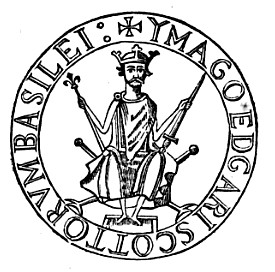
Edgar or Étgar mac Maíl Choluim (Modern Gaelic: Eagar mac Mhaoil Chaluim), nicknamed Probus, "the Valiant" (c. 1074 – 8 January 1107), was King of Alba (Scotland) from 1097 to 1107. He was the fourth son of Malcolm III and Margaret of Wessex but the first to be considered eligible for the throne after the death of his father.
Edgar claimed the kingship in early 1095, following the murder of his half-brother Duncan II in late 1094 by Máel Petair of Mearns, a supporter of Edgar's uncle Donald III. His older brother Edmund sided with Donald, presumably in return for an appanage and acknowledgement as the heir of the aged and son-less Donald.
Edgar received limited support from William II of England as Duncan had before him; however, the English king was occupied with a revolt led by Robert de Mowbray, Earl of Northumbria, who appears to have had the support of Donald and Edmund. Rufus campaigned in northern England for much of 1095, and during this time Edgar gained control only of Lothian. A charter issued at Durham at this time names him "... son of Máel Coluim King of Scots ... possessing the whole land of Lothian and the kingship of the Scots by the gift of my lord William, king of the English, and by paternal heritage".
Edgar's claims had the support of his brothers Alexander and David – Ethelred was Abbot of Dunkeld, and Edmund was divided from his siblings by his support of Donald – and his uncle Edgar Ætheling as these witnessed the charter at Durham.
William Rufus spent 1096 in Normandy which he bought from his brother Robert Curthose, and it was not until 1097 that Edgar received further support which led to the defeat of Donald and Edmund in a hard-fought campaign led by Edgar Ætheling.
Although Geoffrey Gaimar claimed that Edgar owed feudal service to William Rufus, it is clear from Rufus's agreement to pay Edgar 40 or 60 shillings a day maintenance when in attendance at the English court that this is untrue. In any event, he did attend the court on a few occasions. On 29 May 1099, for example, Edgar served as sword-bearer at the great feast to inaugurate Westminster Hall. After William Rufus's death, however, Edgar ceased to appear at the English court. He was not present at the coronation of Henry I.
The inheritance of the Scottish crown was not primogeniture as Duncan II had a legitimate son and heir in the person of William fitz Duncan. With Donald and Edmund removed, however, Edgar was uncontested king of Scots, and his reign incurred no major crises. Compared with his rise to power, Edgar's reign is obscure. One notable act was his gift of a camel (or perhaps an elephant), presumably a "souvenir" of the First Crusade, to his fellow Gael Muirchertach Ua Briain, High King of Ireland.
In 1098, Edgar signed a treaty with Magnus Barefoot, King of Norway, setting the boundary between Scots and Norwegian claims in the west. By ceding claims to the Hebrides and Kintyre to Magnus, Edgar acknowledged the practical realities of the existing situation. Edgar's religious foundations included a priory at Coldingham in 1098, associated with the Convent of Durham. At Dunfermline Abbey he sought support from Anselm of Canterbury with his mother's foundation from which the monks of Canterbury may have been expelled by Domnall Bán.
Hub AI
Edgar, King of Scotland AI simulator
(@Edgar, King of Scotland_simulator)
Edgar, King of Scotland
Edgar or Étgar mac Maíl Choluim (Modern Gaelic: Eagar mac Mhaoil Chaluim), nicknamed Probus, "the Valiant" (c. 1074 – 8 January 1107), was King of Alba (Scotland) from 1097 to 1107. He was the fourth son of Malcolm III and Margaret of Wessex but the first to be considered eligible for the throne after the death of his father.
Edgar claimed the kingship in early 1095, following the murder of his half-brother Duncan II in late 1094 by Máel Petair of Mearns, a supporter of Edgar's uncle Donald III. His older brother Edmund sided with Donald, presumably in return for an appanage and acknowledgement as the heir of the aged and son-less Donald.
Edgar received limited support from William II of England as Duncan had before him; however, the English king was occupied with a revolt led by Robert de Mowbray, Earl of Northumbria, who appears to have had the support of Donald and Edmund. Rufus campaigned in northern England for much of 1095, and during this time Edgar gained control only of Lothian. A charter issued at Durham at this time names him "... son of Máel Coluim King of Scots ... possessing the whole land of Lothian and the kingship of the Scots by the gift of my lord William, king of the English, and by paternal heritage".
Edgar's claims had the support of his brothers Alexander and David – Ethelred was Abbot of Dunkeld, and Edmund was divided from his siblings by his support of Donald – and his uncle Edgar Ætheling as these witnessed the charter at Durham.
William Rufus spent 1096 in Normandy which he bought from his brother Robert Curthose, and it was not until 1097 that Edgar received further support which led to the defeat of Donald and Edmund in a hard-fought campaign led by Edgar Ætheling.
Although Geoffrey Gaimar claimed that Edgar owed feudal service to William Rufus, it is clear from Rufus's agreement to pay Edgar 40 or 60 shillings a day maintenance when in attendance at the English court that this is untrue. In any event, he did attend the court on a few occasions. On 29 May 1099, for example, Edgar served as sword-bearer at the great feast to inaugurate Westminster Hall. After William Rufus's death, however, Edgar ceased to appear at the English court. He was not present at the coronation of Henry I.
The inheritance of the Scottish crown was not primogeniture as Duncan II had a legitimate son and heir in the person of William fitz Duncan. With Donald and Edmund removed, however, Edgar was uncontested king of Scots, and his reign incurred no major crises. Compared with his rise to power, Edgar's reign is obscure. One notable act was his gift of a camel (or perhaps an elephant), presumably a "souvenir" of the First Crusade, to his fellow Gael Muirchertach Ua Briain, High King of Ireland.
In 1098, Edgar signed a treaty with Magnus Barefoot, King of Norway, setting the boundary between Scots and Norwegian claims in the west. By ceding claims to the Hebrides and Kintyre to Magnus, Edgar acknowledged the practical realities of the existing situation. Edgar's religious foundations included a priory at Coldingham in 1098, associated with the Convent of Durham. At Dunfermline Abbey he sought support from Anselm of Canterbury with his mother's foundation from which the monks of Canterbury may have been expelled by Domnall Bán.
Recent media