Hubbry Logo
Edgeworth boxEdgeworth boxMain
Open search
Edgeworth box
Community hub
Edgeworth box
logo
8 pages, 0 posts
0 subscribers
Be the first to start a discussion here.
Edgeworth box
Edgeworth box
from Wikipedia
Fig. 1. An Edgeworth box

In economics, an Edgeworth box, sometimes referred to as an Edgeworth-Bowley box, is a graphical representation of a market with just two commodities, X and Y, and two consumers. The dimensions of the box are the total quantities Ωx and Ωy of the two goods.

Let the consumers be Octavio and Abby. The top right-hand corner of the box represents the allocation in which Octavio holds all the goods, while the bottom left corresponds to complete ownership by Abby. Points within the box represent ways of allocating the goods between the two consumers.

Market behaviour will be determined by the consumers' indifference curves. The blue curves in the diagram represent indifference curves for Octavio, and are shown as convex from his viewpoint (i.e. seen from the bottom left). The orange curves apply to Abby, and are convex as seen from the top right. Moving up and to the right increases Octavio's allocation and puts him onto a more desirable indifference curve while placing Abby onto a less desirable one.

Convex indifference curves are considered to be the usual case. They correspond to diminishing returns for each good relative to the other.

Exchange within the market starts from an initial allocation known as an endowment.

The main use of the Edgeworth box is to introduce topics in general equilibrium theory in a form in which properties can be visualised graphically. It can also show the difficulty of moving to an efficient outcome in the presence of bilateral monopoly.[1] In the latter case, it serves as a precursor to the bargaining problem of game theory that allows a unique numerical solution.[2][3]

History

[edit]

Development of the Edgeworth box

[edit]

The Edgeworth box is named after Francis Ysidro Edgeworth,[4] who presented it in his book Mathematical Psychics: An Essay on the Application of Mathematics to the Moral Sciences, 1881.[5] Edgeworth's original two-axis depiction was developed into the now familiar box diagram by Pareto in his 1906 Manual of Political Economy and was popularized in a later exposition by Bowley. The modern version of the diagram is commonly referred to as the Edgeworth–Bowley box.[6]

The mathematical theory of economic equilibrium

[edit]

The conceptual framework of equilibrium in a market economy was developed by Léon Walras[7] and further extended by Vilfredo Pareto.[8] It was examined with close attention to generality and rigour by twentieth century mathematical economists including Abraham Wald,[9] Paul Samuelson,[10] Kenneth Arrow and Gérard Debreu.[11] This was part of a wider movement in which Wald also sought to bring greater rigour to decision theory and many mathematicians concentrated on minimising dependence on the axiom of choice.

The theory of Walrasian markets has taken pains to find the most general premises from which a given conclusion can be obtained. Areas in which premises can be strengthened or weakened include:

  • Whether functions are differentiable;
  • Whether indifference curves are primitive or derivable from utility functions; and
  • Whether indifference curves are convex.

Assumptions are also made of a more technical nature, e.g. non-reversibility, saturation, etc.

The pursuit of rigour is not always conducive to intelligibility. In this article indifference curves will be treated as primitive. At first we will view them as convex and differentiable and concentrate on interior equilibria, but we will subsequently relax these assumptions.

Market equilibrium

[edit]
Fig. 2. Edgeworth box market

Since there are only two commodities the effective price is the exchange rate between them. Our aim is to find the price at which market equilibrium can be attained, which will be a point at which no further transactions are desired, starting from a given endowment. These quantities will be determined by the indifference curves of the two consumers as shown in Fig. 2.

We shall assume that every day Octavio and Abby go to market with endowments xy ) and x – ωx , Ωy – ωy ) of the two commodities, corresponding to the position ω in the diagram. The two consumers will exchange between themselves under competitive market behaviour. This assumption requires a certain suspension of disbelief since the conditions for perfect competition – which include an infinite number of consumers – aren't satisfied.

If two X's exchange for a single Y, then Octavio's and Abby's transaction will take them to some point along the solid grey line, which is known as a budget line. (To be more precise, a budget line may be defined as a straight line through the endowment point representing allocations obtainable by exchange at a certain price.) Budget lines for a couple of other prices are also shown as dashed and dotted lines in Fig. 2.

Fig. 3. Equilibrium in an Edgeworth box

The equilibrium corresponding to a given endowment ω is determined by the pair of indifference curves which have a common tangent such that this tangent passes through ω. We will use the term 'price line' to denote a common tangent to two indifference curves. An equilibrium therefore corresponds to a budget line which is also a price line, and the price at equilibrium is the gradient of the line. In Fig. 3 ω is the endowment and ω' is the equilibrium allocation.

The reasoning behind this is as follows.

Fig. 4. Division of a neighbourhood by crossing indifference curves

Firstly, any point in the box must lie on exactly one of Abby's indifference curves and on exactly one of Octavio's. If the curves cross (as shown in Fig. 4) then they divide the immediate neighbourhood into four regions, one of which (shown as pale green) is preferable for both consumers; therefore a point at which indifference curves cross cannot be an equilibrium, and an equilibrium must be a point of tangency.

Secondly, the only price which can hold in the market at the point of tangency is the one given by the gradient of the tangent, since at only this price will the consumers be willing to accept limitingly small exchanges.

And thirdly (the most difficult point) all exchanges taking the consumers on the path from ω to equilibrium must take place at the same price. If this is accepted, then that price must be the one operative at the point of tangency, and the result follows.

In a two-person economy there is no guarantee that all exchanges will take place at the same price. But the purpose of the Edgeworth box is not to illustrate the price fixing which can take place when there is no competition, but rather to illustrate a competitive economy in a minimal case. So we may imagine that instead of a single Abby and a single Octavio we have an infinite number of clones of each, all coming to market with identical endowments at different times and negotiating their way gradually to equilibrium. A newly arrived Octavio may exchange at market price with an Abby who is close to equilibrium, and so long as a newly arrived Abby exchanges with a nearly satisfied Octavio the numbers will balance out. For exchange to work in a large competitive economy, the same price must reign for everyone. Thus exchange must move the allocation along the price line as we have defined it.[12]

The task of finding a competitive equilibrium accordingly reduces to the task of finding a point of tangency between two indifference curves for which the tangent passes through a given point. The use of offer curves (described below) provides a systematic procedure for doing this.

Pareto set

[edit]
Fig. 5. Division of the box by two tangential indifference curves

An allocation of goods is said to 'Pareto dominate' another if it is preferable for one consumer and no worse for the other. An allocation is said to be 'Pareto optimal' (or 'Pareto efficient') if no other allocation Pareto dominates it. The set of Pareto optimal allocations is known as the Pareto set (or 'efficient locus').

Consider a pair of tangential curves, one for each consumer as illustrated in Fig. 5, where the point of tangency is shown by the purple dot. Then convexity guarantees that the curves cannot intercept other than at the point of tangency, and the box is accordingly divided into 3 regions. The pale blue area is preferable to the point of tangency for Octavio but worse for Abby; the pale orange area is preferable for Abby but worse for Octavio; and the white area is worse for both. Similar considerations apply to the boundaries. It follows that the point of tangency is Pareto optimal.

Fig 6. Pareto set (purple line) for an Edgeworth box

Thus the Pareto set is the locus of points of tangency of the curves. This is a line connecting Octavio's origin (O) to Abby's (A). An example is shown in Fig. 6, where the purple line is the Pareto set corresponding to the indifference curves for the two consumers.

The vocabulary used to describe different objects which are part of the Edgeworth box diverges. The entire Pareto set is sometimes called the contract curve, while Mas-Colell et al. restrict the definition of the contract curve to only those points on the Pareto set which make both Abby and Octavio at least as well off as they are at their initial endowment. Other authors who have a more game theoretical bent, such as Martin Osborne and Ariel Rubinstein,[13] use the term core for the section of the Pareto set which is at least as good for each consumer as the initial endowment.

Since the Pareto set is the set of points where the consumers' indifference curves are tangential, it is also the set of points where each consumer's marginal rate of substitution is equal to that of the other person.[14]

The first fundamental theorem of welfare economics

[edit]

We have seen that the points of tangency of indifference curves are the Pareto optima, but we also saw previously that the economic equilibria are those points at which indifference curves are tangential to a common price line. It follows that the equilibria are precisely the Pareto optima.

This argument applies with one restriction even if the curves are undifferentiable or if the equilibrium is on the boundary. The condition for equilibrium is that no further exchange will take place, and the condition for no further exchange to take place is that there is no direction of motion which benefits one consumer without harming the other; and this is equivalent to the definition of a Pareto optimum.[15]

The restriction is that equilibrium implies that no local improvement can be made – in other words, that the point is 'locally' Pareto optimal. But Pareto optimality is nowadays considered global by definition.[16] Thus if the nature of the indifference curves allows non-global optima to arise (as cannot happen if they are convex), then it is possible for equilibria not to be Pareto optimal.

Perfect competition is not a precondition for the theorem. So long as the consumers are free to exchange, and will continue to do so until no mutually acceptable exchange is available, equilibrium will be reached and will be (at least 'locally') Pareto optimal.[17]

The second fundamental theorem of welfare economics

[edit]
Fig. 7. The second welfare theorem

Now consider an economy in which the consumers have endowments ω as shown in Fig. 7. Left to itself a free market will take them to ω'. But suppose that some other position in the box – say α' – is considered socially preferable. We can assume that the socially desired position is Pareto optimal.

We may think of the price lines (shown as dashed in the diagram) as corresponding to different distributions of real income, and movement along them as reallocation of resources while incomes remain fixed.

Then in order to reposition society at the desired point α' it is not necessary for the government to redistribute resources in such a way that Octavio holds (α'
x
'
y
) and Abby holds the complement: it is sufficient to reallocate resources to take the economy to any point (say α) on the price line through α', and then leave the market to find its own equilibrium. Indeed, so long as the government recognises a desirable distribution of income it does not need to have any idea of the optimal allocation of resources.

In a statement for a more general economy, the theorem would be taken as saying that α' can be reached by a monetary transfer followed by the free play of market exchange; but money is absent from the Edgeworth box.

The second fundamental theorem does not provide a blueprint for righting society's ills. The government may decide to reallocate resources between Octavio and Abby, moving them from ω to α in advance of the day's trading; and in consequence whoever loses out may decide to take less to market the next day. The second fundamental theorem takes no account of the distortions introduced by the reallocation.[18]

Offer curves

[edit]
Fig. 8. Preferred points on different budget lines

Offer curves provide a means of finding points of equilibrium, and are also useful for investigating their existence and uniqueness.

Two such curves, one for each consumer and both depending on the endowment, can be drawn in the box. We pivot the budget line about ω and trace the two consumers' most favoured points along the line as shown by the coloured dots in Fig. 8. These are points at which the line is tangential to their own indifference curves.

Fig. 9. Offer curves

The locus of a consumer's most favoured points is his or her offer curve. Fig. 9 shows Octavio's offer curve as dark blue and Abby's as brown. They meet at the point ω' and the equilibrium budget line (drawn in grey) is the one passing through this point. The indifference curves through ω' for the two consumers are shown in paler colours.

An offer curve necessarily passes through the endowment point ω. If we take Abby as an example, we note that one of her indifference curves must pass through ω and that a budget line can be chosen to have the same gradient as the indifference curve here, making ω a most favoured point for this line.

In consequence the two consumers' offer curves necessarily intersect at ω; but the property which makes this happen is that ω is the only possible point of intersection consistent with budget lines of differing gradient, and that therefore it doesn't necessarily constitute an equilibrium.

Any intersection of offer curves at a point other than ω determines a stable equilibrium. If the two offer curves are tangential at the endowment point, then this point is indeed an equilibrium and their common tangent is the corresponding budget line.[19]

Terminology for offer curves

[edit]

Offer curves were first used by Vilfredo Pareto – see his Manuale/Manuel Chap. III, §97. He called them 'exchange curves' (linee dei baratti / lignes des échanges), and his name for Octavio's preferred allocation along a budget line was his 'equilibrium point'.

This preferred allocation is sometimes nowadays referred to as Octavio's 'demand', which constitutes an asymmetric description of a symmetric fact. An allocation determines Abby's holding as much as Octavio's, and is therefore as much a supply as a demand.

Offre is French for 'supply', so calling an offer curve a locus of demands amounts to calling a supply curve a locus of demands.

Uniqueness of equilibria

[edit]
Fig. 10. An Edgeworth box with multiple equilibria
Fig. 11. An Edgeworth box with multiple equilibria (detail)

It might be supposed from economic considerations that if a shared tangent exists through a given endowment, and if the indifference curves are not pathological in their shape, then the point of tangency will be unique. This turns out not to be true. Conditions for uniqueness of equilibrium have been the subject of extensive research: see General equilibrium theory.

Figs. 9 and 10 illustrate an example from Mas-Colell et al. in which three distinct equilibria correspond to the endowment point ω. The indifference curves are:

(Octavio)
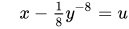
(Abby).
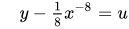
The indifference curves fill the box but are only shown when tangential to some representative budget lines. The offer curves, drawn in Fig. 11, cross at three points shown by large grey dots and corresponding to exchange rates of 12, 1 and 2.

Generalisations

[edit]

Early examinations of the properties of equilibrium were based on an implicit definition as tangency, and convexity seems to have been implicitly assumed.[20] There was no doubt that equilibrium would be reached: gradient ascent would lead to it. But the results lacked generality.

Boundary equilibria and non-differentiable curves

[edit]
Fig. 12. Price lines for a box with boundary equilibria

Kenneth Arrow and Gérard Debreu published papers independently in 1951 drawing attention to limitations in the calculus proofs of equilibrium theorems.[21] Arrow specifically mentioned the difficulty caused by equilibria on the boundary, and Debreu the problem of non-differentiable indifference curves.

Without aiming for exhaustive coverage it is easy to see in intuitive terms how to extend our methods to apply to these cases. We need to broaden the concept of a tangent to include any line which touches the curve: a tangent in the etymological sense rather than that of the differential calculus. In the example of Fig. 12 there is an arc of legal price lines through a point of contact, each touching indifference curves without cutting them inside the box, and accordingly there is a range of possible equilibria for a given endowment.

Competitive equilibrium

[edit]

The equilibria of Fig. 12 are not points at which curves are true tangents to each other. They do however have a property which generalises the definition in terms of tangents, which is that the two curves can be locally separated by a straight line.

Arrow and Debreu defined equilibrium in the same way as each other in their (independent) papers of 1951 without providing any source or rationale for their definition. They retained their definition in their joint paper (on the existence of equilibrium) of 1954.[22] The new definition required a change of mathematical technique from the differential calculus to convex set theory.

Their definition in effect was this: an equilibrium attainable from an endowment ω consists of an allocation x and a budget line through x and ω such that there is no point along the line which either consumer (strictly) prefers to x. A pair comprising an allocation and a line which satisfies this property is known as a 'Walrasian' or 'competitive' equilibrium.

Fig. 13. A 'local' equilibrium

The budget line of this definition is a line which separates the indifference curves of the two consumers, but it does so globally rather than locally. Arrow and Debreu do not explain why they require global separation, which may have made their proofs easier but can be seen to have unexpected consequences. In Fig. 13 the point x is a point of tangency which is also a point at which indifference curves are locally separated by the dashed price line; but since they are not globally separated the point is not an equilibrium according to Arrow and Debreu's definition.

Fig. 14. A Pareto optimum which is not a 'competitive equilibrium'

In Fig. 14 the point x is a Pareto optimum which does not satisfy the definition of competitive equilibrium. The question of whether the economy would settle at such a point is quite separate from whether it satisfies a given definition of equilibrium; evidently in this case it would indeed settle there.

Arrow and Debreu always included the convexity of indifference curves amongst their 'assumptions'. The term 'assumptions' is a vague one which might refer to a presupposition underlying definitions as well as theorems, or to a premise which is needed only for the latter. Given that their definition does not include all equilibria which may exist when curves may be non-convex, it is possible that they meant the assumption of convexity in the former sense. Whether or not this is so, the definition has been widely adopted without any restriction of domain.

It has sometimes been found that results can be derived under their definition without assuming convexity in the proof (the first fundamental theorem of welfare economics being an example).

Existence of competitive equilibrium

[edit]

In some economies there will be no resting point reachable from a given endowment by exchange at uniform prices; hence no resting point exists satisfying the definition of competitive equilibrium. Families of curves of the pattern of Fig. 14 are an example of this.

The fundamental theorems of welfare economics

[edit]

With equilibrium defined as 'competitive equilibrium', the first fundamental theorem can be proved even if indifference curves need not be convex: any competitive equilibrium is (globally) Pareto optimal. However the proof is no longer obvious, and the reader is referred to the article on Fundamental theorems of welfare economics.

The same result would not have been considered to hold (with non-convex indifference curves) under the tangency definition of equilibrium. The point x of Fig. 13 would have been considered an equilibrium which was not (globally) optimal since the yellow region Pareto dominates it.

It does not follow that the result has been strengthened since the attainability of equilibrium has been rendered doubtful. In Fig. 13 the point x may not be a 'competitive equilibrium', but the economy can get stuck there preventing it from reaching the 'true' (and Pareto optimal) equilibrium in the yellow region.

It was always considered essential to the first welfare theorem that equilibrium would actually be attained. Lerner's interpretation of the theorem was that "Fortunately the optimum allocation of goods can be reached automatically".[23] However nothing can guarantee that a global optimum will be attained when local optima are present. If the concept of equilibrium includes local optima such as x, then equilibrium may be attainable but sub-optimal; if such points are excluded, then equilibrium may be optimal but unattainable.

The differences caused by non-convexity become more deep-rooted when we look at the second fundamental theorem. Not every Pareto optimum is a competitive equilibrium (though it may still be a resting place for the economy). Consequently the theorem needs either to be given convexity of preferences as a premise, or else to be stated in such a way that 'equilibrium' is not understood as 'competitive equilibrium' as defined above.

Notes

[edit]

References

[edit]
[edit]
Revisions and contributorsEdit on WikipediaRead on Wikipedia
from Grokipedia
The Edgeworth box is a graphical tool in used to analyze and exchange in a pure exchange with two consumers and two . It represents the total endowments of the two as the width and height of a rectangular box, where any point inside the box denotes a feasible allocation of those between the consumers, with each consumer's perspective oriented from opposite corners. Indifference curves for each consumer are plotted within the box, allowing visualization of Pareto-efficient allocations along the contract curve, where the slopes of the indifference curves are equal, indicating no mutually beneficial trade remains possible. Named after the economist Francis Ysidro Edgeworth, the diagram originated in his 1881 work Mathematical Psychics, where it was introduced to illustrate the indeterminacy of barter outcomes and the determinacy achieved through competitive equilibrium. Edgeworth's original depiction included autarky indifference curves passing through an initial endowment point, defining a lens-shaped area of potential gains from trade, and incorporated offer curves to show equilibrium price rays. Subsequent developments refined the tool: Vilfredo Pareto in 1906 linked it to optimality concepts by emphasizing tangency points on the contract curve; Arthur W. Bowley in 1924 generalized it with bargaining loci; and Wassily Leontief in 1946 popularized its modern form through clear expositions in postwar textbooks. In economic analysis, the Edgeworth box demonstrates key principles such as the first welfare theorem, which states that competitive equilibria are Pareto efficient, lying on the contract curve, and the second welfare theorem, which asserts that any Pareto-efficient allocation can be achieved as a competitive equilibrium with appropriate lump-sum transfers. It highlights the core of feasible allocations within the lens formed by initial endowments and reveals how relative prices guide trades to equilibrium points where excess demands are zero. The diagram's simplicity has made it foundational for teaching general equilibrium theory, though extensions exist for more agents or goods, such as multi-dimensional boxes or numerical simulations.

Fundamentals

Diagram Construction

The Edgeworth box is a rectangular diagram used to represent a pure exchange economy involving two agents and two goods, labeled X and Y, where the dimensions of the rectangle correspond to the fixed total endowments of these goods across the economy. The horizontal dimension (width) equals the total endowment of good X, denoted as X\overline{X}, while the vertical dimension (height) equals the total endowment of good Y, denoted as Y\overline{Y}. This setup assumes a closed economy with no production, where the aggregate resources are constant and fully allocated between the two agents through trade alone. The diagram features two origins positioned at opposite corners to reflect the perspectives of the two agents: Agent A's origin is at the bottom-left corner, with the positive horizontal axis extending rightward to measure increases in good X and the positive vertical axis extending upward to measure increases in good Y; Agent B's origin is at the top-right corner, with the positive horizontal axis extending leftward ( to Agent A) for good X and the positive vertical axis extending downward for good Y. This dual-origin configuration allows quantities to be measured simultaneously from each agent's viewpoint, ensuring that the sum of allocations for each good equals the total endowment at every point. The axes are labeled accordingly, with Agent A's quantities read from the bottom-left and Agent B's from the top-right. An initial endowment point, often denoted as ω\omega, is marked within the rectangle to indicate the starting allocation before any occurs; the coordinates of this point from Agent A's origin give Agent A's initial bundle (ωXA,ωYA)(\omega_X^A, \omega_Y^A), while the coordinates from Agent B's origin give Agent B's initial bundle (ωXB,ωYB)(\omega_X^B, \omega_Y^B), satisfying ωXA+ωXB=X\omega_X^A + \omega_X^B = \overline{X} and ωYA+ωYB=Y\omega_Y^A + \omega_Y^B = \overline{Y}. Any point within the box represents a feasible allocation of the total resources between the two agents, as it divides the fixed endowments without exceeding the economy's constraints. This geometric interpretation facilitates the visualization of all possible redistributions via barter in the pure exchange setting.

Indifference Curves and Preferences

In the Edgeworth box, indifference curves represent each agent's preferences over bundles of the two , with curves for agent A originating from the bottom-left corner and those for agent B from the top-right corner, reflecting the opposing orientations of their consumption spaces. These curves are typically convex to their respective origins, illustrating of diminishing marginal rates of substitution (), where the willingness to trade one good for another decreases as the acquires more of the first good. This convexity arises from the assumption of strictly convex preferences, ensuring that indifference curves bow inward toward the origin and that convex combinations of bundles on a higher indifference curve remain preferable. The representation of preferences through indifference curves relies on several standard assumptions in consumer theory. Preferences are assumed to be complete, meaning every pair of consumption bundles can be compared; transitive, so if one bundle is preferred to another and that to a third, the first is preferred to the third; and continuous, allowing for smooth indifference curves without discontinuities. Additionally, preferences are strictly convex and satisfy local non-satiation, implying that more of at least one good is always preferred and that no finite bundle maximizes utility completely. These assumptions, originally formalized in the context of indifference analysis by Edgeworth, ensure well-behaved preference orderings suitable for graphical analysis in the box diagram. Utility functions provide an implicit mathematical representation of these preferences, where each corresponds to a constant level of , and higher curves indicate preferred bundles. Specifically, quasi-concave functions underpin the convexity of s, as the upper contour sets (bundles at least as good as a given one) form convex sets, aligning with the economic of diminishing marginal substitution rates. No explicit functional forms are required for the graphical , though examples like Cobb-Douglas utilities illustrate how quasi-concavity manifests in convex curves. The for agent A, which measures the slope of their , is given by MRSA=dYAdXA=MUXAMUYA,\text{MRS}_A = -\frac{dY_A}{dX_A} = \frac{\text{MU}_{XA}}{\text{MU}_{YA}}, where MUXA\text{MU}_{XA} and MUYA\text{MU}_{YA} are the marginal utilities of goods XX and YY for agent A, derived from maximization subject to the indifference constraint. Agent B has an analogous MRS, MRSB=dYBdXB=MUXBMUYB\text{MRS}_B = -\frac{dY_B}{dX_B} = \frac{\text{MU}_{XB}}{\text{MU}_{YB}}, but measured from their origin, with the negative sign reflecting the trade-off direction. When indifference curves from both agents intersect, the region between them—often lens-shaped—encompasses allocations that lie above both curves passing through the initial endowment point, representing potential mutual as each agent can reach a higher indifference curve. This lens the inefficiency of the endowment unless the curves are , underscoring the of preferences in identifying Pareto-improving exchanges within the .

Core Concepts

Competitive Equilibrium

In the Edgeworth box framework, a competitive equilibrium, also known as a Walrasian equilibrium, is defined as a price vector and an allocation where each consumer maximizes their utility subject to their budget constraint, and all markets clear such that total demand equals total supply for each good. Specifically, for two consumers A and B and two goods X and Y, the equilibrium allocation (xA,xB)(x_A^*, x_B^*) satisfies the budget constraints pXxXA+pYxYA=pXωXA+pYωYAp_X x_{XA}^* + p_Y x_{YA}^* = p_X \omega_{XA} + p_Y \omega_{YA} and pXxXB+pYxYB=pXωXB+pYωYBp_X x_{XB}^* + p_Y x_{YB}^* = p_X \omega_{XB} + p_Y \omega_{YB}, where ω\omega denotes initial endowments, while market clearing requires xXA+xXB=ωXA+ωXBx_{XA}^* + x_{XB}^* = \omega_{XA} + \omega_{XB} and xYA+xYB=ωYA+ωYBx_{YA}^* + x_{YB}^* = \omega_{YA} + \omega_{YB}. Graphically, the equilibrium point in the Edgeworth box occurs where the indifference curves of both consumers are tangent to each other and to a common budget line passing through the initial endowment point. The slope of this budget line, given by the negative of the relative price ratio −\frac{p_X}{p_Y}, equals the slope of the indifference curves (−\text{MRS}), ensuring \text{MRS}A = \frac{\partial U_A / \partial x{XA}}{\partial U_A / \partial x_{YA}} = \frac{p_X}{p_Y} = \text{MRS}_B, where \text{MRS} is the marginal rate of substitution. This tangency condition reflects that both consumers face the same market prices and optimize accordingly, with the equilibrium located inside the box away from the corners unless endowments are already efficient. To achieve this equilibrium, relative prices adjust iteratively until demands are equated with supplies, often normalized by setting one good as the numeraire (e.g., pY=1p_Y = 1) to focus on the pX/pYp_X / p_Y. The resulting allocation lies on the , as the equalized implies .

Pareto Set

In the Edgeworth box, the Pareto set, often referred to as the , represents the collection of all Pareto efficient allocations between two agents exchanging two . A Pareto efficient allocation is one where no reallocation of the goods can improve the welfare of one agent without reducing the welfare of the other. This set forms a curved line connecting the points of tangency between the indifference curves of the two agents, spanning from one boundary of the box (where one agent receives all of one good) to the opposite boundary. Graphically, the contract curve is typically depicted as a thickened line within the box to highlight its path, illustrating the locus where the marginal rates of substitution for both agents are equal (MRSA=MRSBMRS_A = MRS_B). If the initial endowment point lies off this curve, the allocation is inefficient, as both agents can mutually benefit from trade toward the curve; this potential for improvement is visualized by lens-shaped areas bounded by the agents' indifference curves passing through the endowment. The full Pareto set encompasses all such efficient points, independent of the starting endowment, though the feasible segment—where both agents achieve at least their endowment utility—may form a subset known specifically as the contract curve in some contexts.

Historical Development

Edgeworth's Contributions

introduced the in his 1881 book Mathematical Psychics: An Essay on the Application of Mathematics to the Moral Sciences, presenting it as a graphical method to analyze exchange between two parties in a setting. The diagram depicts two traders with fixed endowments of two , allowing visualization of possible trade outcomes within a rectangular "box" representing the total quantities available. This tool was designed to illustrate the mechanics of barter exchange without relying on monetary prices, highlighting the potential for multiple equitable divisions of . Edgeworth developed the in response to the works of and , critiquing Cournot's assumption of uniform pricing in oligopolistic markets and extending Jevons' theory of exchange to scenarios. He emphasized the inherent indeterminacy of outcomes in the absence of competitive prices, arguing that without external , negotiations between two parties could lead to a wide array of settlements rather than a unique equilibrium. This perspective contrasted with Jevons' law of indifference, which Edgeworth viewed as applicable primarily under perfect competition, not in bilateral exchanges where bargaining power influences results. A central was Edgeworth's recontracting , a hypothetical iterative mechanism where parties repeatedly adjust tentative agreements until reaching a point on the recontract —later recognized as an early conceptualization of the Pareto set—where neither trader can improve their without the other's . Through the , Edgeworth demonstrated a range of stable outcomes along this , spanning from monopolistic exploitation to competitive equality, with the span of indeterminacy narrowing as the number of traders increases toward perfect competition. Published in 1881, this work predated Léon Walras' full general equilibrium framework by visualizing core ideas of mutual advantage in exchange, laying foundational insights for modern general equilibrium theory.

Subsequent Theoretical Advances

Vilfredo Pareto advanced the Edgeworth box in his 1906 Manuale di Economia Politica, standardizing its orientation with indifference curves plotted from opposite corners (southwest for one agent, northeast for the other) and linking tangency points along the contract curve to his optimality criterion, where no further mutually beneficial reallocations are possible. This emphasized multiple Pareto-efficient outcomes rather than a unique welfare maximum, shifting focus to efficiency without interpersonal utility comparisons. Following Francis Y. Edgeworth's initial formulation in 1881, Arthur Lyon Bowley significantly refined the graphical representation of the exchange model in his 1924 book The Mathematical Groundwork of Economics. Bowley assumed that traders initially hold positive amounts of both goods, positioning the endowment point interior to the box rather than at a corner, which became the standard depiction for analyzing from realistic starting allocations. He also introduced the "bargaining locus" as a segmented offer curve, illustrating potential trading paths at disequilibrium prices and convergence toward equilibrium under varying bargaining power, thereby enhancing the diagram's utility for teaching bilateral monopoly and general equilibrium concepts. The to 1950s saw the Edgeworth box increasingly linked to Walrasian , culminating in the Arrow-Debreu model. and Gérard Debreu formalized the of competitive equilibria in their 1954 paper, using set-theoretic methods to prove that, under assumptions of convexity and continuity, a Walrasian equilibrium exists where supply equals demand across all markets; the two-agent, two-good Edgeworth box serves as the canonical illustration of this equilibrium in pure exchange. Debreu's 1959 monograph Theory of Value extended these proofs by axiomatizing preferences and endowments in abstract commodity spaces, demonstrating how the box's corresponds to of the economy in set-theoretic terms. From the 1970s onward, economists like Hal R. Varian standardized the Edgeworth box in modern microeconomics pedagogy through influential textbooks. Varian's Intermediate Microeconomics: A Modern Approach, first published in 1987, presents the box as a core tool for visualizing Pareto efficiency, competitive trade, and welfare theorems, making abstract general equilibrium accessible to undergraduates. This pedagogical emphasis solidified the diagram's role in curricula, with subsequent editions reinforcing its use to explain market outcomes without relying on advanced mathematics. The evolution also involved a shift from purely graphical to mathematical formalization in . By the mid-20th century, the box's intuitive depictions were complemented by set-theoretic representations, such as the excess demand correspondence and fixed-point theorems (e.g., Brouwer's), which rigorously underpin equilibrium in Arrow-Debreu frameworks beyond the two-good case. This transition, prominent in Debreu's work, allowed the Edgeworth box to illustrate foundational while enabling extensions to infinite-dimensional spaces.

Trade Dynamics

Offer Curves

Offer curves, also known as reciprocal demand schedules, represent the locus of points in the Edgeworth box where an agent's optimal consumption bundle satisfies the condition that the amount offered of one good equals the amount demanded of the other at varying ratios, plotted from the agent's origin at their endowment point. This graphical tool derives from the agent's subject to the defined by the endowment and the prevailing prices. To construct an agent's offer , begin at the endowment point and vary the , drawing lines through the endowment with slopes equal to the negative inverse of the ; the optimal points are the tangencies between these lines and the agent's indifference curves, tracing out the which bows inward toward higher indifference curves. For the other agent, the is constructed analogously from their origin at the opposite corner of the , using their own indifference map rotated 180 degrees. The properties of offer curves stem from the underlying preferences: under standard assumptions of strict convexity, the curves are typically convex to their respective origins due to the diminishing along indifference curves, ensuring that as the changes, the agent trades along a smooth, inward-bending path. These curves graphically depict the excess function, showing how net trades adjust with prices while maintaining individual . In terminology, the core concept traces to Francis Ysidro Edgeworth's reciprocal demand analysis, with extensions such as bargaining loci following Arthur Bowley's work. The curve for an agent is defined implicitly through the excess demand function x(p)=DX(p)ωXx(p) = D_X(p) - \omega_X, where pp is the relative price of good X to the other good, DX(p)D_X(p) is the demand for good X, and ωX\omega_X is the endowment of good X; this traces the quantities offered and demanded as prices vary. The intersection of the two agents' offer curves in the Edgeworth box identifies the competitive equilibrium allocation.

Equilibrium Determination

In the Edgeworth box model, the competitive equilibrium is determined by the intersection of the two agents' offer curves, which represents the allocation where relative prices clear both markets simultaneously, ensuring that aggregate demand equals the total endowment. At this intersection, each agent's chosen bundle maximizes their utility given the prevailing prices, and the resulting trade leaves no excess demand for either good. Under standard assumptions such as convex preferences, the offer curves typically intersect at a single point, guaranteeing a unique equilibrium. More specifically, gross substitutability—where the demand for one good increases when the price of the other good rises—ensures that the offer curves are monotone, preventing multiple crossings and thus ensuring uniqueness. These conditions align with the requirement that preferences are strictly convex and monotonic, leading to well-behaved demand responses that converge to one equilibrium allocation. The stability of this equilibrium is analyzed through the tâtonnement , a hypothetical adjustment mechanism where prices rise in response to excess demand and fall with , guiding the economy toward the intersection of the offer curves. When gross substitutability holds, this process converges globally to the unique equilibrium, as the adjustment dynamics exhibit contractive behavior around the intersection point. In contrast, violations of these assumptions can lead to , though such cases are atypical in the standard Edgeworth framework. Multiple equilibria can arise if preferences are non-convex, causing offer curves to intersect more than once, though this is rare in conventional models with smooth, quasi-concave utility functions. For instance, non-convexities may produce kinked or backward-bending offer curves, allowing several price ratios to clear markets, but empirical and theoretical applications typically assume convexity to avoid such multiplicity. Graphically, the equilibrium manifests as where the offer curves cross, which lies on the , confirming that the allocation is Pareto efficient as well as market-clearing. This tangency ensures that the marginal rates of substitution are equalized across agents at the prevailing relative prices, integrating the equilibrium into the broader Pareto set within the box.

Welfare Economics

First Fundamental Theorem

The first fundamental theorem of welfare economics states that, in a competitive equilibrium within an Edgeworth box representing a two-person, two-good exchange economy, the resulting allocation is Pareto efficient, meaning it lies on the where no further mutually beneficial trade is possible. A proof sketch proceeds by contradiction: suppose the equilibrium allocation is not Pareto efficient, so there exists another feasible allocation that improves at least one agent's utility without reducing the other's. Under of preferences, agents would then demand more goods at the equilibrium prices, violating market clearing as aggregate demand would exceed supply. Graphically, in the Edgeworth box, the competitive equilibrium occurs at a point where the indifference curves of both agents are tangent, ensuring their marginal rates of substitution () are equal: MRSA=uA/x1AuA/x2A=uB/x1BuB/x2B=MRSB=p1p2,\text{MRS}_A = \frac{\partial u_A / \partial x_1^A}{\partial u_A / \partial x_2^A} = \frac{\partial u_B / \partial x_1^B}{\partial u_B / \partial x_2^B} = \text{MRS}_B = \frac{p_1}{p_2}, where uAu_A and uBu_B are the utility functions, xijx_i^j denotes good ii for agent jj, and pkp_k are prices. This tangency eliminates the "lens" of potential gains from trade, confirming the allocation's efficiency. The theorem relies on key assumptions, including perfect competition where agents are price-takers, no externalities affecting preferences or endowments, and convex preferences ensuring diminishing marginal rates of substitution for smooth, well-behaved indifference curves. This result implies that decentralized competitive markets can achieve without requiring central or knowledge of agents' preferences, highlighting the allocative power of price signals in exchange economies.

Second Fundamental Theorem

The Second Fundamental Theorem of Welfare Economics states that, under appropriate conditions, any Pareto efficient allocation can be decentralized as a competitive equilibrium through suitable lump-sum transfers of initial endowments. This theorem, independently formalized by and Debreu in the early 1950s, complements the First Fundamental Theorem by showing that efficiency is attainable regardless of the starting distribution, provided redistribution occurs via non-distortionary means. In the Edgeworth box framework, which depicts a two-agent, two-good exchange , Pareto efficient allocations correspond to points on the contract curve where the agents' marginal rates of substitution are equal. Graphically, the theorem is illustrated by adjusting the initial endowment point within the Edgeworth box to align a specific Pareto optimal allocation with the competitive equilibrium. For a desired point on the contract curve, the endowment is shifted such that the budget line—determined by equilibrium prices—becomes tangent to both agents' indifference curves at that point. This tangency condition ensures the allocation is utility-maximizing for each agent given the prices, with total consumption respecting the economy's resource constraints. Such a reconfiguration demonstrates how transfers can "pivot" the equilibrium to any efficient outcome without altering relative prices or marginal incentives. The theorem relies on key assumptions, including the convexity of agents' preferences (ensuring indifference curves are convex to the origin) and production sets (if production is involved), local non-satiation (no bliss points where agents are fully satisfied), and the feasibility of lump-sum transfers that do not depend on agents' actions or private information. These conditions guarantee the existence of supporting prices and the stability of the equilibrium post-transfer. Without convexity, for instance, efficient allocations may not be supportable as equilibria, though such cases are addressed in broader generalizations. A primary implication is the separation of efficiency and equity: distributional objectives can be pursued through initial reallocations, after which competitive markets efficiently achieve the targeted Pareto optimum. This underscores the potential for policy to combine redistribution with market mechanisms, promoting both fairness and efficiency in convex economies. Despite its theoretical elegance, the theorem's application is limited by substantial informational requirements for implementing lump-sum transfers, as designing them to reach a specific efficient allocation demands complete of agents' preferences and endowments—information that is often private and costly to elicit. Imperfect can lead to incentive distortions or infeasible transfers, undermining the decentralization process in real-world settings.

Generalizations

Multi-Agent and Multi-Good Extensions

The Edgeworth box, originally designed for two agents and two goods, can be extended to multiple agents by replicating the basic two-agent framework or employing representative agent models to capture aggregate behavior in larger economies. In replicated economies, where the two-agent setup is duplicated multiple times with equal endowments, the core—defined as the set of allocations not blocked by any coalition—converges to the set of competitive equilibria as the number of replicas grows, establishing the equivalence between core allocations and Walrasian outcomes. This result, known as Edgeworth's conjecture, was rigorously proved by Debreu and Scarf for economies with identical replica structures, demonstrating that competitive markets achieve efficiency even with many participants. For cases involving non-convex preferences, the Shapley-Folkman theorem provides a bound on the inefficiency of core allocations, showing that the sum of non-convex sets approximates convexity, with at most as many agents deviating from convexity as the dimension of the goods space, thus ensuring approximate Pareto efficiency in large economies. Extending the Edgeworth box to multiple goods beyond two renders the graphical representation impractical due to higher dimensionality, prompting a shift to abstract mathematical frameworks like the Arrow-Debreu model, which generalizes the exchange economy to arbitrary numbers of agents and commodities using for allocations and prices. In this model, the generalizes to the set of Pareto-efficient allocations in the consumption set, while equilibrium is characterized by excess whose zero crossings define Walrasian prices, often visualized through simplices rather than boxes for three or more . For three or more , offer curves evolve into offer surfaces or hypersurfaces in price space, representing the locus of net trades as functions of relative prices, which intersect to determine equilibrium in multi-good settings. These extensions find applications in , where the two-agent box models two countries exchanging goods, with endowments representing national factor supplies and the illustrating potential under . In production economies, the box adapts to input allocation between two firms or sectors, with axes denoting factors like labor and capital, isoquants replacing indifference curves, and the efficiency locus tracing cost-minimizing input combinations at equal marginal rates of technical substitution. Mathematically, the existence of general equilibrium in these multi-agent, multi-good settings relies on applied to the excess demand correspondence, which is continuous and satisfies Walras' law, ensuring a price vector where aggregate demand equals supply in the Arrow-Debreu framework. For practical analysis of complex multi-agent, multi-good economies, computational general equilibrium (CGE) models numerically solve for equilibria by simulating agent optimizations and market clearing, incorporating empirical data on production functions and trade flows to evaluate policy impacts like tariffs or subsidies.

Boundary Equilibria and Non-Convexities

In boundary equilibria within the Edgeworth box, the competitive equilibrium allocation occurs on the edge or corner of the box, where at least one agent receives zero units of one good, rendering the marginal rate of substitution (MRS) undefined or infinite for that agent. This arises when endowments or preferences lead to extreme demands, such as one agent demanding all available units of a good at prevailing prices, preventing interior solutions where MRS equalizes across agents and matches the price ratio. For instance, if one agent's endowment dominates the total supply of a good, the equilibrium may assign the entire amount to that agent, with the other receiving none, as trade cannot improve utility without violating feasibility. Non-differentiable indifference curves introduce kinks that further promote boundary equilibria, particularly with preferences like Leontief utilities, where u(x1,x2)=min{ax1,bx2}u(x_1, x_2) = \min\{a x_1, b x_2\} for positive constants aa and bb, resulting in L-shaped curves with right-angle vertices along the ray bx2=ax1b x_2 = a x_1. In the Edgeworth box, equilibria often locate at these vertices on the box's boundary if the relative price aligns with the kink's slope, such as when the price ratio p1/p2=a/bp_1 / p_2 = a / b, allowing no further gains from trade without crossing the non-differentiable point. Graphical representations show offer curves as set-valued correspondences at kinks, where agents are indifferent along flat segments, potentially yielding multiple boundary points as equilibria depending on initial endowments. Non-convex preferences, where indifference curves bow outward rather than inward (violating quasi-concavity), exacerbate these issues by allowing multiple equilibria or none at all, as demand correspondences become non-convex and upper hemicontinuous only under relaxed assumptions. In the Edgeworth box, this manifests as overlapping or disjoint feasible sets, with equilibria possibly on edges where one agent's non-convex leads to corner allocations, such as when endowments fall between critical thresholds defined by the non-convex function's parameters. For example, with one agent having convex preferences represented by a logarithmic function and the other non-convex preferences represented by a quadratic-logarithmic function, interior equilibria exist uniquely if endowments satisfy eB1+eB2/πintx(D)e_{B1} + e_{B2} / \pi_{\text{int}} \geq x^*(D), but boundary or no equilibria occur otherwise, challenging the standard convex assumptions underlying the fundamental welfare theorems. These non-convexities imply potential inefficiencies, non-uniqueness, and the need for generalized equilibrium concepts, such as price-taking behavior with set-valued demands, to restore existence and Pareto optimality.

References

Add your contribution
Related Hubs
User Avatar
No comments yet.