



Community hub
Recent from talks
Knowledge base stats:
Talk channels stats:
Members stats:
Nile Delta
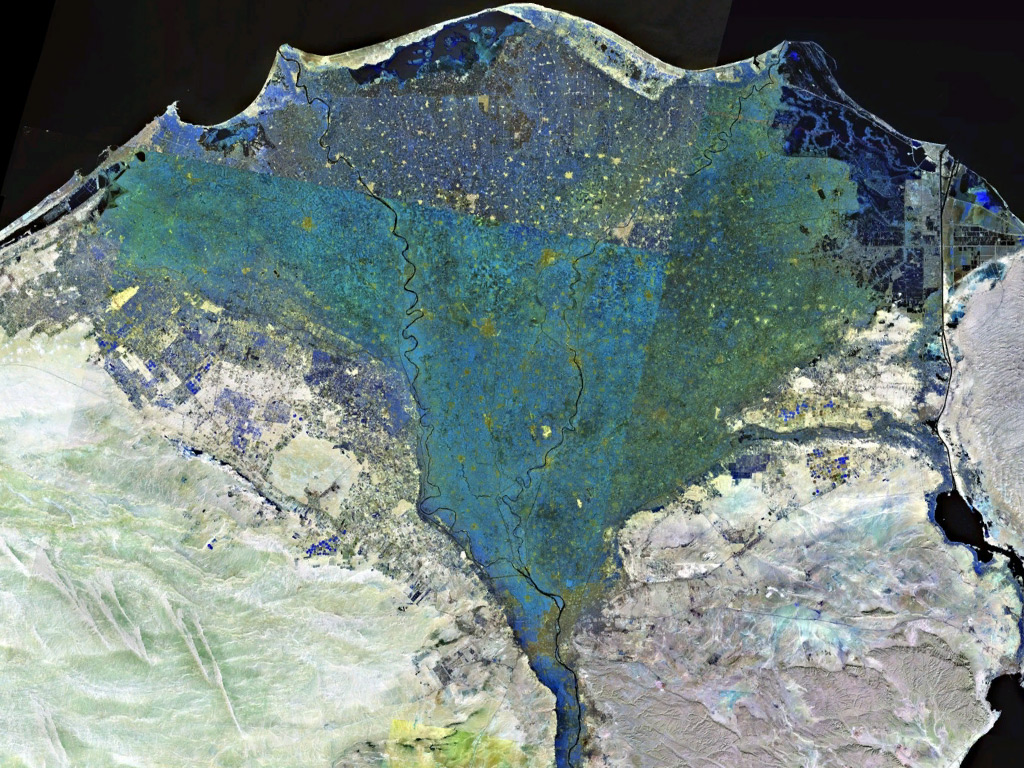
The Nile Delta (Arabic: دلتا النيل, Delta an-Nīl or simply الدلتا, ad-Delta) is the delta formed in Lower Egypt where the Nile River spreads out and drains into the Mediterranean Sea. It is one of the world's larger deltas—from Alexandria in the west to Port Said in the east; it covers 240 km (150 mi) of the Mediterranean coastline and is a rich agricultural region. From north to south the delta is approximately 160 km (100 mi) in length. The Delta begins slightly down-river from Cairo.
From north to south, the delta is approximately 160 km (100 mi) in length. From west to east, it covers some 240 km (150 mi) of coastline. The delta is sometimes divided into sections, with the Nile dividing into two main distributaries, the Damietta and the Rosetta, flowing into the Mediterranean at port cities with the same names. In the past, the delta had several distributaries, but these have been lost due to flood control, silting and changing relief. One such defunct distributary is Wadi Tumilat.[citation needed]
The Suez Canal is east of the delta and enters the coastal Lake Manzala in the north-east of the delta. To the north-west are three other coastal lakes or lagoons: Lake Burullus, Lake Idku and Lake Mariout.
The Nile is considered to be an "arcuate" delta (arc-shaped), as it resembles a triangle or flower when seen from above. Aristotle speculated that the delta was constructed for agricultural purposes due to the drying of the region of Egypt.
In modern day, the outer edges of the delta are eroding, and some coastal lagoons have seen increasing salinity levels as their connection to the Mediterranean Sea increases. Since the delta no longer receives an annual supply of nutrients and sediments from upstream due to the construction of the Aswan Dam, the soils of the floodplains have become poorer, and large amounts of fertilizers are now used. Topsoil in the delta can be as much as 21 m (70 ft) in depth.[citation needed]
People have lived in the Nile Delta region for thousands of years, and it has been intensively farmed for at least the past five thousand years. The delta was a major part of Lower Egypt, and many archaeological sites are located in and around the region. Artifacts belonging to ancient sites have been found on the delta's coast. The Rosetta Stone was found in the delta in 1799 in the port city of Rosetta (an anglicized version of the name Rashid). In July 2019 a small Greek temple, ancient granite columns, treasure-carrying ships, and bronze coins from the reign of Ptolemy II, dating back to the third and fourth centuries BC, were found at the sunken city of Heracleion, colloquially known as Egypt's Atlantis. The investigations were conducted by Egyptian and European divers led by the underwater archaeologist Franck Goddio. They also uncovered a devastated historic temple (the city's main temple) underwater off Egypt's north coast.
In January 2019, archaeologists led by Mostafa Waziri working in the Kom Al-Khelgan area of the Nile Delta discovered tombs from the Second Intermediate Period and burials from the Naqada II era. The burial site contained the remains of animals, amulets and scarabs carved from faience, round and oval pots with handles, flint knives, broken and burned pottery. All burials included skulls and skeletons in the bending position and were not very well-preserved.
Records from ancient times (such as by Ptolemy) reported that the delta had seven distributaries or branches, (from east to west):
Hub AI
Nile Delta AI simulator
(@Nile Delta_simulator)
Nile Delta
The Nile Delta (Arabic: دلتا النيل, Delta an-Nīl or simply الدلتا, ad-Delta) is the delta formed in Lower Egypt where the Nile River spreads out and drains into the Mediterranean Sea. It is one of the world's larger deltas—from Alexandria in the west to Port Said in the east; it covers 240 km (150 mi) of the Mediterranean coastline and is a rich agricultural region. From north to south the delta is approximately 160 km (100 mi) in length. The Delta begins slightly down-river from Cairo.
From north to south, the delta is approximately 160 km (100 mi) in length. From west to east, it covers some 240 km (150 mi) of coastline. The delta is sometimes divided into sections, with the Nile dividing into two main distributaries, the Damietta and the Rosetta, flowing into the Mediterranean at port cities with the same names. In the past, the delta had several distributaries, but these have been lost due to flood control, silting and changing relief. One such defunct distributary is Wadi Tumilat.[citation needed]
The Suez Canal is east of the delta and enters the coastal Lake Manzala in the north-east of the delta. To the north-west are three other coastal lakes or lagoons: Lake Burullus, Lake Idku and Lake Mariout.
The Nile is considered to be an "arcuate" delta (arc-shaped), as it resembles a triangle or flower when seen from above. Aristotle speculated that the delta was constructed for agricultural purposes due to the drying of the region of Egypt.
In modern day, the outer edges of the delta are eroding, and some coastal lagoons have seen increasing salinity levels as their connection to the Mediterranean Sea increases. Since the delta no longer receives an annual supply of nutrients and sediments from upstream due to the construction of the Aswan Dam, the soils of the floodplains have become poorer, and large amounts of fertilizers are now used. Topsoil in the delta can be as much as 21 m (70 ft) in depth.[citation needed]
People have lived in the Nile Delta region for thousands of years, and it has been intensively farmed for at least the past five thousand years. The delta was a major part of Lower Egypt, and many archaeological sites are located in and around the region. Artifacts belonging to ancient sites have been found on the delta's coast. The Rosetta Stone was found in the delta in 1799 in the port city of Rosetta (an anglicized version of the name Rashid). In July 2019 a small Greek temple, ancient granite columns, treasure-carrying ships, and bronze coins from the reign of Ptolemy II, dating back to the third and fourth centuries BC, were found at the sunken city of Heracleion, colloquially known as Egypt's Atlantis. The investigations were conducted by Egyptian and European divers led by the underwater archaeologist Franck Goddio. They also uncovered a devastated historic temple (the city's main temple) underwater off Egypt's north coast.
In January 2019, archaeologists led by Mostafa Waziri working in the Kom Al-Khelgan area of the Nile Delta discovered tombs from the Second Intermediate Period and burials from the Naqada II era. The burial site contained the remains of animals, amulets and scarabs carved from faience, round and oval pots with handles, flint knives, broken and burned pottery. All burials included skulls and skeletons in the bending position and were not very well-preserved.
Records from ancient times (such as by Ptolemy) reported that the delta had seven distributaries or branches, (from east to west):