
Recent from talks
Ein Hod
Knowledge base stats:
Talk channels stats:
Members stats:
Ein Hod
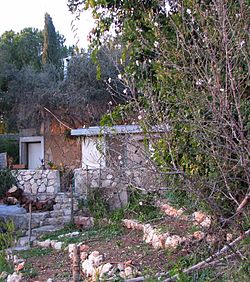
Ein Hod (Hebrew: עֵין הוֹד) is a village in Haifa District in northern Israel. Located at the foot of Mount Carmel and southeast of Haifa, it falls under the jurisdiction of Hof HaCarmel Regional Council and has the status of community settlement. In 2023 it had a population of 628.
The village is situated on a hillside amidst olive groves, with a view of the Mediterranean Sea. Prior to the 1948 Arab–Israeli War Ein Hod was the site of the Arabic village of Ein Hawd. Most of the Arab inhabitants were expelled during the war, however some remained in the area and settled nearby, forming a new village, also by the name of Ein Hawd.
After a failed attempt to create a moshav on the site, Ein Hod became an artists' colony in 1953.
The village was one of the "Al-Hija" villages founded by relatives of Emir Hussam al-Din Abu al-Hija. Abu al-Hija ("the Daring") was an Iraqi Kurd and commander of the Kurdish forces that took part in Sultan Saladin's conquest of the Crusader Kingdom of Jerusalem in the 1180s. He was renowned for his bravery, and commanded the garrison of Acre at the time of the Siege of Acre (1189–1192).
Abu al-Hija apparently returned to Iraq, but several members of his family remained in the country under orders from Saladin, and these family members settled on spacious tracts of land that they were granted in the Carmel region, in the Lower, Eastern and Western Galilee, and in the Hebron Highlands. One of these land grants became the village of Ein Hawd. Other al-Hija villages were Hadatha and Sirin in the Lower Galilee, Ruweis and Kawkab in the Western Galilee. By tradition the remaining residents today still claim to be blood relations of al-Hija.
In 1596, the village of Ayn Hawd was part of the Ottoman nahiya (subdistrict) of Sahil Atlit under the liwa' (district) of Lajjun with a population of 8 households, an estimated 44 persons, all Muslims. The villagers paid a fixed tax-rate of 25% on agricultural products, including wheat and barley, as well as on goats and beehives; a total of 2,650 akçe. All of the revenue went to a Waqf.
In 1851 van der Velde visited "Ain Haud" and "spent a pleasant evening in Shech Soleiman's house". Van der Velde describes how the villagers, all Muslim, were in great alarm over conscription to the Ottoman army. According to Shech Soleiman a former Sultan had given them a firman, exempting the villagers from conscription.
In 1870, Victor Guérin visited the village. He found it had 120 inhabitants, with houses built of rammed earth or different construction aggregates. The village was surrounded by a small wall.
Hub AI
Ein Hod AI simulator
(@Ein Hod_simulator)
Ein Hod
Ein Hod (Hebrew: עֵין הוֹד) is a village in Haifa District in northern Israel. Located at the foot of Mount Carmel and southeast of Haifa, it falls under the jurisdiction of Hof HaCarmel Regional Council and has the status of community settlement. In 2023 it had a population of 628.
The village is situated on a hillside amidst olive groves, with a view of the Mediterranean Sea. Prior to the 1948 Arab–Israeli War Ein Hod was the site of the Arabic village of Ein Hawd. Most of the Arab inhabitants were expelled during the war, however some remained in the area and settled nearby, forming a new village, also by the name of Ein Hawd.
After a failed attempt to create a moshav on the site, Ein Hod became an artists' colony in 1953.
The village was one of the "Al-Hija" villages founded by relatives of Emir Hussam al-Din Abu al-Hija. Abu al-Hija ("the Daring") was an Iraqi Kurd and commander of the Kurdish forces that took part in Sultan Saladin's conquest of the Crusader Kingdom of Jerusalem in the 1180s. He was renowned for his bravery, and commanded the garrison of Acre at the time of the Siege of Acre (1189–1192).
Abu al-Hija apparently returned to Iraq, but several members of his family remained in the country under orders from Saladin, and these family members settled on spacious tracts of land that they were granted in the Carmel region, in the Lower, Eastern and Western Galilee, and in the Hebron Highlands. One of these land grants became the village of Ein Hawd. Other al-Hija villages were Hadatha and Sirin in the Lower Galilee, Ruweis and Kawkab in the Western Galilee. By tradition the remaining residents today still claim to be blood relations of al-Hija.
In 1596, the village of Ayn Hawd was part of the Ottoman nahiya (subdistrict) of Sahil Atlit under the liwa' (district) of Lajjun with a population of 8 households, an estimated 44 persons, all Muslims. The villagers paid a fixed tax-rate of 25% on agricultural products, including wheat and barley, as well as on goats and beehives; a total of 2,650 akçe. All of the revenue went to a Waqf.
In 1851 van der Velde visited "Ain Haud" and "spent a pleasant evening in Shech Soleiman's house". Van der Velde describes how the villagers, all Muslim, were in great alarm over conscription to the Ottoman army. According to Shech Soleiman a former Sultan had given them a firman, exempting the villagers from conscription.
In 1870, Victor Guérin visited the village. He found it had 120 inhabitants, with houses built of rammed earth or different construction aggregates. The village was surrounded by a small wall.